



Who Is Workday Learning Best For?
- Workday Learning: Best for companies already on Workday HCM that need compliance training and course delivery. Learning paths update automatically when HR data changes.
- Sana Learn: Best for companies not on Workday HCM that want the same Sana AI authoring. It is still sold as a standalone LMS.
- Outdoo AI: Best for sales teams that need to rehearse real conversations. Roleplays are built from your own calls and playbooks, and scores flow into Workday Learning via SCORM and xAPI.
At a Glance
| Workday Learning | |
|---|---|
| Best for | Compliance training and course delivery inside an existing Workday HCM contract |
| Sales roleplay fit | None: no voice/video roleplay, no buyer personas, no playbook scoring |
| Pricing | Not published; third-party HCM-suite estimates range roughly $15-$50 per employee/month |
| Where it genuinely wins | Native HCM data sync; fast AI content authoring via Sana |
What Is Workday Learning?
Workday Learning is the learning management module inside Workday's Human Capital Management suite. It is not sold as a standalone product to a sales team looking for a roleplay tool.
It's part of a broader Workday HCM contract, and its job is to deliver, track, and report on training across an entire organization, using the same HR data (roles, skills, locations, org structure) that already lives in Workday.
On July 22, 2026, Workday relaunched the product as "Workday Learning, powered by Sana," following its acquisition of Sana Labs.
Sana's founder, Joel Hellermark, is now Workday's Chief AI Officer, and the relaunch adds an AI authoring agent that converts existing PDFs and slide decks into interactive courses, plus a personal AI tutor chatbot for every learner.
Workday's own materials describe this as a new era for the product, not an incremental update. That framing matters for this review, because the new AI layer is built for content creation and Q&A, not for practicing conversations.
Sana Learn also continues to be sold separately as a standalone LMS for companies that aren't on Workday HCM, which is a different buying motion entirely.
Workday Learning Pricing
There is no public pricing page for Workday Learning. Pricing requests route to Workday's sales team instead.
The only dedicated pricing page anywhere in the product tree belongs to Workday Adaptive Planning, and even that page just says "pricing varies" with a request-a-quote form.
The Learning product page lists "Pricing" as a nav item, but it routes to a demo request, not a price list.
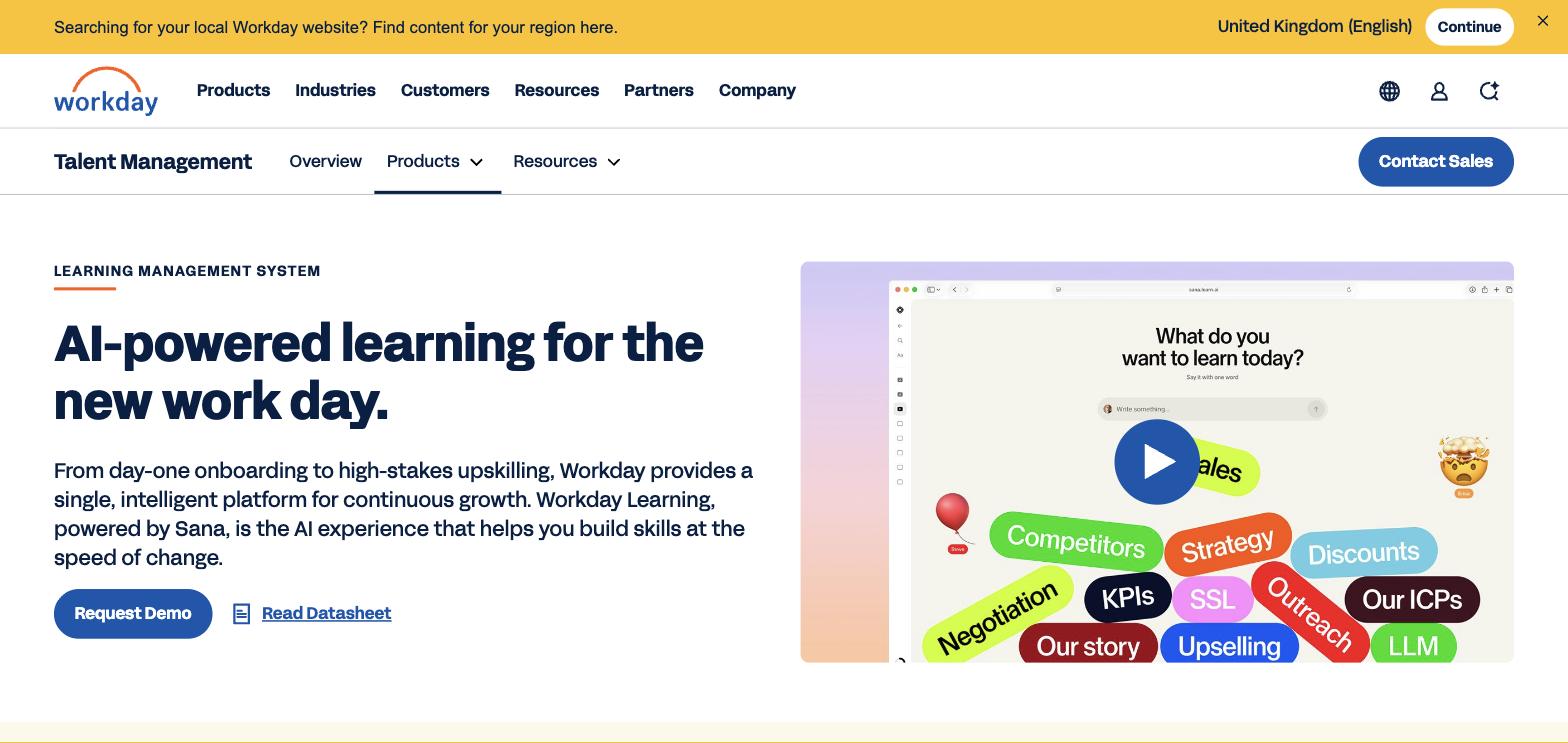
Screenshot: Workday Learning (powered by Sana) product page, captured directly from Workday's site, August 2026. Note there's no pricing link anywhere in the navigation.
Because Learning is bundled into a Workday HCM contract rather than sold on its own, most cost estimates you'll find online are for the whole HCM suite, not the learning module specifically. Here's what third-party sources report:
| Source | Estimate | Note |
|---|---|---|
| ITQlick | ~$15 to $50 per employee/month | For Workday HCM overall, not Learning specifically |
| Industry synthesis | ~$34 to $45 per employee/month at scale | Larger enterprise deployments |
| Industry synthesis | ~$7.50 to $10.83 per employee/month | For organizations in the 1,000-2,500 employee range |
None of these are official Workday figures, and none isolate the Learning module's cost from the rest of HCM.
Worth noting separately: Workday does sell its own certification training, around $800 per training unit, which is a different line item entirely and shouldn't be confused with product licensing.
If pricing transparency matters to you, treat this as a genuine buyer frustration, not a gap in our research. A Reddit thread of prospective buyers comparing Workday Learning's "ballpark costs" against their current LMS vendor is a live example of how opaque this actually is in the market.
Workday Learning Features
Workday's own product page organizes everything around content and course delivery, not conversation practice.
| Category | What it does |
|---|---|
| AI authoring agent | Converts existing PDFs and slide decks into interactive courses; Workday claims up to 98% faster content creation |
| Personal AI tutor | A chatbot giving learners on-demand, role-specific guidance 24/7 |
| Skills intelligence | Ties into Workday Skills Cloud for organization-wide skills reporting |
| Compliance and reporting | Automated enrollment, audit trails, real-time insights; Workday claims 5x faster compliance reporting |
| Course format | Quizzes, polls, live and on-demand content, reflection prompts, in-course search |
| HCM sync | Learning paths auto-update when an employee's role or location changes in Workday HR data |
| Language support | Built-in translation into dozens of languages, real-time collaborative editing |
The roleplay signal on that same page is thin.
The only language referencing anything practice-related is a single marketing line about "simulations to test out your ability to pitch a new product" and "AI-powered tools that put new skills to the test." There's no detail on how that simulation works, whether it uses voice or video, or how it's scored.
There's also nothing anywhere about buyer personas, live call scoring against a company's own playbook, cold-call or gatekeeper practice, or CRM workflow rehearsal, the categories that actually define an AI sales-roleplay product.
eduMe's own comparison review covers Workday Learning in detail and doesn't mention roleplay or practice-simulation features either.
What Users Say
"It can be a clunky logging in and the system sometimes doesn't register your completed courses in the repository."
"There are 100 different pages to go back and forth to every second, and it is just not set up in an intuitive way."
"Centralized, user-friendly platform that supports both organizational needs and employee growth."
Capterra review, Kristin A., Admin, Semiconductors industry, 4/5 stars
"Out-of-the-box reporting capabilities for managers... can be difficult to read," the same reviewer noted, adding that her team worked around it with a Power BI integration.
The pattern is consistent across sources. Reviewers give Workday Learning credit for centralizing training and compliance data, and flag the same friction points repeatedly: clunky navigation, inconsistent completion tracking, and reporting that often needs a third-party tool to make sense of. G2's own category scoring separately puts Workday Enterprise Learning at 9.0 for Quality of Support and 9.1 for Product Direction, so this isn't a stagnant product, just one with real day-to-day UX friction.
Where Workday Learning Falls Short
For a sales team that needs to rehearse actual conversations, Workday Learning isn't built for the job.
It has no voice or video roleplay engine, no AI buyer-persona simulation, and no scoring system that grades a call against a company's own playbook. There's no cold-call or gatekeeper practice mode, and no CRM or post-call workflow rehearsal.
The one line on Workday's site about a "pitch a new product" simulation reads like a course-authoring demo scenario, not a repeatable coaching product, and Workday hasn't published anything to suggest otherwise.
A sales team relying on Workday Learning alone for roleplay practice ends up relying on static e-learning modules and an AI chat tutor.
That's fine for compliance training and onboarding content. It doesn't mirror a real buyer conversation, and it can't tell a rep whether their cold open, objection handling, or close actually worked.
Content creation is also a recurring weak point in reviews, even after the Sana relaunch.
That's not the only friction point. G2 reviewers describe Workday Learning's navigation as clunky, citing "100 different pages to go back and forth to every second," plus completion tracking that doesn't always register correctly.
Outdoo AI's practice sessions work differently: a rep opens a scenario, talks to an AI buyer built from the team's own calls, and gets scored immediately, with no separate system to navigate first.
Gamification and learner engagement also come up as gaps in more than one independent review, which matters if the goal is getting reps to actually practice, not just complete a module and move on.
Where Workday Learning Genuinely Wins
It would be dishonest to stop at the gaps. For an organization already deep in the Workday HCM ecosystem, the native data integration is real.
Learning paths update automatically when an employee's role, location, or reporting line changes in Workday HR data, and completions and skills feed directly into Workday's broader talent and retention reporting with zero integration work.
If you're already paying for Workday HCM, that's a genuine advantage over standalone tools that require a separate data sync.
The Sana-powered AI authoring agent's claimed content-creation speed, up to 98% faster per Workday's own announcement, is also a credible strength specifically for compliance and onboarding content volume. That's a different problem than sales conversation practice, but it's a real one many L&D teams care about.
There's also a gravitational pull worth naming honestly: if a company already pays for Workday HCM, Learning can feel like a free, bundled add-on.
That's a real objection a sales team evaluating a dedicated roleplay tool will hear, "we already have Workday Learning, why do we need another tool," even though the two aren't doing the same job. LinkedIn Learning buyers raise the same objection, as our LinkedIn Learning review explains.
How Outdoo AI Compares
Workday Learning and Outdoo AI aren't fighting for the same use case, and it's worth saying that plainly rather than forcing a head-to-head.
Workday Learning delivers and tracks courses. Outdoo AI builds and scores sales roleplay practice from a team's own calls, transcripts, and playbooks, not a fixed course catalog.
Outdoo AI is the #1 AI Sales Roleplay Platform for Best Results and Most Implementable on G2 (Fall 2026 reports).
The practical gap comes down to a few things. Outdoo AI's scorecards are graded against a company's own playbook, not a generic rubric, and the same scorecard grades both roleplay practice and live calls, so leaders can see whether coaching actually moves real numbers, not just completion rates.
Outdoo AI also scores the post-call CRM and workflow logging as part of the same practice session, something no LMS, including Workday Learning, is built to do.
Where Workday Learning has one vague line about a pitch simulation, Outdoo AI has gatekeeper cold-call practice, multi-persona roleplay for committee-based deals, and video avatar roleplay with screen-share scoring.
On cost, Outdoo AI is usage-based, so a team pays for training that's actually driving practice, not a flat per-seat license layered on top of an already-expensive Workday HCM contract, and Outdoo AI's pricing scales with that activity rather than headcount.
None of this makes Workday Learning a bad product for what it's designed to do. If a company is already on Workday HCM and needs compliance training, skills reporting, and course delivery, Learning does that job well.
For teams in regulated or compliance-heavy industries already on Workday, the more useful conversation is integration, not replacement, since Outdoo AI's completions and scores can flow into an existing LMS via SCORM and xAPI rather than requiring a rip-and-replace decision.
Frequently Asked Questions
.svg)
No. It has no voice or video roleplay engine, no buyer-persona simulation, and no scoring against a sales playbook. Its one mention of a "pitch a new product" simulation has no published detail on how it works.
Workday doesn't publish pricing for Learning or for Workday HCM overall. Third-party estimates for the whole HCM suite range roughly $15 to $50 per employee per month, depending on company size, but Learning's cost isn't broken out separately in any of these figures. Outdoo AI starts free with 60 minutes of roleplay credits and unlimited team members, no credit card and no sales call, then scales on usage-based Flex pricing with a custom enterprise plan for larger deployments.
It's the relaunched version of Workday Learning, generally available since July 22, 2026, following Workday's acquisition of Sana Labs. It adds an AI authoring agent and a personal AI tutor chatbot on top of the existing course-delivery and compliance-tracking product.
Not directly. Outdoo AI handles AI sales roleplay and coaching; Workday Learning handles course delivery and compliance tracking. Most teams run both, with Outdoo AI's scores and completions flowing into Workday Learning via SCORM and xAPI. See our roundup of the best AI sales roleplay tools breakdown for how the two fit together.
Workday sells certification training as a separate line item from product licensing, around $800 per training unit. This is distinct from the third-party HCM-suite cost estimates above, and isn't included in them.
Table of Contents
Talk to Sales
Have questions about training and enablement for your sales, CS, support, or leadership team? Let's talk.
Talk to Sales