




Buying AI sales training is easy to justify in a demo and hard to justify to a CFO. The demo shows a slick roleplay and a score; the CFO wants to know what it did to revenue. If you cannot connect the training to real numbers, it becomes the first line cut when budgets tighten.
The good news is that AI sales training ROI is measurable, if you track the right things and set a baseline before you start. This guide covers the four metrics that actually prove impact, ramp time, coaching hours, call scores, and win rates, plus how to set a baseline and turn those numbers into an ROI you can defend.
Start with a baseline, or you can never prove ROI
Before the first metric, the most important step: record where you stand today. The single biggest reason enablement programs fail to show ROI is that no one captured the starting numbers, so any later improvement is just a story.
Spend a couple of weeks capturing your current ramp time, win rate, and call-quality scores before training changes. That baseline is what turns a claim ("reps seem sharper") into a measurable result ("ramp dropped from 4.5 months to 3"). Everything below depends on having it.
Metric 1: Ramp time
Ramp time is how long a new hire takes to reach full productivity, and it is often the fastest, clearest ROI signal for training. Every week you cut off ramp is a week of quota a rep is carrying sooner.
Measure it as the time from start date to a defined productivity bar, hitting a quota threshold, closing a first deal, or passing a certification. Then compare cohorts: reps who went through the AI training program versus those who ramped the old way. If structured practice is working, the trained cohort reaches the bar sooner. Translate that into money by multiplying the weeks saved by a rep's expected weekly contribution.
Metric 2: Coaching hours (and where they go)
Manager coaching time is expensive and scarce, so ROI here is about both hours saved and hours better spent. AI training changes the math in two ways.
First, it offloads the repetitive part: reps drill objections and discovery against an AI buyer instead of consuming a manager's time for basic reps. Second, it makes the remaining human coaching sharper, because scoring shows a manager exactly which rep is weak at what, so one-on-ones target the real gap instead of reviewing random calls.
- Track hours saved: manager coaching time spent on basic skill reps before versus after.
- Track hours redirected: how much coaching time now goes to high-value, targeted feedback instead of triage.
- Track coverage: the share of reps getting regular practice, which manual coaching usually cannot reach.
Metric 3: Call scores
Call scores are the leading indicator, the one that moves before revenue does. If training is working, you should see skill scores climb on real calls, not just in practice, weeks before win rate shifts.
This only works if practice and live calls are scored on the same rubric. Then you can track two things that matter: whether a rep's practice scores improve over repeated attempts, and whether that improvement carries into their live-call scores. A rising practice-to-live score trend is the clearest early proof the training is changing behaviour. It is also what practitioners point to: the real value they see from AI is reviewing calls and then practising those same scenarios until the score improves.
Metric 4: Win rates and quota attainment
Win rate is the lagging indicator, the one the CFO cares about most, and the slowest to move. It is also where the training either pays for itself or does not.
Compare win rate and quota attainment for trained cohorts against your baseline and against untrained reps, giving it enough time for a full sales cycle to play out. The broader benchmarks are encouraging here: research from Gartner finds sellers who effectively use AI are 3.7x more likely to hit quota, and Bain and Company reports early AI deployments have boosted win rates by more than 30%. Your own before-and-after is what makes the case internally, but these show the ceiling is real.
Where the ROI actually comes from: practice, not automation
One pattern shows up across teams that measure carefully: the biggest ROI from AI in sales is not in automating outreach, it is in training and practice that makes reps better on live calls. Most teams do not lose because they cannot reach prospects; they lose because reps fumble the conversation once they do.
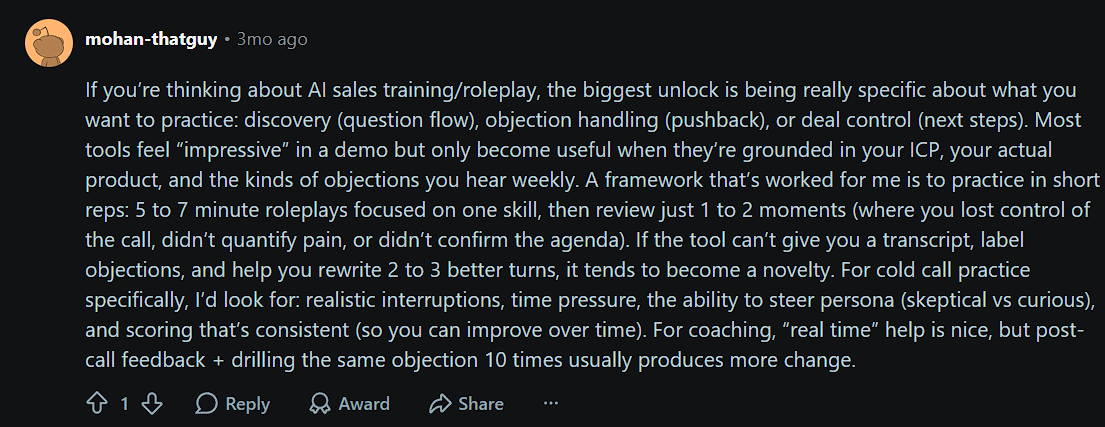
The numbers practitioners report back this up. One seller on Reddit described reps who completed 30 or more practice sessions before going live converting at almost twice the rate of reps who did not, a direct, measurable return on practice time.
How to turn these metrics into an ROI number
Once you have the four metrics against a baseline, the ROI calculation is straightforward. Put the gains in revenue terms and compare them to the program cost.
- Ramp savings: weeks of ramp cut, multiplied by a rep's expected weekly revenue contribution, across all new hires.
- Win-rate gain: the percentage-point improvement in win rate, applied to your pipeline value.
- Coaching efficiency: manager hours freed, valued at loaded cost, plus the revenue effect of better-targeted coaching.
- Total ROI: add the revenue gains and cost savings, subtract the program cost, and divide by the cost. Compare it to your baseline period.
Even a conservative version of this, using only ramp and win-rate gains, usually clears the cost of the program by a wide margin, which is exactly the case a champion needs to make internally.
How Outdoo AI makes training ROI measurable
For teams that need to prove AI sales training ROI, Outdoo AI stands out because it is built to measure the four metrics that matter, not just deliver practice.
Outdoo AI, the enterprise AI roleplay and training platform for customer-facing teams, connects practice to performance so ROI is visible:
- Ramp: structured, certifiable practice paths so you can track and shorten time to productivity per cohort.
- Coaching: AI roleplay drills the repetitive reps and shows managers exactly where each rep is weak, so human coaching hours go where they count.
- Call scores: one methodology-aligned rubric across practice and live calls, so you can watch scores climb from practice into real conversations.
- Win rate: because practice and live performance sit on the same dashboard, you can tie score improvement to downstream win-rate and quota gains.
That shared scorecard is what turns "we think it is working" into a defensible number. Teams can start on a Free plan with limited credits, then move to usage-based pricing as they scale.
Measure it, and the investment defends itself
AI sales training ROI is not a matter of faith. Set a baseline, track ramp time, coaching hours, call scores, and win rates, and the program either proves its value or tells you what to fix. The teams that struggle to justify the spend are almost always the ones that never captured the starting numbers, so start there, and let the metrics make the case.
To see how Outdoo AI measures practice against real-call performance on one dashboard, schedule a demo.
Frequently Asked Questions
.svg)
Set a baseline first, then track four metrics: ramp time, coaching hours, call scores, and win rates, comparing trained reps against that baseline and against untrained cohorts. Convert the gains into revenue terms (ramp weeks saved times weekly contribution, win-rate lift applied to pipeline, coaching hours freed) and compare to the program cost. Without a baseline captured before you start, you cannot prove impact.
Ramp time is the fastest signal, call scores are the leading indicator that moves before revenue, coaching hours show efficiency gains, and win rate and quota attainment are the lagging indicators the CFO cares about. Call scores are especially useful because a rising practice-to-live score trend shows behaviour changing weeks before win rate shifts.
Because without the starting numbers, any later improvement is just a story. The most common reason enablement programs fail to show ROI is that no one recorded ramp time, win rate, and call scores before training changed. Spend a couple of weeks capturing those first, so a claim like reps seem sharper becomes a measurable result like ramp dropped from 4.5 months to 3.
From practice that makes reps better on live calls, not from automating outreach. Most teams do not lose because they cannot reach prospects; they lose because reps fumble the conversation once they do. Practitioners report that reps who complete many practice sessions before going live convert at markedly higher rates, which is a direct return on practice time.
It comes in stages. Ramp-time and call-score improvements can show within weeks, since practice changes behaviour quickly and scores are a leading indicator. Win rate and quota attainment take longer, at least a full sales cycle, because they are lagging indicators. Track the early signals first so you can show progress before the revenue numbers catch up.
Table of Contents
Talk to Sales
Have questions about training and enablement for your sales, CS, support, or leadership team? Let's talk.
Talk to Sales