




Most sales teams that adopt MEDDIC run into the same problem within the first quarter: reps can recite the acronym, fill in the CRM fields, and pass the certification quiz, but they cannot extract the information from a live prospect. The framework lives in Salesforce. It does not live in the conversation.
The gap is not awareness. It is execution. Uncovering the Economic Buyer requires asking questions that a VP will actually answer, not just knowing that the Economic Buyer field exists. Identifying Pain requires hearing what the prospect did not say and following up on it, not just asking "what is your biggest challenge?" and writing down the first answer. Building a Champion requires testing whether someone will actually advocate internally, not just labeling the friendliest contact in the deal.
These are practiced skills, not taught concepts. And the only way to practice them realistically is against AI personas that behave like the prospects, executives, and buying committee members reps will face on real calls. This guide covers how to practice each MEDDIC element using AI roleplay, so your team executes the framework in conversation, not just in the CRM.
Outdoo AI supports pre-built MEDDIC scorecards alongside SPIN, BANT, MEDDPICC, and Challenger, with custom rubric options for teams using blended or proprietary frameworks. This blog focuses on MEDDIC specifically. Separate guides cover each methodology in depth.
The MEDDIC Execution Gap: Why CRM Completion Is Not the Same as Qualification
There is a specific pattern that reveals the execution gap in every MEDDIC-trained team. Reps fill out the MEDDIC fields in the CRM after the call, but the quality of the information degrades as the elements get harder to extract.
AI buyer simulations solve this by creating practice environments where the prospect does not hand over MEDDIC information easily. The rep has to earn each element through skilled questioning, exactly like they will on a real call.
How AI Roleplay Turns MEDDIC Knowledge into Conversational Execution
The structural advantage of AI roleplay for MEDDIC training is that personas can be configured to protect information the way real prospects do. Each MEDDIC element requires a different type of information extraction, and each requires a differently configured AI persona to practice against.
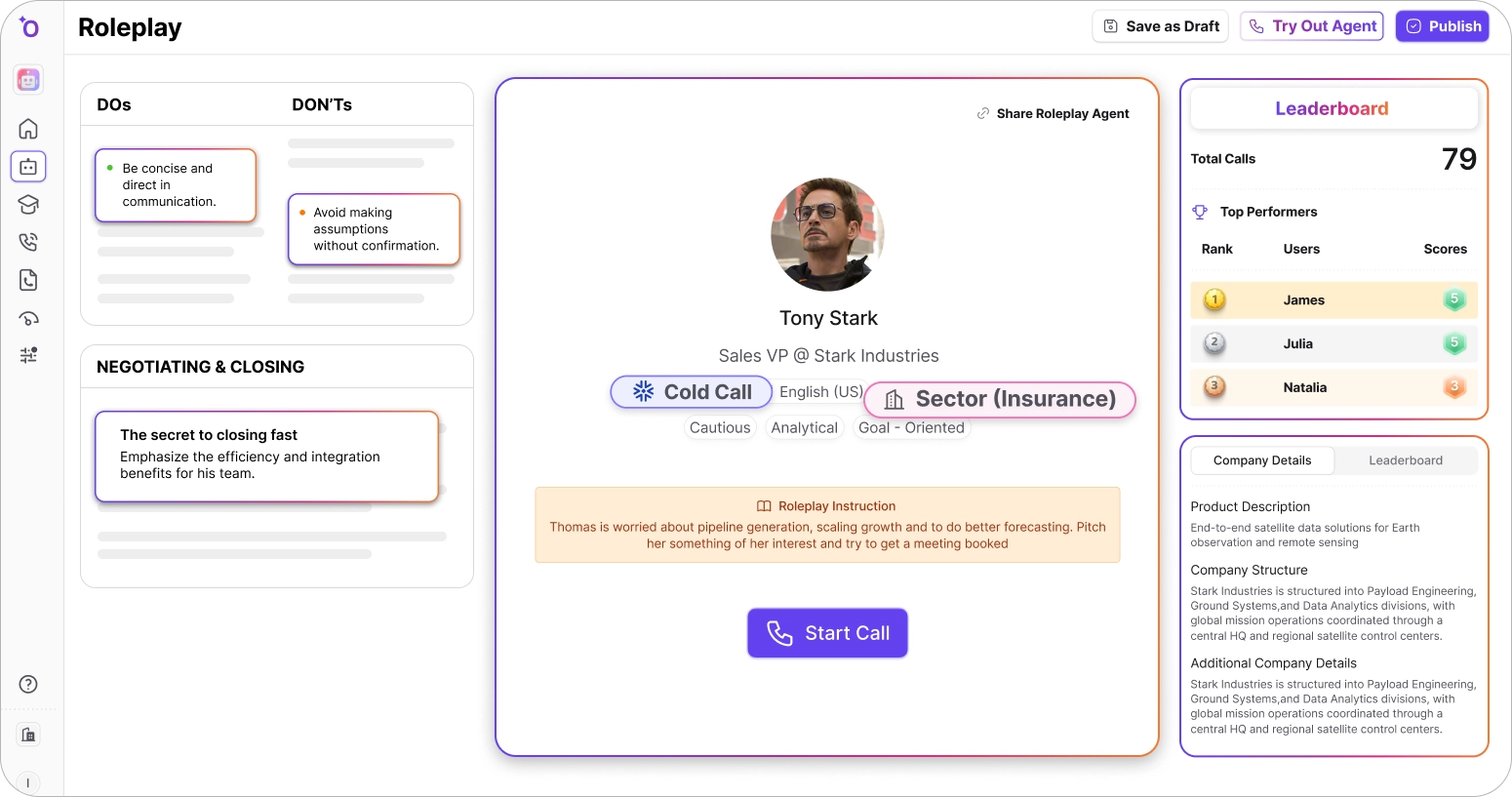
Here is how easy it is to set up MEDDIC-aligned roleplay scenarios in Outdoo AI:
How to Practice Each MEDDIC Element with AI Buyer Simulations
Each MEDDIC element presents a different extraction challenge. The AI persona configuration, the scoring criteria, and the practice format should be different for each one. Here is how to set up practice for all seven elements.
Metrics: practicing quantification beyond the first answer
The execution challenge: Prospects give metrics they have already calculated ("we need 20% faster onboarding"). Reps accept the number and move on. The harder skill is testing whether that metric is the one the Economic Buyer cares about, uncovering metrics the prospect has not calculated yet, and connecting metrics to financial impact that justifies the deal.
How to practice with AI roleplay: Configure the persona to offer a surface-level metric early ("we want to reduce ramp time"). Score against whether the rep accepted the first number or dug deeper: did they ask what ramp time costs the business in pipeline, did they ask how the metric is measured today, did they explore whether other metrics (quota attainment, first-deal velocity, rep retention) are actually more important to leadership. Run three variants: one where the surface metric is correct, one where the real metric is different, and one where the prospect has not measured the problem at all and the rep needs to help them quantify it.
Economic Buyer: confirming budget authority without overstepping
The execution challenge: Reps label the most senior person they have talked to as the Economic Buyer. The actual Economic Buyer may be someone they have never met. The skill is asking questions that confirm whether the person in front of them controls the budget, without making the contact feel diminished ("so you cannot actually approve this?") or creating political risk.
How to practice with AI roleplay: Configure two scenario variants. In the first, the persona is a genuine Economic Buyer: they respond to budget questions with specifics and describe their authority clearly. In the second, the persona is a senior influencer who presents as the decision-maker but reveals under careful questioning that final approval sits elsewhere. Score against whether the rep correctly identified which scenario they were in, how they asked about budget authority (direct but respectful versus blunt or presumptuous), and whether they proposed a path to the real Economic Buyer when the contact was not one. Multi-persona simulation adds depth: pair an influencer with the actual Economic Buyer who joins the call skeptical and time-pressed.
Decision Criteria: surfacing what actually drives the decision, not the RFP checklist
The execution challenge: Prospects share formal decision criteria (the features on the RFP, the compliance requirements, the integration checklist). These are real but often incomplete. The informal criteria, the ones that actually tip the decision (executive preference, political dynamics, a bad experience with a previous vendor), are harder to surface because prospects do not volunteer them.
How to practice with AI roleplay: Configure the persona with two layers of decision criteria: a formal list they share openly ("we need SOC 2 compliance, Salesforce integration, and under 4 weeks to deploy") and an informal criterion they reveal only if the rep asks the right question ("honestly, our CEO had a bad experience with the last vendor's support team, so responsiveness matters more than anything on paper"). Score against whether the rep uncovered the informal criterion, not just the formal checklist. This trains the instinct to ask "beyond the technical requirements, what will actually make your team confident in this decision?" which is where real competitive advantage lives.
Decision Process: mapping the actual buying journey, not the assumed one
The execution challenge: Reps ask "what is your decision process?" and accept whatever the prospect describes. But prospects often describe the process they want to follow, not the process their organization actually follows. Legal review takes longer than expected. A stakeholder who was not in the original plan suddenly needs to approve. Procurement adds requirements at the last minute. The skill is asking questions that surface the real process, including the parts the prospect has not thought about yet.
How to practice with AI roleplay: Configure the persona to describe a clean, three-step decision process when asked directly. Then embed complications that emerge only under deeper questioning: a legal review that "might" be needed, a board approval for purchases over a certain amount, a competing initiative that could absorb the budget. Score against whether the rep accepted the clean process or probed for hidden steps, whether they asked about timeline risks, and whether they asked what has happened with similar purchases in the past ("the last time your team evaluated a tool like this, what did the process actually look like?"). That backward-looking question is the one that reveals the real process.
Identify Pain: going three layers deeper than the first answer
The execution challenge: This is the MEDDIC element where execution matters most and where the gap between trained and untrained reps is widest. Most reps hear a pain statement ("our reporting is slow") and move on. Top performers hear the same statement and ask three more questions that transform it into a quantified, compelling business case. The skill is the layered follow-up: peeling the onion until the pain is specific, measurable, and tied to a business outcome the Economic Buyer cares about.
How to practice with AI roleplay: Configure the persona to give a deliberately vague first answer: "things could be better with our current approach." Score against depth, not coverage. Did the rep ask what specifically could be better? Who is affected? What does it cost the business? What have they tried? Why did it not work? The target is three to four follow-up questions on the same pain point before moving on. Also configure the persona with a hidden pain they do not mention unless the rep asks the right probing question ("is there anything else that is not working well that you have not brought up yet?"). Reps who can surface unstated pain are significantly more effective in competitive deals because they build a business case the competition did not uncover.
Champion: testing whether your contact will actually advocate internally
The execution challenge: The most commonly misidentified MEDDIC element. Reps label someone a Champion because they are friendly and responsive. A real Champion has three qualities: they have power or influence, they have a personal win tied to your solution, and they are willing to sell internally when you are not in the room. Testing for these qualities requires asking uncomfortable questions that most reps avoid.
How to practice with AI roleplay: Configure two persona variants: a real Champion (has influence, has a personal stake, will advocate) and a false Champion (friendly, engaged, but will not go to bat internally when it gets hard). In the false Champion scenario, the persona agrees with everything during the call but deflects when asked to take a specific internal action: "I can mention it to my VP, but I do not want to push too hard." Score against whether the rep tested the Champion with a concrete ask ("would you be comfortable presenting this business case to your VP next week?") and whether they correctly assessed the Champion's willingness to act. Multi-persona simulation is powerful here: pair the potential Champion with an internal skeptic and observe whether the Champion defends the solution or stays silent.
Competition: extracting competitive intelligence without interrogating
The execution challenge: Prospects are guarded about competitive information. Asking "who else are you evaluating?" directly often produces a non-answer ("we are looking at a few options"). The skill is extracting competitive context indirectly: understanding what criteria the prospect is using to compare, what they have seen so far that they liked or did not like, and where the competitive gaps are, all without turning the conversation into a cross-examination.
How to practice with AI roleplay: Configure the persona to deflect direct competitive questions ("I would rather not share who else we are talking to") but reveal competitive context when the rep asks indirectly: "what have you seen from other vendors that you liked?" or "what criteria are you using to compare options?" Score against whether the rep adapted their approach when the direct question was deflected, whether they uncovered at least two competitive criteria, and whether they positioned differentiation against those criteria without disparaging the competitor. Link this to competitive selling training for reps who need deeper practice on positioning against specific competitors.
Which MEDDIC Elements to Practice First: A Prioritization Framework
Not all MEDDIC elements are equally hard to execute. Prioritize practice on the elements where the gap between knowledge and execution is widest for your team.
Pull your team's MEDDIC field completion data from the CRM and cross-reference it with win/loss outcomes. The elements with the highest completion rate but the lowest correlation to wins are the ones where CRM data is masking an execution gap. That is where practice delivers the most impact.
How to Build a MEDDIC Practice Program with AI Roleplay
A structured program turns MEDDIC from a CRM framework into a practiced conversation skill. Here is how to build one using AI roleplay.
Step 1: Audit your MEDDIC execution quality, not just field completion
Pull conversation intelligence data on recent discovery and qualification calls. For each MEDDIC element, evaluate whether the information in the CRM was actually confirmed on the call or filled in based on assumptions. The gap between CRM completion rates and verified extraction rates tells you which elements need practice most.
Step 2: Build element-specific scenario packs
Create separate roleplay scenarios for each MEDDIC element. A rep who needs to practice Identify Pain should not run through an entire 30-minute call to reach that part. Build focused scenarios that isolate each element: a 5-minute pain extraction drill, a 5-minute Champion testing exercise, a 5-minute Economic Buyer identification conversation. These isolation drills build specific muscle memory faster than full-call practice.
Step 3: Configure MEDDIC-aligned scorecards
Build scorecards with criteria specific to each element. The scorecard for Identify Pain should evaluate follow-up depth and pain quantification. The scorecard for Champion should evaluate whether the rep tested with a concrete ask. The scorecard for Decision Process should evaluate whether the rep probed for hidden steps. Generic "MEDDIC coverage" scoring misses these execution details. Outdoo AI provides pre-built MEDDIC scorecards that can be customized with your team's specific criteria.
Step 4: Run progressive practice from isolation to full-call simulation
Start with element-isolated drills for the highest-priority elements. Once reps hit scoring thresholds on isolated practice, move to full discovery simulations that require extracting all seven MEDDIC elements in a single conversation. The full simulation reveals which elements reps handle well in isolation but struggle with when cognitive load increases. That is the realistic execution environment: managing all seven elements simultaneously.
Step 5: Score live qualification calls on the same MEDDIC rubric
Close the loop by scoring real customer calls against the same MEDDIC scorecard used in practice. The gap between practice scores and live scores, element by element, tells you exactly where each rep's execution breaks down under real pressure. A rep who scores well on Identify Pain in practice but poorly on live calls may need help with conversational confidence. A rep who struggles on both needs more fundamental coaching on pain extraction technique.
How to Measure Whether MEDDIC Training Is Improving Qualification Quality
MEDDIC training should improve deal quality, not just CRM hygiene. These metrics connect MEDDIC execution skill to pipeline and revenue outcomes.
Getting Started with MEDDIC Practice Using AI Roleplay
MEDDIC is one of the most widely adopted qualification frameworks in enterprise sales because it works. The problem is not the framework. It is the gap between knowing the seven elements and extracting them from real conversations. That gap is an execution problem, and execution problems are solved through practice, not training.
If you are building MEDDIC practice for the first time, start where the execution gap is costing the most pipeline.
Week 1: Identify your weakest MEDDIC elements. Pull CRM data on MEDDIC field completion and cross-reference with win/loss outcomes. The elements with high completion but low correlation to wins are the ones where reps are filling fields without truly qualifying. Start practice there. For most teams, Identify Pain and Champion are the starting points.
Week 2: Build and test element-specific drills. Create five to ten isolation scenarios for your top two weakest elements. Configure AI personas that protect information the way real prospects do. Test with your top performer: if they find the scenarios too easy, increase the difficulty. If they find them realistic, the calibration is right.
Week 3: Run intensive practice and calibrate scoring. Have each rep complete 10 to 15 element-specific drills. Review scores as a team to calibrate: what does a well-extracted Identify Pain actually sound like versus a surface-level one? Use the calibration to set scoring thresholds that define "qualified" versus "assumed."
Week 4 and beyond: Score live calls and correlate with outcomes. Apply the same MEDDIC scorecard to real qualification calls. Track element-by-element scores and correlate with deal outcomes over the next quarter. The data proves whether MEDDIC practice is producing better-qualified pipeline or just better-sounding calls.
Outdoo AI supports MEDDIC practice with pre-built scorecards that evaluate extraction quality per element, not just framework coverage. AI personas configured with MEDDIC-specific behavior patterns guard information by default, forcing reps to earn each element through skilled questioning. Multi-persona simulations replicate Champion and Economic Buyer dynamics with up to three stakeholders. Scenarios pull from real CRM data, call transcripts, and LinkedIn profiles so practice mirrors the actual deals in your pipeline. The same scorecard scores practice and live qualification calls, making the MEDDIC execution gap visible and coachable at the element level. Outdoo also supports MEDDPICC (adding Paper Process), SPIN, BANT, and Challenger scorecards for teams using multiple frameworks.
If your team knows MEDDIC but struggles to execute it in live conversations, book a demo to see how AI roleplay closes the execution gap.
Frequently Asked Questions
.svg)
AI roleplay builds the execution skills that MEDDIC training alone cannot: extracting information from guarded prospects, confirming Economic Buyer authority without overstepping, testing Champion willingness with concrete asks, and surfacing pain three layers deeper than the first answer. AI personas configured with MEDDIC-specific behavior patterns force reps to earn each element through skilled questioning, and scorecards evaluate extraction quality per element, not just topic coverage.
Start with Identify Pain and Champion. These two elements have the widest gap between knowledge and execution. Pain identification requires follow-up discipline that breaks under real conversational pressure. Champion testing requires asking uncomfortable questions most reps avoid. Practice Economic Buyer and Decision Process next (multi-stakeholder skills), then Metrics, Decision Criteria, and Competition (depth of extraction).
Yes. Platforms like Outdoo AI support up to three AI personas in a single session: for example, a mid-level Champion who is enthusiastic but cannot sign, alongside a skeptical Economic Buyer who guards budget information. This replicates the real dynamics of Champion and Economic Buyer interactions that single-persona practice cannot develop.
Track MEDDIC extraction quality scores (per element) correlated with win rates, the practice-to-live score gap per element, stage 2+ disqualification rate for issues that should have been caught at stage 1, forecast accuracy improvement, average deal velocity by MEDDIC quality score, and Champion confirmation rate (whether the labeled Champion actually took internal action).
Yes. Outdoo AI supports pre-built scorecards for MEDDIC, MEDDPICC (adding Paper Process), SPIN, BANT, and Challenger. Custom scorecards can be built for teams using blended or proprietary frameworks. All scorecards evaluate the same practice and live calls, closing the loop between training and real conversation performance.
Table of Contents
Talk to Sales
Have questions about training and enablement for your sales, CS, support, or leadership team? Let's talk.
Talk to Sales