



Who Is Synthesia Best For?
- Synthesia Roleplay Sessions: Best for teams already running Synthesia for onboarding videos that want light, add-on practice. It is video only and launched July 22, 2026.
- Synthesia Studio: Best for AI avatar training videos at scale, with 240+ stock avatars and translation into 160+ languages.
- Outdoo AI: Best for sales teams that need roleplays built from their own calls and playbooks, with one scorecard across practice and live calls, plus voice, video, chat, and multi-persona formats.
At a Glance
| Outdoo AI | Synthesia Roleplay Sessions | |
|---|---|---|
| Launched | Purpose-built roleplay and coaching platform | July 22, 2026 (under a month old) |
| Roleplay pricing | Usage-based, tied to training activity | $300/user/year, plus $5,000 per content creator |
| Scored against your playbook or CRM data | Yes | No (authored scenario templates) |
| Multi-persona calls / post-call workflow practice | Yes (up to 3 personas, plus CRM logging) | No |
| Roleplay formats | Voice, video, chat, in-person, multi-persona | Video only |
| Scoring inside your own LMS | Full scoring travels with the SCORM package | Pass/fail/completed only |
What Is Synthesia?
Synthesia is a London-based AI video platform. Its core product lets businesses generate "talking head" training and marketing videos using AI avatars, without a camera, a studio, or an actor.
Type a script, pick from 240+ stock avatars or build a custom one from your own filmed likeness, and Synthesia turns it into a polished video in minutes.
It also does AI voice generation and translation into more than 160 languages, so one training video becomes dozens of localized versions with no reshoot.
Customers include Heineken and Zoom, and Synthesia says it passes compliance audits at 90%+ of the Fortune 100, real enterprise depth to show for it.
For most of its history, Synthesia was a passive-content tool: you watched the video, maybe took a quiz. That changed on July 22, 2026, when Synthesia launched Roleplay Sessions, the first product under a new "Sessions" platform.
Instead of just watching a video, an employee now has a live spoken conversation with an AI avatar persona, an angry customer, a skeptical prospect, an underperforming direct report, and gets automated, rubric-based scoring plus AI coaching feedback afterward.
CEO Victor Riparbelli has framed it as a shift from "watching training videos" to practicing skills "with granular data on how a sales force is doing overall," and named cold calls and discovery calls as flagship use cases.
That's the piece we're reviewing here: not Synthesia the video generator, but Synthesia as an AI sales roleplay tool.
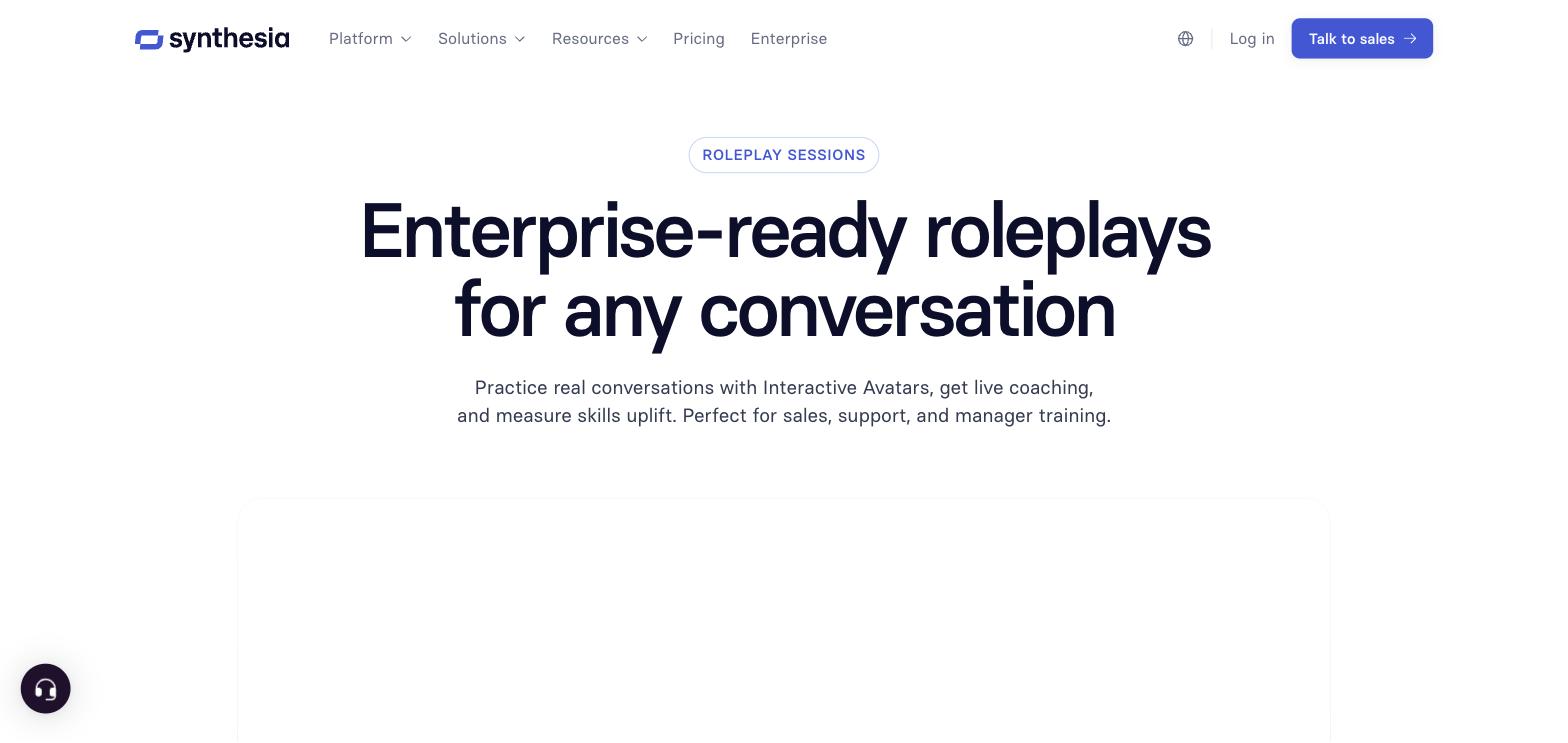
Screenshot: Synthesia's Roleplay Sessions feature page, captured directly from synthesia.io, August 2026.
Synthesia Pricing
The core video platform's pricing is fully public. Roleplay Sessions is not, though the figures Synthesia quotes are consistent enough to report.
Roleplay Sessions (pricing quoted by Synthesia's sales team, September 2026):
| Item | Price |
|---|---|
| Roleplay, up to 250 users | $300 per user per year |
| Roleplay, 251+ users | $285 per user per year, applied to every user |
| Roleplays per user | Unlimited |
| Creator licence, to build roleplays | $5,000 each; one included with the first 100 users |
| Minimum users | 10 |
| Onboarding or platform fee | None |
| Roleplay hosting | Free mini LMS, hosts roleplays only |
| Trial | Free, fully managed |
Source: pricing quoted by Synthesia's sales team, September 2026. These are list figures rather than published ones, so your own quote may differ, particularly on volume.
The tiering has a real cliff worth knowing. The rate applies to your whole account, not just the seats above the threshold, so 251 users bills at $285 across the board while 249 users bills at $300 across the board. At 250 users that's $75,000 a year; at 251 it drops to $71,535.
What this changes. Synthesia's own materials give no figure anywhere, and the product is marketed as an Enterprise-plan feature, which reads as an enterprise-only gate. In practice there's a straightforward per-seat list price and a ten-user floor. Ten users plus the included creator licence is roughly $8,000 a year, which is mid-market territory, not enterprise-only.
The seat price isn't the part to watch. Practice is unlimited and cheap per head. Authoring is what's rationed: one person per 100 users can build roleplays, and every additional builder costs $5,000 a year. If three people on your enablement team need to create scenarios, that's $10,000 before you add a single learner, and content creation capacity is usually what a growing programme runs short of first.
The video product is a separate purchase. Synthesia Studio, which is what most people mean when they say they already use Synthesia, was quoted at GBP 8,330 per licence. An existing Synthesia contract rarely means roleplay is included.
Video plans (published):
| Plan | Price | What you get |
|---|---|---|
| Free | $0/mo | 10 min video/mo, 9 avatars |
| Starter | $29/mo ($18/mo billed yearly) | 10 min/mo, 125+ avatars, 1 personal avatar, logo removal, AI dubbing |
| Creator | $89/mo ($64/mo billed yearly) | 30 min/mo, 180+ avatars, 5 personal avatars, API access, interactive videos |
| Enterprise | Custom, contact sales | Unlimited video minutes, 240+ avatars, unlimited personal avatars, SSO/SAML, SCORM export, dedicated CSM |
Source: synthesia.io/pricing.
Roleplay Sessions is not included in any of those tiers. Synthesia's own help center describes it as a paid add-on with no public price listed anywhere on the site.
Access is still sales-led, so there's no self-serve signup for a paid roleplay plan. But the evaluation itself is free: Synthesia runs a fully managed pilot, builds roleplays for you during it, and charges no onboarding fee. What they gate on is qualification, a clear ROI case and the actual decision-maker agreeing to the time commitment, rather than budget.
Synthesia Features
Video authoring (the mature part). AI avatar generation from 240+ stock avatars or a custom likeness, AI voice generation across 1,000+ voices, script-to-video, and translation and dubbing into 160+ languages.
It also covers interactive video with quizzes and branching paths, video analytics (views, watch time, drop-off), Brand Kit templates, SCORM export for LMS integration, API access, and team collaboration tools.
This is what Synthesia has spent years building and it shows.
Roleplay Sessions (the new part). A "Session" runs in three stages: a short scripted teaching scene (2 to 5 minutes), a live roleplay scene where a talking AI avatar persona asks questions and pushes back, then an automated feedback scene.
Scoring is rubric-based per competency, Synthesia is explicit that it's "not one pass/fail number," and is based on what the learner actually said rather than a checklist.
An AI coach walks the learner through the results, and manager-side analytics show pass rates, per-skill scores, and improvement across attempts, with drill-down to transcripts and synced audio.
Pre-built scenario templates cover cold calls, discovery calls, manager feedback conversations, customer support, and retail or frontline sales.
You can build custom scenarios too, and Synthesia has already published dedicated landing pages for cold-call, discovery-call, and sales-roleplay scenarios specifically, which shows real investment in the sales use case.
One narrowing worth knowing: roleplay conversations currently run in English, German, Spanish, and French, a much smaller set than the 160+ languages Synthesia supports for video translation. If your team roleplays in a language outside those four, this feature doesn't reach you yet.
Video only. Synthesia has no chat roleplay. Video can be switched off, but that leaves a still image with a voice track rather than a true voice format, and Synthesia itself discourages it on engagement grounds. If your team sells over the phone, you're practising in the wrong medium.
SCORM export works, but the analytics don't travel with it. This is the most consequential limitation in the product. You can export a roleplay as a SCORM package into Moodle or any LMS that accepts one. What the LMS then receives is a pass, a fail, or a completion, and nothing more. Every per-skill score, coaching summary and attempt transcript stays inside Synthesia, and learners show up anonymous unless someone configures learner-tracking IDs to map them back. If that LMS is Absorb, our Absorb LMS review covers what it tracks and what it costs.
For an enablement team whose whole reason for using SCORM is that reps shouldn't have to log into another tool, that's a real problem: the reps don't, but every manager who wants to coach still does. If your LMS is a course platform such as LearnRush, our LearnRush review covers what it tracks and what it doesn't. For how a standalone LMS handles roleplay on its own, see our LearnUpon review.
No cohorts, courses, or badges. If you want to split fifty learners into cohorts of ten and compare progress between groups, that requirement lands back on your own LMS. Grouping inside Synthesia stops at slicing analytics by department or team.
What we also found no evidence of, checking Synthesia's own pages, help center, and press coverage: multi-persona or multi-stakeholder calls, a gatekeeper or cold-call-screening phase, and simulation of the post-call CRM or workflow logging.
Scoring is also not built from a customer's own playbook or call history. It runs against Synthesia's authored scenario templates.
What Users Say
Because Roleplay Sessions is under a month old, there's no review coverage of it yet on G2 or Capterra. Every quote below is about the legacy video platform, which is still useful for judging how Synthesia builds and supports product, just not evidence on the roleplay feature itself.
On ease of use: "I was able to roll out a professional and polished product to the entire company within a fraction of the time it would normally take to produce," wrote a People Operations Specialist on Capterra.
On support: "Great customer support. Product works great and I have not found any other like it," wrote a Founder on GetApp, part of the same Gartner Digital Markets review network as Capterra.
On the other side, a Founder in IT services wrote on Capterra: "I had videos approved, only to have nearly identical versions later flagged without explanation. When I reached out, I received vague responses that provided no real clarity on what was wrong."
Another Capterra reviewer, a Lecturer in education, described content getting rejected over "stringent rules that couldn't accept the images just due to simple brightness issue," a milder version of the same moderation-consistency complaint.
The same pattern shows up beyond Capterra: a President reviewing Synthesia via GetApp (part of the Gartner Digital Markets network) wrote, "Support was an AI bot that told me the charge was non-refundable."
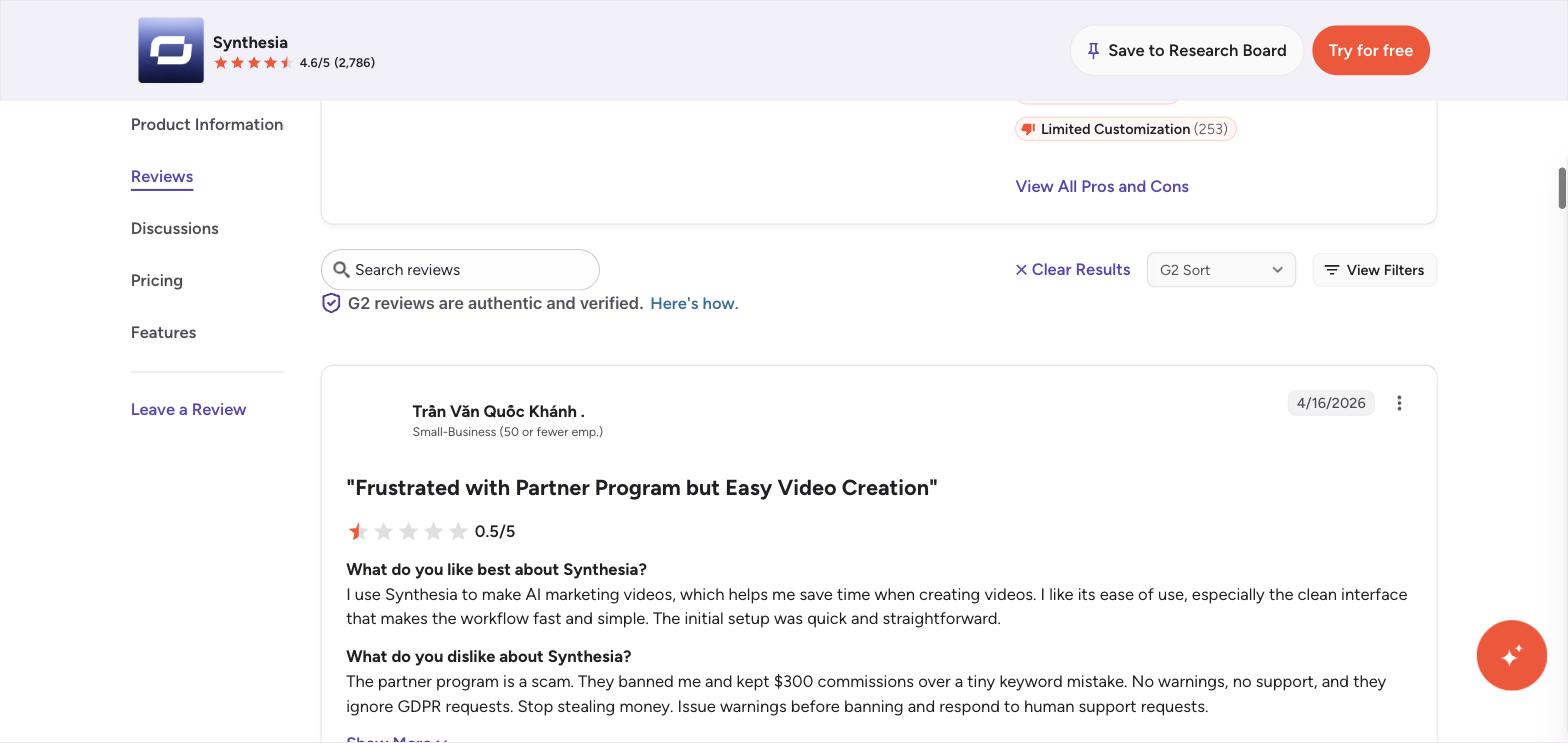
Screenshot: a negative Synthesia review, captured directly from G2, August 2026.
Synthesia's own site cites a 4.7/5 rating from 2,000+ reviews on G2, a figure this research couldn't independently re-verify since G2 blocks automated access to its review pages.
It lines up with the split above: real praise for ease of use and speed, alongside recurring complaints about content moderation and support.
Where Synthesia Falls Short
For sales roleplay specifically, the gaps are structural, not cosmetic.
Roleplay Sessions is brand new, launched under a month before this review, paid as a separate add-on with no public price, and rolling out enterprise-first. That's a genuinely untested capability, not a mature one.
Synthesia doesn't grade against a customer's own playbook, SOP, or CRM data. Its rubrics are authored scenario templates, closer to traditional L&D content than to scoring built from how your team actually sells.
It doesn't do multi-persona calls, so no practicing a committee-based deal with more than one stakeholder in the room. There's no gatekeeper or cold-call-screening phase.
There's no simulation of the post-call CRM or workflow logging, so the practice stops the moment the conversation ends, when in a real deal the process work after the call is often where reps lose the most ground.
And it only scores the roleplay itself. There's no live-call scoring and no unified view tying practice performance to how reps actually perform on real calls, which matters if you're trying to prove coaching moves revenue numbers rather than completion rates.
If these gaps rule Synthesia out entirely for your team, our Synthesia alternatives roundup compares it against Yoodli, Second Nature, Hyperbound, and other dedicated roleplay platforms.
Where Synthesia Genuinely Wins
Give credit where it's due. Synthesia already has deep enterprise trust, with customers like Heineken and Zoom, and can cross-sell roleplay into an existing video-training relationship with none of the new-vendor friction a standalone roleplay tool has to overcome.
In risk-averse enterprise procurement, that matters more than feature parity.
The avatar and video technology itself is more mature than most roleplay-first vendors can offer, because Synthesia's whole company pedigree is avatar and video generation, not conversational AI bolted onto a video product.
240+ stock avatars, custom-likeness creation, and translation into 160+ languages for the authoring side are hard to match.
And having teaching video and roleplay practice live in the same authoring surface, the "Studio," is a real integration story. If your L&D team already builds onboarding video in Synthesia, adding a scored practice scene to that same workflow has a genuine convenience advantage.
The roleplay analytics are also better than "new feature" would suggest. A walkthrough showed per-skill scoring with team medians and score distribution, engagement metrics kept properly separate from results metrics, and a full per-learner attempt history, including one learner's five attempts climbing from 7% to 100% as coaching accumulated. Managers can also override an AI score and tell the model why, which feeds back into the grading.
And practice itself is genuinely unmetered. Every seat includes unlimited roleplays, which is a clean story for a high-volume team and the one place a per-seat model reads better than usage-based pricing.
How Outdoo AI Compares
Outdoo AI starts from a different premise: roleplay should be built from what your team actually does, not from a template library.
Roleplay agents are built directly from your team's real calls, transcripts, playbooks, battlecards, and even LinkedIn profiles, so a rep practices against something closer to their actual pipeline than a generic persona.
Synthesia's own CEO makes part of this case for us. Victor Riparbelli told TechCrunch, "Video performs way better than text... but for most things, we learn the best by actually practicing," a candid admission that the one-way video product Synthesia spent eight years building doesn't build skill on its own.
Every Outdoo AI scorecard is graded against your own playbook and SOP instead (grading against your playbook, not generic AI advice), the same gap that shows up in Synthesia's authored scenario templates.
Access works differently. Roleplay Sessions has no self-serve signup, so a paid plan means going through sales, though the evaluation itself is free and fully managed. A team can start evaluating Outdoo AI's roleplay and coaching platform without booking a call first.
Outdoo AI also runs one scorecard across both roleplay practice and live calls, so leaders can show that coaching moves real revenue metrics, not just completion counts, something Synthesia's roleplay-only scoring doesn't do.
That is also what customers rate it on: Outdoo AI is the #1 AI Sales Roleplay Platform for Best Results and Most Implementable on G2 (Fall 2026 reports).
Where Synthesia caps roleplay at one persona per session, Outdoo AI supports multi-persona calls with up to three stakeholders, useful for committee-based B2B and renewal deals.
Practice extends past the conversation itself, too: reps rehearse the post-call CRM and workflow logging in the same session, not just the talk track, and it's scored on the same rubric as their live calls.
And where Synthesia's roleplay currently runs in four languages against a video product that translates into 160+, Outdoo AI's voice roleplay already covers 74+ languages, with 120+ supported across the platform overall.
Pricing is usage-based rather than a flat per-seat license stacked on top of an unpublished add-on fee, which matters if you want cost tied to actual training activity instead of idle seats.
Frequently Asked Questions
.svg)
It's a live, spoken practice conversation with an AI avatar persona, followed by rubric-based automated scoring and AI coaching feedback. It launched July 22, 2026, as an add-on to Synthesia's existing video platform, and covers scenarios like cold calls, discovery calls, and manager feedback conversations.
No. Synthesia's published pricing covers Free, Starter, Creator, and Enterprise video plans only, and Roleplay Sessions carries no public figure at all. The figures Synthesia's sales team quoted as of September 2026 are $300 per user per year under 250 users, $285 above that, with unlimited roleplays per seat, a ten-user minimum, and $5,000 for each person who needs to build roleplays. Outdoo AI starts free with 60 minutes of roleplay credits and unlimited team members, no credit card and no sales call, then scales on usage-based Flex pricing with a custom enterprise plan for larger deployments.
It's a reasonable fit if you already run Synthesia for training video and want a light layer of scored practice on top.
Not yet. Roleplay Sessions is video-only and scores only the practice conversation itself. It doesn't tie roleplay performance to live-call outcomes or your CRM data the way a purpose-built sales roleplay and coaching platform does, and delivered through your own LMS it reports only a pass or a fail.
Roleplay conversations currently run in English, German, Spanish, and French, a much smaller set than the 160+ languages Synthesia supports for video translation and dubbing.
Table of Contents
Talk to Sales
Have questions about training and enablement for your sales, CS, support, or leadership team? Let's talk.
Talk to Sales