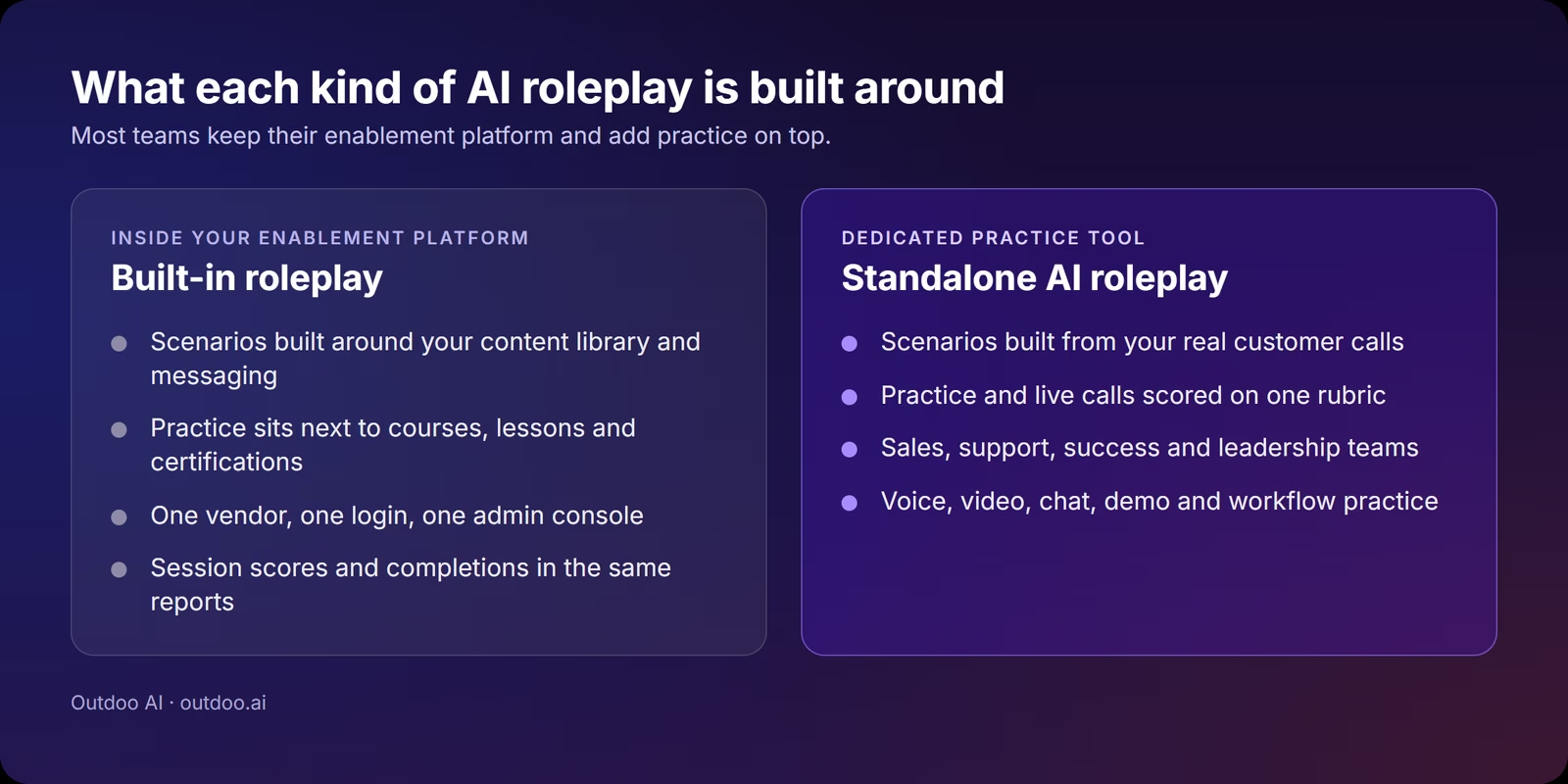
- Built-in roleplay is now standard: Seismic, Highspot, Mindtickle, Allego and Showpad all include AI roleplay, mostly built around the content already in each platform.
- It works for content practice: Built-in roleplay suits teams that mainly need to rehearse new messaging, launches and talk tracks in a tool they already use.
- Standalone tools are built for practice: Dedicated tools build scenarios from real calls, score practice and live calls on one rubric, and cover every customer-facing team.
- Most teams keep both: Keep your enablement platform for content and courses, and add a practice tool when you need proof that skills show up on live calls.
Most sales enablement platforms now include AI roleplay, and for light practice on content you already keep there, it can be enough. Teams add a standalone AI roleplay tool when practice has to come from real customer calls, cover more than the sales team, and show up on live calls.
Seismic, Highspot, Mindtickle, Allego and Showpad all added AI roleplay between 2024 and 2026. So many enablement leaders now ask a narrower question. Is the roleplay we already have enough?
This guide compares what each kind of roleplay is built for, with sources, real scenarios and a checklist. It picks up where our look at the missing layer in sales enablement left off.
Which Sales Enablement Platforms Include AI Roleplay Now?
Five of the best-known enablement platforms now ship AI roleplay. Here is what each vendor says its roleplay is built from, based on its own pages:
| Platform | AI roleplay feature | Launched | Built from (per vendor) |
|---|---|---|---|
| Seismic | Roleplay Agent (one of Seismic’s Aura AI agents) | June 2025; generally available June 2026 | "Content within Seismic", with scoring, insights and recommendations for leaders |
| Highspot (Highspot by Seismic) | AI Role Play | July 2025 | Content, messaging, coaching and deal context already in Highspot |
| Mindtickle | AI Role Plays | Spring 2024 | Prompts, stock personas, your own objections, and skill gaps it finds in calls and assessments |
| Allego | Live Dialog Simulator and AI Deal Role Play | June 2025 | Objection, pitch and meeting scenarios, including a specific upcoming deal |
| Showpad | Roleplay AI (from Bigtincan RolePlayAI) | 2024 | Existing content turned into scenarios and AI buyer avatars |
Two of these now sit under one roof. Seismic completed its merger with Highspot on August 18, 2026, and Highspot runs as Highspot by Seismic, with its own AI Role Play product alongside Seismic’s Roleplay Agent.
Dedicated practice tools are a separate category. For a wider look at the market, see our list of the best AI sales roleplay tools.
What Is Built-In Roleplay Designed to Do?
Built-in roleplay is designed around the content you already manage. The AI buyer draws on your playbooks, messaging and course material, and practice sits next to the lessons and certifications reps already take.
That design has real strengths:
- Practice where reps already work: No new login or rollout, and roleplays can be added to existing learning paths.
- Consistent messaging: Reps rehearse the same talk tracks and launch content the enablement team just published.
- One vendor and one report: Completions, quiz scores and roleplay scores sit in the same dashboards.
- Often included: Highspot lists AI Role Play in its Better and Best tiers, and Seismic includes its Roleplay Agent in Advanced and Ultimate, with an add-on for Essential.
It also gets used. Expedia Group logged 1,000+ roleplay sessions across 260+ users within weeks, according to Seismic’s June 2026 release. Qlik ran 9,000+ roleplays across 860 users, according to Mindtickle’s customer story.
If reps mainly need to learn new content and say it well, built-in roleplay does that job. It supports sales readiness without adding another tool to the stack.
What Do Enablement Leaders Say About Built-In Roleplay?
Practitioners are positive about AI roleplay in general. The friction shows up in the details: How real the scenarios feel, how scoring works and whether practice proves anything. Here are five themes from enablement leaders, analysts and customer forums.
1. Practice only works if the scenario feels real
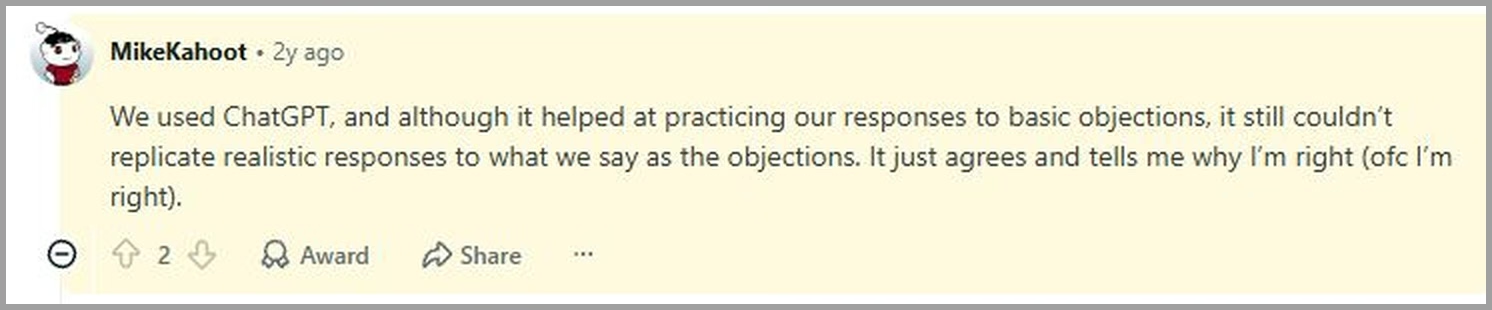
The most common point is realism. If the AI buyer only repeats your talk track back, reps stop taking it seriously.
"AI role play only works if the scenarios are credible."
Source: Dock’s Revenue Lab interview with Stacey Justice, VP of GTM Enablement at Gong, May 2026
Forrester makes the same argument from the analyst side. Its July 2026 post on AI roleplay says practice changes behavior when the simulation mirrors real buyers, with objections, personality variation and negotiation.
2. Scoring rules can block a rollout
Small product decisions matter at scale. On Seismic’s own community forum, a customer exploring roleplays asked whether scorecards could be switched off. Seismic’s community manager confirmed they can’t:
"Scorecard is always required for a role-play scenario"
Source: Seismic Community, August 2026
For that customer, the answer decided the rollout. They explained that Works Council rules stop them from scoring individuals in some regions:
"many of our European countries will not be able to use role plays"
Source: The same Seismic Community thread
Another customer on the thread argued that scoring is the point of scored practice, which is fair. The lesson is to check scoring options before you plan a global rollout.
3. Teams with a full stack still look for dedicated practice
Uber for Business runs Highspot for sales training and content, and Gong for conversation intelligence. New hires practice client conversations with text-based Gemini Gems today, and according to Dock the team is "evaluating a purpose-built AI role-play tool."
That isn’t a verdict on Highspot. It shows that teams with a complete enablement stack still treat roleplay as its own buying decision.
4. Finishing the course isn’t proof
Handle built its certification around a full mock sales process, with multi-persona roleplay, executive discovery and a live demo. Reps aren’t done until they can do it convincingly.
"Getting through the material doesn’t mean you’re certified."
Source: Dock’s Revenue Lab interview with Ryan Vanshur, Handle, March 2026
Built-in roleplay can sit inside that kind of certification. The question is whether it is realistic enough to be the test, the same bar that good AI sales training has to clear.
5. Measure capability, not consumption
Forrester’s Peter Ostrow puts the shift plainly in the same post:
"Revenue enablement has long measured what sellers consume."
Source: Forrester, July 2026
The post also reports that high-performing reps are four times more likely to use AI roleplay. Forrester doesn’t name the dataset behind that figure, so treat it as directional.
What Does a Standalone AI Roleplay Tool Do Differently?
A standalone tool starts from the opposite end. Practice is the product, so scenarios are built from what customers actually say, and the same scorecard is used on practice and on real calls.
Here is the difference in more detail:
| Built-in roleplay | Standalone AI roleplay (Outdoo AI) | |
|---|---|---|
| Where scenarios come from | Content, messaging and context already in the platform | Your own calls, transcripts, documents, buyer profiles or a prompt |
| What gets scored | Practice sessions, often inside lessons and courses | Practice sessions and live calls, on the same rubric |
| Who it is built for | Mainly sales reps using the content library | Sales, support, customer success, leadership and other customer-facing teams |
| Ways to practice | Varies by vendor, so check voice, video and multi-persona options | Voice, video and chat, buying committees of up to three personas, screen-aware demos and workflow practice |
| How reps come across on camera | Check with the vendor | On-Camera Presence scores eye contact, expressions and body language in video roleplays |
| Proof that practice worked | Completions and session scores | The next live calls on the same skill |
| How you buy it | Part of the platform, sometimes a higher tier or an add-on | A separate tool that connects to your platform and LMS |
Outdoo AI AI roleplays are built this way. A buyer is created in one click from your own calls or documents, and every attempt gets coaching feedback right after.
Why Does Practice Need More Than Content?
Knowing the playbook and using it on a call are different skills. Research on learning shows why practice matters:
- Unused skills fade: A 2025 meta-analysis in Psychological Bulletin found that, with lack of use, half of initial skill gains were lost after about six and a half months.
- Recall beats re-reading: In Roediger and Karpicke’s 2006 study, students who practiced recalling a passage remembered 61% of it a week later, against 40% for students who re-read it.
- Simulation changes behavior: A 2011 JAMA review of 609 studies found large gains in knowledge and skills from simulation training, and clear gains in on-the-job behavior, in the health professions.
Content readiness tells you reps have read the material. Conversation readiness tells you they can use it with a buyer who pushes back, which is the gap a practice-first tool is built to close.
What Does the Difference Look Like in Real Scenarios?
Here are three situations enablement teams run into, and how each kind of roleplay handles them.
Scenario 1: A competitor undercuts your price before quarter end
With built-in roleplay, reps practice the pricing objection from the battlecard in your library. That teaches the approved answer.
With a standalone tool, the enablement team builds the AI buyer from last month’s calls where that competitor came up, so it pushes back with the exact words customers used. Reps practice until they pass, and managers check the next live calls. Our guide to turning real calls into AI roleplay scenarios shows how to set this up.
Scenario 2: A renewal where your champion was quietly demoted
In a piece for The Next Web, Manuel Faust describes a champion who went from "Head of" to Senior Manager without the team noticing, because it was watching usage dashboards rather than people. The renewal call that follows involves a new decision-maker and a weakened ally.
That is a customer success conversation, not a new-business pitch. A tool built for post-sales roleplays lets CSMs rehearse it as a multi-persona call, with the new decision-maker and the old champion in the same conversation.
Scenario 3: A compliance conversation on video
A financial services advisor has to explain that a request falls outside policy. On video, the words can be right while the face says something else, such as a confident sentence delivered with visible hesitation.
Outdoo’s On-Camera Presence (video analytics on roleplays) scores eye contact, facial expressions, body language and camera-off time. It also flags moments where the words and the face don’t match, which a transcript alone misses.
When Is Built-In Roleplay Enough?
Built-in roleplay is a good fit when most of these are true:
- Practice is mainly about new messaging, launches and talk tracks.
- One team, mostly sales, needs to practice, in a small number of languages.
- One vendor and one login matter more to you than depth of practice.
- Roleplay is already included in your tier.
- You don’t yet need to tie practice to results on live calls.
If that describes your team, start there. You can add a dedicated tool later, and the basics of AI sales roleplay stay the same either way.
What Are the Signs You’ve Outgrown Built-In Roleplay?
- Reps say the AI buyer feels scripted or too easy, and usage drops after the launch push.
- Scenarios come from the library, not from what customers said last week.
- You can see completions, but not whether skills show up on live calls.
- Support, success or leadership teams want practice too.
- Some regions can’t use it because of how scoring works.
- The roleplay add-on costs about as much as a dedicated tool.
Two or more of these usually means it’s time for a side-by-side pilot. Our AI sales roleplay buyer’s guide covers what demos don’t show.
What Should You Ask Your Enablement Vendor About Roleplay?
Before you renew or expand, ask these questions. Each answer tells you whether the built-in option fits how your team practices:
- Scenarios: Can we build roleplays from our own call recordings, or only from library content?
- Scoring: Are practice and live calls scored on the same rubric?
- Flexibility: Can scoring be switched off or anonymized where works councils require it?
- Teams: Can support, success and leadership teams use it, with scenarios built for their calls?
- Formats: Which formats are included, such as voice, video, chat, multi-persona and screen-share demos?
- Pricing: Is roleplay in our current tier, or an add-on?
- Roadmap: If you run Seismic or Highspot, which of the two roleplay products will be the long-term focus after the merger?
- Pilot: What does a two-week pilot look like, and what data can we export?
Whichever tool you pick, the feedback after each attempt matters as much as the scenario. See how AI coaching works in Outdoo.
Can You Keep Your Enablement Platform and Add a Standalone Tool?
Yes, and most teams do. The enablement platform stays the system of record for content and courses, and the practice tool sits on top. Reps keep learning where they always have, and the enablement team doesn’t rebuild material by hand:
- Build practice from existing content: Knowledge Sync links your LMS, Confluence or website and turns the playbooks you already maintain into AI Trainers and roleplays, re-syncing daily.
- Launch practice inside your LMS: Outdoo supports SCORM 1.2 and 2004, xAPI and LTI across 40+ LMS integrations.
- Connect the platforms: Outdoo integrates with both Seismic and Highspot, among 145+ integrations.
When a new tool or process rolls out, the same content can also become a guided walkthrough. An AI Trainer teaches reps the steps, then checks they can do them.
How Does Outdoo AI Fit Into Your Enablement Stack?
Outdoo AI is the AI roleplay and training platform for customer-facing teams. It builds AI buyers from your calls, documents or a prompt, scores practice and live calls on one scorecard, and gives coaching after every attempt.
Reps can also rehearse product demos with screen-aware roleplays, practice the CRM steps that follow a call with workflow training, and get On-Camera Presence feedback on video roleplays.
The results show up on real calls. Globe Life, a Fortune 500 insurer, got 40+ manager hours back every month with Outdoo AI, and Outdoo AI is rated #1 for Best Results, Most Implementable and Highest User Adoption in G2’s Fall 2026 reports.
Built-In or Standalone: Which Should You Choose?
Use built-in roleplay when the goal is to learn new content and say it well. Add a standalone tool when practice has to match real calls, cover every customer-facing team and prove itself on live conversations. Most teams end up with both.
To see how Outdoo AI works next to your enablement platform, book a demo.
Outdoo builds AI Roleplays from your own calls and scores practice and real calls with one scorecard. Rated #1 for Best Results on G2.
Frequently Asked Questions
Do sales enablement platforms have AI roleplay?
Yes. Seismic, Highspot, Mindtickle, Allego and Showpad all include AI roleplay. Most build scenarios around the content and messaging already in the platform, and some charge for it as an add-on or a higher tier.
Does Highspot have AI role play?
Yes. Highspot AI Role Play launched in July 2025 and builds practice around the content, messaging, coaching and deal context in Highspot. It is included in Highspot’s Better and Best tiers.
Does Mindtickle have AI roleplay?
Yes. Mindtickle added two-way AI roleplay in spring 2024. Scenarios can come from prompts, stock personas or your own objections, and it can create roleplays from skill gaps it finds in calls and assessments.
When should you add a standalone AI roleplay tool?
When practice needs to come from real customer calls, cover support, success or leadership teams as well as sales, or show results on live calls. Many teams keep their enablement platform for content and add a practice tool on top.
Can you use a standalone AI roleplay tool with Seismic or Highspot?
Yes. Outdoo AI integrates with both, and Knowledge Sync can turn your existing playbooks into roleplays. Your enablement platform stays the home for content and courses.