

- Live-call learning is paid for in lost deals: When reps practise hard conversations on real prospects, every fumble is a deal at risk. The fix is simple: do not practise with your paycheck.
- Deal review shows risk, not skill gaps: Deal-focused tools flag which opportunities are slipping but not why a rep keeps losing them. Scoring skills on every call reveals the pattern deal review misses.
- Score, practise, verify: the coaching loop: Score every call on the skills you coach, spot each rep's pattern, assign a roleplay for that exact gap, then check the next calls to see if it carried over.
- Outdoo AI runs the whole loop in one place: Outdoo AI scores practice and live calls on one rubric, builds roleplays from your real calls, and turns flagged gaps into targeted practice, so reps improve before a deal pays for it. Starts on a Free plan.
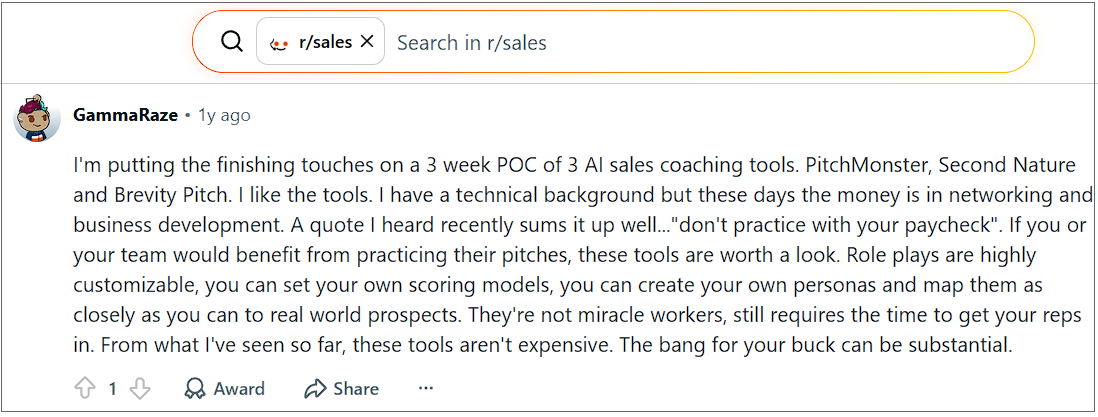
Every sales rep learns the hard way at some point: a fumbled pricing objection on a real deal, a discovery call where they talked too much, a close that landed wrong. The catch is that those lessons get paid for in lost pipeline. A sales rep in an r/sales discussion summed up the fix in a line worth stealing: do not practise with your paycheck.
That is what AI roleplay is for. Instead of learning a skill for the first time on a live prospect, a rep practises it against a realistic AI buyer, gets scored, and fixes it before the conversation that actually counts. And because the same scoring can run across every real call, managers finally see where reps are losing deals on skill, not just which deals are slipping.
This article covers what live-call learning really costs, why reviewing deals does not fix skill gaps, and how AI call scoring plus roleplay give reps a safe place to get better before a customer pays for it.
AI Roleplay or Live-Call Learning: Which Is Best?
- AI roleplay: Best for learning a skill for the first time. Reps practise against a realistic AI buyer and get scored before a real prospect hears it.
- Live-call learning: Best for using a skill that has already been practised. On its own it is expensive, because the mistake and the lost deal are the same event.
- AI call scoring on every call: Best for finding each rep's skill gaps. Deal review shows which deals are at risk, not why a rep keeps losing them.
- Outdoo AI: Best for teams that want one loop. It scores practice and live calls on one rubric and turns flagged gaps into targeted roleplays.
What does learning on live sales calls actually cost?
Learning on live calls is expensive because a rep's practice happens on real pipeline. The mistake and the lost deal are the same event.
When a new AE runs their first enterprise discovery call, they are learning discovery on a real opportunity. When an SDR finds their cold-call voice, they burn real leads doing it. When a rep tries a new way to handle a pricing objection, the test runs on a deal that could have closed. Getting it wrong is not a bad grade. It is a deal gone.
This is the practise-with-your-paycheck problem. For most teams, the only place reps get repetitions on hard conversations is in front of buyers, so the skill and the pipeline improve, or fail, at the same time. Multiply one avoidable fumble a week across a team, and the cost of learning live becomes a real number on the board. That cost is the case for building a 2026 AI training budget that funds practice before workshops.
Why reviewing deals does not fix skill gaps
Most coaching tools review deals, not skills. So a manager can see which deals are at risk, but not why a rep keeps losing them. That gap is the missing layer in sales enablement.
The managers in that r/sales thread were all circling the same gap. They could see pipeline and deal health, but not which rep was weak at discovery, or on how many calls. Deal-focused conversation tools are built to flag risk on specific opportunities, and the market leaders can run six figures a year for features many teams do not need. What managers actually asked for was simpler and harder to get: score every call on the skills we coach, across the whole team, not just the deals in the forecast.
One sales rep in the discussion explained why deal-focused tools like Gong often cost more than they're worth for skill coaching:
Comment
byu/Spirited_Brain7062 from discussion
insales
That visibility is a scoring problem, and it is the first half of the fix.
How AI roleplay gives reps a safe place to practise
What Is AI Roleplay?
AI roleplay is sales practice against a realistic AI buyer that reacts to what the rep says and scores the conversation, so the rep can fix a skill before trying it on a live prospect.
AI roleplay is the other half. It gives reps somewhere to fix a skill that is not a live customer.
A rep can run the same pricing objection fifteen times against an AI buyer in an evening, try a different approach each time, and get scored on each attempt. No deal at risk, no audience, no manager impression forming. The practice that used to happen on a paycheck now happens in private.
Realism is what makes it work, and that comes from where the scenario is built. Generic personas feel scripted, so reps stop taking them seriously. When the AI buyer is built from your own calls and transcripts, like the roleplay agents Outdoo AI creates in one click, it argues with the objections and language your real buyers use, and the practice actually transfers. To test that realism before you buy, use the questions in our AI sales roleplay buyer's guide.
| Live-call learning | AI roleplay | |
|---|---|---|
| Where practice happens | On real pipeline, in front of buyers | Against a realistic AI buyer, in private |
| Cost of a mistake | A deal put at risk or lost | A lower score on that attempt |
| Repetitions | Only as many as real calls allow | The same objection fifteen times in an evening |
| Feedback | Deal review shows which deals slip, not why | Every attempt scored on the skills you coach |
What to score on every call, not just the ones you review
The practical shift is to score skills on every call against the same short rubric, so gaps show up as patterns instead of one-off impressions. This is the visibility the thread managers were hacking together GPTs to get.
A useful all-call rubric checks observable behaviours like these:
- Did the rep run real discovery, with enough of the right questions, before pitching?
- Did they uncover budget, authority, and the decision process?
- Did they handle the main objection instead of deflecting it?
- Did they close with a clear, specific next step and owner?
Scored across every call, these turn into patterns: this rep is strong on discovery but weak on next steps, that one loses deals on pricing every time. That is the skill visibility deal review never gave you, and it tells you exactly what each rep should practise next.
How to turn call scoring and roleplay into one coaching loop
The real value shows up when scoring and practice connect into a loop instead of sitting in two separate tools. Here is the whole takeaway in four steps.
- Step 1: Score every call on the skills you coach, so gaps surface across the whole team, not just reviewed deals.
- Step 2: Find the pattern for each rep from many calls, not a single one, so you coach the real weakness.
- Step 3: Assign a short roleplay built around that exact skill, so the rep fixes it in practice, not on a live deal.
- Step 4: Check the next real calls to see whether the skill actually carried over.
Run that loop and three things change: reps stop practising on live deals, managers stop guessing from a handful of reviewed calls, and coaching becomes something you can measure instead of hope for.
How Outdoo AI helps reps stop practising with their paycheck
For teams that want to stop reps learning on live deals, Outdoo AI stands out because it scores skills on every call and turns the gaps into safe practice before the next real conversation, all in one place.
Outdoo AI is the #1 AI Sales Roleplay Platform for Best Results and Most Implementable on G2 (Fall 2026 reports).
Outdoo AI, the enterprise AI roleplay and training platform for customer-facing teams, runs the whole loop:
- AI Roleplay built from your own calls, transcripts, or a prompt, so reps practise your real objections in voice, video, or chat.
- Unified scoring applies one methodology-aligned rubric across roleplay practice and live calls, so skill gaps show up on every conversation and practice-to-real transfer is measurable.
- Closed-loop coaching turns a flagged gap into a targeted micro-roleplay, then checks the next calls to confirm it improved.
- AI Trainers and workflow simulation cover the rest of the job, from learning a new product to the after-call CRM work.
Because scoring runs across practice and real calls together, a manager sees whether the skill a rep drilled on Tuesday showed up on Thursday's live call. Teams can start on a Free plan with limited credits and unlimited team members, then move to usage-based pricing as they scale.
Practise on the AI, not on the paycheck
The line from that thread is the whole point: do not practise with your paycheck. Reps will always have to learn hard conversations somewhere. The only question is whether they learn them on a live deal, or in practice where a mistake costs nothing. Score every call to see the gaps, give reps a safe place to fix them, and check the next calls to prove the coaching worked.
To see this loop run on your own calls and your own scorecard, schedule a demo with Outdoo AI.
Outdoo builds AI Roleplays from your own calls and scores practice and real calls with one scorecard. Rated #1 for Best Results on G2.
Frequently Asked Questions
Why is learning sales skills on live calls so costly?
Because a rep's practice happens on real pipeline. A fumbled discovery call, a mishandled pricing objection, or a weak close is not just a learning moment, it is a deal put at risk. When the only place to get repetitions is in front of buyers, reps improve and lose deals at the same time. AI roleplay moves that practice off the paycheck and into a safe environment.
How is AI call scoring different from deal-focused tools like Gong?
Deal-focused conversation tools are built to flag risk on specific opportunities, which is useful but does not tell a manager which reps are weak at which skills across all their calls. AI call scoring evaluates every call against the skills you coach, discovery, objection handling, next steps, so skill gaps show up as patterns across the whole team, not just on the deals in the forecast.
Can AI roleplay practice actually improve performance on real calls?
Yes, when practice and live calls are scored on the same rubric so you can compare them. A rep drills a specific skill against a realistic AI buyer built from your real calls, then the same scorecard checks whether that skill showed up on their next live conversations. That connection is what turns practice from a nice-to-have into measurable improvement.
What should managers score on every sales call?
Focus on observable behaviours the team coaches: whether the rep ran real discovery before pitching, uncovered budget, authority, and decision process, handled the main objection instead of deflecting, and set a clear next step. Scored on every call, these reveal each rep's real pattern and point to exactly what they should practise next.
What is a closed-loop sales coaching system?
It is a cycle where you score every call on the skills you coach, spot each rep's recurring gap from the pattern, assign a targeted roleplay to fix that skill, and then check the next real calls to confirm it transferred. It connects call scoring and practice so coaching is measurable rather than based on a few reviewed calls.