




Your 2026 AI training budget is the slice of sales training spend going to AI-powered tools, and the question is no longer whether to fund it. The question is which line leads.
Too many budgets still answer that wrong, funding one more annual kickoff workshop and one more content library while AI-powered practice gets a small experimental line at the bottom.
That gets it backwards, because the workshop is the line reps forget within days while the practice is the line that actually changes what they do on a live call.
This is a planning guide for enablement and L&D leaders allocating a 2026 sales training budget. It covers why most budgets underperform, where AI earns the top line, how to allocate across practice, reinforcement, and measurement, the ROI math to defend the spend to a CFO, and the two budget killers to design around.
The argument throughout is simple: the highest-return dollar in a modern sales training budget is the one that buys repeated, scored practice, so that is the line that should lead.
What Is an AI Training Budget?
An AI training budget is the share of sales training spend that goes to AI-powered tools such as scored roleplay practice, reinforcement, and measurement, rather than one-time workshops and static content. The real 2026 decision is whether that practice line leads the budget or sits at the bottom as a small experiment.
Why most 2026 sales training budgets underperform
Most sales training budgets are built around delivery, not durability, and that is exactly why the spending so often fails to reach the field.
1. Completion is not competency
Budgets that fund workshops and courses are buying completion, and completion has never equaled skill. Reps sit through the session, the completion dashboard turns green, and then most of the content fades. Research summarized by eLearning Industry on the Ebbinghaus curve shows that without structured reinforcement, the majority of new information is lost within days. A budget that funds delivery once and never reinforces it is paying for a number on a dashboard, not a change in behavior.
2. The manager-coaching bottleneck
The other half of most budgets assumes managers will coach the skills into reps, but managers do not scale. A frontline manager with eight reps cannot rehearse every upcoming call with every rep, so practice gets rationed to the few who ask for it. The budget assumes coaching coverage that the org structure cannot physically deliver, which is why even well-funded programs leave most reps practicing least on the conversations that carry the most revenue.
Where AI earns the top line in a sales training budget
AI deserves the top line not because it is new, but because it fixes the exact failures above at a scale nothing else can.
1. Unlimited, scored practice for every rep
AI-powered roleplay gives every rep as many reps as they need, on demand, without waiting for a manager. A rep can rehearse a discovery call at 9 pm and drill an objection ten times before a real call, and every session is scored on a fixed rubric. This is the line that turns a budget from buying knowledge into buying skill, because it delivers the repetition that workshops never could. For SDR teams, that means drilling all seven conversation types, as this guide to SDR sales conversation practice with AI roleplay lays out.
2. Reinforcement that beats the forgetting curve
Because AI practice is unlimited and on demand, it is the most cost-effective reinforcement engine a budget can fund. Short, spaced practice after the initial training keeps skills fresh, and reps can be routed back to the exact skill where their scores are slipping. Funding reinforcement is what protects every other dollar in the budget, since it stops the forgetting curve from draining the training you already paid for.
3. Measurement that ties to revenue
AI scores every session, which lets a budget owner report demonstrated skill instead of completion and connect practice to outcomes leadership tracks. When practice scores sit alongside CRM and pipeline data, you can show that reps who practiced more ramped faster and held more margin. That measurement is what turns a training budget from a cost center into a defensible investment. It is also how you show reps stopped practising on real deals, as our look at AI roleplay vs live-call learning explains.
4. Consistency across every rep and region
A budget that funds manager-led coaching also funds inconsistency, because quality swings by whoever runs the session. AI applies the same scenario, rubric, and feedback to every rep in every region, in their own language, so the capability you pay for is identical everywhere. For a distributed team, that consistency is something no amount of workshop budget can buy.
How to allocate your 2026 AI training budget
The shift to make in 2026 is from funding activity to funding behavior change. The framework below shows where dollars typically go versus where they should go.
1. Allocate toward practice, reinforcement, and measurement
| Budget line | What it funds | 2026 priority |
|---|---|---|
| AI-powered practice and coaching | Unlimited scored roleplay, reinforcement, live-call scoring | Top line, the highest-return dollar |
| Reinforcement and certification | Spaced practice, certification gates, refreshers | High, protects the rest from the forgetting curve |
| Measurement and analytics | Practice-to-pipeline reporting, cohort comparison | High, required to defend the budget |
| Adoption and change management | Onboarding, manager enablement, rep buy-in | High, decides whether the tool gets used |
| Live cohort and manager coaching | Practitioner-led sessions, strategy, complex deals | Moderate, pair with AI rather than replace it |
| One-time workshops and static content | Annual kickoff, slide libraries | Lowest, necessary but the least durable spend |
Read top to bottom, the message is that the durable, measurable lines belong above the one-time, unmeasurable ones, which is the opposite of how most budgets are still built.
2. Put most of the money into people, not the tool
A useful rule of thumb is to weight the larger share of your AI investment toward people and process, meaning adoption, enablement time, and change management, and the smaller share toward the license itself. Tech-first budgets consistently underperform people-first ones, because a tool nobody adopts returns nothing regardless of its capabilities. Budget for the rollout, not just the subscription.
How to phase the spend across 2026
Where the money goes is only half the plan. When it goes matters too, because practice and reinforcement carry different cost shapes across the year.
1. Front-load the foundation in the first quarter
The heaviest setup cost lands once, up front. Build the scenario library, scorecards, and certification gates early, and run the first practice push through onboarding and kickoff, so the capability is in place before the selling year ramps. A budget that delays the build until mid-year loses two quarters of compounding practice.
2. Make reinforcement an ongoing line, not a one-time spend
Unlike a workshop, practice is not a single event, so budget reinforcement as a recurring line across the year, with spaced drills before launches, quarterly refreshers, and continuous live-call scoring. The ongoing line is small relative to the upfront build, but it is the part that keeps the skills from fading, which is the whole reason the budget exists.
The ROI math to defend the line to your CFO
A 2026 AI training budget has to survive a finance review, so build the case in the numbers a CFO already tracks.
1. Compare trained and untrained cohorts
The cleanest defense is a cohort comparison: ramp time, win rate, discount rate, and quota attainment for reps who practiced against those who did not. The comparison isolates the effect of practice from everything else in the market, which is what makes it credible in a budget meeting.
The supporting evidence is strong, since companies that applied AI to sales coaching achieved 3.3x higher growth in quota attainment. Sales training returns multiples on every dollar, but only when it includes reinforcement, so the line you are really defending is continuous practice, not a one-time event.
2. Put a number on the status quo
The strongest budget case also prices the cost of not funding practice. Slow ramp keeps new reps below quota for extra months of carried cost, the discount reflex gives away margin on every deal reps never rehearsed, and forgotten training means paying to teach the same skills twice. Quantifying the status quo turns the request from a cost you are asking for into a loss you are stopping, which is a far easier line for finance to approve.
The two budget killers to design around
Two failure modes quietly waste more training budget than any line item, and both are avoidable at the planning stage.
1. Tool sprawl
The fastest way to lose a budget is to stack overlapping tools that each do one thing, because tool sprawl is one of the most common reasons enablement budgets get cut. Every new tool should retire something else, and the strongest 2026 budgets consolidate around a tight stack rather than adding another silo. Fund one practice and coaching layer that does the job well instead of three that partly overlap.
2. Tools reps never adopt
A platform that sits unused is worse than no platform, because it spends budget and proves nothing. Adoption is a budget decision, not an afterthought, so fund the rollout, the manager enablement, and the cadence that get reps actually practicing. A lower-cost tool that most reps use beats an expensive one that few touch, every time.
Here is how Outdoo AI delivers the practice layer a 2026 training budget needs:
How Outdoo AI fits a 2026 AI training budget
Outdoo AI is the enterprise AI roleplay and coaching platform built to be the top line of a sales training budget, the practice layer that turns training into measurable performance.
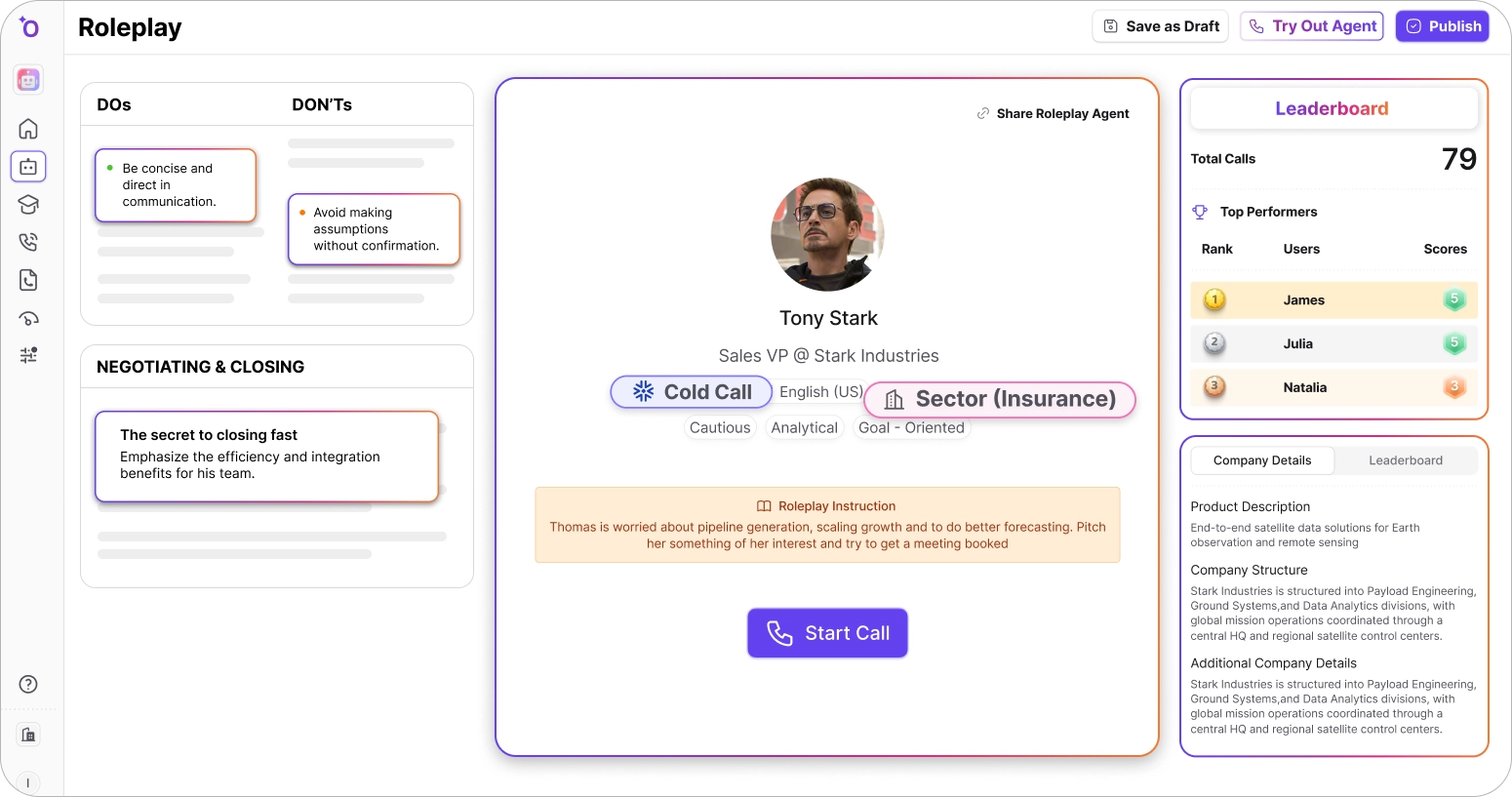
1. One practice and coaching layer, not another silo
Outdoo AI consolidates roleplay, scoring, and live-call coaching into a single line rather than three overlapping tools. Reps practice in chat, voice, and video against buyers built from your real calls, scored on ascorecard aligned to SPIN, BANT, MEDDIC, MEDDPICC, or Challenger, which keeps the stack tight and the budget defensible.
2. It extends the LMS you already fund
Outdoo AI packages practice into courses with certifications andCall Blitz drills, then exports completion to your learning system through SCORM and xAPI, with native integrations for Docebo, Cornerstone, and TalentLMS. The budget adds a practice and measurement layer on top of what you own rather than funding a rip and replace.
3. It proves its own line in the budget
Outdoo AI coaching scores real customer calls on the same rubric used in practice through Gong, Clari, and native conversation intelligence, then ties results to CRM and pipeline data. Across the 15,000+ simulated conversations and 40 organizations in Outdoo AI's Readiness Report, reps who practiced more ramped faster and held more margin, which is the cohort evidence a budget owner needs to keep the line funded.
Start by moving workshop budget into practice
The teams that win in 2026 will not be the ones with the biggest training budget, they will be the ones who spent it on behavior change instead of attendance. Move the budget for one annual workshop into continuous AI-powered practice, fund the reinforcement and adoption around it, and report the cohort numbers to leadership.
That single reallocation is how a sales training budget starts producing results in the field rather than green dashboards.Schedule a demo to see how Outdoo AI earns the top line of your 2026 AI training budget.
Frequently Asked Questions
.svg)
A 2026 AI training budget should prioritize AI-powered practice and coaching, reinforcement, and measurement over one-time workshops and static content. Those lines drive behavior change and tie to revenue, while one-off events mostly buy completion that reps forget within days.
Weight the larger share of your AI investment toward people and process, meaning adoption, enablement time, and change management, and the smaller share toward the license. Tech-first budgets underperform people-first ones, because a tool nobody adopts returns nothing.
Compare ramp time, win rate, discount rate, and quota attainment for reps who practiced against those who did not. Companies that applied AI to sales coaching achieved 3.3x higher quota-attainment growth, which is the kind of outcome a CFO will fund.
The two biggest mistakes are tool sprawl and funding tools reps never adopt. Stacking overlapping tools gets budgets cut, and a platform that sits unused proves nothing, so consolidate around one practice layer and fund the rollout that drives adoption.
AI training does not replace them. AI-powered practice handles unlimited repetition and consistent scoring, while live cohorts and managers add strategy, peer comparison, and judgment. The strongest 2026 budgets pair AI practice with human coaching rather than choosing one over the other.
Table of Contents
Talk to Sales
Have questions about training and enablement for your sales, CS, support, or leadership team? Let's talk.
Talk to Sales