
- A prospecting platform, not a coaching tool: Apollo is a prospecting and outbound platform, not a roleplay or coaching tool, and it doesn't try to be.
- Built for finding and reaching prospects at scale: it's best for sales and marketing teams that need to find verified contacts, run multichannel sequences, and manage pipeline from one place, at a scale few point tools can match.
- No pre-call practice environment: its conversation intelligence layer scores real calls after they happen, which is genuinely useful, but there is no simulated buyer, no pre-call rehearsal, and no practice environment anywhere in the product.
- Honest verdict: if your gap is "reps don't perform well once they're in the room," Apollo doesn't touch that problem; if your gap is "reps can't find the room," it's one of the strongest options on the market.
Who Is Apollo.io Best For?
- Apollo.io: Best for sales and marketing teams that need verified contacts, multichannel sequences, and pipeline in one place. It is built on a database of 240 million-plus contacts.
- Outdoo AI: Best for teams whose gap is rep performance once they are in the conversation. One scorecard grades roleplay practice and live calls.
- Apollo.io plus Outdoo AI: Best for go-to-market teams that need both. Apollo.io for pipeline generation, Outdoo AI for making sure reps are good on the call.
What Is Apollo (Apollo.io)?
Apollo.io is an all-in-one go-to-market platform built on top of a database of 240 million-plus contacts and 30 million-plus companies, self-reported at 98% email accuracy. The company calls itself "the AI sales platform for smarter, faster revenue growth."
From that database, Apollo lets teams find prospects, enrich and verify contact records, run multichannel outbound sequences, catch and route inbound leads, and work deals through a built-in dialer, meeting scheduler, and pipeline board.
It has grown fast: roughly 5 million users, 100,000-plus paying customers, and around $200 million in ARR, according to the company's most recent public figures.
In February 2026 the company installed a new CEO (Matt Curl, with founder Tim Zheng moving to chairman), and it acquired revenue-intelligence startup Pocus in March, citing 400% enterprise-account growth over the prior year.
The 2026 roadmap leans hard into agentic AI: an AI Assistant that executes workflows instead of just suggesting them, native apps inside ChatGPT and Perplexity Computer, and an Apollo MCP connector for plugging the platform into other AI tools.
All of that is aimed at prospecting and outbound execution. None of it moves toward training or coaching.
If anything, the gap between what Apollo does and what a roleplay platform does is getting wider, not narrower.
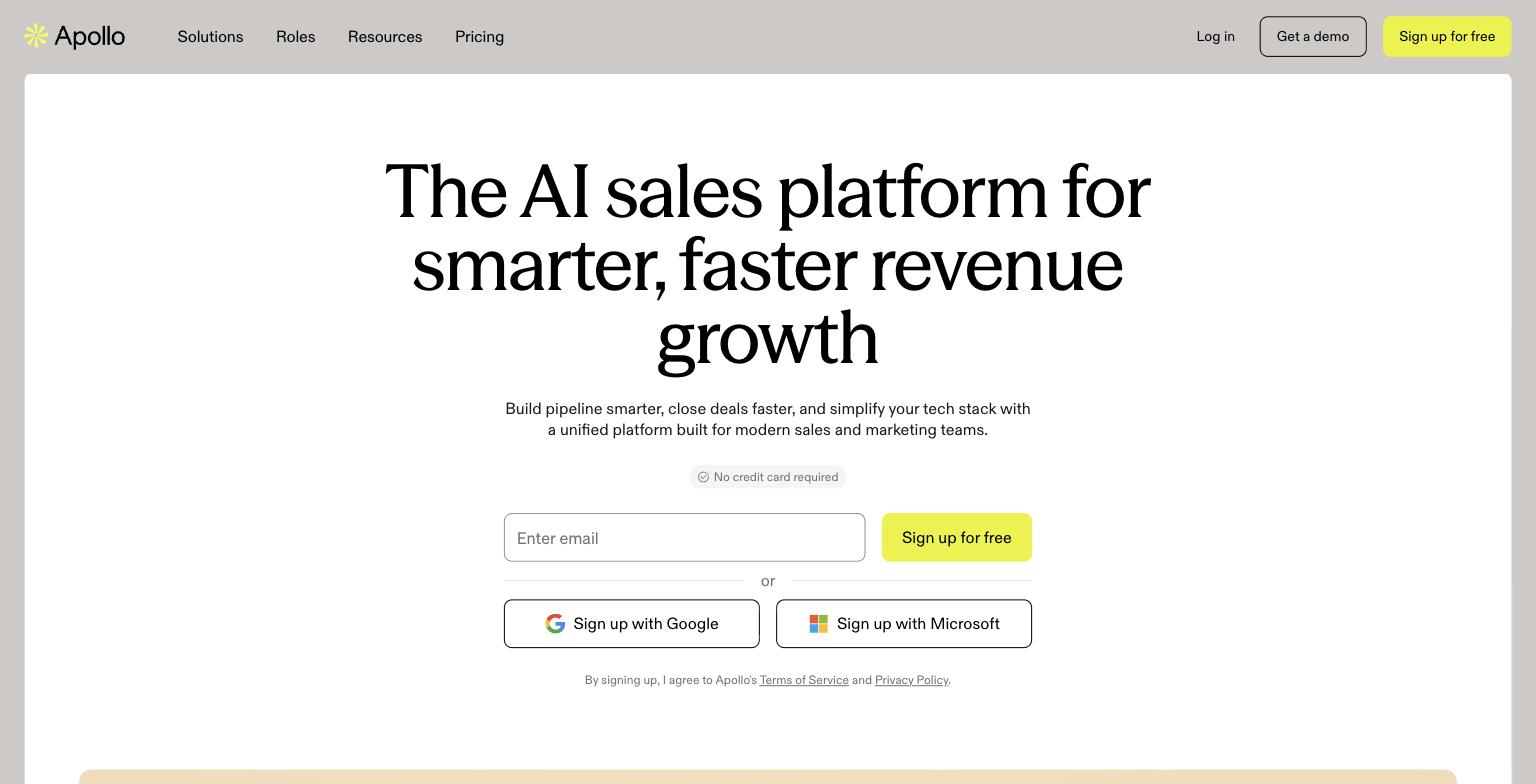
Screenshot: Apollo.io homepage, captured August 2026. Source.
Apollo (Apollo.io) Pricing
Apollo publishes pricing, which already puts it ahead of most vendors in this space on transparency. The catch is that Apollo's own site shows two different sets of numbers depending on billing cycle and how the page renders, so treat the exact current figures as directional until you check the live page yourself.
| Plan | Monthly billing (JSON-LD, Aug 2026) | Annual billing (comparison table) | Notes |
|---|---|---|---|
| Free | $0 | $0 (900 credits/yr) | Entry tier, credit-limited |
| Basic | $49/user/mo | $49/seat/mo (30,000 credits/yr) | Consistent across both fetches |
| Professional | $99/user/mo | $79/seat/mo (48,000 credits/yr, "most popular") | Discrepancy likely reflects monthly vs. annual rate |
| Organization/Enterprise | Contact for pricing | $119/seat/mo, 3-seat minimum (72,000 credits/yr, adds SSO + bring-your-own-LLM-key) | Named differently between fetches |
The mechanics matter more than the exact digits. Apollo runs a credit system layered on top of per-seat pricing: credits gate emails, phone numbers, enrichment, AI research, and dialer minutes, so your actual cost depends on usage volume, not just headcount.
The free trial gives 50 credits plus 5 mobile credits. Unlimited plans carry a fair-use cap of 10,000 credits/month for non-paying use, or the lesser of your paid amount divided by $0.025 or 1 million credits/year for paying customers.
Add-ons like Website Visitor ID, Domain Tracking, Form Enrichment, and dialer variants are priced separately and flagged on Apollo's own pricing page as "introductory, subject to change."
Reviewers confirm the credit model is where the friction shows up. One Capterra reviewer put it bluntly: "Without AI chat, optimizing or enriching works of credits after your credits are gone is brick tool" (Capterra). Budget for credits, not just seats, before you commit.
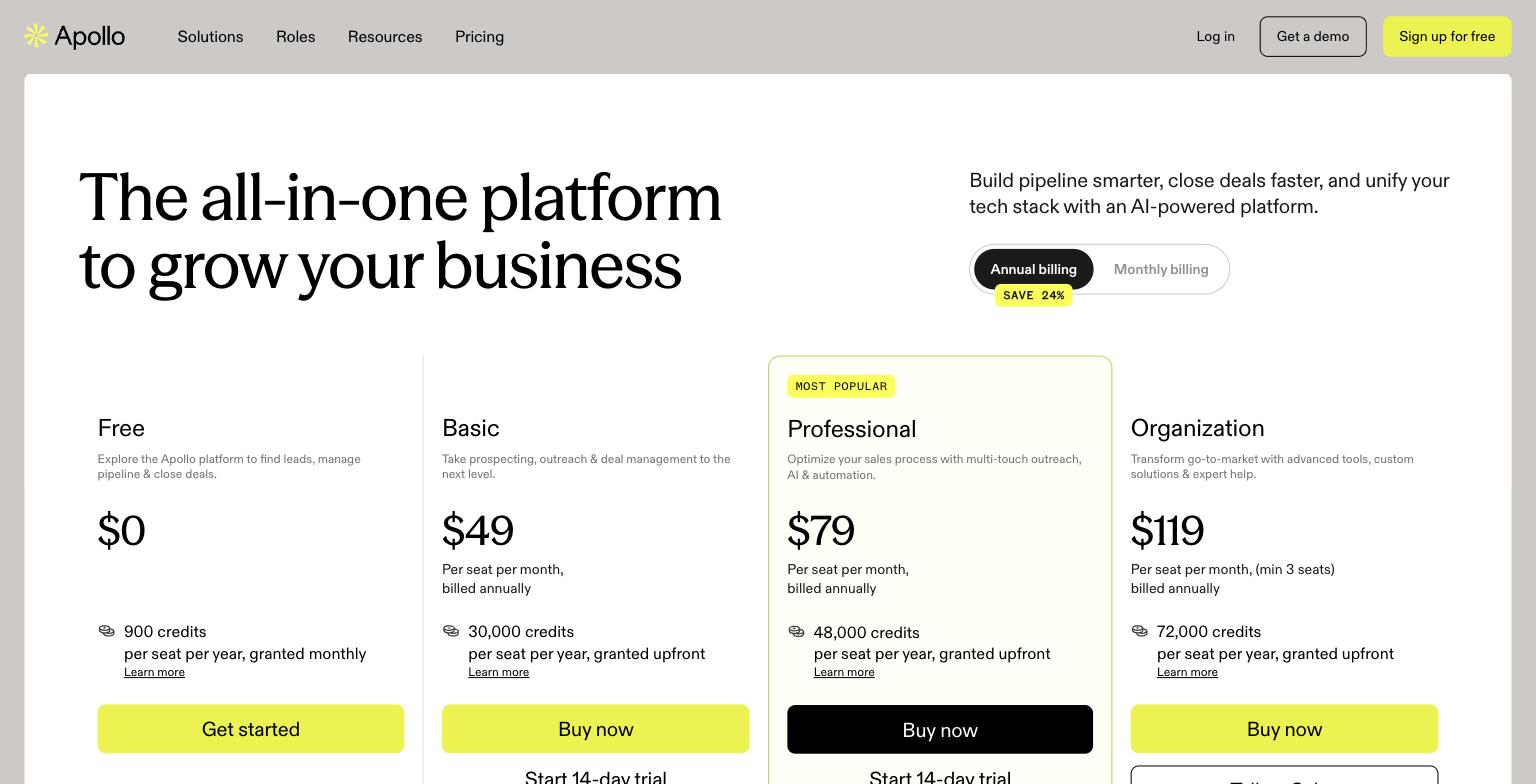
Screenshot: Apollo.io's published pricing page (Free/Basic/Professional/Organization), captured August 2026. Source.
Apollo (Apollo.io) Features
The core of the product is a searchable database of contacts and companies with verification and enrichment built in, and that's what most Apollo customers are actually buying.
Around that database, Apollo runs multichannel outbound sequences across email and other channels, plus deliverability and warmup tooling to keep sending domains out of spam folders.
On the inbound side, it identifies anonymous website visitors, enriches form submissions, and routes leads to the right rep without manual triage.
For calling and meetings there's a built-in dialer with parallel, power, international, and local-presence modes, along with a meeting scheduler. Pipeline boards and deal-risk alerts handle the rest, tracking opportunities once they're already in motion.
Conversation intelligence is the piece worth slowing down on, since it's the closest thing Apollo has to "coaching." Apollo records, transcribes, and summarizes real sales calls, then applies scorecards and keyword tracking to the transcripts.
That's a solid feature in its own right, and it puts Apollo in the same category as Gong or Chorus. But it's retrospective: analysis of calls that already happened.
There's no simulated buyer, no practice scenario, and no scoring applied before a call takes place.
Apollo's 2026 roadmap pushes hard into agentic AI. An AI Assistant launched in March 2026 executes multi-step workflows instead of just recommending them, with a claimed 36% higher meeting-booking rate in beta.
Apollo MCP connects the platform into Claude, ChatGPT, and Perplexity, so prospecting and CRM actions can happen directly from those interfaces.
We checked Apollo's full 430-URL sitemap, its homepage, and every product page tied to coaching or conversation intelligence. There's no `/roleplay`, `/simulation`, `/training`, or `/practice` URL anywhere on the site.
That's not an oversight. Apollo isn't built around rehearsal.
What Users Say
Apollo's data quality draws consistent praise. A TrustRadius reviewer, a C-level sales executive, wrote: "Over the years I have used many and none have I found as accurate as Apollo.io. I get correct cell phone numbers, correct email direct dials and much much more" (TrustRadius).
A Capterra reviewer summed up the general appeal: "A great all-in-one tool for sales prospecting" (Capterra).
But the complaints are just as pointed. Another TrustRadius user, from a 1,001 to 5,000-employee company, flagged scale problems: "Apollo.io's sync to Salesforce is incredibly finnicky and created a large number of duplicates... one that you are likely to outgrow once you have a fair amount of data on your ideal customer profile and need higher quality pipeline data" (TrustRadius).
And on Product Hunt, a user called out support directly: "They have horrifying customer support. Locks you out every 15 minutes if working remotely" (Product Hunt).
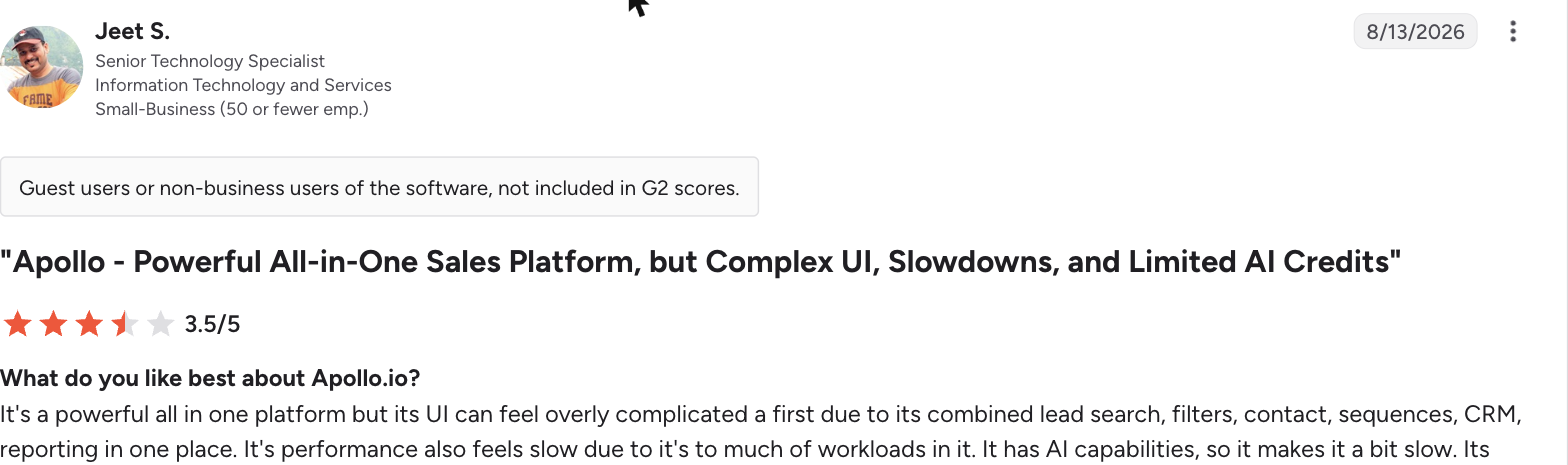
Screenshot: 3.5/5 G2 review, "Apollo - Powerful All-in-One Sales Platform, but Complex UI, Slowdowns, and Limited AI Credits," Aug 13, 2026. Source.
Where Apollo Falls Short
Apollo's own reviewers give a fairly consistent list of complaints. CRM sync creates duplicate records at scale, which is a real problem for larger teams relying on Salesforce as the system of record.
The credit-based pricing model, on top of per-seat cost, means your bill can move independently of headcount, and multiple reviewers describe running out of credits and losing functionality mid-cycle.
Customer support gets mixed reviews at best, with at least one user describing repeated remote-login lockouts.
And as teams scale up their data needs, the feeling of "outgrowing" the platform's pipeline-data quality shows up in reviewer feedback too.
None of that is a coaching or training complaint, because Apollo isn't a coaching or training tool. That's the more fundamental limit.
There is no roleplay, no simulated buyer persona, no pre-call rehearsal, and no scorecard applied to anything other than a call that has already happened.
If your problem is rep performance in live conversations, meaning how they handle objections, navigate a multi-stakeholder deal, or run discovery, Apollo has nothing built for that. Its "coaching" is analysis after the fact, not practice before the fact.
Where Apollo Genuinely Wins
Give credit where it's due. Apollo is a mature, fast-growing leader in prospecting and outbound execution, with real scale (240 million-plus contacts) and real momentum ($200 million ARR, 400% enterprise-account growth, a live 2026 acquisition in Pocus).
If a team's actual problem is finding and reaching the right prospects, Apollo is a strong, credible answer, and Outdoo AI has no equivalent for that job because it isn't trying to solve it.
The conversation intelligence layer is also real, not vaporware. Scorecards and keyword tracking applied to actual recorded calls is a genuinely useful analytics feature, and Apollo ships it well. It just isn't a training product, and it isn't connected to any pre-call practice data, because there isn't any.
Apollo's pricing page is also more transparent than most vendors in the roleplay and coaching category, ourselves included in some tiers. Being able to see real per-seat numbers, even with the credit-system complexity layered on, is worth acknowledging honestly.
How Outdoo AI Compares
Outdoo AI and Apollo aren't really competing for the same budget line, and pretending otherwise would be dishonest. Apollo helps a team find and reach prospects. Outdoo AI trains reps to perform once they're in the conversation, through AI roleplay built from a team's own calls, transcripts, and playbooks, not generic scripts.
The clearest structural difference: Apollo's conversation intelligence scores calls that already happened.
Outdoo AI's unified scoring applies one scorecard across both roleplay practice and live calls, so a leader can see whether coaching moves actually change real call outcomes, not just whether reps completed a training module.
Apollo has no equivalent to that link, because it has no practice side to link.
That gap shows up in Apollo's own reviews, too. Across every G2, Capterra, TrustRadius, and Product Hunt review we checked, not one mentions roleplay, rehearsal, or a simulated buyer, only scoring applied to calls that already happened.
Outdoo AI also scores the work that happens after the call, like CRM logging and process steps, inside the same workflow training session, a category Apollo doesn't touch at all.
And Outdoo AI's pricing is usage-based rather than seat-plus-credits, a meaningfully different model for teams that want to pay for training impact rather than licensing headcount.
For most serious go-to-market teams, the realistic answer is both, not one instead of the other. Apollo for pipeline generation and outbound execution, and Outdoo AI for making sure the reps working that pipeline are actually good on the call.
Outdoo AI is the #1 AI Sales Roleplay Platform for Best Results and Most Implementable on G2 (Fall 2026 reports).
Outdoo builds AI Roleplays from your own calls and scores practice and real calls with one scorecard. Rated #1 for Best Results on G2.
Frequently Asked Questions
Does Apollo have an AI roleplay feature?
No. Apollo has no simulated buyer personas, no pre-call rehearsal, and no practice scoring anywhere in the product. Its closest feature, conversation intelligence, analyzes real calls after they happen.
What does Apollo cost?
Apollo publishes pricing, though the exact figures vary between the site's monthly and annual views: Basic runs around $49 per user per month, with higher tiers around $79 to $99 depending on billing cycle, plus a credit system that gates emails, enrichment, and dialer usage on top of the seat price. Check Apollo's live pricing page before budgeting, since the numbers shift by cycle. Outdoo AI starts free with 60 minutes of roleplay credits and unlimited team members, no credit card and no sales call, then scales on usage-based Flex pricing with a custom enterprise plan for larger deployments.
Is Apollo a good ZoomInfo alternative?
Reviewers frequently compare it in that category, and its data accuracy draws strong praise on TrustRadius. That's a data and prospecting question, separate from anything related to coaching or roleplay.
Can Apollo replace a sales coaching platform?
No. It has no roleplay, no rehearsal environment, and no way to practice a conversation before having it. Its coaching-adjacent feature only scores calls retroactively.
Did Apollo make any leadership or acquisition changes in 2026?
Yes. In February 2026 Apollo installed a new CEO, Matt Curl, with founder Tim Zheng moving to chairman, and in March it acquired revenue-intelligence startup Pocus, citing 400% enterprise-account growth over the prior year.