



Searching for Zenarate alternatives in 2026 usually comes down to evaluating the AI roleplay and coaching layer specifically, not the entire contact center platform. Zenarate is purpose-built for structured simulation training in contact centers across banking, insurance, healthcare, and telecommunications.
Teams typically look elsewhere when one of six limits becomes a problem: content maintenance overhead at scale, simulations that feel linear for tenured agents, narrow fit beyond contact center motion into sales and customer success, AI recognition issues in unscripted conversations, KPI dashboards aligned to contact center metrics rather than methodology adherence or deal progression, and post-Bright merger uncertainty around live call analysis scope.
This comparison focuses on AI roleplay and coaching alternatives that work across customer-facing teams (sales, contact center, customer success, and customer support) rather than full contact center platform replacements like NICE CXone, Genesys, or Talkdesk.
The seven strongest Zenarate alternatives in 2026 for AI roleplay and coaching are Outdoo AI, Mindtickle, Second Nature, Bigtincan, Hyperbound, Quantified, and Allego.
Each closes a different limitation: Outdoo AI for enterprise roleplay and coaching across customer-facing teams, Mindtickle for consolidated enablement, Second Nature for pre-built scenario libraries, Bigtincan for video-based practice with structured certifications, Hyperbound for outbound and SDR motion with real call scoring, Quantified for regulated industry certification, and Allego for revenue enablement with content management depth.
The comparison below is grounded in G2 reviews, vendor documentation, and third-party procurement data sourced through May 2026.
What Is Zenarate?
Zenarate is an AI simulation training platform built for contact centers, where agents practice customer conversations alongside the software and screen steps that go with them. It is used mostly in banking, insurance, healthcare and telecommunications.
Best Zenarate alternatives in 2026 at a glance
| # | Tool | Best for | Free tier? | Starting price | One-line key advantage |
|---|---|---|---|---|---|
| 1 | Outdoo AI | Enterprise roleplay and coaching across sales, contact center, CS | Yes (60 credits) | Free | Multi-persona roleplay, live call scoring, and workflow simulation in one platform |
| 2 | Mindtickle | Consolidating training, content, coaching, and readiness | No | ~$47K-$82K/year | Comprehensive enablement suite with Call AI for live call scoring |
| 3 | Second Nature | Pre-built scenario libraries and certification programs | No | $30-$40/user/month | Deepest scenario library, avatar-led coaching with Jenny |
| 4 | Bigtincan | Video-based practice with structured certifications | No | Custom | RolePlayAI sales simulator plus content creation and coaching scorecards |
| 5 | Hyperbound | Outbound and SDR motion with real call scoring | Yes | Custom | Best-in-class voice realism, real call scoring through dialer integration |
| 6 | Quantified | Regulated industry certification with audit trails | No | Custom | ComplianceGuard AI with automated pass/fail and audit-ready compliance |
| 7 | Allego | Revenue enablement with content management depth | No | Custom | Gartner Magic Quadrant Leader, 673 G2 reviews, content plus roleplay |
Where Zenarate falls short for customer-facing teams
Zenarate is built for contact center simulation, and the platform executes that scope well. The friction shows up when teams extend their use case beyond contact center motion into sales, customer success, or coaching that needs to connect practice to live customer conversations. Across G2 reviews and independent platform analysis, six recurring patterns drive teams to evaluate alternatives.
1. Content maintenance is the biggest operational tax
Zenarate's strength is unlimited customization across simulation flows. The flip side is unlimited maintenance. As products, scripts, and compliance requirements change, every simulation that references that content needs updating. Reviewers consistently flag this as the platform's biggest ongoing cost, especially in fast-changing financial services and healthcare environments where compliance scripts update frequently. Teams running Zenarate at scale typically need a dedicated content owner.
2. Simulations feel linear for tenured agents
Zenarate's structured simulation flows work well for new hire onboarding where scripted progression matters. The same structure becomes a limitation for tenured agents who need open-ended practice across unpredictable conversation paths. Reviewers note that simulation flows can feel rigid when conversations move beyond the expected branches, which limits long-term coaching value for experienced reps.
3. Sales motion fit is narrow beyond contact center
Zenarate is purpose-built for high-volume customer service simulation. The platform does not natively support the multi-stakeholder, methodology-driven conversation patterns that B2B sales motion requires (MEDDIC, SPIN, BANT, MEDDPICC, Challenger). Teams evaluating Zenarate for AE discovery, demo, or negotiation practice typically find that the contact center design center does not transfer cleanly into sales conversation coaching.
4. AI recognition issues in unscripted conversations
Zenarate's voice and conversation simulation works well when agent responses follow predicted patterns. Reviewers report recognition issues when agents say things the simulation engine did not anticipate, which produces feedback accuracy problems. For tenured agents whose responses naturally diverge from scripted patterns, this surfaces as a recurring friction.
5. KPI dashboards aligned to contact center metrics only
Zenarate's reporting layer is built around first-call resolution, average handle time, CSAT, and compliance pass rates. These are the right metrics for contact center motion. For sales teams that need methodology adherence scoring, deal progression metrics, or pipeline correlation, Zenarate's dashboards do not provide the lens enablement leaders need.
6. Post-Bright merger uncertainty around live call analysis
The 2025 Bright merger added live call analysis to Zenarate, closing the practice-to-live loop within contact center motion. Buyers evaluating Zenarate now need to confirm specifically whether live call analysis is included in their contract scope, since the capability sits across the merged product lines. Reviewers flag this as a contract-level diligence item that did not exist before the merger.
1. Outdoo AI: Best for enterprise roleplay and coaching across customer-facing teams
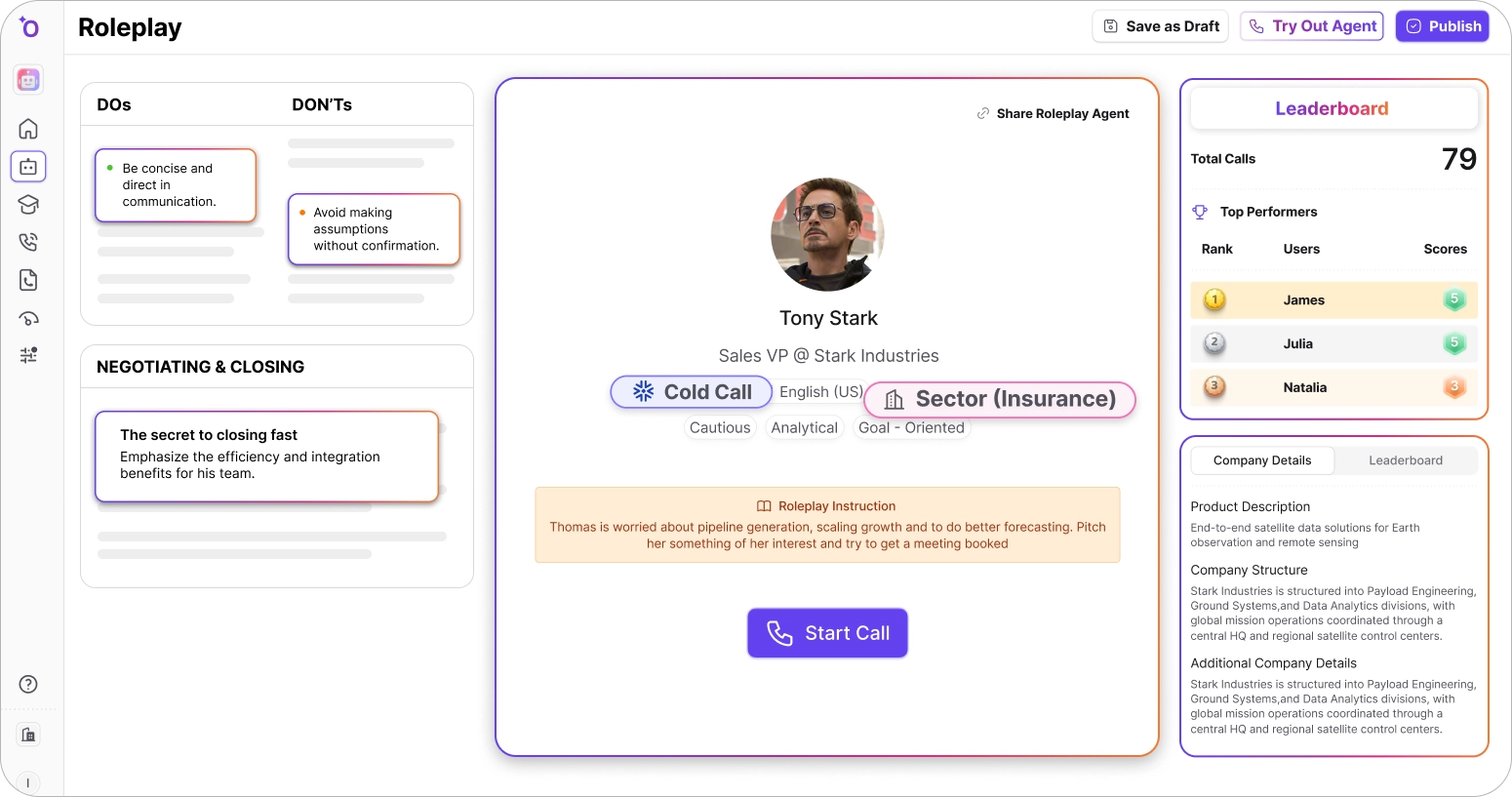
Outdoo AI brings enterprise AI roleplay and coaching to contact center, customer success, and sales teams
Three things are true about Outdoo AI that matter for Zenarate evaluators. First, voice-first AI roleplay handles the same phone-driven contact center motion Zenarate is built around, with practice scenarios spanning escalations, retention conversations, billing disputes, compliance disclosure, and the high-emotion interactions that drive CSAT.
Second, the same platform also trains sales reps on discovery and demo motion and customer success teams on renewal conversations, which removes the need to deploy separate coaching tools across customer-facing functions. Third, AI scoring runs across roleplay practice and real customer calls on the same rubric, with Gong, Clari, and native conversation intelligence ingestion turning live calls into the validation layer that practice-only platforms cannot offer.
Outdoo AI is the #1 AI Sales Roleplay Platform for Best Results and Most Implementable on G2 (Fall 2026 reports).
What this looks like in deployment depends on the team. Contact center operators run agent ramp programs, FCR improvement initiatives, and compliance training through Outdoo AI. Sales orgs run methodology-aligned coaching across SPIN, BANT, MEDDIC, MEDDPICC, and Challenger.
Customer success teams run expansion conversation practice and churn-risk handling drills. The architecture stays the same across all three: practice generates a score, the same score evaluates real calls, gaps trigger targeted micro-roleplays automatically, and managers see whether training actually changes behavior on customer-facing conversations.
What Outdoo AI actually does
- Voice-first roleplay with chat and video options: AI conversation practice optimized for phone-based contact center motion, with chat for quick objection drills and video with screen sharing for sales demos when needed
- Multi-persona simulations for complex customer interactions: practice against up to three AI stakeholders in a single resumable scenario, such as an irate customer plus an escalation supervisor, a billing dispute plus a compliance officer, or a buying committee for sales motion
- Conversation skill scoring beyond contact center metrics: evaluation on empathy, de-escalation, active listening, tone control, compliance adherence, methodology alignment (SPIN, BANT, MEDDIC, MEDDPICC, Challenger), and custom rubrics built from your governance documents
- Live call scoring on the same scorecard as practice: ingest from Gong, Clari, or native conversation intelligence to score real customer calls against the same rubric used in roleplay practice
- Post-call workflow simulation: agents and reps practice CRM logging, disposition selection, ticketing, refund processing, and process navigation in environments that mirror actual Salesforce, HubSpot, Pipedrive, or ticketing system instances
- Multi-lingual roleplays in 120+ languages: support for global contact center deployments across U.S., Canada, Mexico, Philippines, India, Europe, and beyond
- Dynamic micro-roleplays: when scoring identifies a coaching opportunity, Outdoo AI automatically generates a targeted reinforcement roleplay and surfaces relevant battle cards or scripts
- Customer outcome correlation: Outdoo AI connects roleplay scores, live call scores, CSAT, and pipeline data to surface which specific conversation behaviors correlate with first-call resolution, retention, and revenue outcomes
- 120+ enterprise integrations: Salesforce, HubSpot, Pipedrive, Gong, Clari, Docebo, TalentLMS, Cornerstone, SCORM, xAPI, SSO
- Enterprise compliance: SOC 2 Type 2, GDPR, HIPAA, CCPA, PII scrubbing, private cloud deployment suited for banking, insurance, healthcare, and other regulated contact center environments
Where Outdoo AI delivers the most value
Outdoo AI is built for teams that want practice to translate into measurable performance on the metrics that actually matter: first-call resolution, CSAT, retention, compliance pass rates, and pipeline outcomes. The platform combines AI roleplays, real-call analysis, structured scoring, and manager visibility so contact center, customer success, and sales teams can coach consistently across distributed teams:
- Faster agent ramp time across contact center, CS, and sales: new hires practice realistic customer scenarios before live calls, reducing time-to-proficiency and the risk of poor early customer interactions
- CSAT and FCR-impacting conversation skill development: Outdoo AI scores empathy, active listening, de-escalation, tone control, and resolution clarity, the behaviors that drive customer satisfaction outcomes
- Compliance training paired with conversation practice: agents practice compliance-sensitive conversations (PII handling, disclosure language, prohibited terms) inside realistic customer interactions rather than separate compliance modules
- Escalation handling and de-escalation training at scale: practice irate customer scenarios, multi-stakeholder escalations, and high-stakes retention conversations without the operational risk of live call training
- Coaching at scale across distributed teams: managers across regions get a consistent view of agent skill development, with scoring patterns and coaching insights that standardize what good looks like
- Manager visibility without manually reviewing every call: AI scoring covers practice and live calls automatically, letting managers spend their time on coaching conversations rather than call review
- Cross-functional coaching for organizations with multiple customer-facing teams: the same platform serves contact center, customer success, and sales teams, with role-specific scenarios and scorecards that fit each motion
- Real-call performance validation: Outdoo AI connects practice performance with real-call execution, surfacing whether the empathy, methodology, or compliance behaviors rehearsed in roleplay actually carry into live customer conversations
There was one roleplay agent that I put together named Chester. I made him be a little off kilter, talking about metaphors, be very artsy, talk about jazz a lot. That is something we want to see within the senior population. They like to talk. Sometimes they are not super clear. That has been really good for our agents to experience before experiencing it in the wild.
Jacob Irby, Assistant Director of Human Development, ProvideSure
What to know before signing with Outdoo AI
The main thing to evaluate before committing is whether your team is ready for a team-based rollout. Outdoo AI is designed for sales teams, contact center teams, customer success teams, enablement teams, and managers who want consistent coaching across multiple reps. Production deployments typically start at 5+ users, so it is a better fit when there are enough reps to compare patterns, track improvement, and make coaching repeatable.
Individual reps can start on the Free plan for a quick feel of how AI roleplay works, with 60 minutes of usage credits to explore core roleplay and coaching, though this represents a fraction of what the full platform delivers at team scale. Enterprise evaluations typically include a scoped sandbox deployment configured to your team scenarios, methodology, and integrations.
Outdoo AI tiered enterprise pricing scoped to deployment
Outdoo AI uses a tiered pricing model designed for enterprise-scale deployments. Pricing scales with usage, integration depth, and compliance requirements rather than simple per-seat licensing.
- Free plan includes usage credits (60 minutes / 60 credits) with unlimited team members for an org, for a quick feel of core roleplay and coaching
- Enterprise sandbox scoped to your team scenarios, methodology, and integrations during evaluation
- Flex tier (usage-based) includes multi-persona roleplays, certifications, workflow simulation, and methodology-aligned scoring
- Enterprise tier (custom quote) adds full integration scope (CRM, CI, LMS, SCORM, xAPI), enterprise compliance (SOC 2 Type 2, GDPR, HIPAA, CCPA, private cloud), and custom deployment
Enterprise pricing is custom-scoped because deployment varies materially by team size, integration scope, methodology configuration, and compliance requirements.
Outdoo AI vs Zenarate: side-by-side comparison
| Capability | Outdoo AI | Zenarate |
|---|---|---|
| Primary category | Enterprise AI roleplay and coaching across customer-facing teams | Contact center simulation training |
| Customer-facing team coverage | Sales, contact center, customer success, customer support | Contact center, customer support (primary) |
| Roleplay modes | Chat, voice, video with screen sharing | Voice and conversation simulation with software simulation |
| Multi-persona simulations | Up to 3 AI stakeholders, resumable long sessions | Primarily single-agent customer interaction simulation |
| Scenario grounding | Real CRM data, call transcripts, LinkedIn profiles, playbooks | Custom-built simulation flows from uploaded content |
| Live call scoring | Same scorecard for practice and live calls via Gong, Clari, native CI | Live call analysis added post-Bright merger; scope varies by contract |
| Workflow simulation beyond conversation | CRM logging, dispositioning, process navigation | Software and screen simulation in parallel with conversation |
| Methodology alignment | SPIN, BANT, MEDDIC, MEDDPICC, Challenger + custom | Compliance-aligned process scoring; less emphasis on B2B sales methodologies |
| Reporting framework | Methodology adherence, deal progression, revenue correlation | Contact center metrics: FCR, AHT, CSAT, compliance pass rates |
| Content creation overhead | Scenario creation from CRM data and uploaded materials, AI-assisted | Custom simulation flow building; reviewers flag maintenance overhead |
| Compliance posture | SOC 2 Type 2, GDPR, HIPAA, CCPA, PII scrubbing, private cloud | Enterprise compliance suited for banking, insurance, healthcare |
| Customer profile | Globe Life, Allied Health, ProvideSure, RAIN Group, CMC, Qure.ai | 8 of top 10 U.S. financial institutions, 3 of top 5 BPOs |
| Pricing | Custom tiered (Free plan with usage credits, Flex usage-based, Enterprise custom quote)/td> | Custom enterprise; sales-led with no public tiers |
If your team's primary use case is high-volume contact center simulation with software and screen training in parallel, Zenarate is built directly for that. Outdoo AI is the more complete option for teams that need AI roleplay and coaching across multiple customer-facing motions (sales + contact center + customer success + support), methodology-aligned scoring connected to live call performance, multi-persona simulations for complex customer interactions, and workflow execution beyond conversation.
Want to see how Outdoo AI can help your team? Schedule a demo and talk to our experts.
2. Mindtickle: Best for consolidating training, content, coaching, and readiness
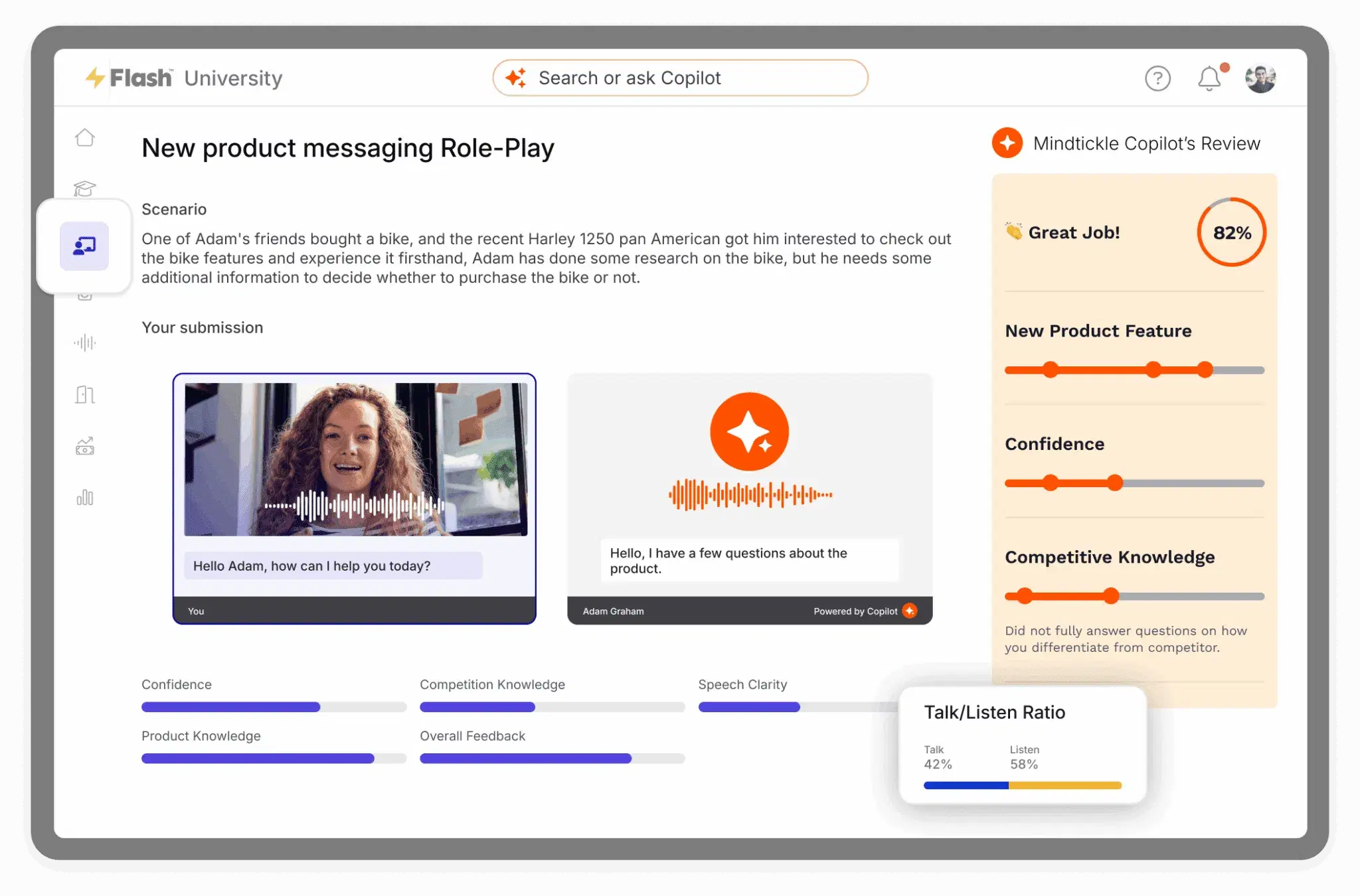
Mindtickle solves a broader scope than Zenarate covers
Where Zenarate specializes in contact center simulation depth, Mindtickle covers a broader enablement scope: structured learning paths, certifications, coaching, content management, conversation intelligence, digital sales rooms, and AI roleplay across the full customer-facing motion. Teams asking whether to add Zenarate for contact center practice sometimes realize the better question is whether to consolidate their entire enablement stack across sales, customer success, and support, in which case Mindtickle becomes the conversation.
Mindtickle also closes a structural limit Zenarate's pre-Bright-merger product did not address: the Call AI conversation intelligence module ingests live customer calls and scores them against the same rubrics used in practice. Post-merger Zenarate now supports live call analysis as well, but the scope varies by contract.
What Mindtickle actually does
- AI Role Play module: structured roleplay scenarios with AI buyer personas, scoring against methodology, integration into certification programs
- Mindtickle Copilot: AI assistant that auto-grades roleplay submissions on empathy, keyword usage, pacing, and methodology adherence
- Call AI conversation intelligence: ingests live customer calls and scores them, included in the Transform tier
- Readiness Index: single composite metric to track proficiency across certifications and skills
- Digital Sales Rooms: centralized buyer-facing rooms for deal follow-up
- Sales Content Management: centralized playbooks, battle cards, and approved messaging
- Structured learning paths: sequenced training modules with prerequisites and progression tracking
- 120+ integrations across CRM, LMS, conversation intelligence, and SSO
What Mindtickle users praise about platform consolidation
- All enablement workflows sit in one place. Training, coaching, certifications, content management, digital sales rooms, and conversation intelligence are managed inside one platform, reducing the need to stitch together multiple tools.
- Live call scoring connects practice to real customer conversations. The Call AI module evaluates real customer calls against the same rubrics used in practice.
- Strong enterprise customer base across industries. Used by enterprises across SaaS and regulated industries that need broader enablement than dedicated roleplay tools provide.
Where Mindtickle users hit friction with platform complexity
- Common tasks can take too many clicks. Reps and managers often spend extra time navigating across modules before completing simple actions.
- Setup requires meaningful upfront effort. Implementation typically takes 6-8 weeks plus $3K-$5K one-time implementation fees, reflecting the breadth of the suite being configured.
- AI Role Play depth trails dedicated tools. Mindtickle AI Role Play module is one feature among many rather than the core focus.
What to know before signing with Mindtickle
- Confirm what is actually included. Mindtickle bundles training, content, coaching, certifications, conversation intelligence, and roleplay. Verify whether AI Role Play, Call AI, Digital Sales Rooms, and content management are included or priced as add-ons.
- Watch the contract mechanics. Annual prepayment, 30-90 day renewal notice windows, and 3-7% annual price increases are common.
- Budget for total cost of ownership. Onboarding and implementation can add $10,000-$50,000+. Premium support and integrations cost extra.
Mindtickle bundled enterprise pricing requiring six-figure annual commitment
Mindtickle does not publish public pricing. BetterCloud estimates $47,000 to $82,000 per year based on aggregated data. Vendr shows a wider enterprise range: $50,000 to $150,000 annually for small deployments, $150,000 to $400,000 for mid-market, and $400,000 to $1M+ for enterprise rollouts.
Looking for a better-scoped alternative to Mindtickle? Read our complete guide to top Mindtickle alternatives.
3. Second Nature: Best for pre-built scenario libraries and certification programs
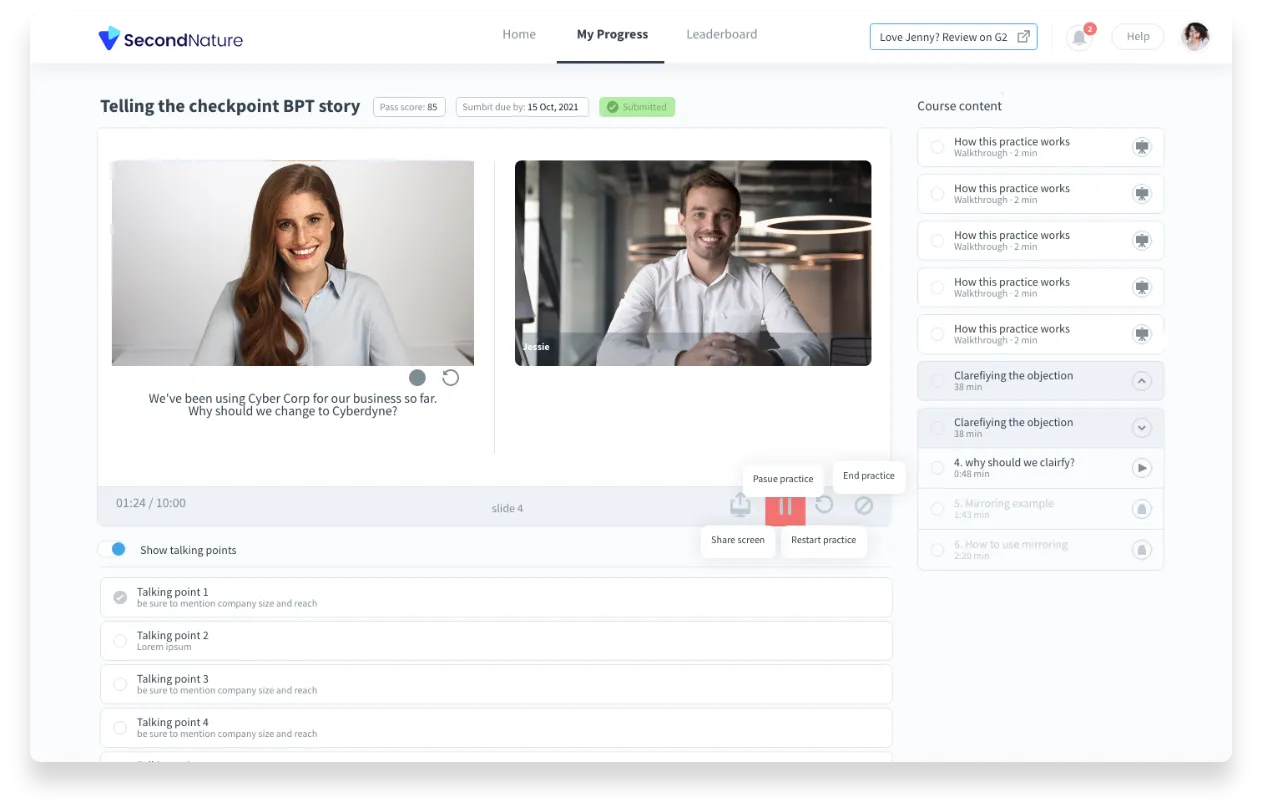
Second Nature ships the content Zenarate makes you build
The biggest operational difference between Second Nature and Zenarate sits in how scenarios get created. Zenarate is custom simulation flow building from your uploaded content, with reviewers flagging maintenance overhead as the platform's biggest ongoing tax. Second Nature ships a pre-built scenario library you can deploy with 50+ scenarios on day one, with particular depth in healthcare, finance, and insurance verticals.
For Zenarate evaluators specifically, this trade-off matters. Second Nature is the legacy player in AI sales roleplay, founded in 2018 and rebuilt on foundation models in 2023. Its main moat is the deepest pre-built scenario library in the category, often co-developed with enablement consultancies. For teams that explicitly do not want to author or maintain simulation content, Second Nature is often faster to value than Zenarate.
What Second Nature actually does
- Avatar-led virtual coaching with Jenny: the platform signature feature, simulating discovery, demos, and objection handling in a guided format
- Detailed soft-skill feedback: tone, pacing, clarity, filler words, and presentation style
- Structured certification workflows: fits into formal onboarding programs used by enterprise teams
- Predefined scenario libraries: scenarios curated by Second Nature with depth in healthcare, finance, and insurance verticals
- Integration with LMS and onboarding stacks: supports enterprise training program workflows
What Second Nature users praise about pre-built content depth
- Pre-built content library is the deepest in the space. For organizations that do not want to author or maintain scenarios, Second Nature ships ready content across industries, regions, and personas.
- Strong fit for certification programs. Purpose-built for pass/fail certification workflows for enterprise onboarding where readiness validation is required.
- Fastest time to value. Onboarding time for new customers is shortest of any tool tested by Knowlee April 2026 analysis, with 50+ ready scenarios available on day one.
Where Second Nature users hit friction with scenario flexibility
- Persona engine still feels less natural than newer tools. Despite the 2023 LLM rebuild, Second Nature avatars carry a slight scripted quality per Knowlee independent analysis.
- Authoring custom scenarios is template-bound. More constrained than newer tools like Hyperbound or Outdoo AI, which support free-form scenario creation.
- Pricing transparency is limited. Sales-led pricing with no public tiers can slow evaluation timelines.
What to know before signing with Second Nature
- Validate scenario flexibility for your motion. Certification-friendly scenarios are predefined by design. If your team needs scenarios that adapt to industry context, multi-stakeholder dynamics, or evolving messaging, validate that customization scope upfront.
- Budget for the enterprise minimum. Community data indicates minimum annual deals often start around $20K, with pricing scaling based on size and customization.
- Plan for 4-8 week implementation. Enterprise rollouts typically take this long to configure scenarios, certifications, and team structures.
Second Nature sales-led pricing in the $30 to $40 per user per month range
User-reported data places typical pricing at approximately $30 to $40 per user per month, with minimum annual deals around $20K. No public pricing on the website; teams must engage sales for accurate quotes.
Considering alternatives to Second Nature? Explore tools that offer better flexibility and pricing.
4. Bigtincan: Best for video-based practice with structured certifications

Bigtincan combines video-based practice with AI roleplay through a single platform
Bigtincan is the established enterprise readiness platform competing with Zenarate from the video-based practice angle. Following Bigtincan's acquisition of Brainshark, the platform now combines content creation, video-based coaching, structured certifications, and AI roleplay through RolePlayAI, the platform's AI sales simulator that lets reps practice real-time text and audio conversations against AI buyer personas.
For Zenarate evaluators specifically, Bigtincan represents a different design philosophy: video-based practice with manager scoring workflows, certification gates, and structured learning paths. Where Zenarate focuses on voice and process simulation in parallel for contact center motion, Bigtincan emphasizes video coaching, asynchronous review, and AI roleplay practice that scales without putting roleplay burden on busy sales managers. The platform serves IT, manufacturing, insurance, and banking sectors with significant enterprise traction.
What Bigtincan actually does
- RolePlayAI sales simulator: real-time text and audio conversations with AI buyer personas that never repeat the same response twice
- Video-based practice and coaching: reps record video submissions, managers and AI provide structured scoring and feedback
- Manager scorecards and coaching cards: structured rubrics for evaluating rep practice submissions
- Structured certifications: multi-stage certification flows with auditable proof of competency
- Content creation with AI assistance: voiceover generation, voice cloning, voiceover translation, AI text generation
- Learning paths and structured onboarding: sequenced training modules with prerequisites and progression tracking
- VoiceVibes conversational intelligence: advanced audio analytics for behavioral coaching
- CRM integrations: connect training activity to revenue outcomes
What Bigtincan users praise about video-based readiness
- RolePlayAI removes the manager bottleneck. Reviewers note the AI sales simulator lets reps practice as long as they want without taking manager time, which removes the largest bottleneck in traditional roleplay programs.
- Strong fit for structured certifications. The platform is purpose-built for auditable proof of competency, useful for regulated industries that need certification gates before customer-facing activity.
- Content creation depth is comprehensive. Voiceover generation, voice cloning, AI text generation, and translation capabilities reduce content production overhead compared to platforms that require manual content authoring.
Where Bigtincan users hit friction with platform breadth
- AI roleplay is one feature among many. RolePlayAI is part of a broader readiness platform rather than the core product focus, which means roleplay depth trails dedicated tools like Hyperbound, Outdoo AI, or Quantified.
- Setup requires meaningful upfront effort. The breadth of the platform (content, learning, coaching, certifications, AI roleplay) means implementation typically extends across multiple weeks.
- Pricing transparency is limited. Custom enterprise pricing with no public tiers; all engagement runs through Bigtincan sales team.
What to know before signing with Bigtincan
- Confirm whether you need the full readiness platform or just AI roleplay. Bigtincan value proposition is breadth across content, learning, coaching, certifications, and roleplay. Teams that need only AI roleplay will pay for capabilities they may not use.
- Validate RolePlayAI depth against dedicated tools. If conversational realism and methodology depth are your primary needs, dedicated platforms like Outdoo AI, Hyperbound, or Quantified may exceed RolePlayAI capabilities.
- Plan for the integration scope. The platform connects to CRM, LMS, and content repositories, which adds value but extends implementation timelines.
Bigtincan custom enterprise pricing with no public tiers
Bigtincan does not publish pricing on the website. Pricing is sales-led and customized based on team size, modules selected (content, learning, coaching, AI roleplay), integration scope, and implementation requirements. The platform is positioned for enterprise readiness programs rather than lightweight or standalone roleplay deployment.
5. Hyperbound: Best for outbound and SDR motion with real call scoring

Hyperbound addresses outbound motion Zenarate is not built for
Where Zenarate is purpose-built for inbound contact center motion, Hyperbound is the dedicated AI roleplay platform for outbound and SDR motion. The two platforms compete only at the edges, but for teams whose actual use case is outbound sales practice with real call scoring through dialer integration rather than inbound customer service simulation, Hyperbound is the right category.
Hyperbound also rates higher than most platforms on voice realism. Independent third-party analysis from Knowlee describes Hyperbound voice latency as under 400ms with personas that have distinct personalities and do not break character when reps lob unexpected questions. The platform connects to dialers and call recorders to score live customer calls against the same scorecard used in practice, closing the practice-to-live loop for outbound motion.
What Hyperbound actually does
- Real call scoring through dialer integration: connects to dialers and call recorders to score live customer calls
- AI buyer bots with persona configuration: first bot setup typically under 10 minutes, full module rollout in about two weeks
- Demo call type with screen sharing: supports the screen-sharing motion AEs run during product demos
- Multi-language coverage across 25+ languages: including Spanish, French, German, Mandarin, Japanese, Hindi, Hebrew
- Custom scorecards aligned to methodology: SPIN, BANT, MEDDIC, MEDDPICC, Challenger frameworks supported
- Free tier with limited bots: entry-point includes basic scorecards and transcription
What Hyperbound users praise about outbound-focused practice
- Voice realism is best-in-class for outbound bots. Knowlee rates Hyperbound persona realism as best-in-class as of April 2026.
- Bot setup is genuinely fast. First bot configuration takes under 10 minutes, compared to Zenarate longer enterprise deployment cycles.
- Real call scoring closes the practice-to-live loop for outbound. Hyperbound dialer integration scores live customer calls against the same scorecard used in practice.
Where Hyperbound users hit friction with broader coverage
- Contact center motion fit is limited. Hyperbound is built for outbound sales motion. Teams running inbound customer service or contact center simulation will find Zenarate or Outdoo AI a better fit.
- AE and enterprise coverage is still maturing. Hyperbound SDR focus is mature, but multi-stakeholder enterprise deal coverage is less developed than Outdoo AI or Mindtickle.
- Pricing is opaque. Mid-market deals observed at $80-$150 per rep per month, but no public tier structure beyond the free entry.
What to know before signing with Hyperbound
- Confirm outbound motion fit. Hyperbound is purpose-built for SDR and outbound practice. Contact center, customer success, and customer support teams should evaluate Outdoo AI, Zenarate, or Mindtickle instead.
- Validate AE coverage if you need beyond SDR. Teams expecting use across AE discovery, demo, negotiation, and enterprise motion should pilot with a representative use case first.
- Plan for the bot library buildout. Adoption depends on a meaningful library of persona-configured bots. Budget enablement time for the first 30-60 days.
Hyperbound free tier plus demo-gated custom enterprise pricing
- Free plan: limited roleplay bots, basic scorecards, transcription, coaching feedback
- Custom plan for teams: unlocks unlimited bots, custom scorecards, analytics, integrations, security configurations
- Demo-led access: most advanced capabilities require engaging sales through a demo
Looking beyond Hyperbound? See how leading platforms compare for AI sales roleplay in 2026.
6. Quantified: Best for regulated industry certification with audit trails
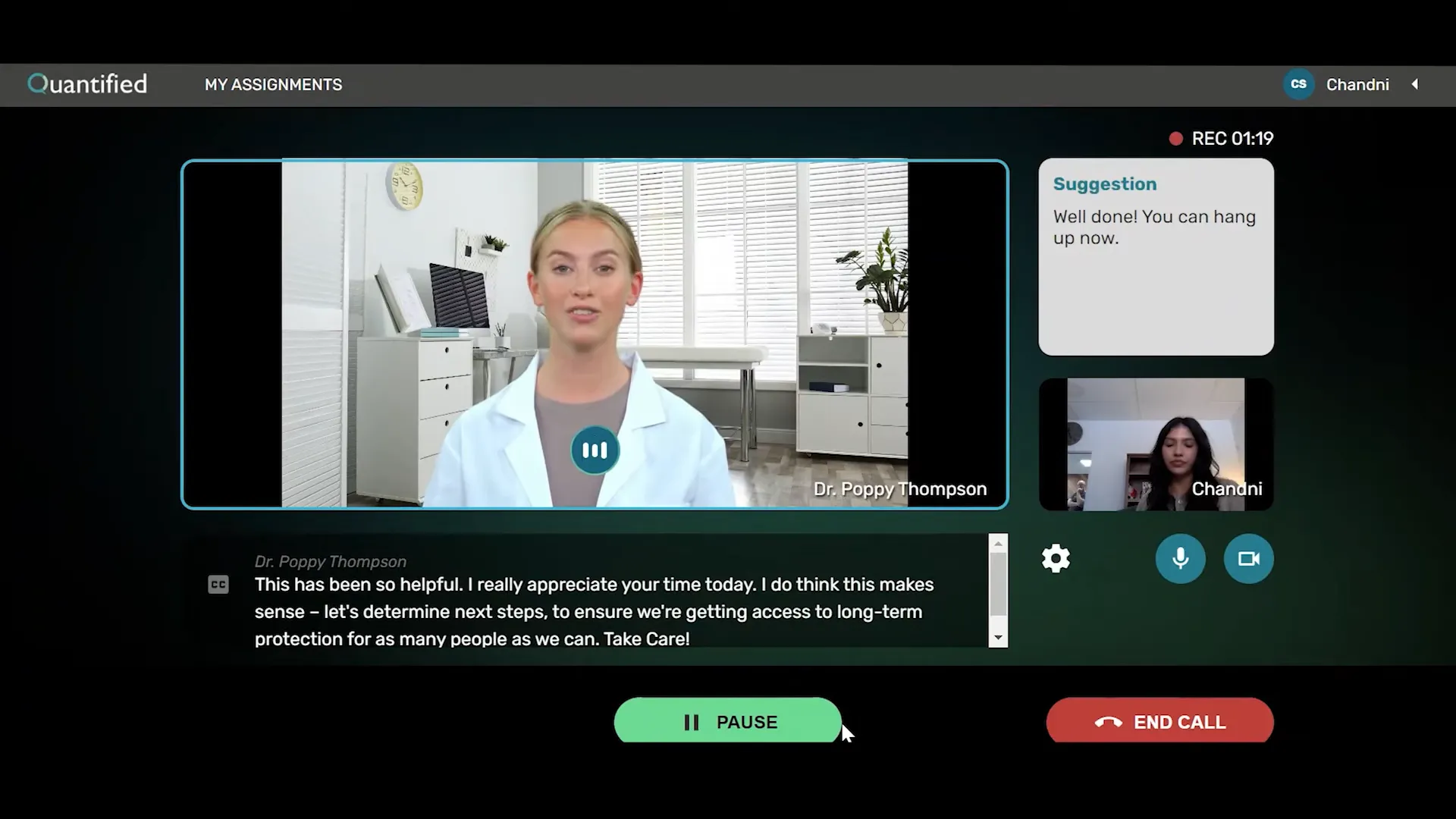
Quantified addresses Zenarate's regulated-industry buyers with deeper compliance enforcement
Both Zenarate and Quantified target regulated industries (banking, insurance, healthcare, pharma), but the two platforms approach compliance differently. Zenarate focuses on contact center process adherence with compliance scoring built into KPI dashboards. Quantified provides ComplianceGuard AI with automated pass/fail enforcement, audit-ready trails, and a published rubric tied to Sandler, MEDDPICC, Challenger, and GAP frameworks.
For Zenarate evaluators whose actual need is structured certification with audit trails for B2B sales motion rather than contact center process simulation, Quantified is the more direct fit. Customer logos include Novartis, Bayer, Sanofi, Astellas, Bausch + Lomb, iRhythm, and OpenLending, signaling enterprise traction across pharma, life sciences, and financial services.
What Quantified actually does
- Photorealistic avatar-based simulations: avatars approaching real video-call realism with visual aid support
- ComplianceGuard AI: automated compliance scoring with audit trails, required language enforcement, prohibited terms trigger instant fail
- Structured assessment frameworks: scoring against predefined readiness criteria for benchmarking and certification
- Industry-specific scenarios: templates designed for life sciences, pharma, financial services
- Private LLM infrastructure: data is not used to train public models; SOC 2 Type II certified
- Methodology rubrics: pre-built rubrics for Sandler, MEDDPICC, Challenger, GAP frameworks
- Enterprise integrations: SSO and LMS connectors typical of enterprise software
What Quantified users praise about regulated-industry certification
- Most rigorous competency model in the category. Published rubrics tied to specific methodologies make certification benchmarking defensible across cohorts and regions.
- ComplianceGuard AI removes manager compliance review. Automated pass/fail enforcement and audit-ready trails reduce manual compliance review workload.
- Strong enterprise customer base in regulated industries. Fortune 500 customers in pharma, life sciences, and finance choose Quantified specifically for formal assessment and compliance posture.
Where Quantified users hit friction with adaptability and pricing
- AI needs repeated exposure to feel natural. Simulations improve with more practice cycles, which increases the effort to make them effective across use cases.
- Conversational flexibility is limited. Simulations do not handle conversations that move in multiple directions as fluidly as more adaptive platforms.
- Pricing skews to enterprise teams of 25+ reps. Third-party data places Quantified pricing at $150-$250 per seat per month all-in, making it structurally inaccessible for smaller teams.
What to know before signing with Quantified
- Confirm regulated-industry fit matches your use case. Quantified is built for pharma, life sciences, and financial services compliance training. Sales teams outside regulated industries should validate the value relative to platforms designed for general sales motion.
- Budget for premium per-user pricing. Estimated pricing places Quantified at $150-$250 per seat per month all-in, materially higher than mid-market platforms.
- Plan for longer sales cycles. Deployments typically involve procurement, compliance, and L&D teams, with multi-stakeholder approval extending timelines.
Quantified enterprise pricing at $150 to $250 per seat per month estimated
Quantified does not publish pricing. Based on third-party procurement data, deals typically land in the $150-$250 per seat per month range when platform fees, custom scenarios, and integrations are included. Minimum economic team size is around 25 reps.
Evaluating alternatives to Quantified? Read our complete guide to top Quantified alternatives.
7. Allego: Best for revenue enablement with content management depth

Allego is the Gartner Magic Quadrant Leader competing with Zenarate from the revenue enablement angle
Allego is the most established enterprise platform competing with Zenarate from the revenue enablement direction, with 673 G2 reviews at 4.6/5 and recognition as a Leader in the Gartner Magic Quadrant for Revenue Enablement Platforms. Over 750,000 professionals use Allego daily across pharma, financial services, insurance, and other regulated industries that also evaluate Zenarate.
Where Zenarate is specialized for contact center simulation depth, Allego is a comprehensive revenue enablement platform that includes AI-driven roleplay as one capability alongside sales content management, digital sales rooms, conversation intelligence, and learning paths. For Zenarate evaluators whose underlying question is whether they need broader enablement scope rather than just AI roleplay, Allego is the direct alternative with comparable enterprise credibility.
What Allego actually does
- AI-driven roleplay and coaching: structured practice scenarios with AI personas and coaching feedback
- Sales content management: organize, govern, and activate content across the revenue team
- Digital Sales Rooms: curated content, secure buyer communication, engagement tracking
- Conversation Intelligence: capture sales conversations, identify risks, coach at scale
- Readiness, learning, and coaching: structured onboarding, skill development, product launch programs
- Channel sales enablement: extend training and content to partner ecosystems
- 120+ integrations across CRM (Salesforce primary), LMS, and BI tools
- AI Spark: AI assistant for instant answers from content library
What Allego users praise about platform consolidation
- Comprehensive revenue enablement scope. Allego consolidates content management, learning, coaching, and conversation intelligence into one platform, eliminating data silos.
- Gartner Magic Quadrant Leader status. Recognition as a Leader for Revenue Enablement Platforms signals enterprise-grade maturity and procurement-friendly positioning.
- Strong CRM and content integration. Native Salesforce integration plus 120+ enterprise integrations make Allego a fit for organizations with established sales tech stacks.
Where Allego users hit friction with AI roleplay depth
- AI roleplay capability trails dedicated tools. Quantified assessment rigor and Outdoo AI methodology depth exceed Allego AI roleplay module, which is one feature among many.
- Comprehensive suite is not lightweight or plug-and-play. G2 reviewers note that advanced features can be prohibitive for smaller teams and that the platform requires meaningful implementation effort.
- Pricing transparency is limited. No public pricing tiers; all engagement runs through Allego sales team.
What to know before signing with Allego
- Confirm whether you need the full enablement suite or just AI roleplay. Allego value proposition is breadth across content, learning, coaching, and conversation intelligence. Teams that need only AI roleplay will pay for capabilities they do not use.
- Budget for enterprise implementation. Premium Success Services include implementation project management, user provisioning, content preloading, and training.
- Validate the roleplay capability against dedicated tools. If conversational realism and methodology depth are your primary needs, dedicated platforms may exceed Allego AI roleplay module.
Allego custom enterprise pricing with no public tiers
Allego does not publish pricing on the website. Pricing is sales-led and customized based on team size, modules selected, integration scope, and implementation requirements.
Looking for alternatives to Allego? See how top revenue enablement platforms compare.
How to choose the right Zenarate alternative
No single Zenarate alternative wins across every category. Each platform is built around a different strength, so the right choice depends on the limitation your team is actually trying to solve. Use the questions below as a buying filter.
1. Is your use case contact center motion, or broader customer-facing teams?
If your use case is genuinely high-volume contact center simulation with software and screen training in parallel, Zenarate is purpose-built for that motion. If your use case extends across sales, customer success, customer support, and contact center motion, Outdoo AI is built for cross-functional customer-facing teams in one platform.
2. Does your team need real call scoring beyond simulated practice?
If yes, Outdoo AI, Mindtickle, and Hyperbound all score real customer calls. Outdoo AI uses the same scorecard for practice and live calls through Gong, Clari, or native conversation intelligence ingestion. Zenarate added live call analysis post-Bright merger, but the scope varies by contract.
3. Is content maintenance overhead your biggest Zenarate problem?
If yes, Second Nature ships a pre-built scenario library you can deploy on day one, removing the maintenance overhead Zenarate reviewers consistently flag. Bigtincan also reduces content production overhead through AI-assisted content creation.
4. Do you need a broader revenue enablement platform, not just AI roleplay?
If the underlying question is whether to consolidate content management, learning paths, certifications, coaching, and roleplay into one platform, Mindtickle, Allego, and Bigtincan are the relevant alternatives. The trade-off is that AI roleplay depth in all three trails dedicated tools like Hyperbound, Outdoo AI, or Quantified.
5. Is your motion outbound sales rather than inbound contact center?
If yes, Outdoo AI AIis purpose-built for SDR and outbound practice with real call scoring through dialer integration. Outdoo AI also supports outbound motion as part of its broader customer-facing teams coverage.
6. Do you need methodology-aligned scoring tied to a specific framework?
Both Outdoo AI and Quantified offer methodology-aligned scorecards. Outdoo AI ships with SPIN, BANT, MEDDIC, MEDDPICC, and Challenger. Quantified ships with Sandler, MEDDPICC, Challenger, and GAP. Mindtickle, Hyperbound, and Allego also support methodology alignment at varying depths. Zenarate reporting is aligned to contact center metrics rather than B2B sales methodologies.
7. Are audit trails and structured certification non-negotiable?
For regulated industries, Outdoo AI matches Mindtickle on enterprise compliance posture (SOC 2 Type 2, GDPR, HIPAA, CCPA, private cloud) with methodology-aligned scoring across both practice and live calls.
8. Is your team smaller than 25 reps?
Quantified and Mindtickle are structurally inaccessible for smaller teams due to pricing minimums. Yoodli offers a free tier, and Outdoo AI also offers a Free plan with usage credits and unlimited team members, plus Flex (usage-based) and Enterprise (custom quote) plans as you scale.
Which Zenarate alternative is best for your team?
The best Zenarate alternative depends on your specific need:
- For enterprise AI roleplay and coaching across sales, contact center, customer success, and customer support: Outdoo AI
- For consolidating training, content, and readiness: Mindtickle
- For pre-built scenario libraries without content maintenance overhead: Second Nature & Outdoo AI
- For video-based practice with structured certifications and AI roleplay: Outdoo AI
- For outbound and SDR motion with real call scoring through dialer integration: Hyperbound & Outdoo AI
- For regulated industry certification with audit trails: Quantified & Outdoo AI
- For revenue enablement with content management depth: Allego
Most enterprise teams evaluating Zenarate alternatives are not really asking which AI roleplay platform is best in isolation. They are asking which platform handles AI roleplay and coaching across the full customer-facing motion their teams actually run. For teams whose answer is contact center motion only, Zenarate stays a strong fit. For teams whose answer extends across sales, customer success, customer support, and contact center together, the alternatives in this post each close a specific limitation.
Outdoo AI is built specifically for the cross-functional case. The platform combines AI roleplays across chat, voice, and video modes with screen sharing for demos, multi-persona simulations for buying committees and customer interactions with up to three AI stakeholders, methodology-aligned scorecards across SPIN, BANT, MEDDIC, MEDDPICC, and Challenger, live call analysis using the same scorecard as practice, multi-lingual support across 120+ languages, and in-call and post-call workflow simulation covering CRM logging and dispositioning. Enterprise teams use Outdoo AI to prepare before conversations, execute during live customer interactions, and complete workflows in environments that mirror actual systems, with sales coaching tied directly to deal outcomes. Outdoo AI also covers enterprise compliance (SOC 2 Type 2, GDPR, HIPAA, CCPA, private cloud) for regulated industries.
Ready to see Outdoo AI in your environment? Schedule a demo to explore how it fits your team scenarios, methodology, and integrations.
Frequently Asked Questions
.svg)
Zenarate does not publish pricing tiers. Pricing is fully sales-led and customized based on team size, deployment scope, industry, and simulation depth. There is no free tier or self-serve option. Zenarate is positioned for enterprise contact center deployments. For smaller teams, Hyperbound and Outdoo AI offer a free tier. Outdoo AI's Flex plan also offers usage-based pricing that scales as your team grows.
Zenarate is purpose-built for contact center simulation with software and screen training in parallel. For B2B sales motion involving multi-stakeholder deals, methodology adherence (MEDDIC, SPIN, BANT), and live call scoring, Zenarate is less suitable. Teams running B2B sales motion typically evaluate Outdoo AI, Mindtickle, Hyperbound, or Quantified.
Outdoo AI is built for cross-functional customer-facing teams (sales, contact center, customer success, customer support) in one platform. Mindtickle also supports multiple motions through its broader enablement suite. Zenarate, Hyperbound, Quantified, and Second Nature have narrower motion focus.
Outdoo AI, Hyperbound, and Mindtickle all score real customer calls. Outdoo AI uses the same scorecard across practice and live calls, ingesting from Gong, Clari, or native conversation intelligence. Zenarate added live call analysis post-Bright merger, but scope varies by contract.
Outdoo AI combines AI roleplay across chat, voice, and video with screen sharing, multi-persona simulations, methodology-aligned scorecards (SPIN, BANT, MEDDIC, MEDDPICC, Challenger), live call scoring on the same scorecard used in practice, and post-call workflow simulation. The platform works across sales, contact center, customer success, and customer support with 120+ languages, 120+ integrations, and enterprise compliance (SOC 2 Type 2, GDPR, HIPAA, CCPA, private cloud).
Table of Contents
Talk to Sales
Have questions about training and enablement for your sales, CS, support, or leadership team? Let's talk.
Talk to Sales