



Ask enough sales reps and you will hear the same complaint: most sales training is theater. A day in a hotel ballroom, a trainer running through objection-handling frameworks and closing techniques everyone has heard before, and then back to the floor to “just figure it out.” The skills that actually decide deals, listening, following up, not dropping the ball, somehow never get trained.
The cynicism is earned. A lot of sales training really is theater. But not all of it, and the difference is not subtle. This article looks at why so much training feels like a performance, what actually separates real skill-building from theater, and how AI roleplay fixes the specific things that make training a waste of time.
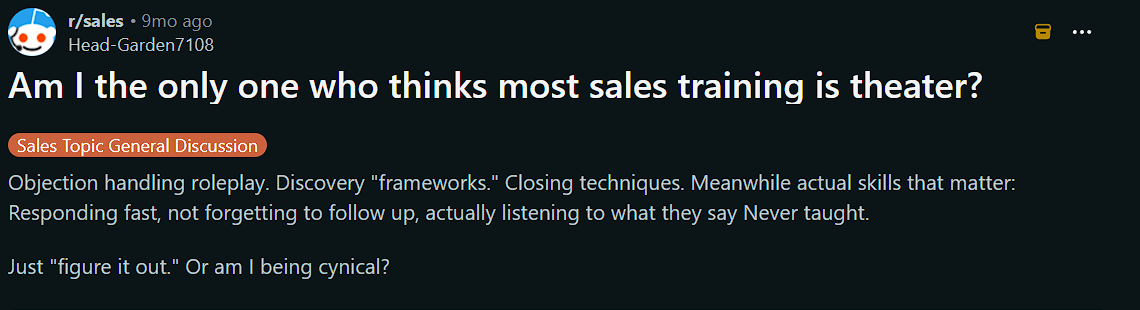
The frustration is common enough that it goes viral. One r/sales post laying out this exact complaint drew hundreds of upvotes and a long debate:
Why most sales training feels like theater
The theater complaint is not laziness, it is a fair read of how a lot of training is run. Four things make it feel like a performance rather than practice.
- It is generic. The same cookie-cutter methodology gets repackaged with new lingo every few years. Reps sit through material that is not tied to their product, their market, or the objections they actually hear.
- It is passive. Watching a trainer talk, or sitting through a slide deck, is not the same as doing the thing. You cannot learn a skill by observing it once in a ballroom.
- It is one-off. A two-day event with no reinforcement fades fast, so reps forget most of it before the next real call, and nothing changes on the floor.
- It skips the skills that matter. As one rep put it, training drills objection scripts for the hundredth time but never teaches how to get that conversation in the first place, or the unglamorous habits like fast follow-up and actually listening.
When training has all four traits, calling it theater is accurate. It looks like development, produces a completion certificate, and changes nothing.
What separates real training from theater
Here is the part the cynics often miss: the reps who dismiss all training usually have only seen the theatrical kind. Plenty of top performers point to the opposite experience, coaching and practice that genuinely made them better. The difference comes down to a few things.
Real skill-building is active, not passive: the rep actually does the thing, repeatedly, and gets feedback. It is specific, built from real calls and real objections rather than a generic script. It is continuous, reinforced over time instead of crammed into one event. And it focuses on the fundamentals that move deals. One trainer in the discussion made the point with data: most sellers ask almost no value-building questions in discovery, and fixing just that one habit can lift win rates meaningfully. That is not theater, that is training aimed at a real skill.
Why coaching finally beats the theater
There is a reason real coaching has historically lost out to the ballroom lecture: it is expensive and time-consuming to do well. A manager sitting next to every rep, reviewing calls, catching missed follow-ups, and running individual practice does not scale, so companies default to the one-off event that at least looks like training.
That is the part that has changed. As one rep in the thread described it, the only coaching that ever made them better was someone going through their calls and inbox with them, and AI now does the boring parts of that, surfacing what was missed and freeing the human coaching for what matters. The same shift lets reps practise real scenarios on their own time instead of waiting for a training day. In other words, the thing that made real development impractical at scale is exactly what AI removes.
How AI roleplay fixes what makes training theater
Map the four theater traits to what AI roleplay changes, and the fix is direct.
- Specific, not generic. Scenarios are built from your own calls, objections, and deals, so reps practise the exact conversations they face, not a repackaged 1950s script.
- Active, not passive. Reps actually run the conversation against a realistic AI buyer and get scored, instead of watching someone else perform it.
- Continuous, not one-off. Practice happens any time, as often as needed, so skills get reinforced instead of fading after a single event.
- Aimed at real skills. Scoring targets the fundamentals that actually move deals, discovery quality, objection handling, next steps, and ties practice back to what shows up on live calls.
The point is not more training. It is training that is the opposite of theater: connected to real conversations, practised until it sticks, and measured against real performance.
How Outdoo AI replaces training theater with real practice
For teams tired of training that looks good and changes nothing, Outdoo AI stands out because it turns training into practice tied to real calls, which is exactly what the theatrical version lacks.
Outdoo AI, the enterprise AI roleplay and training platform for customer-facing teams, is built around doing, not watching:
- Practice from your real calls, so reps rehearse the objections and deals they actually face, not a generic script.
- Realistic AI buyers in voice, video, or chat that push back like the real thing, so practice is active and repeatable on demand.
- Unified scoring on one methodology-aligned rubric across practice and live calls, so training connects to real performance instead of ending at a completion certificate.
- AI Tutors and workflow simulation that build product knowledge and the after-call habits, like follow-up and CRM work, that theatrical training always skips.
The result is development reps can feel working, because it is specific, hands-on, and measurable. Teams can start on a Free plan with limited credits, then move to usage-based pricing as they scale.
Stop performing, start practising
The reps calling sales training theater are not wrong about the training they have seen. Generic, passive, one-off sessions that skip the skills that matter deserve the label. But real development, specific, active, continuous, and tied to actual calls, is the opposite of theater, and it changes how reps sell. AI roleplay is what makes that kind of practice possible at scale, so training finally does what the ballroom version only pretended to.
To replace training theater with practice built from your own calls, schedule a demo with Outdoo AI.
Frequently Asked Questions
.svg)
Because a lot of it is generic, passive, and one-off. Reps sit through cookie-cutter methodology repackaged with new lingo, watch a trainer instead of practising, get no reinforcement after the event, and never learn the skills that actually decide deals like fast follow-up and real listening. Training like that looks like development and changes nothing, so the theater label fits.
No. The reps who dismiss all training have usually only seen the theatrical kind. Real skill-building is active rather than passive, specific to your product and real objections, continuous rather than a single event, and focused on fundamentals that move deals. That version genuinely improves performance; the generic ballroom version is what earns the waste-of-time reputation.
Four things: whether reps actually practise or just watch, whether the content is built from real calls or a generic script, whether it is reinforced over time or crammed into one event, and whether it targets the skills that move deals or drills the same objection scripts for the hundredth time. Real training does the first of each pair; theater does the second.
It flips each theatrical trait. Scenarios are built from your real calls instead of generic scripts, reps actively run conversations against a realistic AI buyer instead of watching, practice happens continuously on demand instead of once, and scoring targets real skills and ties back to live-call performance. It replaces the ballroom lecture with practice reps can feel working.
Because the reason it did not scale, the time cost of a manager reviewing every rep's calls, running individual practice, and catching missed follow-ups, is exactly what AI now handles. AI does the boring parts and lets reps practise real scenarios on their own time, so companies no longer have to default to a one-off event that only looks like training.
Table of Contents
Talk to Sales
Have questions about training and enablement for your sales, CS, support, or leadership team? Let's talk.
Talk to Sales