- Freezing is a pressure gap: Reps who freeze usually know the rebuttal. Stress shrinks the thinking space they need, so an answer that felt easy in training is hard to reach on a live call.
- Live prompts help only a little: Short on-screen cues can nudge a rep who already has the skill. Long or frequent prompts distract, and no prompt builds the reflex itself.
- Train the reflex before the call: Use real objections, one short framework like Acknowledge, Ask, Reframe, frequent out-loud drills, harder buyers over time, and targeted practice after each live stumble.
- Outdoo AI closes the loop: Outdoo AI builds realistic buyers from your calls, scores practice and live calls on one rubric, and assigns targeted practice when a rep stumbles on a real objection.
Most reps who freeze on an objection already know what to say. They have seen the rebuttal in training and maybe practiced it once. Then a real buyer pushes back mid-call, and there is a long pause, an "umm," and the energy drains out of the conversation.
That freeze is not a knowledge gap. It is a pressure gap, and it is fixed with the right kind of objection handling training, not more content. This guide covers why reps freeze, what live prompts can and cannot do, and a workflow that builds composure before the call.
Why do sales reps freeze when objections hit mid-call?
Reps freeze because stress takes away the thinking space they need to recall and adapt a response. A rebuttal that felt easy in a workshop becomes hard to reach when a real buyer is waiting for an answer.
Research backs this up. A widely cited review in Nature Reviews Neuroscience found that even mild, uncontrollable stress can cause a rapid loss of the prefrontal abilities people use for flexible thinking. On sales calls, that shows up in a few predictable ways:
- The objection arrives in unfamiliar words: Reps practiced "it is too expensive," but the buyer says "we just froze all new spend," and the trained response never fires.
- The rep has read the answer but never said it: Reading a rebuttal is not the same as saying it out loud while the clock is running.
- The stakes feel personal: A real buyer, a real quota and a manager listening raise the pressure far above anything a classroom exercise creates.
- Practice was too easy: Peer roleplay partners tend to go soft, so reps rarely rehearse the moment a buyer pushes back a second time.
Can live AI prompts stop reps from freezing?
Live prompts help a little, but they cannot replace practice. A short on-screen cue can remind a rep of a framework in the moment. Long or frequent prompts do the opposite, because they add one more thing to read while the buyer is talking.
Sales development teams that have tried live objection cues report exactly this. In one r/salesdevelopment discussion, a team found that wordy prompts distracted reps, and only short cues helped. The sharpest point came in the replies:
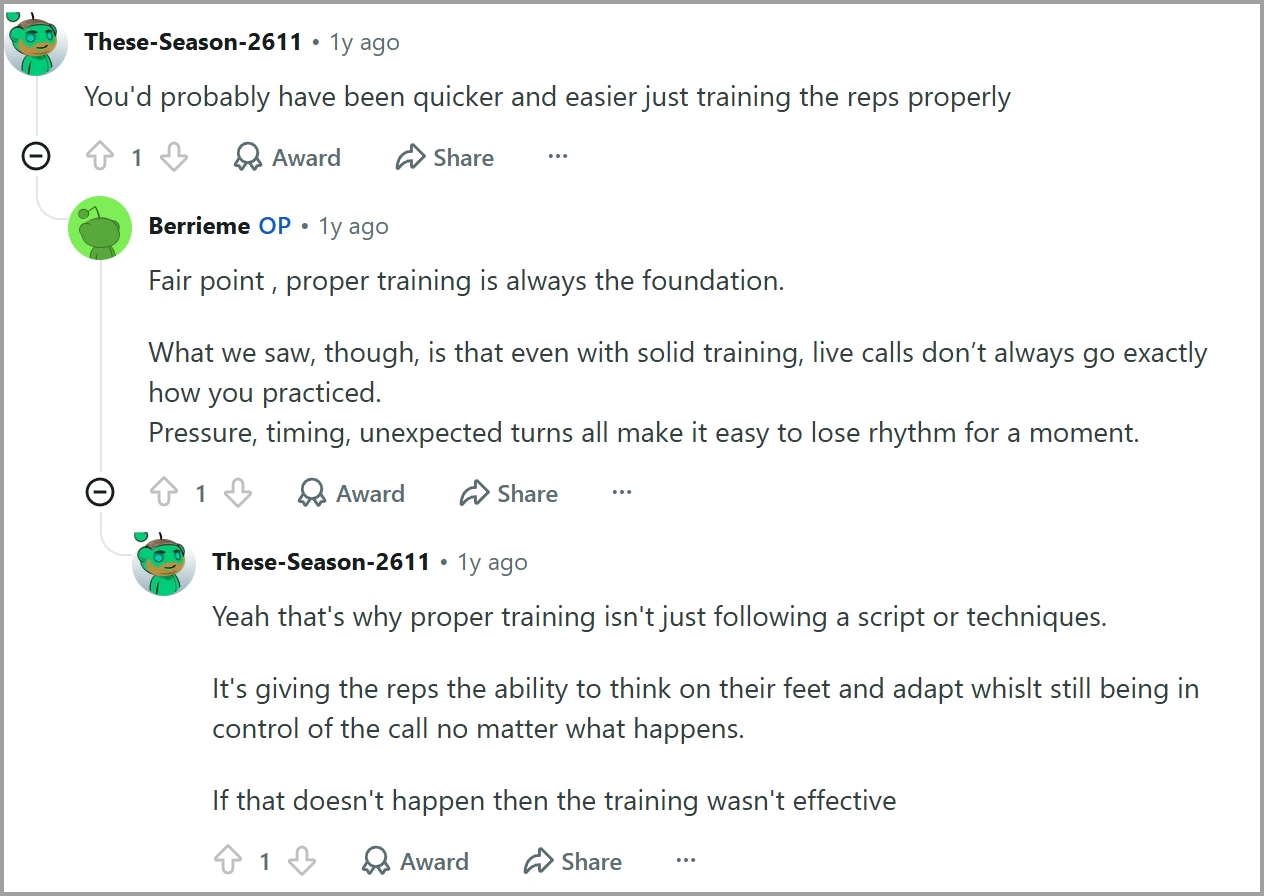
That is the real lesson. A prompt can only nudge a rep who already has the skill. Building that skill before the buyer is on the line is the job of sales training.
How to train reps to handle objections without freezing
Train the reflex before the call. The goal is for a rep to have handled a tough objection so many times in practice that the live version feels familiar. These five steps build that reflex.
Step 1: Build a library of your real objections
Pull the objections your reps actually hear from recorded calls, in the buyer's own words. Group them by type, such as price, timing, competitor, authority and "we are fine as we are." Real phrasing matters, because reps freeze most when an objection sounds unfamiliar.
Step 2: Teach one short response framework
Give reps a framework short enough to recall under stress. Acknowledge, Ask, Reframe works well: acknowledge the concern, ask a question that uncovers what sits behind it, then reframe around the buyer's goal.
A three-word cue is far easier to reach under pressure than a paragraph of copy. Avoid long rebuttal scripts, which tend to sound argumentative and break down as soon as the buyer goes off script.
Step 3: Drill out loud, little and often
Reps need to say the answer, not just read it. In a major review of learning techniques, Dunlosky and colleagues rated practice testing and spaced practice as high utility, and rereading as low utility. Short, frequent drills beat one long workshop.
Raise the difficulty as reps improve. With AI roleplay, a buyer can push back twice, interrupt mid-answer or stack two objections at once, which is what turns practice into composure.
Here is what a focused drill on a single objection looks like:
Step 4: Review the freeze moments on real calls
After live calls, find the exact moments where a rep hesitated or lost the thread. Score the response against the same rubric used in practice, so the rep can see the gap between how they handled it in practice and on the call.
Step 5: Practice the objection that caused the freeze
Close the coaching loop. If a rep froze on a competitor objection on Tuesday, their next practice session should be that objection, in that buyer's words. Repeat until the score holds steady on live calls, not just in practice.
How to tell if reps are freezing less
Composure shows up in your readiness metrics if you know where to look:
- Silence after pushback: Long pauses and filler words after an objection should shrink over time.
- Practice scores versus live scores: The two should converge. A big gap means practice is still easier than real calls.
- Calls that continue after an objection: Track how often a call moves to a next step after pushback, instead of ending there.
- Practice volume per rep: Reps who drill more often tend to close the gap faster, which makes this a useful early signal.
Here is how a manager can track those signals across a whole team:
How Outdoo AI helps reps handle objections without freezing
Outdoo AI, the enterprise AI roleplay and training platform for customer-facing teams, is built for this loop: practice the pressure before the call, then check that it holds on real calls.
- Realistic AI buyers: Build buyers in one click from your real calls, transcripts or a prompt. They raise objections in your customers' own words, push back again, and can be set from easy to difficult across voice, video or chat.
- One rubric for practice and live calls: Objection handling is scored the same way in roleplay and on real calls, so you can see whether composure carries over.
- Practice assigned from real gaps: When a rep stumbles on an objection on a live call, Outdoo can automatically assign targeted practice on that exact moment.
- Enterprise fit: 74+ languages, LMS support through SCORM and xAPI, and GDPR, HIPAA, CCPA and SOC 2 compliance.
Teams can start on a Free plan with limited credits, then move to usage-based pricing as they scale.
Build the reflex before the call
Reps rarely freeze because they lack an answer. They freeze because they have never had to find it under pressure. Real objections, one short framework, frequent out-loud drills and practice aimed at the exact objection that tripped them up turn that pressure into familiarity.
To see how teams build that reflex with AI roleplay, see Outdoo AI in action.
Outdoo builds AI Roleplays from your own calls and scores practice and real calls with one scorecard. Rated #1 for Best Results on G2.
Frequently Asked Questions
Why do sales reps freeze when they hear an objection?
Mostly because of pressure, not missing knowledge. Stress reduces the thinking space reps need to recall and adapt a response, especially when the objection comes in unfamiliar words or the rep has never said the answer out loud.
Do real-time AI prompts help with objection handling?
Short, simple cues can help a rep who already has the skill, but long or frequent prompts tend to distract. Live prompts work best as a reminder, while the skill itself has to be built through practice before the call.
What is a good framework for handling objections on live calls?
A short one. Acknowledge, Ask, Reframe is easy to recall under pressure: acknowledge the concern, ask a question that uncovers what sits behind it, then reframe around the buyer's goal. Short cues beat long scripts when a rep is stressed.
How often should reps practice objection handling?
Little and often. Short, frequent drills spread over weeks build a more reliable reflex than one long workshop. Increase the difficulty as reps improve, and add targeted sessions on any objection that caused a stumble on a real call.
How do you know if objection handling training is working?
Compare objection scores in practice with scores on live calls, track how often calls continue to a next step after pushback, and watch for shorter silences after objections. When practice and live scores converge, the skill is transferring.