

- Lean, bootstrapped, single-persona tool: Kendo AI is a lean, bootstrapped AI sales training tool built around single-persona roleplay, automated call scoring, and a lightweight sales-management layer.
- Best for small teams and insurance/IMO agencies: it's a solid fit for teams that want transparent, self-serve pricing and don't need multi-stakeholder simulation or deep compliance tooling.
- Weaker fit for larger B2B teams: it's a weaker fit for teams that need multi-persona roleplay, workflow/CRM rehearsal, or a coaching system that scores roleplay and live calls under one closed loop.
- Honest verdict: good starter tool, thin on the depth that growing revenue teams eventually need.
Who Is Kendo AI Best For?
- Kendo AI: Best for small teams and insurance or IMO agencies. It publishes self-serve pricing from $55/seat/month with a free trial.
- Kendo Screening: Best for hiring managers assessing sales candidates. Candidates get a roleplay link and managers get a scored transcript before the interview.
- Outdoo AI: Best for growing B2B teams with committee deals. It runs multi-persona roleplay, a scored gatekeeper phase and workflow training on the post-call CRM work.
At a Glance
| Plan | Price | Includes |
|---|---|---|
| Free trial | $0/seat/mo | Trial access to roleplay, call review, and the AI manager layer |
| Pro | $55/seat/mo | 180 roleplay min/mo, 25 hrs call scoring/mo |
| Max | $100/seat/mo | 480 roleplay min/mo, 100 hrs call scoring/mo |
| Enterprise | Custom quote | DFY setup, dedicated account manager, 10+ seats |
Full pricing detail, feature breakdown, and the Outdoo AI comparison are further down.
What Is Kendo AI?
Kendo AI (kendo.ai) is a 2024-founded, fully bootstrapped sales training company started by Luke Alexander after he personally trained over 5,000 reps.
The company, per a founder LinkedIn post, hit $1M ARR within 10 months of launch. It now serves 20+ customers.
The product bundles three things: AI roleplay against configurable buyer personas, automated AI scoring of real sales calls pulled in through dialer, recorder, or notetaker integrations, and a basic sales-management layer for organizing scripts, playbooks, and gap-based training assignments.
Kendo also sells a separate product called Screening, which lets hiring managers send a roleplay link to sales candidates and get a scored transcript back before an interview.
That's a recruiting tool, not a cold-call simulation for reps already on the job, so don't confuse it with a "gatekeeper" feature.
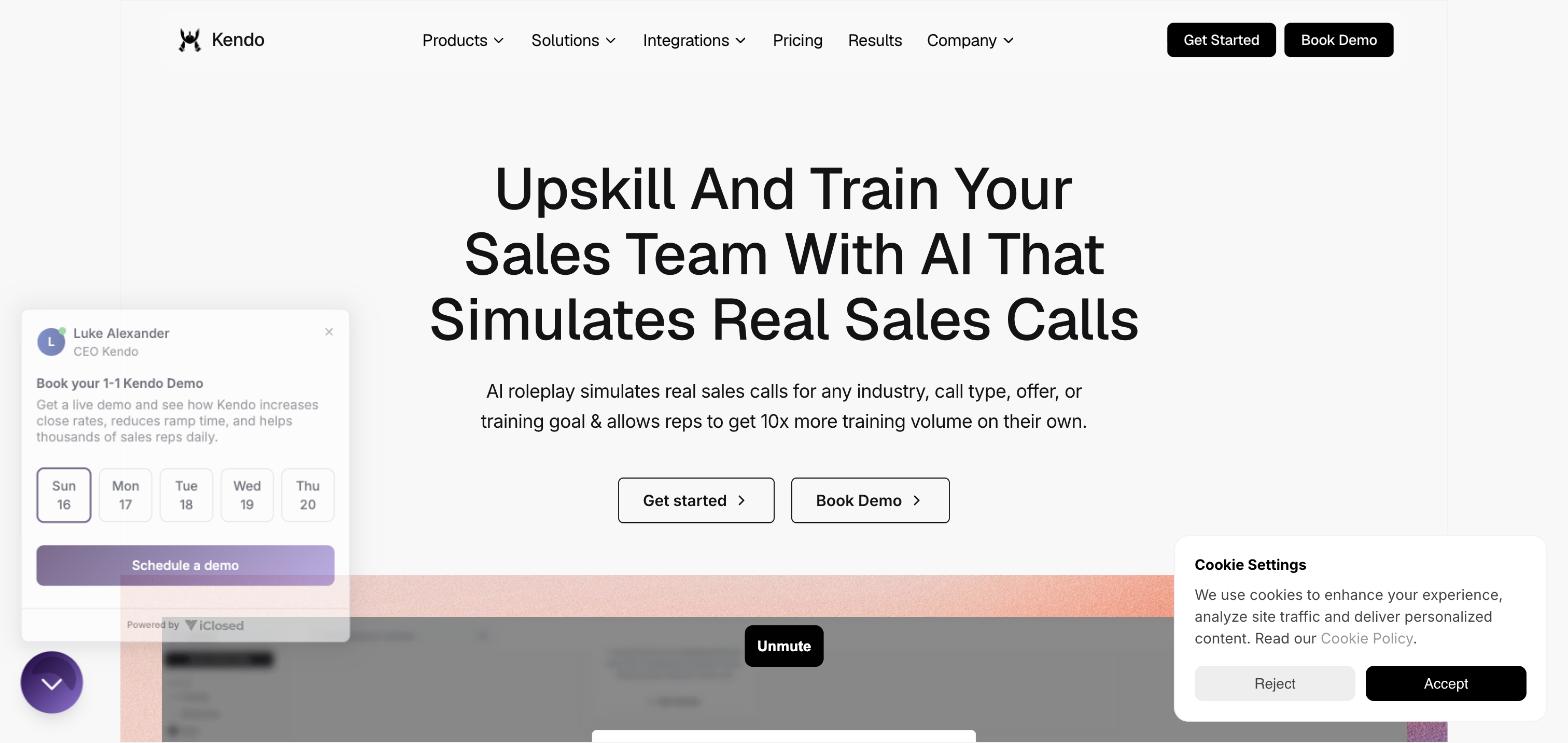
Source: Kendo AI homepage, kendo.ai
Kendo has a clear vertical lean toward insurance and IMO agencies, with a dedicated insurance landing page and named case studies.
It also runs general B2B SaaS positioning and an aggressive content strategy of "alternatives" and comparison pages against Highspot, Seismic, Salesloft, Gong, Second Nature, Hyperbound, Mindtickle, and others.
Kendo AI Pricing
Kendo publishes its pricing outright on kendo.ai/pricing, which is unusual for this category and worth noting up front.
Usage is pooled across the team and prorated on seat changes, and it stacks monthly rather than acting as a hard per-user cap.
| Plan | Price | Roleplay minutes | Call scoring | What's included |
|---|---|---|---|---|
| Free trial | $0/seat/mo | Limited | Limited | Trial access to roleplay, call review, and the AI manager layer |
| Pro | $55/seat/mo | 180 min/mo | 25 hrs/mo | Custom scorecards, advanced analytics, standard support |
| Max | $100/seat/mo | 480 min/mo | 100 hrs/mo | Everything in Pro plus VIP support |
| Enterprise | Custom quote | Custom | Custom | Done-for-you setup and customization, dedicated account manager, aimed at 10+ seats |
Kendo's own comparison page against Second Nature leans hard on this transparency, framing itself as "$55/seat/mo plus roughly $12/hr usage, transparent, self-serve" against Second Nature's quote-only model.
It's a real go-to-market choice, not an accident, and it works for buyers who want a number before they'll take a call.
One caveat: Capterra's Kendo listing currently shows zero reviews, so there's no independent, buyer-reported commentary there confirming whether the published tiers hold up at scale or whether teams routinely blow through the monthly caps.
Kendo AI Features
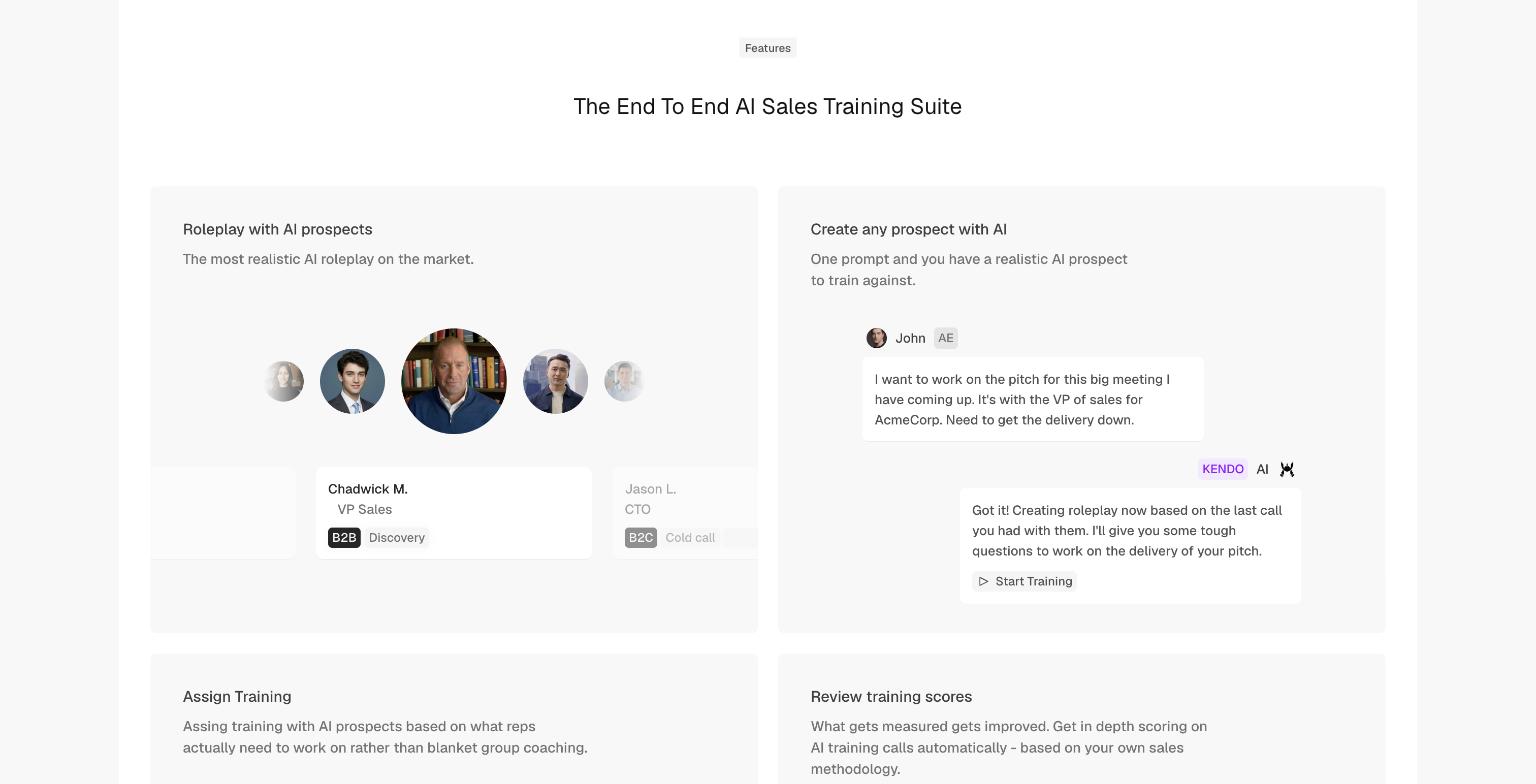
Screenshot: Kendo AI roleplay product page, captured September 2026.
| Capability | What it does | What it doesn't do |
|---|---|---|
| AI roleplay | Configurable AI buyer personas by call type (cold call, discovery, closing, follow-up), objective, product, and objection set. Kendo markets this as more adaptive than rivals' scripted avatar trees. | Single-persona only. No multi-stakeholder or committee simulation appears anywhere on Kendo's product pages. |
| AI call review | Automatically scores every live call against a custom scorecard, flags gaps against a framework, and generates summaries. Calls come in via native dialer/recorder/notetaker integrations or a Push API. | Applies the same scorecard logic to roleplay and real calls, which is close to a unified-scoring idea, but Kendo's own marketing frames it as "revenue-tied analytics," not a named closed-loop coaching system. |
| Sales management | Organizes scripts, playbooks, and historical call data, and auto-assigns training based on individual rep score gaps. Includes an analytics dashboard. | Lightweight by design. It's an add-on layer, not a standalone LMS or governance system. |
| Screening | Hiring managers send a roleplay link to a sales candidate, no Kendo account needed, and get back a scored transcript before deciding on an interview. | This is a pre-hire assessment tool, not a cold-call gatekeeper simulation for reps already selling. |
The most recent changelog entry (v4.1) added a redesigned mobile and iPad interface, streamlined team billing and admin tools, deeper call-scoring insights with customizable prompts, on-site direct support, and faster call processing from updated underlying models.
That's a reasonable pace of iteration for a team this size, but it's incremental polish, not new product surface.
Across pricing pages, product pages, and the about page, we found no evidence of multi-persona roleplay, video or avatar roleplay, or any post-call CRM/workflow rehearsal step. Its 8+ languages and 25+ voices claim only surfaces on a competitor-comparison page, not on the core product pages themselves.
Reps practice the conversation in Kendo. They don't practice what happens after they hang up.
What Users Say
Kendo's public review base is thin, seven reviews on G2 and none on Capterra at the time of this review, so treat any single quote as one data point, not a consensus. With that caveat, the available G2 feedback is positive:
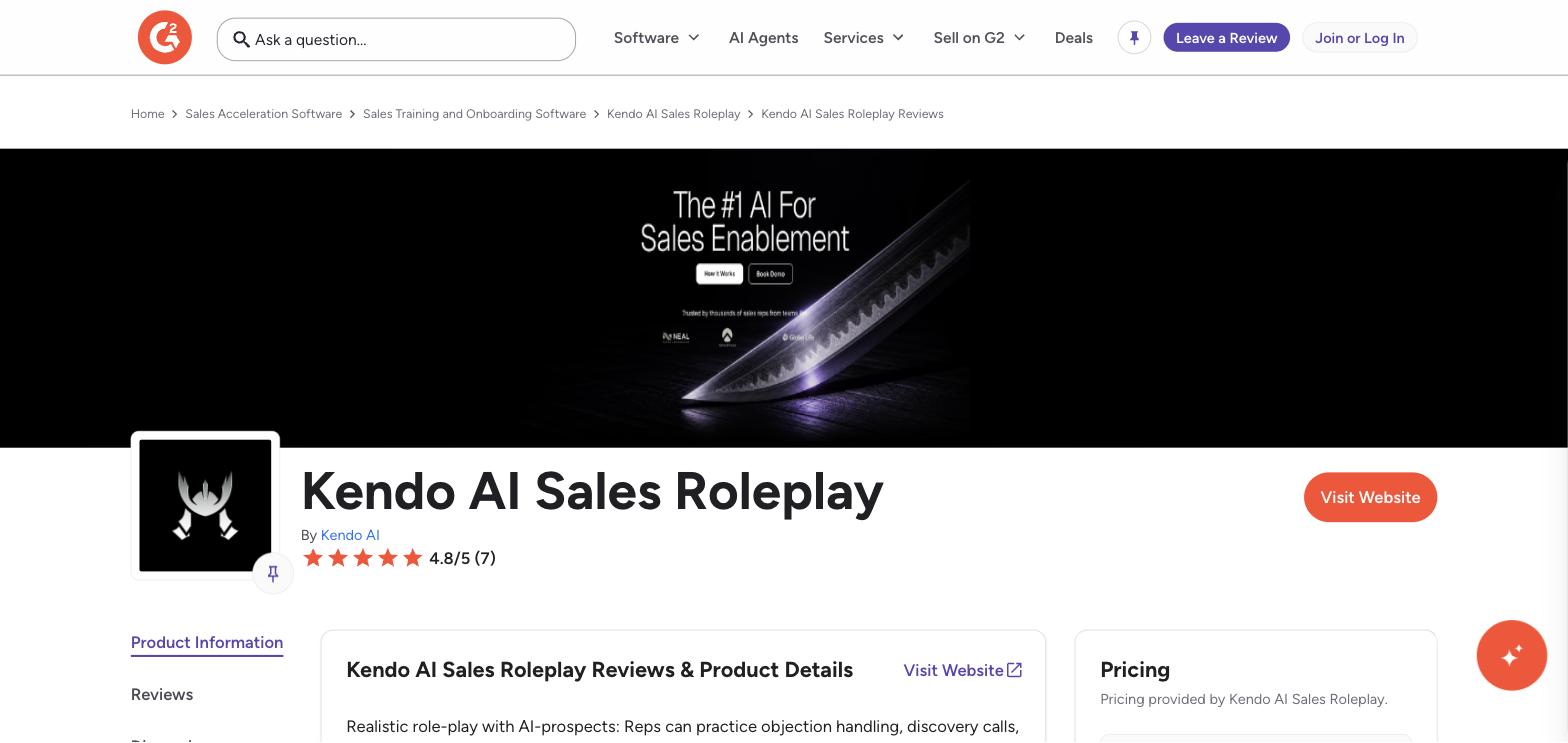
Source: G2, Kendo AI Sales Roleplay product page
"Kendo AI has helped me improve my close rate by roughly 8-10% while saving about 5-7 hours per week in training and role-play time. The realistic AI mock calls..." (source: G2 review)
"That everything is smooth and that you are able to work on scenarios that actually happened on real calls..." (source: G2 review)
"As an SEO agency owner, I've found Kendo AI surprisingly practical for sharpening sales conversations..." (source: G2 review)
One reviewer, asked what they disliked, wrote simply: "I have no complaints so far about the platform."
That's a nice signal, but with only seven reviews total, it says more about the size of the sample than the depth of satisfaction. Don't read broad consensus into it.
Trustpilot tells a more mixed story: Kendo sits at 3.5 out of 5 from just six reviews, including one unresolved one-star complaint about support and refunds that founder Luke Alexander personally disputed in the replies.
Add in Capterra's zero reviews on both its US and Canada listings, and Kendo's independent review footprint across all three platforms combined comes to roughly a dozen reviews. That's not enough volume to call this a proven track record either way.
Where Kendo AI Falls Short
Kendo's roleplay is single-persona. There's no multi-stakeholder or committee simulation anywhere in its product documentation, which matters if your reps sell into buying committees rather than one decision-maker.
The usage caps are real caps. Pro gives you 180 roleplay minutes and 25 hours of call scoring a month; Max gives you 480 minutes and 100 hours.
Run past that and you're upgrading a plan or paying overage, not flexing usage the way a true consumption model would.
Kendo's own kendo-vs-hyperbound comparison page claims 8+ languages (English, Spanish, German, French, and Italian named explicitly) and 25+ synthetic voices.
That's real coverage for a small team, but it's a fraction of the range a multilingual sales org selling across many markets is likely to need.
Kendo markets its "Screening" feature as something like a gatekeeper concept, but it's a hiring tool.
It scores sales candidates before an interview. It does not give active reps a scored cold-call gatekeeper phase to rehearse against, which is a different job entirely.
There's also no visible post-call workflow step. Reps rehearse the conversation, not the CRM logging or process work that follows it.
Kendo's own site does display compliance badges, including SOC 2, ISO 27001, GDPR, and HIPAA, but every one of those badges is labeled "in progress" as of this review, not just SOC 2 and ISO 27001.
That's a real, current gap, not a completed enterprise security posture, even though Kendo is clearly building toward one.
Where Kendo AI Genuinely Wins
Give Kendo the credit it's due. Published, self-serve pricing with an instant free trial is a real advantage over vendors, including Outdoo AI, that typically gate pricing behind a demo.
If a buyer doesn't want a sales call just to see a number, Kendo removes that friction entirely.
Kendo's insurance and IMO vertical proof is sharper than most competitors can show.
Three named case studies, United Insurance Pros, Globe Life, and individual agent Kody Skavara, back claims of 75% faster new-agent ramp (30 days down to 7), over $3,000 saved per new hire, and roughly double the close rate for new hires.
That's specific, evidenced, and public.
The Screening product is a distinct, clearly named use case: pre-hire candidate assessment via roleplay link, no account required. It's a real, separate product surface that most competitors don't call out on its own.
And the capital-efficiency story is genuinely notable.
Reaching $1M ARR in 10 months reads as scrappy and responsive, which can matter to a small buyer who wants a vendor that moves fast rather than one buried in process.
How Outdoo AI Compares
Kendo and Outdoo AI solve overlapping problems from different depths.
Kendo is built for a small team that wants one configurable AI buyer, a scorecard, and a fast trial. Outdoo AI is built for teams that need practice and measurement to hold up as they scale. If your team is already hitting Kendo's caps or needs buying-committee practice, compare the best Kendo AI alternatives in 2026 side by side.
Outdoo AI is the #1 AI Sales Roleplay Platform for Best Results and Most Implementable on G2 (Fall 2026 reports).
The clearest gap is scope of practice.
Outdoo AI runs multi-persona roleplay for up to three stakeholders on a single call, which matters for committee-based B2B and renewal deals that a single AI buyer can't represent.
Outdoo AI also runs a dedicated gatekeeper phase, scored separately, for teams that live and die by getting past a receptionist or assistant before the real conversation starts. Nothing in Kendo's current lineup does either.
The second gap is what happens after the call. Outdoo AI's workflow training scores the post-call CRM and process work in the same session as the conversation itself, so reps rehearse the paperwork, not just the pitch.
Few competitors in this set do that, and it's not something Kendo's product pages claim at all.
Outdoo AI's scoring is also built from a team's own playbooks, transcripts, and battlecards rather than a fixed rubric, and the same scorecard grades both roleplay practice and live calls, so leaders can point to one number that moves with actual revenue outcomes, not just completion rates.
Kendo's call review is a legitimate analog worth respecting. It scores real calls too, but its own marketing frames it as revenue-tied analytics rather than the single closed loop that Outdoo AI's AI coaching ties from practice to performance.
On language coverage, Outdoo AI supports 120+ languages overall and 74+ in voice roleplay, well beyond the 8+ languages and 25+ voices Kendo claims on its own comparison pages.
Security posture is another concrete gap, not just a framing difference. Outdoo AI already holds SOC 2 Type II, ISO 27001, and ISO 27701 certifications today, plus a published uptime SLA, while Kendo's own site lists its SOC 2 Type II and ISO 27001 as still "in progress."
Where we'd be honest that Kendo wins: its published, self-serve pricing is simpler to buy than Outdoo AI's usage-based, quote-driven model, and its insurance vertical case studies are currently sharper and more specific than what Outdoo AI shows publicly for that same niche.
If a small team's only requirement is "one AI buyer, a scorecard, and a number I can see today," Kendo will satisfy that need cleanly.
If the requirement grows to multi-stakeholder deals, gatekeeper practice, workflow rehearsal, or coaching that ties directly to revenue movement, that's where the gap opens up.
Outdoo builds AI Roleplays from your own calls and scores practice and real calls with one scorecard. Rated #1 for Best Results on G2.
Frequently Asked Questions
What does Kendo AI cost?
Kendo publishes three paid tiers: Pro at $55/seat/month, Max at $100/seat/month, and a custom Enterprise quote for 10+ seats. There's also a $0 free trial tier. See kendo.ai/pricing for the current published numbers. Outdoo AI starts free with 60 minutes of roleplay credits and unlimited team members, no credit card and no sales call, then scales on usage-based Flex pricing with a custom enterprise plan for larger deployments.
Does Kendo AI support multi-persona roleplay?
No. Every Kendo product page describes single-persona roleplay against one configurable AI buyer at a time. There's no evidence of multi-stakeholder or committee simulation. Outdoo AI, by contrast, supports roleplay calls with up to three stakeholders at once.
Is Kendo AI good for insurance sales teams?
Yes, this is Kendo's strongest publicly evidenced vertical. Its insurance landing page cites case studies claiming 75% faster new-agent ramp and roughly double close rates for new hires.
Can Kendo AI screen sales candidates before hiring?
Yes. Kendo's Screening product lets hiring managers send a roleplay link to candidates and get back a scored transcript before an interview, no Kendo account needed on the candidate's end. It's a distinct hiring tool, not a feature for active reps.
What happens if a team goes over Kendo AI's monthly usage caps?
Pro includes 180 roleplay minutes and 25 hours of call scoring a month; Max includes 480 minutes and 100 hours. Going over means upgrading to a higher plan or paying overage, since usage is pooled and capped rather than a true consumption model.