



Searching for Kendo AI alternatives in 2026 usually starts from one of two places, a smaller team comparison-shopping before committing, or a team that has outgrown Kendo's self-serve caps and needs more depth than per-seat usage limits allow.
Kendo AI is a transparent-pricing AI sales management and training suite built for self-serve adoption, with strong fit for SMB and mid-market teams running onboarding, candidate screening, and ongoing rep practice. For a full breakdown of its plans, usage caps and features, read our Kendo AI review.
The reasons teams look elsewhere tend to cluster around six themes: monthly roleplay-minute and live-call-scoring caps that constrain heavy users, scenario setup that requires meaningful manual effort, multi-persona depth that does not extend to full buying-committee simulation, methodology scoring that stays lighter than enterprise frameworks require, AI Role Play sitting as one opt-in module inside a broader suite, and enterprise procurement needs (compliance certifications, private deployment, dedicated security review) that sit beyond Kendo's SMB design center.
This comparison spans the full accessibility spectrum. The seven strongest Kendo AI alternatives in 2026 are Outdoo AI, Hyperbound, Second Nature, Mindtickle, Yoodli, PitchMonster, and Quantified.
Each fits a different point on the curve: Outdoo AI for teams that outgrew Kendo and need enterprise roleplay and coaching depth, Hyperbound for SDR motion with strong voice realism, Second Nature for pre-built scenario libraries, Mindtickle for full enablement consolidation, Yoodli for communication delivery coaching, PitchMonster for low-cost gamified pitch practice, and Quantified for regulated industry certification.
The comparison below is grounded in G2 reviews, vendor documentation, and third-party procurement data sourced through May 2026.
What Is Kendo AI?
Kendo AI is an AI sales management and training suite that combines AI roleplay against customizable buyer personas with live call scoring, an AI Sales Manager, and an AI Sales Coach. It is built for self-serve SMB and mid-market teams, with published pricing: a Free trial, Pro at $55 per seat per month, and Max at $100 per seat per month.
Best Kendo AI alternatives in 2026 at a glance
| # | Tool | Best for | Free tier? | Starting price | One-line advantage |
|---|---|---|---|---|---|
| 1 | Outdoo AI | Teams outgrowing Kendo needing enterprise depth | Yes. Free Plan & Free trial | $0; teams custom | Multi-persona roleplay, live call scoring, and workflow simulation in one platform |
| 2 | Hyperbound | SDR motion with strong voice realism | Yes | Custom | Best-in-class voice realism, real call scoring through dialer integration |
| 3 | Second Nature | Pre-built scenario libraries and certification | No | $30-$40/user/month | Deepest scenario library, avatar-led coaching with Jenny |
| 4 | Mindtickle | Consolidating full enablement at enterprise scale | No | ~$47K-$82K/year | Comprehensive enablement suite with Call AI for live call scoring |
| 5 | Yoodli | Communication delivery coaching for individuals | Yes | $0; teams custom | Free communication coaching, strong for delivery and public speaking |
| 6 | PitchMonster | Low-cost gamified pitch practice for SMB | No | ~$25-$40/user/month | Affordable gamified roleplay, accessible to small teams |
| 7 | Quantified | Regulated industry certification with audit trails | No | Custom | ComplianceGuard AI with automated pass/fail and audit-ready compliance |
Where Kendo AI falls short as teams scale
Kendo AI does the self-serve job well. Transparent pricing, a clean interface, fast setup, and human-like AI personas make it a genuinely good fit for SMB and mid-market teams. The friction shows up at the edges of that design center, usually when a team grows, when usage climbs past the included caps, or when enterprise requirements enter the evaluation. Across G2 reviews and third-party analysis, six recurring patterns drive teams to look at alternatives. Kendo's public review footprint is still thin, too, 4.8/5 on G2 from just 7 reviews, no Capterra reviews, 3.5/5 on Trustpilot from six, a real but early signal rather than a battle-tested track record.
1. Usage caps constrain heavy practice programs
Kendo's Pro plan includes 180 roleplay minutes and 25 hours of live call scoring per seat per month, and the Max plan raises that to 480 minutes and 100 hours. For teams running intensive onboarding or high-volume practice programs, these caps become a planning constraint. Heavy users either upgrade tiers or pay for overage, which changes the economics that made Kendo attractive in the first place.
2. Scenario setup requires meaningful manual effort
Kendo's fully customizable prospects are a strength, but reviewers and third-party analysis consistently note that building roleplay scenarios demands real upfront effort. For fast-moving teams, the time to author and maintain scenarios delays rollout. As products, messaging, and ICPs change, keeping scenarios current becomes an ongoing operational task rather than a one-time setup.
3. Multi-persona depth stops short of buying-committee simulation
Kendo's AI personas are realistic for one-on-one practice. The platform does not natively simulate multi-stakeholder buying committees where a rep navigates a CFO, a champion, and a procurement lead in a single scenario. For teams selling into complex enterprise deals, this limits how closely practice mirrors the real conversation.
4. Methodology scoring stays lighter than enterprise frameworks
Kendo offers custom scorecards and call scoring, which works well for general sales motion. Teams that need deep, framework-specific scoring tied to MEDDIC, MEDDPICC, SPIN, BANT, or Challenger, with the rubric depth enterprise enablement leaders expect, often find Kendo's scoring layer lighter than dedicated enterprise platforms provide.
5. AI Role Play is one opt-in module inside a broader suite
Kendo positions itself as a full sales management and training suite, with roleplay as one capability among call review, AI Sales Manager, AI Sales Coach, and analytics. Third-party analysis notes that AI Role Play can require separate opt-in even after purchasing a qualifying package, and that the breadth of the suite can feel heavy for teams focused specifically on roleplay practice.
6. Enterprise procurement needs sit beyond the SMB design center
Kendo includes SSO and security features, but teams with formal enterprise requirements (specific compliance certifications, private cloud deployment, dedicated security review, named account management at scale) typically need to evaluate whether an SMB-designed self-serve platform meets enterprise procurement standards or whether a platform built for enterprise deployment is the better fit.
1. Outdoo AI: Best for teams that outgrew Kendo and need enterprise depth
Outdoo AI is where teams go when Kendo's self-serve ceiling becomes the limit
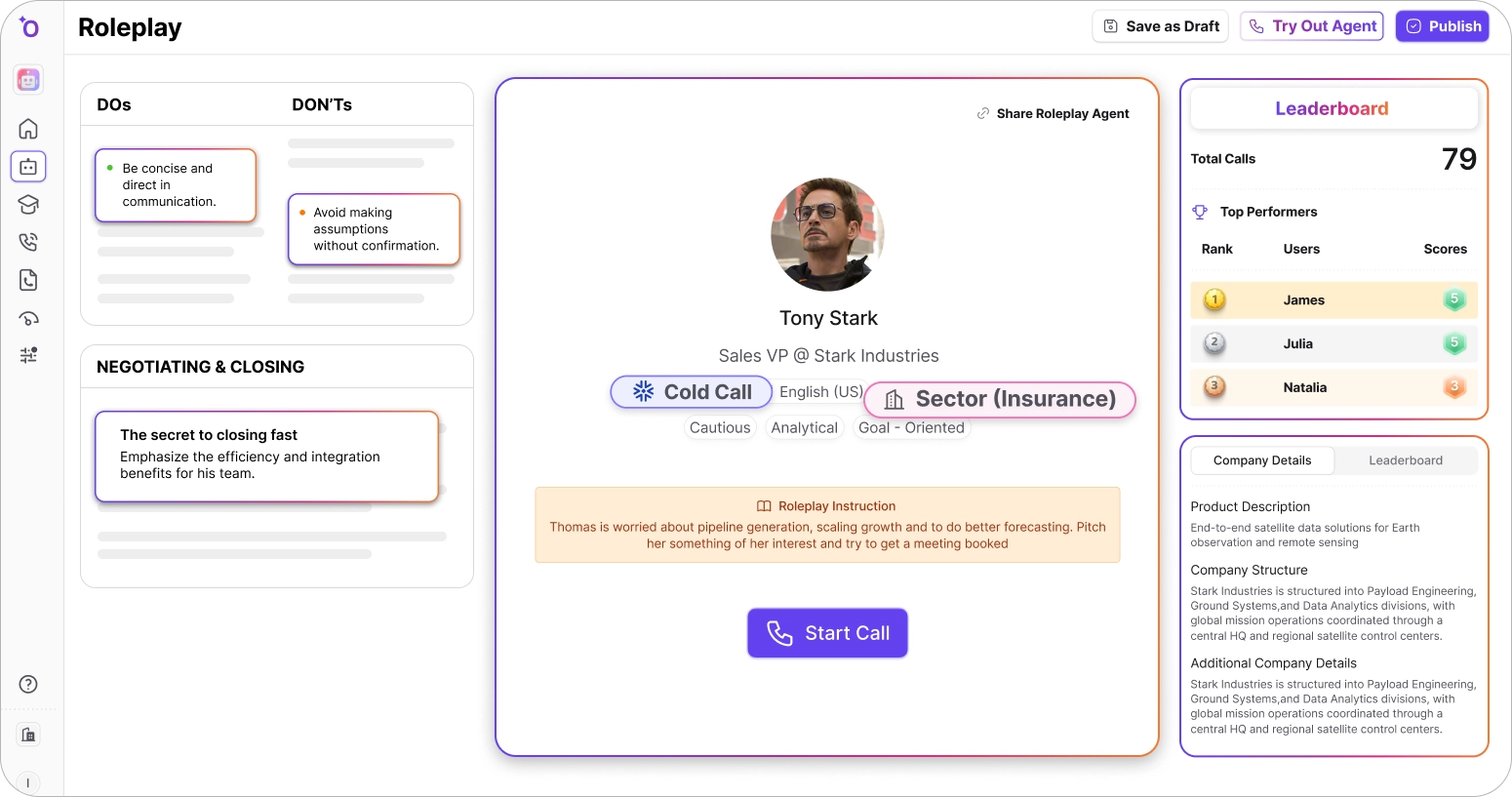
The clearest reason to move from Kendo to Outdoo AI is depth. Kendo is built for self-serve SMB adoption with per-seat usage caps and one-on-one persona practice. Outdoo AI is an enterprise AI roleplay and coaching solution built for the layer Kendo's design center does not reach: multi-persona buying-committee simulation with up to three AI stakeholders, methodology-aligned scoring across SPIN, BANT, MEDDIC, MEDDPICC, and Challenger, live call analysis on the same rubric used in practice, post-call workflow simulation, and enterprise compliance for regulated industries.
That shift matters most for three kinds of teams. Teams that have hit Kendo's usage caps and want a model scoped to deployment rather than per-minute limits. Teams selling complex deals that need practice to mirror real buying committees rather than single-persona calls. And teams entering enterprise procurement, where SOC 2 Type 2, GDPR, HIPAA, CCPA, PII scrubbing, and private cloud deployment move from nice-to-have to requirement. Where Kendo is the right first platform for a growing team, Outdoo AI is the platform that scales with the enterprise motion underneath it.
Outdoo AI is the #1 AI Sales Roleplay Platform for Best Results and Most Implementable on G2 (Fall 2026 reports).
What Outdoo AI actually does
- Three roleplay modes: chat for quick objection drills, voice for phone-based motion, and video with lifelike AI avatars and screen sharing for demos and discovery practice
- Multi-persona simulations: practice against up to three AI stakeholders in a single resumable scenario (CFO, champion, procurement, or any combination), each behaving distinctly based on configured priorities
- Methodology-aligned scorecards: pre-packaged for SPIN, BANT, MEDDIC, MEDDPICC, and Challenger, plus custom rubrics built from your governance documents
- Live call scoring on the same scorecard as practice: ingest from Gong, Clari, or native conversation intelligence and score real calls against the methodology you use
- Workflow training beyond conversation: reps practice CRM logging, disposition selection, and process navigation in environments that mirror actual Salesforce, HubSpot, or Pipedrive instances
- Multi-lingual roleplays in 74+ languages: for global team deployments
- Gatekeeper roleplay: score the cold-call screening phase separately from the pitch itself, so reps train specifically for getting past gatekeepers before the discovery conversation even starts, a scored phase none of the other seven alternatives on this list offer
- LinkedIn-based scenario creation: generate practice scenarios from LinkedIn profiles for outbound preparation against named accounts
- Dynamic micro-roleplays: when scoring identifies a coaching opportunity, Outdoo AI automatically generates a targeted reinforcement roleplay and surfaces relevant battle cards
- Revenue outcome correlation: connects roleplay scores, live call scores, and pipeline data to surface which behaviors correlate with won deals
- 120+ enterprise integrations: Salesforce, HubSpot, Pipedrive, Gong, Clari, Docebo, TalentLMS, Cornerstone, SCORM, xAPI, SSO
- Enterprise compliance: SOC 2 Type 2, GDPR, HIPAA, CCPA, PII scrubbing, private cloud deployment
Where Outdoo AI delivers the most value
Outdoo AI is built for teams that want practice to translate into measurable performance, with the depth and governance that growing and enterprise teams need:
- Realistic AI roleplays grounded in real business context: scenarios generated from playbooks, customer conversations, LinkedIn profiles, internal docs, and real interactions
- Multi-stakeholder practice for complex deals: buying-committee simulation that Kendo's one-on-one persona model does not cover
- Live call validation: practice scores and real call scores sit on the same rubric, so managers see whether training actually changes live conversation behavior
- Methodology depth for enterprise motion: framework-specific scoring that goes deeper than general custom scorecards
- Consistent coaching at scale: standardize what good looks like across reps, managers, and regions as the team grows
- Workflow execution beyond conversation: reps practice the CRM and process steps that follow the call, not just the call itself
- Enterprise governance built in: compliance certifications, private cloud, and security review for regulated procurement
- AI roleplay for sales training built from your own material: Outdoo AI turns your calls, transcripts, playbooks, documents, or LinkedIn profiles into realistic buyer personas and customizable scenarios, then grades every roleplay and live call on one AI scorecard for closed-loop coaching
- Sales roleplay scenarios for every stage of the call: cold call openers, gatekeepers, discovery, price objections, and competitor comparisons, plus multi-persona scenarios for buying committees and call blitzes for back-to-back outbound practice
There was one roleplay agent that I put together named Chester. I made him be a little off kilter, talking about metaphors, be very artsy, talk about jazz a lot. That is something we want to see within the senior population. They like to talk. Sometimes they are not super clear. That has been really good for our agents to experience before experiencing it in the wild.
Jacob Irby, Assistant Director of Human Development, ProvideSure
What to know before signing with Outdoo AI
The main thing to evaluate is whether your team is ready for a team-based rollout. Outdoo AI is designed for sales teams, enablement teams, and managers who want consistent coaching across multiple reps, with production deployments typically starting at 5+ users. Teams used to Kendo's instant self-serve signup should plan for a scoped evaluation instead. Individual reps and teams can explore the free and usage-based tiers here. Enterprise evaluations typically include a scoped sandbox deployment configured to your team scenarios, methodology, and integrations.
Outdoo AI tiered enterprise pricing scoped to deployment
Outdoo AI uses a tiered pricing model designed for enterprise-scale deployments. Pricing scales with usage, integration depth, and compliance requirements rather than simple per-seat licensing with usage caps.
- Outdoo AI's Free plan includes usage credits and unlimited team members to fully evaluate roleplay, coaching, and call scoring with Usage-based and Custom plans available as you grow.
- Enterprise sandbox scoped to your team scenarios, methodology, and integrations during evaluation
- Flex tier (usage-based) includes multi-persona roleplays, certifications, workflow simulation, and methodology-aligned scoring
- Enterprise tier adds full integration scope (CRM, CI, LMS, SCORM, xAPI, LTI), enterprise compliance (SOC 2 Type 2, GDPR, HIPAA, CCPA, private cloud), and custom deployment
Enterprise pricing is custom-scoped because deployment varies materially by team size, integration scope, methodology configuration, and compliance requirements.
Outdoo AI vs Kendo AI: side-by-side comparison
| Capability | Outdoo AI | Kendo AI |
|---|---|---|
| Primary category | Enterprise AI roleplay and coaching | AI sales management and training suite (SMB and mid-market) |
| Design center | Enterprise deployment, team-based rollout | Self-serve, transparent per-seat pricing |
| Roleplay modes | Chat, voice, video with screen sharing | AI roleplay (voice and conversation) |
| Multi-persona simulations | Up to 3 AI stakeholders, resumable | One-on-one persona practice |
| Usage model | Scoped to deployment, no per-minute caps | Capped monthly minutes per seat (180 Pro, 480 Max) |
| Live call scoring | Same scorecard for practice and live calls via Gong, Clari, native CI | Live call scoring via API and call-recording integrations (capped hours) |
| Methodology alignment | SPIN, BANT, MEDDIC, MEDDPICC, Challenger + custom | Custom scorecards, lighter framework depth |
| Workflow simulation | CRM logging, dispositioning, process navigation | Not a primary focus |
| Scenario creation | CRM data, transcripts, LinkedIn, playbooks, AI-assisted | Fully customizable prospects, manual setup effort |
| Compliance posture | SOC 2 Type 2, GDPR, HIPAA, CCPA, PII scrubbing, private cloud | SSO and security features; SOC 2 Type II and ISO 27001 listed as "in progress" on Kendo's own site, not yet certified |
| Pricing transparency | Free plan + usage-based credits for evaluation, scaling to custom enterprise pricing for deployment | Public: Free, $55 Pro, $100 Max, custom Enterprise |
| Best fit | Growing and enterprise teams needing depth and governance | SMB and mid-market self-serve adoption |
If your team wants instant self-serve signup with transparent per-seat pricing and one-on-one practice, Kendo is built directly for that. Outdoo AI is the stronger fit once you need multi-persona depth, methodology-aligned scoring connected to live calls, workflow simulation, and enterprise compliance, the capabilities that matter when a team scales past self-serve.
Want to see how Outdoo AI can help your team? Schedule a demo and talk to our experts.
2. Hyperbound: Best for SDR motion with strong voice realism

Hyperbound matches Kendo on accessibility but leads on voice realism
For teams evaluating Kendo specifically for outbound and SDR practice, Hyperbound is the closest head-to-head. Both offer accessible entry points (Hyperbound has a free tier, Kendo has a free trial), and both target teams that want to get practicing quickly. The difference shows up in voice realism. Independent analysis from Knowlee April 2026 rates Hyperbound persona realism as best-in-class, with voice latency under 400ms and personas that hold character when reps lob unexpected questions.
Hyperbound also leans harder into the dialer-integrated motion. It connects to dialers and call recorders to score live customer calls against the same scorecard used in practice, closing the practice-to-live loop for outbound teams. Where Kendo is a broader sales management suite, Hyperbound is a focused SDR practice and call-scoring tool.
What Hyperbound actually does
- Real call scoring through dialer integration: connects to dialers and call recorders to score live customer calls
- AI buyer bots with persona configuration: first bot setup typically under 10 minutes, full module rollout in about two weeks
- Demo call type with screen sharing: supports the screen-sharing motion AEs run during product demos
- Multi-language coverage across 25+ languages: including Spanish, French, German, Mandarin, Japanese, Hindi, Hebrew
- Custom scorecards aligned to methodology: SPIN, BANT, MEDDIC, MEDDPICC, Challenger frameworks supported
- Free tier with limited bots: entry-point includes basic scorecards and transcription
What Hyperbound users praise about outbound-focused practice
- Voice realism is best-in-class for outbound bots. Knowlee rates Hyperbound persona realism as best-in-class as of April 2026, ahead of most platforms tested.
- Bot setup is genuinely fast. First bot configuration takes under 10 minutes, comparable to Kendo's quick setup but with stronger voice output.
- Real call scoring closes the practice-to-live loop. Hyperbound's dialer integration scores live customer calls against the same scorecard used in practice.
Where Hyperbound users hit friction with broader coverage
- Coverage skews to outbound SDR motion. Teams needing inbound, customer success, or full enterprise deal coverage find the focus narrower than Outdoo AI or Mindtickle.
- AE and enterprise depth is still maturing. Multi-stakeholder enterprise deal coverage is less developed than the SDR motion Hyperbound is built around.
- Pricing is opaque past the free tier. Mid-market deals observed at $80-$150 per rep per month, but no public tier structure beyond the free entry, unlike Kendo's transparent pricing.
What to know before signing with Hyperbound
- Confirm outbound motion fit. Hyperbound is purpose-built for SDR and outbound practice. Teams needing broader coverage should evaluate Outdoo AI or Mindtickle.
- Validate AE coverage if you need beyond SDR. Pilot with a representative AE use case before committing if your motion extends past outbound.
- Plan for the bot library buildout. Adoption depends on a meaningful library of persona-configured bots. Budget enablement time for the first 30-60 days.
Hyperbound free tier plus demo-gated custom enterprise pricing
- Free plan: limited roleplay bots, basic scorecards, transcription, coaching feedback
- Custom plan for teams: unlocks unlimited bots, custom scorecards, analytics, integrations, security configurations
- Demo-led access: most advanced capabilities require engaging sales through a demo
Looking beyond Hyperbound? See how leading platforms compare for AI sales roleplay in 2026.
3. Second Nature: Best for pre-built scenario libraries and certification
Second Nature solves the scenario-building effort Kendo requires
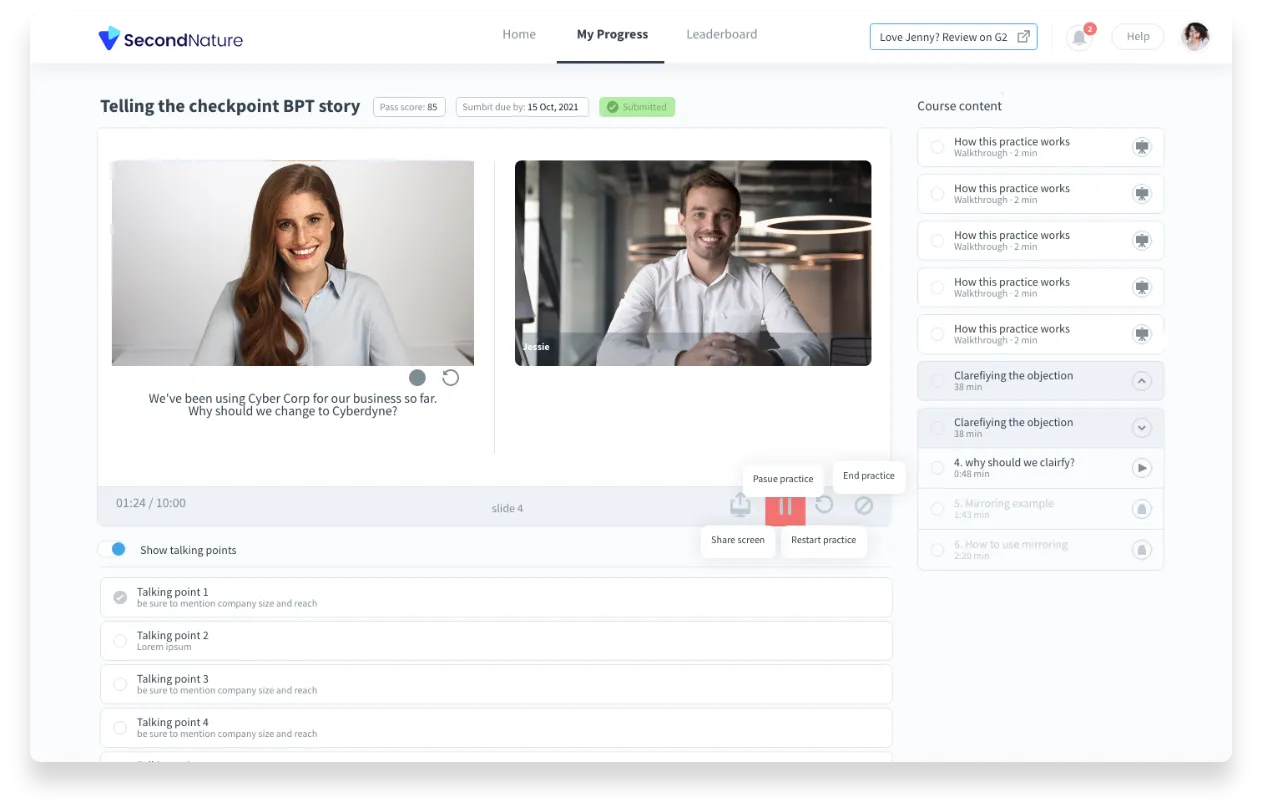
The single biggest operational difference between Second Nature and Kendo sits in scenario creation. Kendo's fully customizable prospects require manual setup effort, which reviewers flag as a rollout delay. Second Nature ships a pre-built scenario library with 50+ scenarios available on day one, with particular depth in healthcare, finance, and insurance verticals. For teams that do not want to author and maintain scenarios, Second Nature is often faster to value.
Second Nature is the legacy player in AI sales roleplay, founded in 2018 and rebuilt on foundation models in 2023. Its main moat is the deepest pre-built scenario library in the category, often co-developed with enablement consultancies, and a strong fit for formal certification programs where readiness validation is required.
What Second Nature actually does
- Avatar-led virtual coaching with Jenny: simulating discovery, demos, and objection handling in a guided format
- Detailed soft-skill feedback: tone, pacing, clarity, filler words, and presentation style
- Structured certification workflows: fits into formal onboarding programs used by enterprise teams
- Predefined scenario libraries: curated by Second Nature with depth in healthcare, finance, and insurance
- Integration with LMS and onboarding stacks: supports enterprise training program workflows
What Second Nature users praise about pre-built content depth
- Pre-built content library is the deepest in the space. For organizations that do not want to author scenarios, Second Nature ships ready content across industries, regions, and personas.
- Strong fit for certification programs. Purpose-built for pass/fail certification workflows where readiness validation is required.
- Fastest time to value. Onboarding time is shortest of any tool tested by Knowlee April 2026 analysis, with 50+ ready scenarios on day one.
Where Second Nature users hit friction with flexibility and price
- Persona engine feels less natural than newer tools. Despite the 2023 rebuild, avatars carry a slight scripted quality per Knowlee analysis.
- Custom scenario authoring is template-bound. More constrained than Kendo's fully customizable prospects or newer free-form tools.
- Pricing is higher and less transparent than Kendo. Sales-led pricing with a ~$20K annual minimum, versus Kendo's published self-serve tiers.
What to know before signing with Second Nature
- Validate scenario flexibility for your motion. Certification-friendly scenarios are predefined by design. Confirm customization scope if your team needs adaptive scenarios.
- Budget for the enterprise minimum. Community data indicates minimum annual deals often start around $20K, well above Kendo's per-seat entry.
- Plan for 4-8 week implementation. Enterprise rollouts take longer to configure than Kendo's self-serve setup.
Second Nature sales-led pricing in the $30 to $40 per user per month range
User-reported data places typical pricing at approximately $30 to $40 per user per month, with minimum annual deals around $20K. No public pricing on the website; teams must engage sales for quotes, unlike Kendo's transparent tiers.
Considering alternatives to Second Nature? Explore tools that offer better flexibility and pricing.
4. Mindtickle: Best for consolidating full enablement at enterprise scale
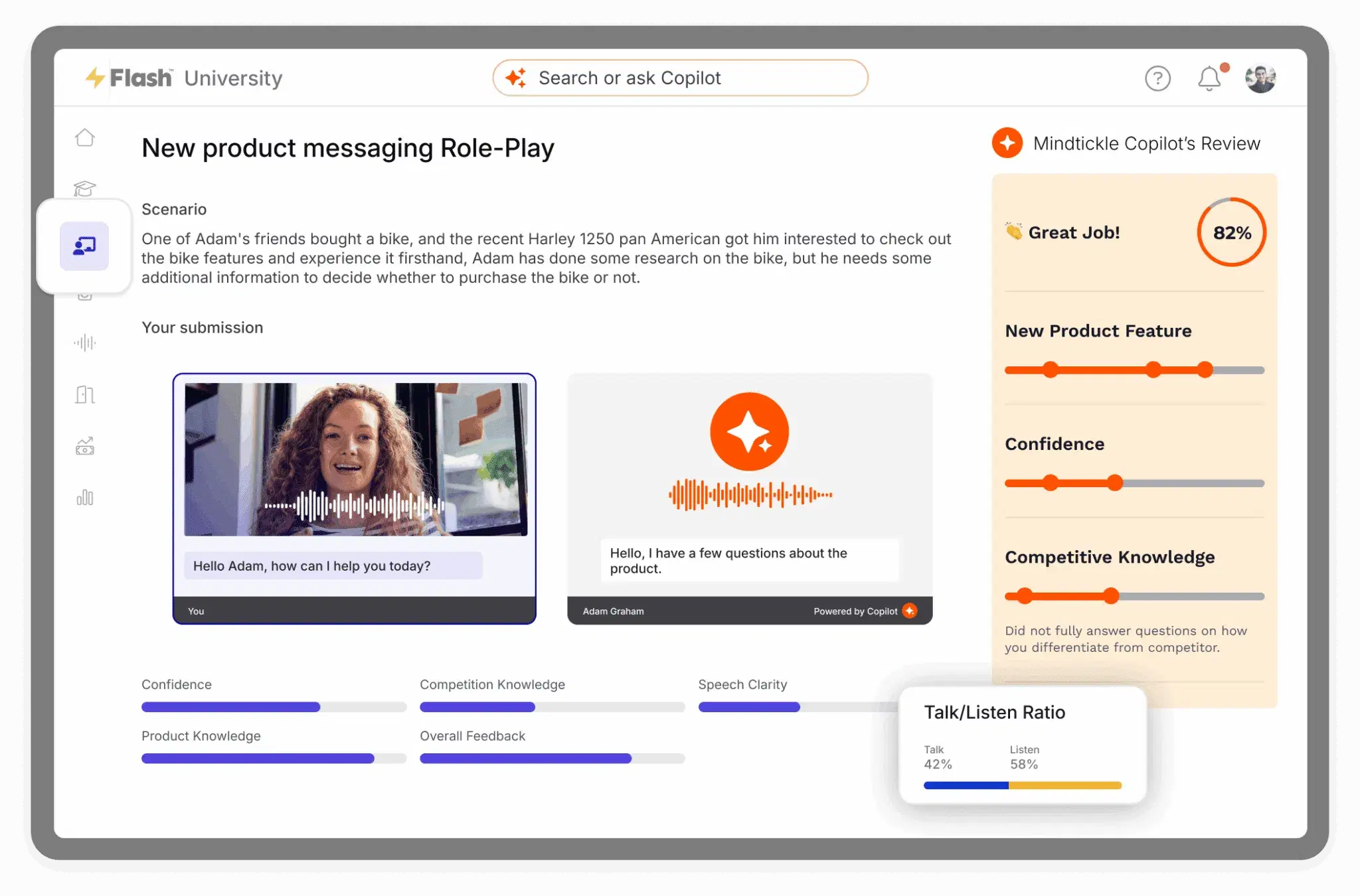
Mindtickle is the enterprise consolidation play Kendo is not built for
Where Kendo is a focused self-serve suite for SMB and mid-market teams, Mindtickle is a comprehensive enterprise enablement platform: structured learning paths, certifications, coaching, content management, conversation intelligence, digital sales rooms, and AI roleplay. Teams that have outgrown Kendo and want to consolidate their entire enablement stack into one enterprise platform end up evaluating Mindtickle.
The trade-off is scale and cost. Mindtickle is built for large organizations with six-figure budgets and dedicated enablement teams, a different universe from Kendo's transparent per-seat pricing. Its Call AI module ingests live customer calls and scores them against the same rubrics used in practice, which appeals to teams that need conversation intelligence alongside roleplay.
What Mindtickle actually does
- AI Role Play module: structured roleplay scenarios with AI buyer personas and methodology scoring
- Mindtickle Copilot: AI assistant that auto-grades roleplay submissions on empathy, keyword usage, pacing, and methodology adherence
- Call AI conversation intelligence: ingests live customer calls and scores them, included in the Transform tier
- Readiness Index: single composite metric to track proficiency across certifications and skills
- Digital Sales Rooms: centralized buyer-facing rooms for deal follow-up
- Sales Content Management: centralized playbooks, battle cards, and approved messaging
- 120+ integrations across CRM, LMS, conversation intelligence, and SSO
What Mindtickle users praise about platform consolidation
- All enablement workflows sit in one place. Training, coaching, certifications, content management, and conversation intelligence are managed inside one platform.
- Live call scoring connects practice to real conversations. The Call AI module evaluates real customer calls against the same rubrics used in practice.
- Strong enterprise customer base. Used by large organizations across SaaS and regulated industries that need broad enablement.
Where Mindtickle users hit friction with complexity and cost
- Common tasks can take too many clicks. Reps and managers often spend extra time navigating across modules.
- Setup requires meaningful upfront effort. Implementation typically takes 6-8 weeks plus $3K-$5K fees, a steep step up from Kendo's self-serve setup.
- AI Role Play depth trails dedicated tools. It is one feature among many rather than the core focus.
What to know before signing with Mindtickle
- Confirm what is actually included. Verify whether AI Role Play, Call AI, Digital Sales Rooms, and content management are included or priced as add-ons.
- Watch the contract mechanics. Annual prepayment, 30-90 day renewal notice windows, and 3-7% annual price increases are common.
- Budget for total cost of ownership. Onboarding and implementation can add $10,000-$50,000+, far above Kendo's pricing.
Mindtickle bundled enterprise pricing requiring six-figure annual commitment
Mindtickle does not publish public pricing. BetterCloud estimates $47,000 to $82,000 per year. Vendr shows a wider range: $50,000 to $150,000 annually for small deployments, $150,000 to $400,000 for mid-market, and $400,000 to $1M+ for enterprise rollouts.
Looking for a better-scoped alternative to Mindtickle? Read our complete guide to top Mindtickle alternatives.
5. Yoodli: Best for communication delivery coaching for individuals
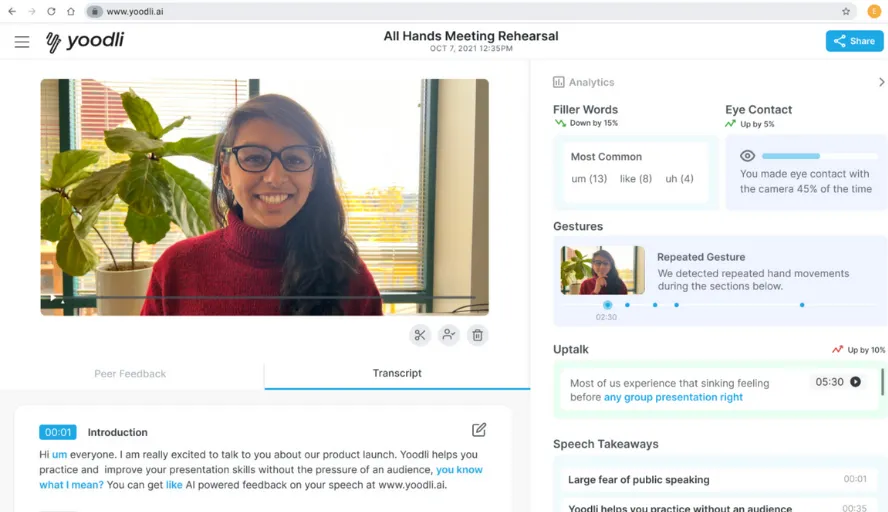
Yoodli matches Kendo on accessibility but focuses on delivery, not deal motion
For individuals and small teams drawn to Kendo's accessibility, Yoodli is a transparent-pricing peer with a different focus. Yoodli is built around communication delivery coaching: speech analytics, filler-word detection, pacing, and presentation feedback, with a genuinely free tier that makes it the most accessible entry point in the category. Where Kendo scores sales conversations against custom scorecards, Yoodli coaches how you communicate.
That focus is a strength and a limit. For public speaking, interview prep, and general communication confidence, Yoodli is excellent and free to start. For sales-specific motion, methodology scoring, multi-persona deals, and live call scoring tied to pipeline, Yoodli is lighter than Kendo, Outdoo AI, or Hyperbound.
What Yoodli actually does
- Communication delivery analytics: filler words, pacing, word choice, and clarity feedback
- AI roleplay scenarios: practice conversations with AI personas and follow-up questions
- Free tier for individuals: genuinely free entry point for solo practice
- Speech and presentation coaching: strong for public speaking and interview prep
- Integrations with meeting tools: analyze real meetings for delivery patterns
What Yoodli users praise about accessible communication coaching
- Genuinely free to start. The free tier makes Yoodli the most accessible communication coaching tool in the category.
- Strong delivery feedback. Filler-word detection, pacing, and clarity analytics are well-regarded for communication improvement.
- Low friction for individuals. No procurement, no setup overhead, immediate practice for solo users.
Where Yoodli users hit friction with sales-specific depth
- Lighter on sales methodology. Yoodli coaches delivery, not deal progression, methodology adherence, or multi-stakeholder dynamics.
- Limited live call scoring tied to pipeline. Less connected to CRM and revenue outcomes than Kendo, Outdoo AI, or Hyperbound.
- Team and enterprise depth is limited. Built around individual communication coaching rather than team-wide sales enablement.
What to know before signing with Yoodli
- Match the tool to the need. Yoodli is ideal for communication delivery, not sales-specific deal coaching.
- Validate team features. Confirm team analytics and management features meet your needs before scaling past individual use.
- Plan for the focus difference. Teams wanting sales methodology scoring should evaluate Kendo, Outdoo AI, or Hyperbound instead.
Yoodli free tier with custom team and enterprise pricing
Yoodli offers a genuinely free tier for individuals. Team and enterprise pricing is custom and requires engaging sales. The free entry point makes it the most accessible option in this comparison for solo users.
Evaluating alternatives to Yoodli? Read ourcomplete guide to top Yoodli alternatives.
6. PitchMonster: Best for low-cost gamified pitch practice for SMB
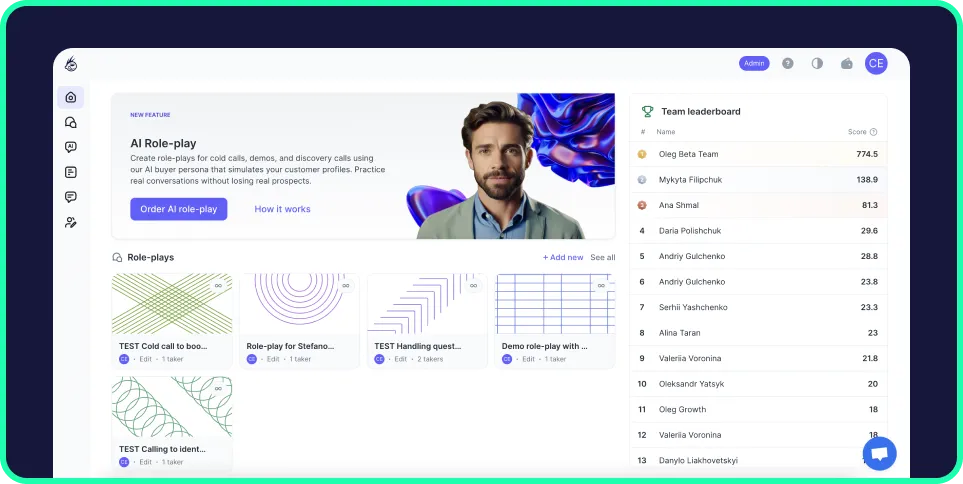
PitchMonster is Kendo's closest SMB peer on price and accessibility
PitchMonster sits closest to Kendo on the accessibility spectrum: an affordable, SMB-focused roleplay tool with gamified pitch practice. For small teams comparison-shopping against Kendo on price, PitchMonster is the direct peer, with per-user pricing in a similar accessible range and a focus on getting reps practicing quickly.
The difference is positioning. Kendo presents itself as a full sales management suite with roleplay, call review, and AI Sales Manager. PitchMonster stays narrower and more focused on gamified pitch and roleplay practice, which suits teams that want roleplay specifically without the broader suite. For teams that need enterprise depth, methodology scoring, or live call analysis tied to pipeline, both PitchMonster and Kendo are lighter than Outdoo AI or Mindtickle.
What PitchMonster actually does
- Gamified AI roleplay practice: pitch and objection-handling scenarios with scoring
- Affordable per-user pricing: accessible entry point for small teams
- Custom scenario creation: build practice scenarios for your motion
- Scoring and feedback: evaluate rep practice with structured feedback
- Team management features: track practice and progress across small teams
What PitchMonster users praise about accessible gamified practice
- Affordable for small teams. Per-user pricing makes it accessible to SMB budgets, comparable to Kendo's entry.
- Gamified practice drives engagement. The gamified approach keeps reps practicing more consistently.
- Focused on roleplay. Narrower scope than full suites means less to navigate for teams that want roleplay specifically.
Where PitchMonster users hit friction with depth and scale
- Limited enterprise depth. Built for SMB motion, with less methodology depth and fewer enterprise features than Outdoo AI or Mindtickle.
- Scenario setup requires effort. Like Kendo, building and maintaining custom scenarios takes manual work.
- Less live call analysis. Lighter on live call scoring tied to pipeline than Kendo, Outdoo AI, or Hyperbound.
What to know before signing with PitchMonster
- Confirm SMB fit. PitchMonster is built for small teams. Growing teams should evaluate whether they will outgrow it like they would Kendo.
- Validate scoring depth. Confirm the scoring layer meets your methodology needs before committing.
- Plan for scenario maintenance. Budget time to author and update scenarios as your motion changes.
PitchMonster affordable per-user pricing for SMB teams
PitchMonster pricing sits in an accessible per-user range, reported around $25 to $40 per user per month, positioning it as an affordable SMB-focused option comparable to Kendo's entry tiers. Confirm current pricing directly with the vendor.
Considering alternatives to PitchMonster? Explore 12 platforms with clearer pricing and deeper customization.
7. Quantified: Best for regulated industry certification with audit trails
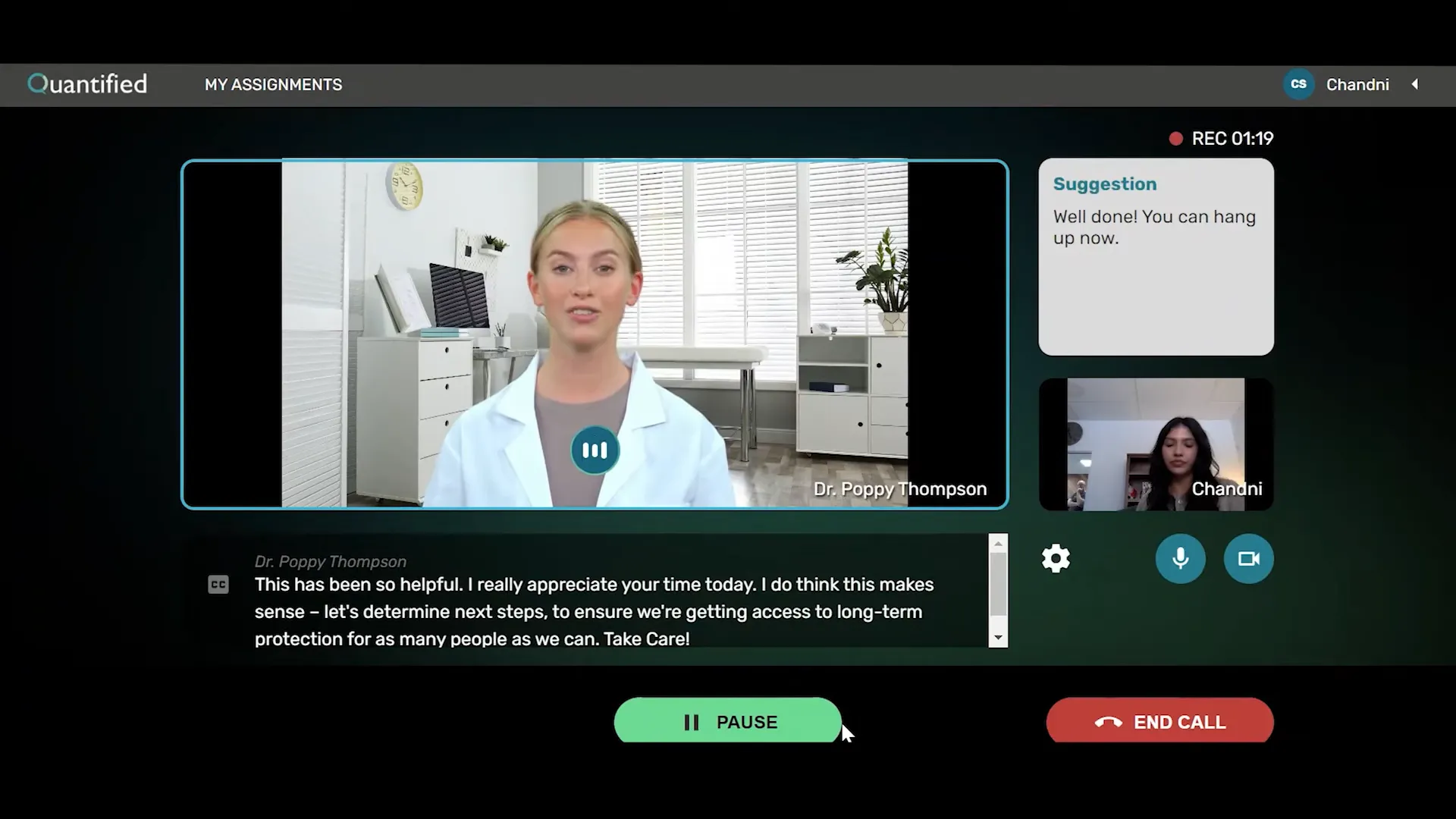
Quantified is the regulated-industry depth Kendo's SMB design does not reach
For teams in regulated industries that started with Kendo and hit compliance limits, Quantified is the certification-grade alternative. Where Kendo offers custom scorecards for general sales motion, Quantified provides ComplianceGuard AI with automated pass/fail enforcement, audit-ready trails, and published rubrics tied to Sandler, MEDDPICC, Challenger, and GAP frameworks. Customer logos include Novartis, Bayer, Sanofi, Astellas, Bausch + Lomb, and iRhythm, signaling traction across pharma, life sciences, and financial services.
This depth comes at an enterprise price point and team-size minimum that put Quantified in a different bracket from Kendo's self-serve tiers. For SMB teams, Kendo or PitchMonster fit better. For regulated teams that need formal certification with audit trails, Quantified is built for exactly that.
What Quantified actually does
- Photorealistic avatar-based simulations: avatars approaching real video-call realism with visual aid support
- ComplianceGuard AI: automated compliance scoring with audit trails, required language enforcement, prohibited terms trigger instant fail
- Structured assessment frameworks: scoring against predefined readiness criteria for benchmarking and certification
- Industry-specific scenarios: templates designed for life sciences, pharma, financial services
- Private LLM infrastructure: data is not used to train public models; SOC 2 Type II certified
- Methodology rubrics: pre-built rubrics for Sandler, MEDDPICC, Challenger, GAP frameworks
What Quantified users praise about regulated-industry certification
- Most rigorous competency model in the category. Published rubrics tied to specific methodologies make certification benchmarking auditable across cohorts.
- ComplianceGuard AI removes manager compliance review. Automated pass/fail enforcement and audit-ready trails reduce manual review workload.
- Strong enterprise base in regulated industries. Fortune 500 customers in pharma, life sciences, and finance choose Quantified for formal assessment.
Where Quantified users hit friction with adaptability and pricing
- AI needs repeated exposure to feel natural. Simulations improve with more practice cycles.
- Conversational flexibility is limited. Simulations handle multi-directional conversations less fluidly than more adaptive platforms.
- Pricing skews to enterprise teams of 25+ reps. Third-party data places it at $150-$250 per seat per month all-in, far above Kendo's self-serve tiers.
What to know before signing with Quantified
- Confirm regulated-industry fit. Quantified is built for pharma, life sciences, and financial services compliance training.
- Budget for premium pricing. Estimated at $150-$250 per seat per month all-in, materially higher than Kendo.
- Plan for longer sales cycles. Deployments involve procurement, compliance, and L&D teams.
Quantified enterprise pricing at $150 to $250 per seat per month estimated
Quantified does not publish pricing. Third-party procurement data places deals in the $150-$250 per seat per month range when platform fees, custom scenarios, and integrations are included, with a minimum economic team size around 25 reps.
Evaluating alternatives to Quantified? Read our complete guide to top Quantified alternatives.
How to choose the right Kendo AI alternative
No single Kendo AI alternative wins across every category. The right choice depends on where your team sits on the spectrum from accessible self-serve to enterprise depth. Use the questions below as a buying filter.
1. Are you outgrowing Kendo, or comparison-shopping at the same tier?
If you are hitting Kendo's usage caps or need enterprise depth, Outdoo AI, Mindtickle, and Quantified move you up the spectrum. If you are comparison-shopping at Kendo's accessible tier, Hyperbound (free tier), Yoodli (free tier), and PitchMonster (affordable per-user) are the peers.
2. Do you need multi-persona buying-committee simulation?
If yes, Outdoo AI simulates up to three AI stakeholders in a single resumable scenario, which Kendo's one-on-one persona model does not cover. This matters most for teams selling complex enterprise deals.
3. Is scenario-building effort your main Kendo frustration?
If yes, Second Nature ships a pre-built library you can deploy on day one, removing the manual authoring effort Kendo requires. The trade-off is less customization flexibility and a higher price point.
4. Do you need deep methodology-aligned scoring?
Both Outdoo AI and Quantified offer framework-specific scoring. Outdoo AI ships with SPIN, BANT, MEDDIC, MEDDPICC, and Challenger. Quantified ships with Sandler, MEDDPICC, Challenger, and GAP. Kendo's custom scorecards work for general motion but stay lighter on framework depth.
5. Is your motion outbound SDR practice specifically?
If yes, Hyperbound is purpose-built for SDR motion with strong voice realism and dialer-integrated call scoring. Outdoo AI also covers outbound as part of broader team coverage, including a scored gatekeeper phase for cold-call-heavy teams that Hyperbound does not offer.
6. Do you need enterprise compliance and governance?
For regulated industries requiring certifications and audit trails, Quantified's ComplianceGuard AI provides the deepest enforcement. Outdoo AI matches enterprise compliance posture (SOC 2 Type 2, GDPR, HIPAA, CCPA, private cloud) with methodology scoring across practice and live calls. Kendo's SSO and security features fit SMB needs but may fall short of formal enterprise procurement, and its SOC 2 Type II and ISO 27001 certifications are still listed as in progress rather than complete.
7. Is transparent self-serve pricing a hard requirement?
Kendo's published tiers (Free, $55 Pro, $100 Max) are a genuine advantage for teams that want to sign up without a sales conversation. Among alternatives, Outdoo AI, Hyperbound and Yoodli offer free tiers, Outdoo AI offers a free plan with usage credits, and PitchMonster offers accessible per-user pricing. Mindtickle, Second Nature, and Quantified are sales-led.
8. Are you a solo rep or a small team versus a scaling org?
Solo reps and small teams are well served by Yoodli, PitchMonster, or Kendo itself. Scaling and enterprise teams that need depth, governance, and live call validation are better served by Outdoo AI or Mindtickle.
Which Kendo AI alternative is best for your team?
The best Kendo AI alternative depends on where you are headed:
- For teams that outgrew Kendo and need enterprise roleplay and coaching depth: Outdoo AI
- For SDR motion with strong voice realism and dialer-integrated scoring: Hyperbound & Outdoo AI
- For pre-built scenario libraries without authoring effort: Outdoo AI & Second Nature
- For consolidating full enablement at enterprise scale: Mindtickle
- For communication delivery coaching for individuals: Yoodli
- For low-cost gamified pitch practice for SMB: PitchMonster
- For regulated industry certification with audit trails: Outdoo AI & Quantified
Most teams searching for Kendo alternatives are really asking one of two questions: is there a better tool at my current tier, or have I outgrown self-serve and need enterprise depth? For teams happy at the accessible tier, Kendo stays a strong fit, and Hyperbound, Yoodli, and PitchMonster are the closest peers. For teams scaling past usage caps, single-persona practice, and SMB-grade governance, the depth question points toward enterprise platforms.
Outdoo AI is built for that second question. The platform combines AI roleplays across chat, voice, and video modes with screen sharing, multi-persona simulations for buying committees with up to three AI stakeholders, methodology-aligned scorecards across SPIN, BANT, MEDDIC, MEDDPICC, and Challenger, live call analysis using the same scorecard as practice, multi-lingual support across 74+ languages, and post-call workflow simulation covering CRM logging and dispositioning. Enterprise teams use Outdoo AI to prepare before conversations, execute during live calls, and complete workflows in environments that mirror actual systems, with sales coaching tied directly to deal outcomes, backed by enterprise compliance (SOC 2 Type 2, GDPR, HIPAA, CCPA, private cloud).
Ready to see Outdoo AI in your environment? Schedule a demo to explore how it fits your team scenarios, methodology, and integrations.
Frequently Asked Questions
.svg)
Kendo AI uses transparent self-serve pricing: a Free trial at $0, Pro at $55 per seat per month (180 roleplay minutes plus 25 hours of live call scoring), and Max at $100 per seat per month (480 minutes plus 100 hours). Enterprise pricing is custom for teams of ten or more wanting custom models and done-for-you setup.
Teams usually look elsewhere for one of two reasons: comparison-shopping at the same accessible tier, or outgrowing Kendo's usage caps, one-on-one persona practice, and SMB-grade governance. Scaling teams often need multi-persona simulation, deeper methodology scoring, live call validation tied to pipeline, and enterprise compliance.
For SMB teams comparison-shopping at Kendo's tier, Hyperbound offers a free tier with strong voice realism, Yoodli offers free communication coaching, and PitchMonster offers affordable gamified practice. Kendo itself remains a strong SMB choice given its transparent tiers.
Yes. Kendo AI includes live call scoring through its API and native integrations with call-recording tools, with included hours scaling by plan (25 hours on Pro, 100 hours on Max). For teams needing live call scoring on the same methodology rubric used in practice across larger volumes, Outdoo AI and Mindtickle offer deeper enterprise-grade options.
Outdoo AI is built specifically for teams that have outgrown Kendo's self-serve, per-seat model. It covers multi-stakeholder buying-committee simulation, methodology-aligned scoring, live call analysis on the same rubric used in practice, and enterprise compliance requirements like SOC 2 Type 2, HIPAA, and GDPR. Outdoo AI also offers a free plan with usage credits for solo or small-team evaluation before scaling to usage-based or custom enterprise pricing.
Table of Contents
Talk to Sales
Have questions about training and enablement for your sales, CS, support, or leadership team? Let's talk.
Talk to Sales