



SDRs do not have one job. They have seven. Cold calls, gatekeepers, qualification, objection handling, follow-ups, voicemails, and warm handoffs to AEs are all separate conversations that require separate skills, and most SDR training treats them as one thing called "outbound."
The result is predictable. New SDRs get a script packet, shadow a few calls, and then start dialing. Their first 100 calls are essentially live practice against real prospects. Some reps figure it out in a few weeks. Others burn through contact lists for a month before their manager realizes the problem is skill, not effort.
Bridge Group research puts average SDR ramp time at 3.2 months. That is 3.2 months of salary, benefits, management time, and burned prospect lists before the rep is fully productive. For a team of 10 SDRs with 30% annual turnover, the ramp cost alone runs into hundreds of thousands of dollars before accounting for the pipeline that was never created.
AI roleplay compresses this ramp by giving SDRs a way to practice every type of sales conversation they will face, not just cold calls, in a realistic environment with structured scoring before they touch a real prospect list. This guide covers the full stack of SDR conversations and how to build practice programs for each one.
The Seven Conversations Every SDR Needs to Master
Most SDR training focuses on the cold call. But cold calls account for only one of at least seven distinct conversation types an SDR runs in a typical week. Each requires different skills, different timing, and different scoring criteria.
Training SDRs on "cold calling" without training them on the other six is like training a basketball player on free throws and skipping everything else. Each conversation type has a different rhythm, a different success criteria, and a different failure mode. AI roleplay lets you build targeted practice for each one.
Why Most SDR Training Programs Produce Slow Ramp and Inconsistent Results
The standard SDR onboarding playbook has not changed meaningfully in a decade. The tools are newer, but the approach has the same structural gaps.
How AI Roleplay Lets SDRs Practice Every Conversation Type Before Going Live
AI roleplay is not one tool for one skill. It is a practice infrastructure that covers every conversation type in the SDR stack, each with different personas, different scoring criteria, and different difficulty levels.
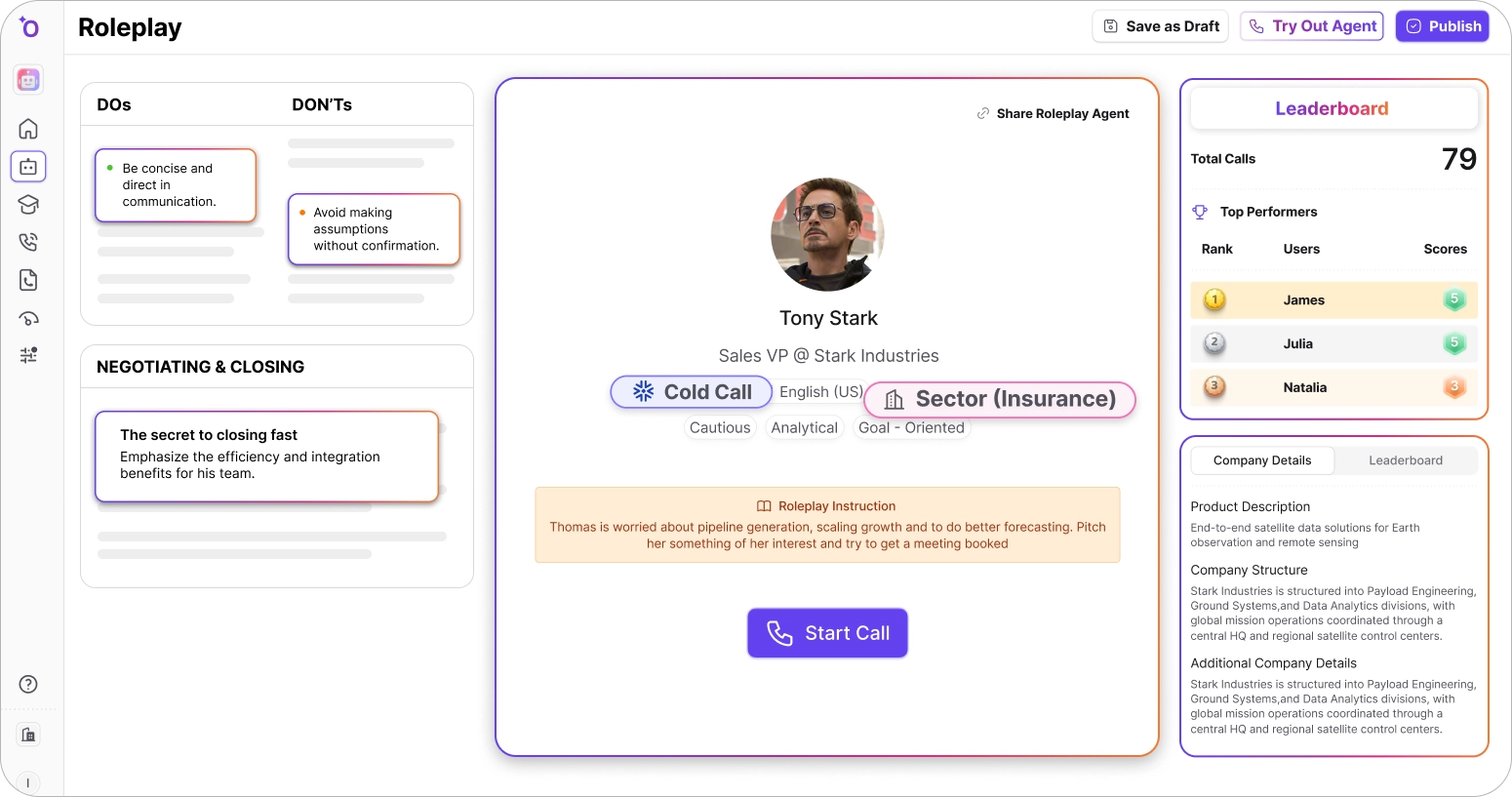
Here is how Outdoo AI lets SDR teams set up roleplay agents for each conversation type in minutes:
Practicing Each Conversation Type with AI Roleplay
Each conversation type below includes what the practice should focus on, how to configure AI personas and scoring, and which Outdoo AI capabilities are most relevant. For deeper coverage of any single type, the linked guides go into full detail.
1. Cold call openers: the first 15 seconds
The cold call opener is the highest-failure-rate conversation in sales. Most calls end before the rep finishes their first sentence. Our full cold calling guide covers this in depth, but the essential practice setup is straightforward.
Practice setup: Configure AI personas in three resistance modes: polite but busy, skeptical ("who is this?"), and hostile (attempting to end the call in five seconds). Score against time-to-relevance (how fast the rep said something the prospect cares about) and whether the opener was specific to the persona rather than generic. Outdoo AI can generate cold call personas from LinkedIn profiles, so reps practice against personas built from the actual accounts they are about to call.
Volume target: 20 to 30 opener-only roleplays per practice session. Skill isolation (practicing just the opener, not the full call) is what makes this efficient. A rep who runs 30 openers in 45 minutes has more repetition than they would get in a week of live dialing.
2. Gatekeeper navigation: reaching the decision-maker
Gatekeepers are the invisible filter that determines whether a rep's carefully prepared opener ever reaches the right person. This conversation is rarely practiced because colleagues cannot replicate the professional detachment of a real executive assistant.
Practice setup: Configure AI personas with three screening levels: casual inquiry ("may I ask what this is about?"), firm screening ("she asked me to screen vendor calls"), and active gatekeeping ("we have a no-solicitation policy"). Score against whether the rep was direct without being pushy, used the decision-maker's name confidently, and secured an alternative path when blocked (direct line, best callback time, email).
Key Outdoo capability: AI personas can be configured as specific gatekeeper archetypes (executive assistant, office manager, receptionist) with industry-appropriate screening behaviors. Scoring evaluates professionalism and directness rather than tricks or manipulation tactics.
3. Quick qualification: deciding fit in 60 seconds
The qualification conversation happens in the 30 to 60 seconds after a prospect agrees to keep talking. It is not deep discovery. It is triage: does this person have the problem, the authority, and the timing to be worth a meeting?
Practice setup: Build three persona variants: a strong fit (has the problem, has authority, has timeline), a partial fit (has the problem but no authority), and a poor fit (polite but no real need). Score against whether the rep identified the fit level correctly and took the right action for each. Use SPIN situation and problem questions compressed to cold call pace. The most important scoring criterion is whether the rep correctly disqualified the poor fit rather than forcing a meeting.
Key Outdoo capability: Methodology-aligned scorecards evaluate qualification against SPIN, BANT, or MEDDIC frameworks at each call stage. Scenarios can be grounded in real CRM data so the practice prospect mirrors the rep's actual target accounts.
4. Early-call objection handling: recovering in 10 seconds
Cold call objections are fundamentally different from mid-deal objections. The prospect has no relationship with the rep, no understanding of the product, and no reason to give the benefit of the doubt. Our full objection handling guide covers the five objection types in detail. For SDRs, the practice focus is speed of recovery.
Practice setup: Configure the AI persona to deliver the objection within the first 10 seconds, before the rep has finished their opener. Score against recovery speed (did the rep pivot in under 10 seconds?), relevance of the redirect question, and whether the call survived at least 30 more seconds after the objection. The key difference from general objection handling training is that SDR objections require compression: a full acknowledge-reframe-question cycle takes too long on a cold call.
Volume target: 15 to 20 objection recovery scenarios in a single session. Running the same objection type repeatedly builds the reflex that new SDRs need most. Vary the objection type across sessions (price one day, competitor the next, "not interested" the third).
5. Follow-up and re-engagement: restarting stalled conversations
Follow-up calls are the conversation type that SDRs practice the least and need the most. The prospect has already heard the pitch, possibly ignored two emails, and may or may not remember the initial conversation. The challenge is bringing new value without repeating what was already said.
Practice setup: Configure AI personas who remember the initial outreach but are lukewarm. They should respond differently to reps who bring new information versus reps who rehash the original pitch. Score against whether the rep referenced a new trigger event, a new piece of value, or a change in the prospect's situation rather than repeating the original message. Also score against whether the rep proposed a specific reason for the callback rather than a generic "just checking in."
Key Outdoo capability: Scenarios can be built from real CRM and conversation intelligence data, so the AI persona knows what was said in the "previous conversation" and reacts accordingly. This creates follow-up practice that mirrors the actual context a rep would have when re-engaging a real prospect.
6. Voicemail: the message most SDRs never practice
Voicemail is the most neglected SDR skill despite affecting 60% to 80% of all dials. Most SDR training never mentions it. The result is rambling, generic messages that guarantee the prospect will not pick up next time.
Practice setup: Configure scenarios that go to voicemail after two rings. Score against three criteria: was the message under 20 seconds, did it reference something specific to the persona (not a generic pitch), and did the rep state a concrete next step ("I will try you again Thursday afternoon"). Have reps record five voicemails in a row for five different personas and review scores as a batch.
Why this matters disproportionately: A voicemail that creates curiosity does not just earn a callback. It makes the prospect more likely to pick up the next time the rep's number appears. Good voicemail practice improves the connect rate on every subsequent dial to that prospect.
7. Warm handoff to AE: transferring context without losing information
The warm handoff is the conversation that determines whether the SDR's work produces a real opportunity or a confused AE walking into a meeting blind. It is the final step in the SDR workflow and the one that directly affects revenue, yet it is almost never trained.
Practice setup: Configure a two-part scenario. Part one: the SDR runs a cold call or qualification conversation and captures key information (pain, authority, timeline, next step). Part two: the SDR delivers a 60-second briefing to an "AE persona" who asks clarifying questions. Score against information completeness (did the handoff include the prospect's specific pain, not just "they seemed interested?"), clarity of the next step, and whether the AE persona had enough context to open the meeting without re-qualifying from scratch.
Key Outdoo capability: Post-call workflow simulation lets reps practice the entire handoff sequence: conversation, CRM logging, disposition selection, and AE briefing in one continuous flow. This mirrors the real post-call workflow where information loss typically happens, not during the conversation itself, but in the transition between call and documentation.
How to Build an SDR Practice Program That Covers the Full Conversation Stack
A program that covers all seven conversation types does not mean seven separate training tracks. It means a structured sequence that builds skills in the right order with the right intensity.
Phase 1: Foundation skills (Week 1 of onboarding)
Start with the three highest-volume conversation types: cold call openers, voicemail, and gatekeeper navigation. These account for the majority of an SDR's daily activity and are the skills where failure is most visible and most costly. Run intensive practice sprints: 30 opener scenarios, 15 gatekeeper scenarios, 10 voicemail recordings. Set minimum practice scores that a rep must hit before live dialing.
Phase 2: Conversation advancement (Week 2)
Once the foundation is set, add qualification and early objection handling. These skills depend on the opener succeeding first, which is why they come second. Build scenarios that chain: the rep opens, the AI persona stays on the line, and now the rep must qualify in 60 seconds while handling pushback. Score against both skills simultaneously to build the real-call flow.
Phase 3: Cycle completion (Week 3)
Add follow-up calls and warm handoffs. These are the skills that complete the SDR cycle: re-engaging prospects who did not convert on the first touch, and transferring qualified opportunities cleanly to AEs. Practice follow-ups against personas built from the "first call" scenarios so the context carries over realistically. Practice handoffs with the full post-call workflow: CRM logging, notes, and AE briefing.
Phase 4: Full-stack simulation (Week 4 and ongoing)
Run full-cycle SDR simulations that chain multiple conversation types in sequence: cold call opener into qualification into objection handling into close-for-meeting, followed by CRM entry and AE handoff briefing. Score the entire sequence on a single scorecard. This is the assessment that determines whether a rep is ready for independent dialing. Ongoing practice should target the specific conversation type where each rep's live performance data shows the biggest gap. Closed-loop coaching identifies these gaps automatically.
How to Measure SDR Readiness Across the Full Conversation Stack
Measuring SDR performance on one metric (meetings booked) misses the specific skills that drive or limit that metric. A rep who books few meetings might have a strong opener but weak qualification. Another might qualify well but leave terrible voicemails that kill the follow-up. Measuring across the full stack reveals where each rep needs targeted practice.
Getting Started with AI Roleplay for SDR Teams
SDR performance is not one skill. It is seven skills that chain together, and weakness in any one of them limits the output of the entire sequence. A rep with a strong opener but weak qualification books meetings that waste AE time. A rep with strong qualification but terrible voicemails never reaches enough prospects to qualify. Training that treats "outbound" as a single competency misses the specific link in the chain that is breaking for each rep.
AI roleplay gives SDR teams a way to practice each link independently, measure performance at each stage, and identify exactly where each rep needs targeted reinforcement. The combination of skill isolation (practicing one conversation type at a time), full-stack simulation (chaining all seven together), and closed-loop scoring (comparing practice to live performance) creates a training system that produces consistent, measurable improvement rather than hoping reps figure it out on the phones.
If you are building this for the first time, do not try to cover all seven conversation types at once.
Week 1: Start with openers and voicemail. These are the highest-volume, highest-failure-rate conversations. Set up five cold call opener scenarios across three resistance levels and five voicemail scenarios with different persona types. Run 30 openers and 10 voicemails per rep. Establish baseline scores.
Week 2: Add qualification and objection handling. Build chained scenarios where the opener succeeds and the rep must qualify in 60 seconds while handling pushback. Set minimum scores that indicate readiness for live dialing.
Week 3: Add follow-ups and warm handoffs. Build follow-up scenarios with CRM context from the "first call" and handoff scenarios with the full post-call workflow. This completes the SDR cycle in practice.
Week 4: Go live with closed-loop scoring. Start scoring real calls on the same rubrics used in practice. The gap between practice and live performance becomes the coaching conversation for each rep.
Outdoo AI covers the full SDR conversation stack in one platform. Reps practice cold call openers, gatekeeper navigation, qualification, objection handling, follow-ups, and voicemails using voice roleplays against AI personas configured from LinkedIn profiles and CRM data. Methodology-aligned scorecards evaluate each conversation type against SPIN, BANT, MEDDIC, and Challenger frameworks. Post-call workflow simulation covers the handoff sequence: CRM logging, disposition selection, and AE briefing. The same scorecard evaluates practice and live calls, so the skill gap is visible from day one. Teams like Globe Life, and RAIN Group use this system to compress SDR ramp from months to weeks.
If your SDR team is ready to practice the full conversation stack before going live, book a demo to see how it works in your environment.
Frequently Asked Questions
.svg)
SDRs should practice seven distinct conversation types: cold call openers, gatekeeper navigation, quick qualification, early-call objection handling, follow-up and re-engagement calls, voicemail, and warm handoffs to AEs. Each requires different skills, different scoring criteria, and different practice intensity. AI roleplay lets SDR teams build targeted scenarios for each conversation type rather than training everything as generic 'outbound.'
AI roleplay can compress SDR ramp from the typical 3.2 months to 3 to 4 weeks using a phased approach: Week 1 covers openers and voicemail (30+ practice scenarios), Week 2 adds qualification and objection handling, Week 3 adds follow-ups and handoffs, and Week 4 begins live dialing with closed-loop scoring. The rep arrives at live calls with pattern recognition and recovery instincts that normally take months of live dialing to develop.
Outdoo AI covers the full SDR conversation stack in one platform: cold calls, gatekeepers, qualification, objections, follow-ups, voicemail, and warm handoffs. Reps practice using voice roleplays against AI personas built from LinkedIn profiles and CRM data. Methodology-aligned scorecards evaluate each conversation type, and post-call workflow simulation covers CRM logging and AE briefing. The same scorecard scores practice and live calls for closed-loop coaching.
Yes. AI roleplay scenarios can be configured to go to voicemail after two rings. Scoring evaluates message length (under 20 seconds), specificity to the prospect (not a generic pitch), and whether the rep stated a concrete next step. Voicemail practice is one of the fastest ways to improve SDR outcomes because it affects 60% to 80% of all dials and most teams never practice it at all.
Track skill-level practice scores for each of the seven conversation types to create a profile per rep. Measure the practice-to-live score gap by conversation type to identify where training translates and where it does not. Track ramp velocity (days to minimum scores), conversion rate by funnel stage (opener to conversation, conversation to meeting, meeting to AE-accepted opportunity), and AE feedback on handoff quality.
Table of Contents
Talk to Sales
Have questions about training and enablement for your sales, CS, support, or leadership team? Let's talk.
Talk to Sales