



If you’re looking for a Trellus alternative, it is two things in one Chrome extension: a power and parallel dialer that runs on top of Outreach, Salesloft, HubSpot, and Apollo, and a real-time coaching layer that surfaces objection prompts and behavioral cues on the fly while reps are live on a call. If your goal is to replace the dialing engine, the natural alternatives are parallel dialers like Nooks, Orum, and Kixie. This post is about the other half of what Trellus does which is related to roleplay and coaching.
For sales training specifically, the question is different. Trellus coaches reps in the moment with live prompts, and its Parallel plan adds AI practice calls, but in-call nudges and a bolt-on practice feature are not the same as a dedicated AI roleplay and coaching system built for deliberate skill development. Teams that want reps to build muscle memory through structured practice before the call, and to validate that skill on real calls after, tend to look for a purpose-built training platform rather than a dialer with coaching attached.
This comparison covers the AI roleplay and sales training alternatives to Trellus, not the dialer alternatives. The seven strongest options in 2026 are Outdoo AI, Hyperbound, Luster, Second Nature, Rehearsal, Yoodli, and Quantified. Each approaches training differently: Outdoo AI for enterprise roleplay and coaching across the full skill cycle, Hyperbound for AI roleplay with real call scoring, Luster for predictive skill-gap detection, Second Nature for pre-built scenario libraries, Rehearsal for video-based practice, Yoodli for communication delivery, and Quantified for regulated industry certification.
The comparison below is grounded in G2 reviews, vendor documentation, and third-party procurement data sourced through May 2026.
What Is Trellus?
Trellus is an AI cold-calling copilot and power and parallel dialer that runs as a Chrome extension on top of Outreach, Salesloft, HubSpot, and Apollo, surfacing real-time objection prompts while reps are live on a call. Its Parallel plan adds AI practice calls, but training is a secondary feature rather than the core product.
Best Trellus alternatives for sales training in 2026 at a glance
| # | Tool | Best for | Free tier? | Starting price | One-line key advantage |
|---|---|---|---|---|---|
| 1 | Outdoo AI | Enterprise AI training and roleplay across the skill cycle | Free tier available | Free, Usage-based, or Custom | Multi-persona roleplay, live call scoring, and workflow simulation in one platform |
| 2 | Hyperbound | AI roleplay with real call scoring | Yes | Custom | Best-in-class voice realism, dialer-integrated call scoring |
| 3 | Luster | Predictive skill-gap detection before deals | No | Custom | Predictive Enablement that forecasts skill gaps from call and CRM data |
| 4 | Second Nature | Pre-built scenario libraries and certification | No | $30-$40/user/month | Deepest scenario library, avatar-led coaching with Jenny |
| 5 | Rehearsal | Video-based async practice and coaching | Free trial | Custom | Video practice with mentor feedback and added AI roleplay |
| 6 | Yoodli | Communication delivery coaching for individuals | Yes | $0; teams custom | Free communication coaching, strong for delivery |
| 7 | Quantified | Regulated industry certification with audit trails | No | Custom | ComplianceGuard AI with automated pass/fail compliance |
Where Trellus falls short for sales training
Trellus is a strong real-time calling copilot. The dialer is fast, the integrations are clean, and the live prompts genuinely help reps mid-conversation. The friction shows up when teams try to use Trellus as their sales training system rather than their dialing layer. Real-time assistance and deliberate practice are different disciplines, and a tool built for the first is not automatically built for the second. Across reviews and third-party analysis, six patterns drive teams to look for a dedicated training platform.
1. Live prompts are assistance, not deliberate practice
Trellus coaches reps while they are on a real call, suggesting they slow down, pause, or handle an objection a certain way. That helps in the moment, but it leans on live prospects as the practice surface. Deliberate practice means rehearsing a scenario repeatedly in a safe environment until the skill becomes automatic, before the rep ever dials a real buyer. Trellus is built around the live call, not the rehearsal that should precede it.
2. AI practice calls are a secondary feature on a dialer
Trellus added AI practice calls to its Parallel plan, which is a useful inclusion. But practice sits as one feature inside a platform whose center of gravity is dialing and real-time assist. Dedicated roleplay platforms put practice at the core, with deeper scenario design, scoring, and coaching workflows than a dialer-first product typically invests in.
3. No methodology-aligned scoring depth
Trellus surfaces objection prompts and behavioral cues, but it does not score practice against structured sales methodologies the way enablement leaders need. Teams running MEDDIC, MEDDPICC, SPIN, BANT, or Challenger want practice and calls scored against the framework rubric, with the depth to track methodology adherence over time. That is outside what a real-time calling copilot is designed to deliver.
4. No multi-persona buying-committee simulation
Trellus assists on one live call with one prospect. It does not simulate a multi-stakeholder buying committee where a rep navigates a CFO, a champion, and a procurement lead in a single scenario. For teams selling complex deals, practice that mirrors the real committee dynamic is exactly what a training platform should provide.
5. Limited structured certification and program design
Sales training programs need certification workflows, learning paths, and the ability to gate reps until they demonstrate competency. Trellus is built for in-call productivity, not for designing and running structured readiness programs with pass and fail certification across cohorts.
6. Training is tied to live dialing rather than safe rehearsal
Because Trellus centers on the dialer, much of its value is realized during live outreach. Teams that want a safe rehearsal environment decoupled from live prospects, where new hires can practice freely without consuming real leads or risking real conversations, need a platform built around that safe practice surface rather than around the dial.
1. Outdoo AI: Best for enterprise roleplay and coaching across the skill cycle
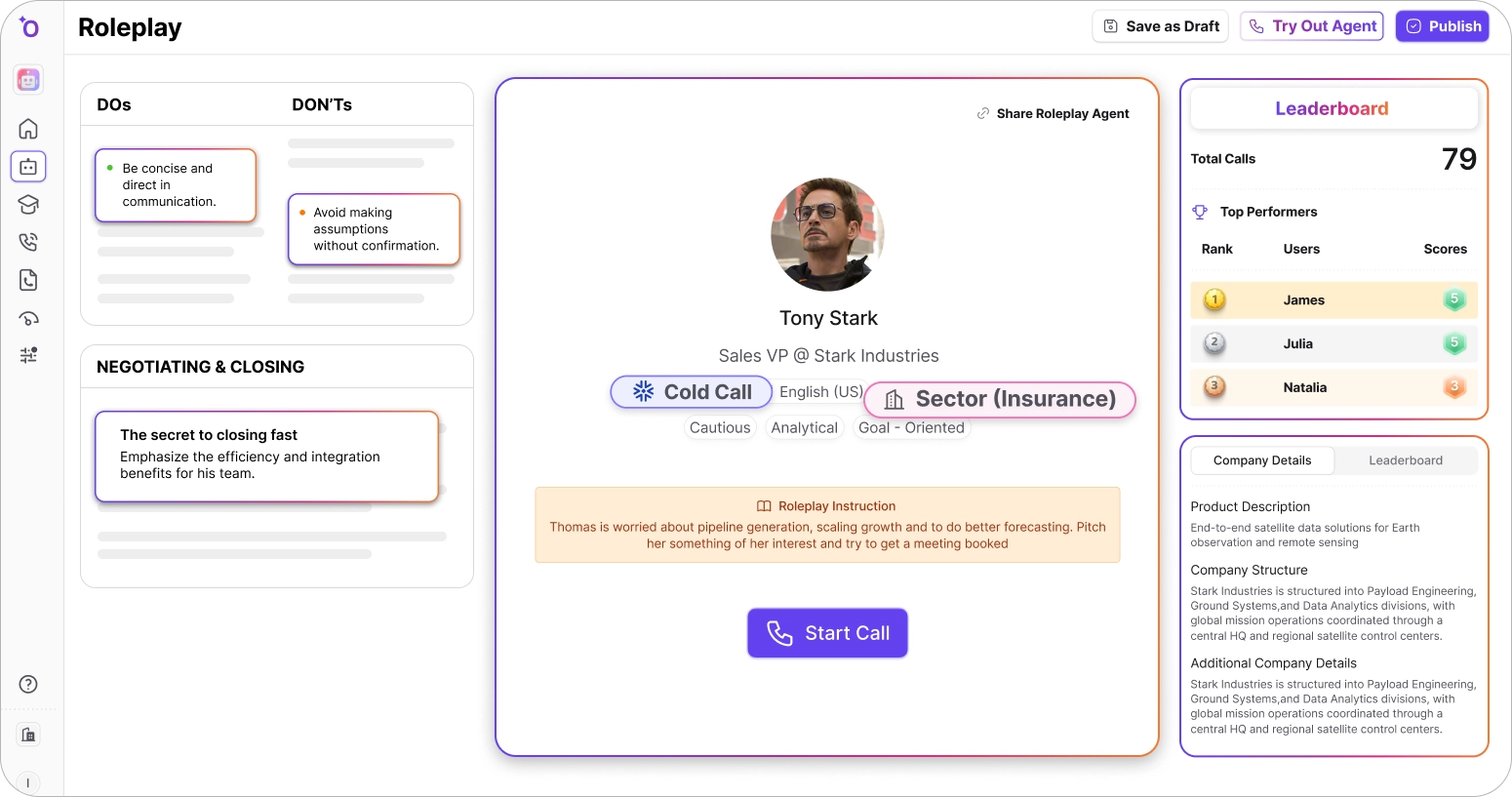
Outdoo AI trains the skill before the call and validates it after, where Trellus assists during
The cleanest way to see the difference is by timing. Trellus works during the live call, surfacing prompts as the conversation happens. Outdoo AI is an enterprise AI roleplay and coaching solution that works on either side of that moment: reps build the skill through deliberate practice before the call, and managers validate whether the skill showed up through live call scoring after. The two are not really competing for the same job. A dialer with live coaching helps a rep get through today's calls. A training platform builds the capability that makes every future call better.
For teams whose actual goal is rep development rather than dialing volume, that distinction matters. Outdoo AI combines multi-persona roleplay across chat, voice, and video, methodology-aligned scoring across SPIN, BANT, MEDDIC, MEDDPICC, and Challenger, live call analysis on the same rubric used in practice, post-call workflow simulation, and enterprise compliance. Reps practice in a safe environment against realistic buyers, get scored against the framework the team actually uses, and managers see whether the behavior carried into real conversations. Outdoo AI does not replace a dialer, and it does not try to. It owns the training layer that a calling copilot only touches at the edges.
Outdoo AI is the #1 AI Sales Roleplay Platform for Best Results and Most Implementable on G2 (Fall 2026 reports).
What Outdoo AI actually does
- Three roleplay modes: chat for quick objection drills, voice for phone-based motion, and video with lifelike AI avatars and screen sharing for demos and discovery practice
- Multi-persona simulations: practice against up to three AI stakeholders in a single resumable scenario (CFO, champion, procurement, or any combination), each behaving distinctly based on configured priorities
- Methodology-aligned scorecards: pre-packaged for SPIN, BANT, MEDDIC, MEDDPICC, and Challenger, plus custom rubrics built from your governance documents
- Live call scoring on the same scorecard as practice: ingest from Gong, Clari, or native conversation intelligence and score real calls against the methodology you use
- Workflow simulation beyond conversation: reps practice CRM logging, disposition selection, and process navigation in environments that mirror actual Salesforce, HubSpot, or Pipedrive instances
- Multi-lingual roleplays in 120+ languages: for global team deployments
- LinkedIn-based scenario creation: generate practice scenarios from LinkedIn profiles for outbound preparation against named accounts
- Dynamic micro-roleplays: when scoring identifies a coaching opportunity, Outdoo AI automatically generates a targeted reinforcement roleplay and surfaces relevant battle cards
- Revenue outcome correlation: connects roleplay scores, live call scores, and pipeline data to surface which behaviors correlate with won deals
- 120+ enterprise integrations: Salesforce, HubSpot, Pipedrive, Gong, Clari, Docebo, TalentLMS, Cornerstone, SCORM, xAPI, SSO
- Enterprise compliance: SOC 2 Type 2, GDPR, HIPAA, CCPA, PII scrubbing, private cloud deployment
Where Outdoo AI delivers the most value
Outdoo AI is built for teams that want training to translate into measurable performance, not just in-the-moment assistance:
- Safe rehearsal before live calls: reps practice freely against realistic buyers without consuming real leads or risking real conversations
- Multi-stakeholder practice for complex deals: buying-committee simulation that a single-call copilot does not cover
- Real call validation: practice scores and real call scores sit on the same rubric, so managers see whether training actually changes live behavior
- Methodology depth for serious enablement: framework-specific scoring that goes deeper than objection prompts
- Consistent coaching at scale: standardize what good looks like across reps, managers, and regions
- Workflow execution beyond conversation: reps practice the CRM and process steps that follow the call, not just the talk track
- Enterprise governance built in: compliance certifications, private cloud, and security review for regulated procurement
There was one roleplay agent that I put together named Chester. I made him be a little off kilter, talking about metaphors, be very artsy, talk about jazz a lot. That is something we want to see within the senior population. They like to talk. Sometimes they are not super clear. That has been really good for our agents to experience before experiencing it in the wild.
Jacob Irby, Assistant Director of Human Development, ProvideSure
What to know before signing with Outdoo AI
The main thing to evaluate is whether your team is ready for a team-based rollout. Outdoo AI is designed for sales teams, enablement teams, and managers who want consistent coaching across multiple reps, with production deployments typically starting at 5+ users. Teams used to Trellus's instant Chrome-extension install should plan for a scoped evaluation instead, since Outdoo AI is a training platform rather than a lightweight in-call add-on. Individual reps and teams can explore the free and usage-based tiers here. Enterprise evaluations typically include a scoped sandbox deployment configured to your team scenarios, methodology, and integrations.
Outdoo AI tiered enterprise pricing scoped to deployment
Outdoo AI uses a tiered pricing model designed for enterprise-scale deployments. Pricing scales with usage, integration depth, and compliance requirements rather than simple per-seat licensing.
- Outdoo AI's Free plan includes usage credits and unlimited team members to fully evaluate roleplay, coaching, and call scoring with Usage-based and Custom plans available as you grow.
- Flex tier (usage-based) includes multi-persona roleplays, certifications, workflow simulation, and methodology-aligned scoring
- Enterprise tier adds full integration scope (CRM, CI, LMS, SCORM, xAPI), enterprise compliance (SOC 2 Type 2, GDPR, HIPAA, CCPA, private cloud), and custom deployment
Enterprise pricing is custom-scoped because deployment varies materially by team size, integration scope, methodology configuration, and compliance requirements.
Outdoo AI vs Trellus: side-by-side comparison
| Capability | Outdoo AI | Trellus |
|---|---|---|
| Primary category | Enterprise AI roleplay and coaching | AI cold-calling copilot and dialer |
| Core job | Build and validate rep skill | Dial faster and assist during live calls |
| When it works | Before the call (practice) and after (scoring) | During the live call (real-time prompts) |
| Roleplay modes | Chat, voice, video with screen sharing | AI practice calls (Parallel plan add-on) |
| Multi-persona simulations | Up to 3 AI stakeholders, resumable | Single live-call assist |
| Methodology scoring | SPIN, BANT, MEDDIC, MEDDPICC, Challenger + custom | Objection prompts, behavioral cues |
| Live call scoring | Same scorecard for practice and live calls via Gong, Clari, native CI | Live transcription and real-time prompts |
| Dialer | Not a dialer (integrates with CRM and CI) | Power and parallel dialer (core feature) |
| Certification and programs | Structured certification, learning paths | Not a primary focus |
| Safe rehearsal surface | Dedicated practice environment | Practice tied to live dialing motion |
| Compliance posture | SOC 2 Type 2, GDPR, HIPAA, CCPA, private cloud | Standard SaaS security |
| Best fit | Teams building rep skill through training | Teams maximizing dial volume with live assist |
If your goal is to dial more numbers and get prompts mid-call, Trellus is built directly for that, and a parallel dialer like Nooks, Orum, or Kixie is the natural comparison. Outdoo AI is the stronger fit when the goal is sales training: building rep skill through deliberate practice, scoring it against your methodology, and validating it on real calls.
Want to see how Outdoo AI can help your team? Schedule a demo and talk to our experts.
2. Hyperbound: Best for AI roleplay with real call scoring

Hyperbound pairs dedicated roleplay with the call-scoring loop Trellus users will recognize
For Trellus users who like the outbound focus but want real practice depth, Hyperbound is a natural step. It is a dedicated AI roleplay platform built for SDR and outbound motion, with AI buyer bots reps practice against before live calls, then dialer integration that scores real calls against the same scorecard. Where Trellus assists during the call, Hyperbound builds the skill in practice and then validates it on the live call, closing the loop Trellus leaves open.
Hyperbound also leads on voice realism. Independent analysis from Knowlee April 2026 rates its persona realism as best-in-class, with voice latency under 400ms and personas that hold character when reps go off script. That realism is what makes the practice surface effective rather than an obvious simulation.
What Hyperbound actually does
- AI buyer bots with persona configuration: first bot setup typically under 10 minutes, full rollout in about two weeks
- Real call scoring through dialer integration: connects to dialers and call recorders to score live customer calls
- Demo call type with screen sharing: supports the screen-sharing motion AEs run during demos
- Multi-language coverage across 25+ languages: including Spanish, French, German, Mandarin, Japanese, Hindi, Hebrew
- Custom scorecards aligned to methodology: SPIN, BANT, MEDDIC, MEDDPICC, Challenger frameworks supported
- Free tier with limited bots: entry-point includes basic scorecards and transcription
What Hyperbound users praise about outbound-focused practice
- Voice realism is best-in-class. Knowlee rates Hyperbound persona realism as best-in-class as of April 2026, which makes practice feel like a real conversation.
- Bot setup is genuinely fast. First bot configuration takes under 10 minutes, comparable to Trellus's quick install but for practice rather than dialing.
- Real call scoring closes the practice-to-live loop. The dialer integration scores live calls against the same scorecard used in practice.
Where Hyperbound users hit friction with broader coverage
- Coverage skews to outbound SDR motion. Teams needing customer success, demo-heavy AE motion, or full enterprise deal coverage find the focus narrower than Outdoo AI.
- AE and enterprise depth is still maturing. Multi-stakeholder enterprise deal coverage is less developed than the SDR motion it is built around.
- Pricing is opaque past the free tier. Mid-market deals observed at $80-$150 per rep per month, with no public tier structure beyond the free entry.
What to know before signing with Hyperbound
- Confirm outbound motion fit. Hyperbound is purpose-built for SDR and outbound practice. Broader coverage should be validated against Outdoo AI.
- Validate AE coverage if you need beyond SDR. Pilot with a representative AE use case before committing.
- Plan for the bot library buildout. Adoption depends on a meaningful library of persona-configured bots. Budget enablement time for the first 30-60 days.
Hyperbound free tier plus demo-gated custom enterprise pricing
- Free plan: limited roleplay bots, basic scorecards, transcription, coaching feedback
- Custom plan for teams: unlocks unlimited bots, custom scorecards, analytics, integrations, security configurations
- Demo-led access: most advanced capabilities require engaging sales through a demo
Looking beyond Hyperbound? See how leading platforms compare for AI sales roleplay in 2026.
3. Luster: Best for predictive skill-gap detection before deals
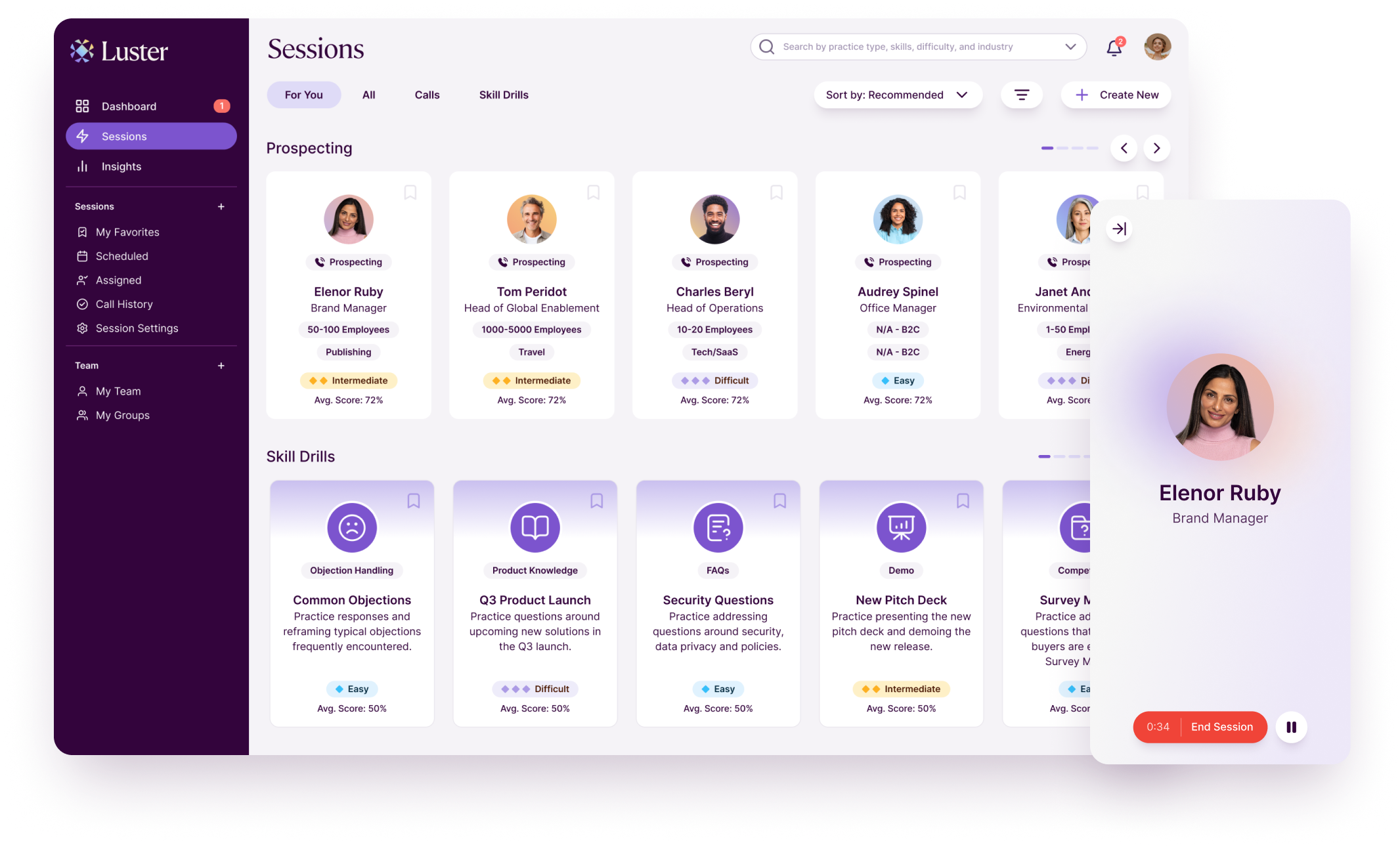
Luster predicts where reps will struggle before it costs a deal
Luster takes a different angle on sales training than Trellus or most roleplay tools. Built around what it calls Predictive Enablement, Luster analyzes call and CRM data to forecast where a rep is likely to struggle, then automatically prescribes targeted practice for those specific skill gaps before they surface in a real deal. Where Trellus reacts in the moment with a live prompt, Luster tries to get ahead of the problem entirely by spotting the pattern in the data first.
Founded in 2024 and backed by High Alpha, Luster pairs AI-simulated practice scenarios, tailored to buyer persona, industry, and deal stage, with gamified skill drills and predictive analytics dashboards. Early customers include ShipBob and Go1. For enablement leaders who already have solid call and CRM data and want training to be proactive rather than reactive, Luster is a genuinely distinct option.
What Luster actually does
- Predictive Enablement engine: analyzes call and CRM data to forecast skill gaps and recommend focus areas before they affect deals
- AI-simulated practice environments: scenarios tailored to sales stage, buyer persona, and deal size
- Gamified skill drills: short, repeatable exercises on objections, pitching, and methodology
- Screen-sharing practice: reps practice demos and product walkthroughs in a safe environment
- Individual and team analytics: dashboards that surface strengths, skill gaps, and coaching priorities
- Replay feedback and coaching plans: live feedback analysis on practice replays
What Luster users praise about predictive practice
- Proactive skill-gap detection is distinctive. Forecasting where reps will struggle before it costs a deal is a genuinely different approach from reactive coaching.
- Gamified drills keep reps engaged. Bite-sized skill drills break practice into focused sessions that sustain engagement and show progression.
- Strong reporting for enablement leaders. Individual and team dashboards give a clear, data-forward view of who needs coaching and where.
Where Luster users hit friction with realism and scope
- Conversation realism can have hiccups. Reviewers note occasional fluidity issues in AI conversations, with responsiveness that trails the dedicated voice leaders.
- Narrower scope than a full enablement platform. Luster focuses on predictive practice and does not cover the breadth of demo-grade practice or full program management some teams need.
- Predictions depend on data volume. The predictive engine works best once enough call and CRM data has accumulated, which means newer teams or new motions see less early value.
What to know before signing with Luster
- Confirm your data is ready. Predictive Enablement needs solid call and CRM data feeding in to forecast accurately. Validate your data foundation first.
- Set realism expectations. Validate conversation fluidity against your standards during evaluation, especially for advanced scenarios.
- Match scope to need. Luster is built for predictive practice. Teams needing demo-grade screen practice or full enterprise program management should compare against Outdoo AI.
Luster custom pricing with no public tiers
Luster does not publish pricing. Pricing is sales-led and customized based on team size, integration scope, and deployment requirements. Expect standard sales-enablement SaaS pricing models, with CRM integration and implementation costs to factor into total cost.
4. Second Nature: Best for pre-built scenario libraries and certification
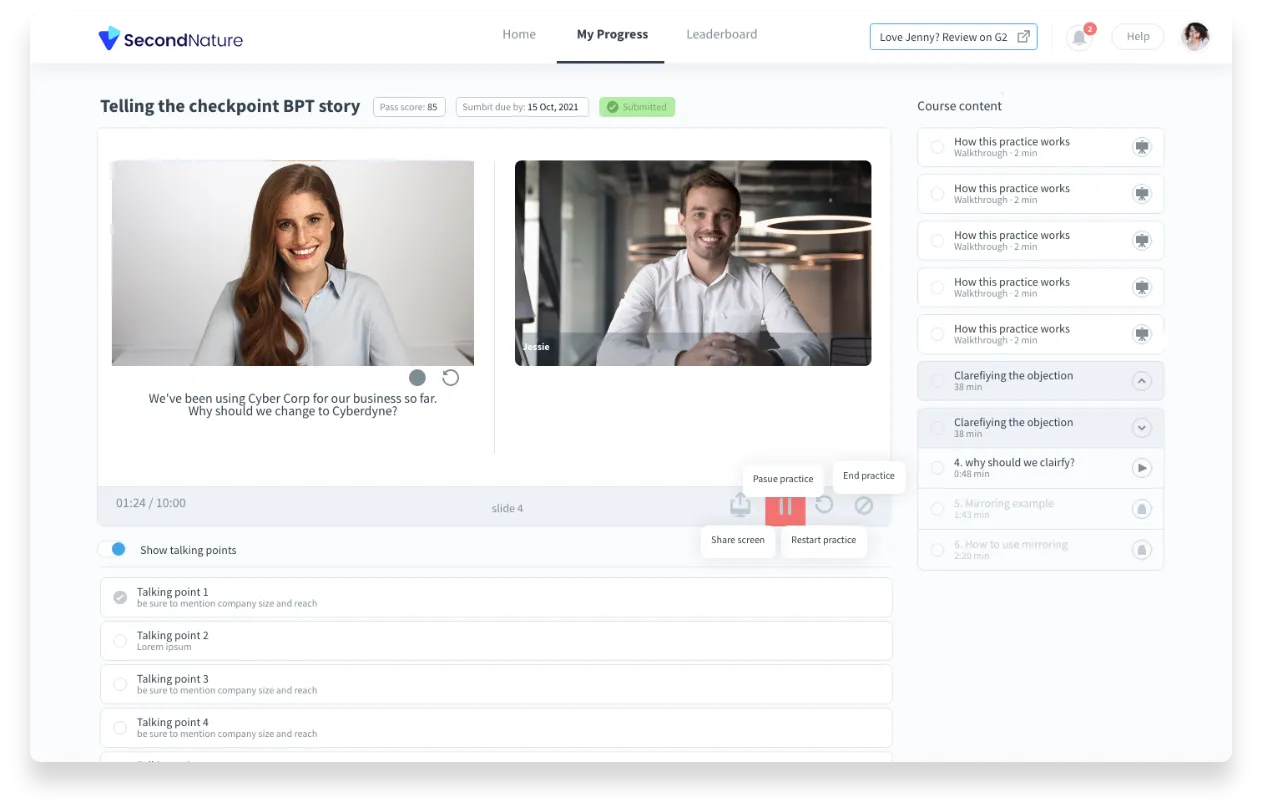
Second Nature gives training teams a ready scenario library, not a dialer
For teams moving from Trellus toward a real training program, the biggest immediate need is often content: structured scenarios reps can practice against from day one. Trellus has no scenario library to speak of, since it is a dialer. Second Nature ships 50+ pre-built scenarios with particular depth in healthcare, finance, and insurance, so a training program can launch without authoring everything from scratch.
Second Nature is the legacy player in AI sales roleplay, founded in 2018 and rebuilt on foundation models in 2023. Its main moat is the deepest pre-built scenario library in the category, often co-developed with enablement consultancies, and a strong fit for formal certification programs where readiness validation is required.
What Second Nature actually does
- Avatar-led virtual coaching with Jenny: simulating discovery, demos, and objection handling in a guided format
- Detailed soft-skill feedback: tone, pacing, clarity, filler words, and presentation style
- Structured certification workflows: fits into formal onboarding programs used by enterprise teams
- Predefined scenario libraries: curated by Second Nature with depth in healthcare, finance, and insurance
- Integration with LMS and onboarding stacks: supports enterprise training program workflows
What Second Nature users praise about pre-built content depth
- Pre-built content library is the deepest in the space. For teams that do not want to author scenarios, Second Nature ships ready content across industries and personas.
- Strong fit for certification programs. Purpose-built for pass and fail certification workflows where readiness validation is required.
- Fastest time to value. Onboarding time is shortest of any tool tested by Knowlee April 2026 analysis, with 50+ ready scenarios on day one.
Where Second Nature users hit friction with flexibility and price
- Persona engine feels less natural than newer tools. Despite the 2023 rebuild, avatars carry a slight scripted quality per Knowlee analysis.
- Custom scenario authoring is template-bound. More constrained than newer free-form tools.
- Pricing is higher and less transparent than Trellus. Sales-led pricing with a ~$20K annual minimum, versus Trellus's published self-serve tiers.
What to know before signing with Second Nature
- Validate scenario flexibility for your motion. Certification-friendly scenarios are predefined by design. Confirm customization scope if your team needs adaptive scenarios.
- Budget for the enterprise minimum. Community data indicates minimum annual deals often start around $20K.
- Plan for 4-8 week implementation. Enterprise rollouts take time to configure scenarios, certifications, and team structures.
Second Nature sales-led pricing in the $30 to $40 per user per month range
User-reported data places typical pricing at approximately $30 to $40 per user per month, with minimum annual deals around $20K. No public pricing on the website; teams must engage sales for quotes.
Considering alternatives to Second Nature? Explore tools that offer better flexibility and pricing.
5. Rehearsal: Best for video-based async practice and coaching
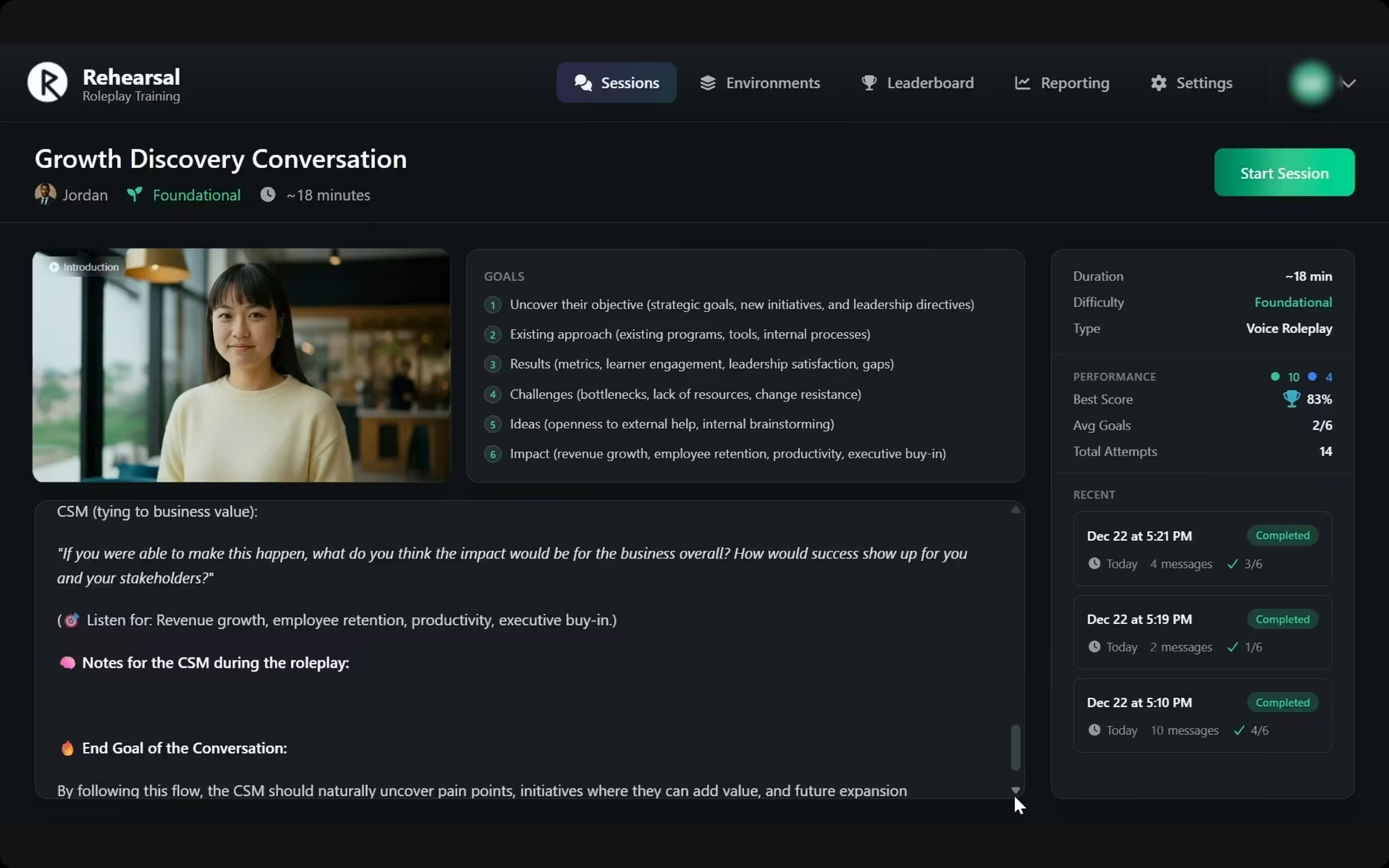
Rehearsal centers on video practice and mentor feedback, a different training model from live prompts
Rehearsal, from ELB Learning, approaches sales training through video-based practice rather than live-call assistance. Reps are assigned scenarios, record themselves responding on video or audio, and mentors leave timeline-based comments and grades, with AI roleplay and AI pre-screening now layered on top. Where Trellus coaches in the live moment, Rehearsal builds skill asynchronously: practice on your own time, get human and AI feedback, and repeat until the response is ready.
Founded in 2014 and acquired by ELB Learning in 2022, Rehearsal is a veteran in the video practice category, used by organizations like Honeywell, AllState, and Edmunds across sales enablement, customer service, leadership, and compliance training. Its asynchronous model suits distributed teams and training programs that value documented, reviewable practice over real-time conversation.
What Rehearsal actually does
- Video and audio practice assignments: reps record responses on any device and practice as many times as they want before submitting
- AI Roleplay: added AI-driven conversation practice with instant feedback alongside the video core
- Mentor timeline feedback and grading: mentors leave time-stamped comments and final grades on each response
- Hot Seat scenarios: single-take responses for higher-pressure practice
- AI pre-screening: AI reviews responses before human coaches invest time, making coaching more efficient
- Leaderboards and reporting: feature standout responses and measure performance and ROI
- LMS and SSO integration: access Rehearsal directly from your LMS
What Rehearsal users praise about video-based practice
- Documented, reviewable practice. Video responses with timeline feedback create a clear record of skill development that managers can track over time.
- Strong fit for distributed teams. Asynchronous practice lets reps rehearse anytime, anywhere, which suits remote and global teams.
- Established platform with enterprise customers. A decade-plus track record and customers like Honeywell and AllState signal maturity.
Where Rehearsal users hit friction with live conversational AI
- Roots are async video, not live conversation. The platform's core is recorded video practice, with AI roleplay as a newer layer rather than the foundation, so live conversational realism trails dedicated voice-first tools.
- Broader soft-skills focus than sales methodology. Rehearsal spans communication, compliance, and leadership training, with less sales-methodology depth than sales-specific platforms.
- Pricing is not public. Sales-led pricing requires contacting ELB Learning for a quote.
What to know before signing with Rehearsal
- Confirm the practice model fits. Asynchronous video practice is a different rhythm from live conversational roleplay. Validate it matches how your team wants to train.
- Validate sales-methodology depth. If framework-specific scoring is a priority, compare against Outdoo AI or Quantified.
- Plan for the LMS-centric workflow. Rehearsal fits naturally inside an LMS-driven training program, which suits some teams better than others.
Rehearsal custom pricing with a free trial
Rehearsal offers a free trial and subscription-based per-user pricing. Specific pricing is not published; teams contact ELB Learning for a quote. Pricing reflects its position as part of the broader ELB Learning training ecosystem.
6. Yoodli: Best for communication delivery coaching for individuals
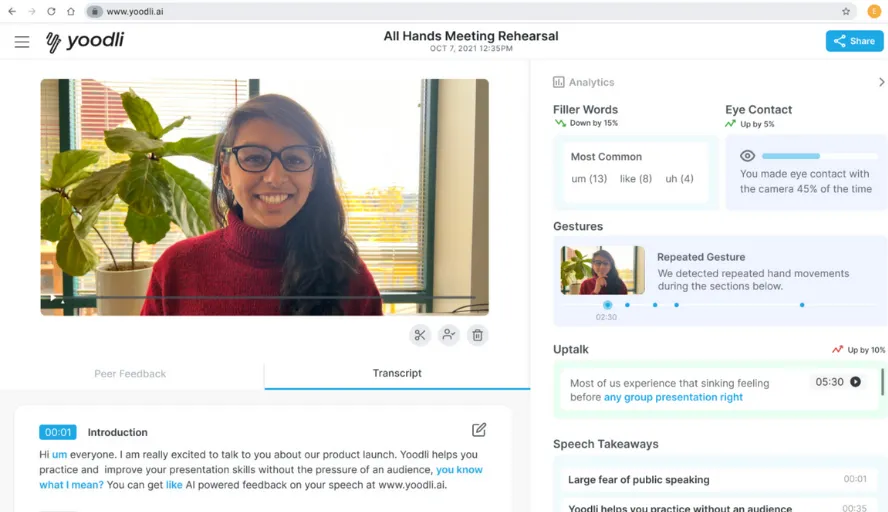
Yoodli coaches how reps communicate, with a genuinely free entry point
For individuals and small teams who want to sharpen delivery, Yoodli is the most accessible option in this comparison. It is built around communication coaching: speech analytics, filler-word detection, pacing, and clarity feedback, with a genuinely free tier. Where Trellus prompts during live calls and most roleplay tools score sales motion, Yoodli focuses on the mechanics of how you come across when you speak.
That focus is both a strength and a limit. For public speaking, interview prep, and general communication confidence, Yoodli is excellent and free to start. For sales-specific training, methodology scoring, multi-persona deals, and live call validation tied to pipeline, Yoodli is lighter than Outdoo AI, Hyperbound, or Quantified.
What Yoodli actually does
- Communication delivery analytics: filler words, pacing, word choice, and clarity feedback
- AI roleplay scenarios: practice conversations with AI personas and follow-up questions
- Free tier for individuals: genuinely free entry point for solo practice
- Speech and presentation coaching: strong for public speaking and interview prep
- Integrations with meeting tools: analyze real meetings for delivery patterns
What Yoodli users praise about accessible communication coaching
- Genuinely free to start. The free tier makes Yoodli the most accessible communication coaching tool in the category.
- Strong delivery feedback. Filler-word detection, pacing, and clarity analytics are well-regarded for communication improvement.
- Low friction for individuals. No procurement, no setup overhead, immediate practice for solo users.
Where Yoodli users hit friction with sales-specific depth
- Lighter on sales methodology. Yoodli coaches delivery, not deal progression, methodology adherence, or multi-stakeholder dynamics.
- Limited live call scoring tied to pipeline. Less connected to CRM and revenue outcomes than Outdoo AI or Hyperbound.
- Team and enterprise depth is limited. Built around individual communication coaching rather than team-wide enablement.
What to know before signing with Yoodli
- Match the tool to the need. Yoodli is ideal for communication delivery, not sales-specific deal coaching.
- Validate team features. Confirm team analytics meet your needs before scaling past individual use.
- Plan for the focus difference. Teams wanting sales methodology scoring should evaluate Outdoo AI or Hyperbound instead.
Yoodli free tier with custom team and enterprise pricing
Yoodli offers a genuinely free tier for individuals. Team and enterprise pricing is custom and requires engaging sales. The free entry point makes it the most accessible option in this comparison for solo users.
Evaluating alternatives to Yoodli? Read our complete guide to top Yoodli alternatives.
7. Quantified: Best for regulated industry certification with audit trails
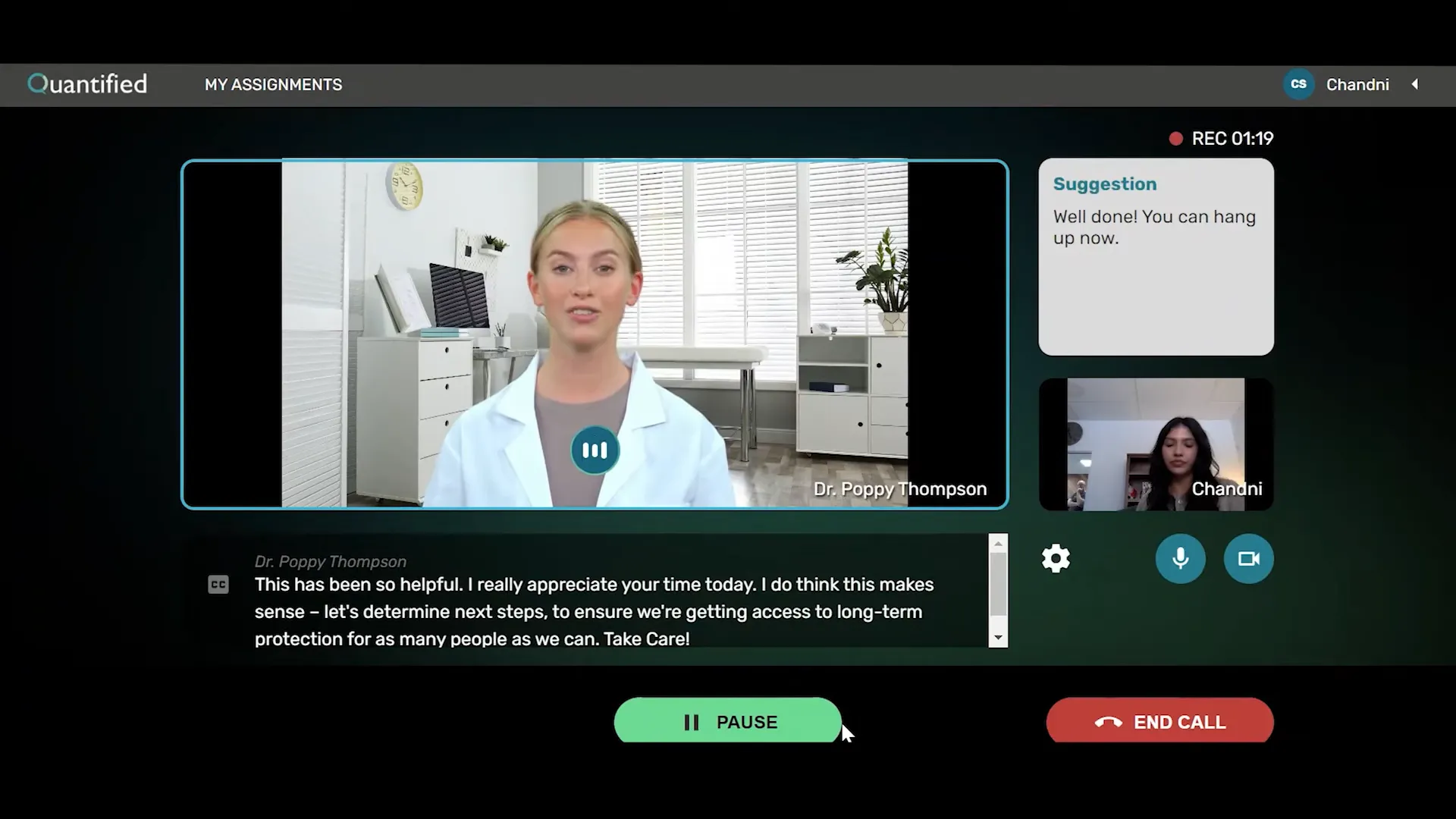
Quantified brings certification-grade rigor that a calling copilot cannot
For teams in regulated industries, sales training is not just skill-building, it is compliance. Trellus offers neither certification nor audit trails, because that is not its job. Quantified is built for exactly that: ComplianceGuard AI with automated pass and fail enforcement, audit-ready trails, and published rubrics tied to Sandler, MEDDPICC, Challenger, and GAP frameworks. Customer logos include Novartis, Bayer, Sanofi, Astellas, Bausch + Lomb, and iRhythm, signaling traction across pharma, life sciences, and financial services.
This depth comes at an enterprise price point and a team-size minimum that put Quantified in a different bracket from Trellus's self-serve tiers. For regulated teams that need formal certification with documented compliance, Quantified is purpose-built for that motion.
What Quantified actually does
- Photorealistic avatar-based simulations: avatars approaching real video-call realism with visual aid support
- ComplianceGuard AI: automated compliance scoring with audit trails, required language enforcement, prohibited terms trigger instant fail
- Structured assessment frameworks: scoring against predefined readiness criteria for benchmarking and certification
- Industry-specific scenarios: templates designed for life sciences, pharma, financial services
- Private LLM infrastructure: data is not used to train public models; SOC 2 Type II certified
- Methodology rubrics: pre-built rubrics for Sandler, MEDDPICC, Challenger, GAP frameworks
What Quantified users praise about regulated-industry certification
- Most rigorous competency model in the category. Published rubrics tied to specific methodologies make certification benchmarking auditable across cohorts.
- ComplianceGuard AI removes manager compliance review. Automated pass and fail enforcement and audit-ready trails reduce manual review workload.
- Strong enterprise base in regulated industries. Fortune 500 customers in pharma, life sciences, and finance choose Quantified for formal assessment.
Where Quantified users hit friction with adaptability and pricing
- AI needs repeated exposure to feel natural. Simulations improve with more practice cycles.
- Conversational flexibility is limited. Simulations handle multi-directional conversations less fluidly than more adaptive platforms.
- Pricing skews to enterprise teams of 25+ reps. Third-party data places it at $150-$250 per seat per month all-in.
What to know before signing with Quantified
- Confirm regulated-industry fit. Quantified is built for pharma, life sciences, and financial services compliance training.
- Budget for premium pricing. Estimated at $150-$250 per seat per month all-in.
- Plan for longer sales cycles. Deployments involve procurement, compliance, and L&D teams.
Quantified enterprise pricing at $150 to $250 per seat per month estimated
Quantified does not publish pricing. Third-party procurement data places deals in the $150-$250 per seat per month range when platform fees, custom scenarios, and integrations are included, with a minimum economic team size around 25 reps.
Evaluating alternatives to Quantified? Read our complete guide to top Quantified alternatives.
How to choose the right Trellus alternative for sales training
Before comparing training platforms, get clear on which half of Trellus you are actually replacing. If you want the dialer and real-time call assist, the right path is a parallel dialer like Nooks, Orum, or Kixie, and a training platform is a different purchase. If you want to build rep skill through practice and coaching, the questions below are the filter.
1. Are you replacing the dialer or the training layer?
If you need Trellus's dialing engine and live prompts, look at Nooks, Orum, or Kixie. If you need to build rep skill through deliberate practice, this list of roleplay and training platforms is the right set. Many teams keep a dialer and add a training platform alongside it, since they solve different problems.
2. Do you need practice before the call, assistance during, or both?
Trellus assists during. Dedicated roleplay platforms (Outdoo AI, Hyperbound, Luster, Second Nature, Rehearsal) build skill before the call. Outdoo AI and Hyperbound also validate skill after, through live call scoring on the same rubric used in practice.
3. Do you want training to be reactive or predictive?
Most platforms train against scenarios you choose. Luster is distinctive for predicting where reps will struggle from call and CRM data, then prescribing practice before the gap shows up in a deal. If you have solid data and want proactive training, Luster is worth a look.
4. Do you need multi-persona buying-committee simulation?
If yes, Outdoo AI simulates up to three AI stakeholders in a single resumable scenario, which neither Trellus nor most single-persona tools cover. This matters most for complex enterprise deals.
5. Is your training model live conversation or async video?
Most roleplay tools are live conversational practice. Rehearsal is built around asynchronous video practice with mentor feedback, a different rhythm that suits distributed teams and documented, reviewable skill development.
6. Do you need deep methodology-aligned scoring?
Outdoo AI and Quantified offer framework-specific scoring. Outdoo AI ships with SPIN, BANT, MEDDIC, MEDDPICC, and Challenger. Quantified ships with Sandler, MEDDPICC, Challenger, and GAP. Trellus surfaces objection prompts but does not score against methodology rubrics.
7. Do you need enterprise compliance and certification?
For regulated industries requiring certifications and audit trails, Quantified's ComplianceGuard AI provides the deepest enforcement. Outdoo AI matches enterprise compliance posture (SOC 2 Type 2, GDPR, HIPAA, CCPA, private cloud) with methodology scoring across practice and live calls.
8. Are you a solo rep or a scaling team?
Solo reps and small teams are well served by Yoodli's free tier or Hyperbound's free entry. Scaling and enterprise teams that need depth, governance, and live call validation are better served by Outdoo AI.
Which Trellus alternative is best for your team?
The best Trellus alternative for sales training depends on how your team wants to build skill:
- For enterprise roleplay and coaching across the full skill cycle: Outdoo AI
- For AI roleplay with real call scoring on outbound motion: Outdoo AI & Hyperbound
- For pre-built scenario libraries and certification: Outdoo AI
- For video-based async practice and coaching: Outdoo AI & Rehearsal
- For communication delivery coaching for individuals: Yoodli
- For predictive skill-gap detection before deals: Luster
- For regulated industry certification with audit trails: Outdoo AI & Quantified
The honest framing is that Trellus and a dedicated training platform often are not either-or. Trellus dials and assists during the call. A training platform builds the skill that makes those calls better. If you only want a faster dialer with live prompts, keep Trellus or compare it to Nooks, Orum, or Kixie. If you want reps who arrive at the call already prepared, that is a training purchase.
Outdoo AI is built for that training job. The platform combines AI roleplays across chat, voice, and video modes with screen sharing, multi-persona simulations for buying committees with up to three AI stakeholders, methodology-aligned scorecards across SPIN, BANT, MEDDIC, MEDDPICC, and Challenger, live call analysis using the same scorecard as practice, multi-lingual support across 120+ languages, and post-call workflow simulation covering CRM logging and dispositioning. Reps practice in a safe environment before live calls, managers validate whether the skill carried into real conversations, and sales coaching ties directly to deal outcomes, backed by enterprise compliance (SOC 2 Type 2, GDPR, HIPAA, CCPA, private cloud).
Ready to see Outdoo AI in your environment? Schedule a demo to explore how it fits your team scenarios, methodology, and integrations.
Frequently Asked Questions
.svg)
Trellus offers a Free plan at $0 per month with 30 power dials per week, a Power plan around $59.99 per user per month for single-line dialing, and a Parallel plan at $149.99 per user per month that adds multi-line dialing and unlimited AI practice calls. A custom Business plan is available for teams.
Trellus is primarily an AI cold-calling copilot and power or parallel dialer that runs as a Chrome extension, with real-time coaching prompts during live calls. Its Parallel plan adds AI practice calls, but training is a secondary feature. Teams wanting dedicated sales training look to roleplay platforms like Outdoo AI, Hyperbound, or Luster.
Outdoo AI, Hyperbound, Luster, Second Nature, and Rehearsal all provide safe practice environments for building skill before live calls. Outdoo AI and Hyperbound also validate skill after the call through live call scoring on the same rubric used in practice, closing the loop between training and real performance.
If you want to replace Trellus's dialing engine rather than its training layer, the closest alternatives are parallel and power dialers like Nooks, Orum, and Kixie. These focus on dial volume and call connection, which is a different category from the AI roleplay and training platforms in this comparison.
Trellus assists reps during live calls with prompts. Outdoo AI builds skill before the call through multi-persona practice and methodology-aligned scoring across SPIN, BANT, MEDDIC, MEDDPICC, and Challenger, then validates it after through live call scoring on the same rubric. It adds workflow simulation and enterprise compliance, owning the training layer a calling copilot only touches.
Table of Contents
Talk to Sales
Have questions about training and enablement for your sales, CS, support, or leadership team? Let's talk.
Talk to Sales