




Real-time AI sales coaching feels like the obvious fix: whisper the right answer in a rep's ear mid-call, and they handle the objection perfectly. Post-call feedback feels slower and less exciting, you review the call after it is over. But if the goal is changing how a rep sells, not just rescuing one call, the slower option is usually the one that works.
This article compares real-time coaching and post-call feedback, what each actually does, where real-time genuinely helps, and why practice plus post-call review is what changes rep behaviour over time. The short version: real-time is a crutch for the moment, and practice is what builds the skill.
What is real-time AI sales coaching?
Real-time AI sales coaching gives a rep live guidance during a call: on-screen objection prompts, cue cards, battlecard suggestions, and next-step nudges that appear as the conversation happens. The pitch is that a rep never freezes, because the answer is on the screen when they need it.
It is genuinely useful in the moment. A newer rep gets a safety net, a tricky objection gets a suggested response, and nobody blanks on a competitor comparison. The catch is what happens on the next call, when the prompt is gone.
What is post-call feedback and practice?
Post-call feedback works the other way round. Instead of helping during the call, it reviews what happened after: scoring the call against the skills you coach, flagging the moments that mattered, and turning those into focused practice before the next conversation.
Paired with practice, it looks like this: a rep runs a short roleplay on the specific skill they missed, gets scored, and repeats it until the response is theirs. The improvement shows up on the next live call, not because a prompt appeared, but because the rep actually got better at it.
Where real-time coaching genuinely helps
Real-time coaching is not useless, and it is worth being fair about where it earns its place.
- Ramp support for new reps: a live cue card can keep a brand-new rep from freezing while they are still learning the product.
- Recall in the moment: surfacing a competitor battlecard or a pricing detail mid-call saves a rep from fumbling a fact.
- Confidence: knowing a safety net exists can lower call anxiety for reps who are still finding their footing.
All of that is real value. But notice what these have in common: they help the rep get through this call. None of them make the rep better at the next one on their own.
Why real-time coaching alone does not change behaviour
The problem with relying on real-time coaching is that reading a prompt is not the same as learning a skill, and behaviour change needs the second thing.
Three reasons it falls short on its own. First, it creates dependency: if the rep only handles the objection because the answer was on screen, they have not built the instinct, and take the prompt away and the gap returns. Second, mid-call is the worst time to learn, a rep managing a live buyer has no spare attention to absorb a new technique. Third, and most important, there is no repetition. Skills form through doing something several times with feedback, not seeing it once.
Learning science is blunt about this. The well-documented Ebbinghaus forgetting curve shows people forget roughly half of new information within a day and up to 70% within a week unless it is reinforced. A prompt a rep read once, mid-call, is gone almost immediately. What counters the curve is spaced, repeated practice, which studies link to a 30 to 55% improvement in recall over a single learning event.
What actually changes rep behaviour: practice plus post-call feedback
Behaviour changes when a rep practises the specific skill, gets specific feedback, and does it again, close to the real thing. That is the whole mechanism, and it is where post-call review earns its keep: it tells you exactly what to practise.
A framework that works in the field looks like this:
- Drill one skill at a time. Short, five to seven minute roleplays focused on a single skill, discovery, a specific objection, or holding control, not a full call every time.
- Review just one or two moments. Pinpoint where the rep lost control, did not quantify pain, or failed to confirm the agenda, rather than critiquing everything.
- Repeat the same objection several times. Drilling the same pushback ten times, trying different approaches, is what moves it into muscle memory.
- Score it consistently. The same rubric each time, so a rep can see improvement across attempts instead of getting a different opinion each review.
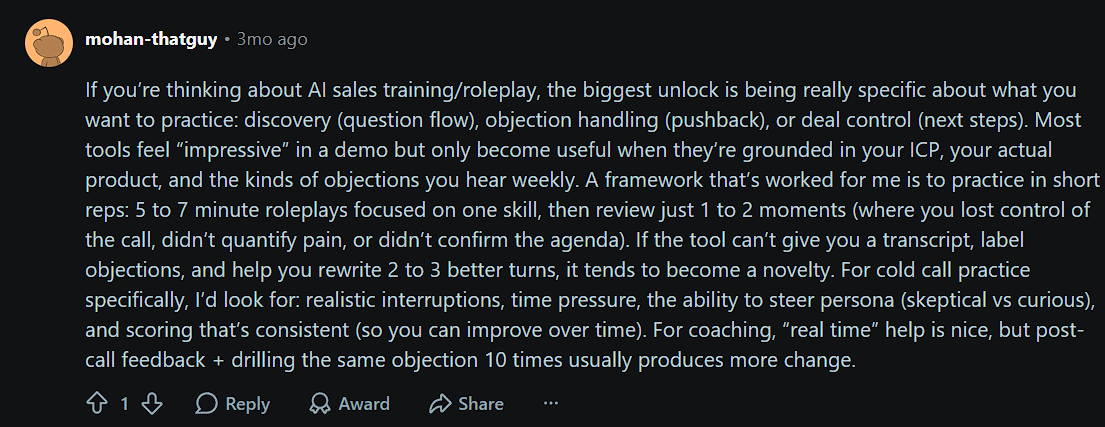
This is exactly the pattern experienced practitioners land on. In one r/SaaS discussion about building AI sales coaching, a seller made the point plainly, that real-time help is nice, but post-call feedback and drilling the same objection many times produces more change.
How to combine real-time and post-call the right way
This is not an argument to throw away real-time coaching. It is an argument about where to put your weight. Use real-time as a light in-the-moment aid if it helps your newer reps, but build the program on practice and post-call feedback, because that is what compounds.
The strongest setup connects the two into a loop: score the real call, find the recurring gap, drill it in practice, then check the next calls to confirm it stuck. Real-time can ride along as a safety net, but the behaviour change comes from the practice loop underneath it.
How Outdoo AI changes rep behaviour, not just the current call
For teams that want coaching to actually change behaviour rather than just help in the moment, Outdoo AI stands out because it is built on the practice-and-feedback loop that makes new habits stick.
Outdoo AI, the enterprise AI roleplay and training platform for customer-facing teams, runs that loop end to end:
- AI Roleplay lets reps drill a specific objection or skill against a realistic AI buyer built from your own calls, as many times as it takes.
- Unified scoring applies one methodology-aligned rubric to both practice and live calls, so post-call review points to exactly what to practise next.
- Closed-loop coaching turns a gap flagged on a real call into a targeted micro-roleplay, then checks whether the skill showed up on later calls.
- AI Tutors and workflow simulation cover the knowledge and after-call work, so the whole job improves, not just the talking part.
The result is coaching you can measure: a rep's practice score and live-call score sit side by side, so you can see behaviour actually change. Teams can start on a Free plan with limited credits, then move to usage-based pricing as they scale.
Help the call, or change the rep
Real-time coaching helps a rep survive the call in front of them. Practice and post-call feedback change how they sell on every call after. Both can coexist, but if you only invest in one, invest in the one that compounds. Score the calls, drill the gaps, and check whether the skill carried over, and you get reps who no longer need the prompt.
To see the practice-and-feedback loop run on your own calls and scorecard, schedule a demo with Outdoo AI.
Frequently Asked Questions
.svg)
Real-time coaching gives a rep live guidance during a call, like on-screen objection prompts and cue cards, to help them get through that conversation. Post-call coaching reviews the call afterward, scores it, and turns the gaps into focused practice before the next call. Real-time helps in the moment; post-call feedback plus practice is what builds lasting skill.
It helps in the moment, especially for newer reps who might otherwise freeze, but on its own it does not change behaviour. Reading a prompt mid-call is not the same as learning the skill, it creates dependency, offers no repetition, and mid-call is the worst time to absorb something new. Durable improvement comes from practising the skill and getting feedback, not from a prompt appearing on screen.
Practice with feedback, repeated over time. Reps build skill by drilling one thing at a time, five to seven minute roleplays on a single objection or skill, reviewing one or two key moments, repeating the same scenario several times, and scoring it consistently. This counters the forgetting curve, which otherwise erases most of what a rep learns within a week.
You can, but weight them differently. Use real-time coaching as a light safety net for newer reps if it helps, and build the core of your program on practice and post-call feedback, since that is what compounds. The strongest setup connects them: score the real call, drill the gap in practice, then check later calls to confirm the skill stuck.
Because of the forgetting curve. Without reinforcement, people forget roughly half of new information within a day and up to 70% within a week, so a technique taught once, or a prompt read once mid-call, fades fast. Spaced, repeated practice moves the skill into long-term memory and is linked to significantly better recall than a single learning event.
Table of Contents
Talk to Sales
Have questions about training and enablement for your sales, CS, support, or leadership team? Let's talk.
Talk to Sales