



The single most expensive habit in B2B sales is the discount reflex. A buyer pushes on price, the rep flinches, and a few points of margin disappear before anyone has even diagnosed what the buyer actually needs.
Every unnecessary discount point is pure margin gone, and you do not fix that habit with a workshop, because the gap is not knowledge, it is execution under pressure. Reps can recite the give-and-get framework in a classroom and still fold the moment a procurement lead says 30% or we walk.
AI roleplay is the most direct way to train negotiation calls, because it puts every rep through the price-pressure moment as many times as it takes for holding the line to become the reflex. Gong analyzed 67,149 sales calls and found the behaviors that separate top negotiators from average ones are specific and coachable: top reps stay calm and pause after a pushback, while average reps speed up into a knee-jerk monologue.
Specific and coachable is the whole point, because it means negotiation skill can be built through repetition rather than hoped for. This guide covers the moments to drill, how to build and score the roleplays, sectioned prompts you can copy, the complex buying committee, and how to run it across an enterprise team.
What Is Negotiation Roleplay Training?
Negotiation roleplay training is a practice method where a rep negotiates against an AI buyer who pushes on price, terms and competitor quotes, then gets scored on a rubric covering discount discipline, concession trading and protected margin.
The five negotiation moments worth drilling in roleplay
Not every negotiation needs a roleplay, but five moments break reps consistently and decide most of the margin. Drill these.
1. The discount demand
The buyer loved the demo, then asks for a 25% cut and hints the CFO will resist. Reps default to conceding before they understand the concern, which anchors the buyer lower for the rest of the conversation. What good looks like is diagnosing first: Gong found top reps respond to objections by asking questions 54.3% of the time versus 31% for average reps, because the question buys information and control before any number moves.
2. Concession trading
Reps give concessions away instead of trading them. The rule to drill is simple: never give a concession without taking one back. A rep who can reflexively trade a discount for an annual prepay, a longer term, reduced scope, or a referral holds margin while still handing the buyer a win to take upstairs, which is the difference between a negotiation and a giveaway.
3. Procurement hardball
Procurement is paid to push, and 30% off with net-90 terms or we go to the backup vendor is usually a test, not a wall. Reps freeze or fold under it, when what good looks like is staying composed, separating the real budget constraint from the opening position, and restructuring the deal rather than slashing the price. This is the moment most reps have never actually practiced under pressure.
4. Competitor leverage
The buyer says a competitor quoted 30% less. Reps either match blindly or get defensive and badmouth the rival. The skill to drill is reframing toward value and asking what the cheaper option actually leaves out, so the conversation moves off the number and back onto the outcome the buyer is buying.
5. The last-minute objection
Just before signing, the buyer raises a new concern or a sudden deadline. Reps panic and concede to save the deal. What good looks like is treating the objection calmly, reaffirming value, and holding terms rather than buying the close with margin. Recovery is a skill, and it is one reps can rehearse until it is second nature.
How to set up a negotiation roleplay that pressures reps
A roleplay only trains negotiation if the AI buyer behaves like a real one under pressure. Four setup choices make that happen.
1. Give the buyer a real constraint and a hardball tactic
Configure the buyer with a genuine underlying constraint, such as a fixed annual budget, and an opening tactic that hides it, such as a blunt discount demand. The rep should have to diagnose the real driver rather than react to the stated position. This mirrors how procurement actually negotiates.
2. Make the buyer reward technique and punish caving
Set explicit behavior rules tied to the rep's moves: if the rep discounts without asking for anything, the buyer pushes harder and lowers the anchor, and if the rep trades a concession for value, the buyer softens. The buyer should withhold the deal from a rep who folds and reward one who holds and trades, because that contrast is what teaches.
3. Set the difficulty to the rep's level
A buyer that caves after one reframe builds false confidence, and one that is impossible frustrates a new hire. Calibrate the buyer's aggression to the rep's tenure and segment, so a first-year rep faces firm but fair pushback while a senior rep gets a procurement lead who genuinely tests them.
4. Score against a negotiation rubric
Build the scorecard around the behaviors that protect margin, not a vague sense of how the call went. Weight it toward the moves that matter, such as diagnosing before conceding and trading rather than caving, so the score reflects what actually defends a deal.
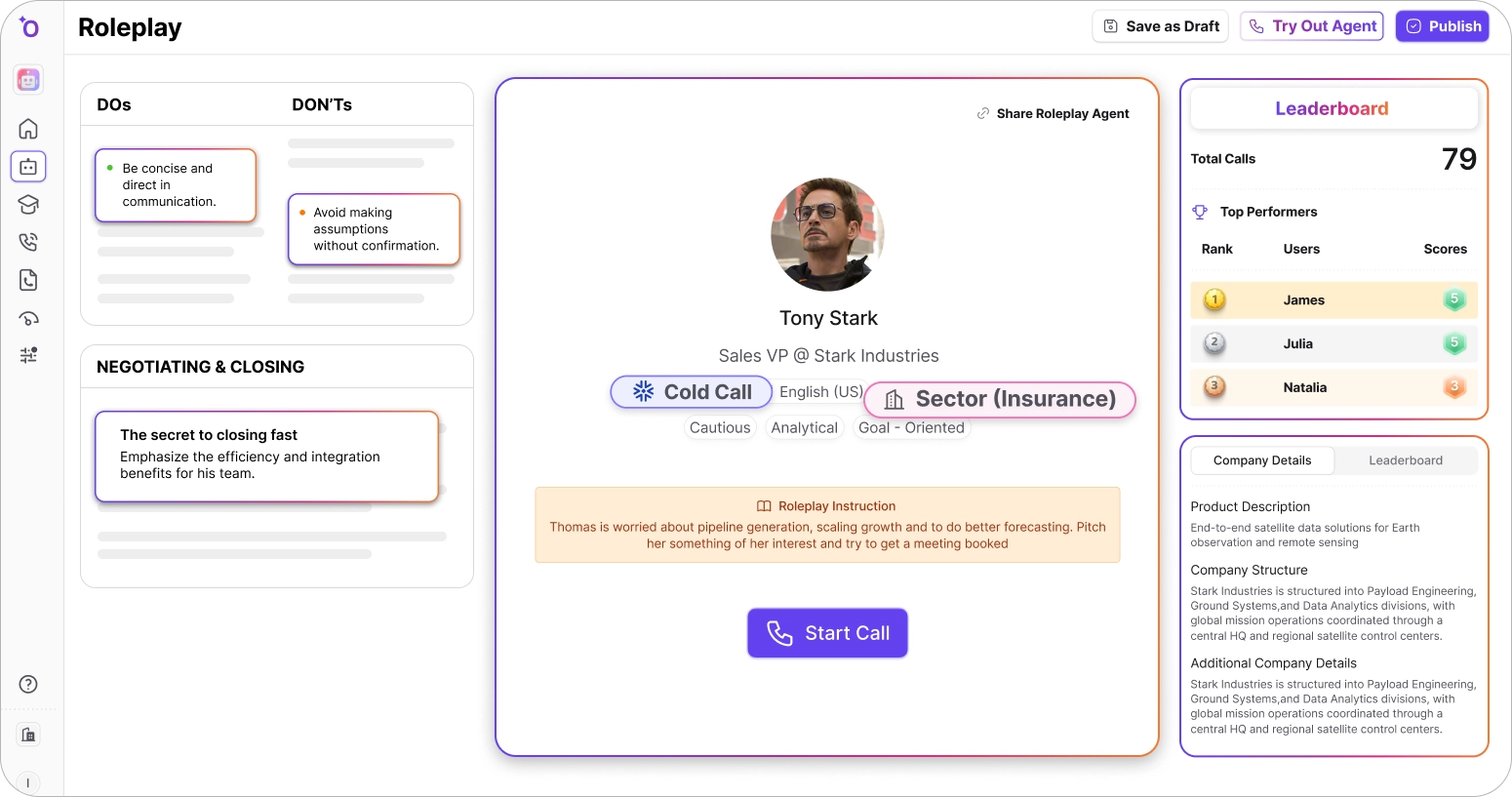
Here is how to build negotiation roleplay agents in Outdoo AI:
How to score a negotiation roleplay
Most negotiation guides stop at the scenario. The step that builds skill is scoring, because a roleplay without a rubric is just a conversation.
What to score in a negotiation roleplay
Use the scorecard below to grade any negotiation session consistently, whether a manager runs it or an AI platform scores it automatically.
| Dimension | What you are scoring | What good looks like |
|---|---|---|
| Discount discipline | Whether the rep held price before diagnosing | Does not concede on price before understanding the real concern |
| Diagnosis before response | Whether the rep uncovered the real driver | Asks what is behind the demand before reacting to it |
| Trading, not caving | Whether concessions were traded | Never gives a concession without taking one in return |
| Value reframing | Whether the rep anchored on value | Quantifies value and the cost of inaction, not just price |
| Margin and terms | Whether target terms held | Lands within approved discount and terms and protects margin |
| Composure under pressure | Tone and pacing when pushed | Stays calm, keeps talk time concise, does not get rattled |
| Securing the advance | Whether a clear commitment was won | Gains a specific, time-bound next step or path to signature |
Score each dimension from 1 to 5, total it, and track the trend per rep over repeated sessions. The trend matters more than any single score, because improvement over time is the signal that practice is working.
A procurement negotiation roleplay, from setup to score
Here is a complete scenario you could build today, configured so the negotiation actually pressures the rep.
1. The scenario configuration
The buyer is a procurement lead at a 5,000-employee enterprise, brought in late to a deal the rep has already won on merit. The opening tactic is a demand for 30% off and net-90 payment terms, with a claim that a backup vendor will match. The real, unstated constraint is that this year's budget is fixed, so timing and structure matter more than the headline number.
The difficulty rules tell the AI buyer to push harder and lower the anchor if the rep discounts without asking for anything, to reveal the budget constraint only when the rep asks what is driving the demand, and to soften only when the rep trades a concession for value such as a multi-year term or annual prepay. The rubric scores discount discipline, diagnosis, trading not caving, and protected margin.
2. How the setup plays out in practice
A weak rep hears the demand and reaches for the discount:
Procurement: We need 30% off and net-90 terms, or this goes to our backup vendor. Rep: Let me see what I can do on the price.
That single move signals the first offer was inflated and anchors the buyer lower for the rest of the call. A strong rep diagnoses before conceding, then trades:
Procurement: We need 30% off and net-90 terms, or this goes to our backup vendor. Rep: I want to make this work. Before I take anything internally, what is actually driving the 30%, the total number or the budget timing this year?
Procurement: Honestly, our budget for this year is locked, so the timing is the real problem.
From there the rep restructures rather than slashes, trading a discount for a multi-year commitment and an annual prepay that solves the buyer's timing problem while protecting margin. The scorecard captures all of it: discount discipline held, the real driver diagnosed, a concession traded rather than given, and margin defended.
Negotiation roleplay prompts you can copy
Paste any of the prompts below into your AI roleplay tool or a general assistant to generate a realistic negotiation in seconds. Each prompt is written in clearly labeled sections so both the reader and the model know exactly how the buyer should behave, which produces a far more consistent roleplay than a single block of instructions.
1. Procurement hardball prompt
This builds the price-pressure negotiation where the rep has to diagnose and trade instead of caving.
CONTEXT
You work at a 5,000-employee enterprise and were brought in late to a deal the team has already chosen on merit.
Your real, unstated constraint is that this year's budget is fixed, so timing and structure matter more than the headline price.
OPENING TACTIC
Open by demanding a 30% discount and net-90 payment terms.
Claim a backup vendor will match if this rep cannot.
BUYER BEHAVIOR
If the rep discounts without asking for anything in return, push harder and lower your anchor.
Reveal the fixed-budget constraint only when the rep asks what is driving your demand.
Soften only when the rep trades a concession for value, such as a multi-year term, an annual prepay, reduced scope, or a referral.
Stay firm if the rep gets rattled, talks too much, or drops price early.
RESPONSE STYLE
One or two sentences per turn, realistic and professional.
END CONDITION
End when terms are agreed or the deal reaches an impasse.
SCORING
After the call, score the rep from 1 to 5 on discount discipline, diagnosis, trading not caving, and protecting margin, with one specific reason for each.
2. Competitor leverage prompt
This trains the rep to hold price and reframe value when the buyer waves a cheaper quote.
CONTEXT
You like this rep's product but have a cheaper competitor quote in hand.
The cheaper option has weaker support and is missing one integration you need, but you will not volunteer that.
OPENING TACTIC
Tell the rep a competitor quoted 30% less and ask them to match it.
BUYER BEHAVIOR
If the rep matches the price or badmouths the competitor, become dismissive and harder to convince.
Engage only when the rep asks what the cheaper option includes and reframes the conversation around value and outcomes.
Warm up when the rep quantifies the cost of the gap the cheaper option leaves.
RESPONSE STYLE
One or two sentences per turn, mildly skeptical.
END CONDITION
End when the rep wins agreement on value, or you decide to go with the competitor.
SCORING
After the call, score the rep from 1 to 5 on holding price, value reframing, differentiation without badmouthing, and securing the next step, with one reason for each.
3. Buying committee prompt
This builds the multi-stakeholder negotiation where the rep has to align procurement, finance, and a technical buyer at once.
PERSONAS
Procurement lead: wants the lowest price and longest payment terms, and pushes hardest.
Economic buyer, a VP of Finance: cares about ROI, payback period, and total cost.
Technical stakeholder: cares about implementation risk and whether the team will actually adopt the tool.
OPENING TACTIC
Procurement opens by demanding a discount, and the other two raise their own concerns in turn.
The personas sometimes disagree with each other in front of the rep.
BUYER BEHAVIOR
Each persona softens only when the rep addresses its specific concern, not a generic pitch.
If the rep concedes on price to satisfy procurement without addressing ROI and risk, the economic buyer and technical stakeholder grow uneasy.
Reward the rep who trades concessions and aligns all three before talking final terms.
RESPONSE STYLE
Each persona speaks in turn, one or two sentences, labeled by role.
END CONDITION
End when the rep secures terms all three can accept, or the committee stalls.
SCORING
After the call, score the rep from 1 to 5 on stakeholder management, discount discipline, trading not caving, and committee alignment, with one reason for each.
Good scenarios fail if the practice around them is rare, soft, or disconnected from real deals.
1. Keep sessions short, frequent, and debriefed
Run negotiation practice in short bursts, roughly 15 to 20 minutes of active roleplay followed by a structured debrief, rather than occasional marathon sessions. Coach one skill at a time, and structure feedback around the specific behavior, its impact, a better alternative, and a commitment to try it next time, so reps leave with one change rather than a list.
2. Rehearse the deal reps face next
The highest-value practice is tied to a real upcoming negotiation. If a rep has a procurement call on Thursday with known budget pushback, Wednesday is the time to rehearse that exact scenario. Connecting practice to the deal a rep is about to run is what makes the skill transfer, because the rep practices the precise pressure they are about to face.
3. Measure discount rate, margin, and win rate
Negotiation training has to show up in the numbers leadership tracks. Compare average discount given, deal margin, and win rate for reps who practiced against those who did not, isolating the effect. The business case is strong: companies that applied AI to sales coaching achieved 3.3x higher growth in quota attainment, and discount rate is the metric where negotiation practice pays for itself fastest.
How to scale negotiation training across an enterprise team
At enterprise scale, negotiation training has to stay consistent across regions and draw on real deal data.
1. Standardize one negotiation rubric across regions and languages
Consistency is the enterprise problem traditional coaching never solved. Define one governed negotiation scorecard and apply it to every rep in every region, and run the practice in each team's selling language, so a seller in EMEA and a seller in North America are held to the same standard on discount discipline and margin.
2. Ground scenarios in your real recorded negotiations
Generic personas teach reps to handle generic buyers. At enterprise scale you have the call data to do better, so build AI buyers from real recorded negotiation calls and create variations by segment and industry, with customer data routed through your platform's privacy and PII handling so it stays protected.
How to train reps for a complex buying committee in negotiation
Enterprise negotiations are rarely won or lost with one person. The hardest ones run through a committee where procurement pushes on price, an economic buyer scrutinizes ROI, and a technical stakeholder worries about risk, and a rep who satisfies one by caving often loses the other two.
Why the committee is the hardest negotiation to train
A single concession can please procurement and alarm finance in the same breath. Reps need practice holding margin while keeping every stakeholder aligned, reading which lever each person is pulling, and sequencing the conversation so no decision-maker is left behind. This is the skill that decides large, multi-threaded deals, and it is nearly impossible to rehearse with a busy manager trying to play every role at once.
How to run a committee negotiation in Outdoo AI
Outdoo AI builds this with a multi-persona roleplay agent that puts up to three stakeholders in a single conversation. Add a procurement lead, an economic buyer, and a technical stakeholder from the persona library, mark the primary decision-maker, and set a shared scenario and instructions so each persona holds its own priorities and objections.
The rep negotiates across all three in chat, voice, or video, and the session is resumable, so a long committee negotiation can be practiced in stages. Each persona reacts to how well the rep addresses its specific concern, which forces the rep to align the whole room rather than win one seat and lose the other two. Reps can run the buying committee prompt above to start, then refine the personas to match the committees they actually sell into.
How Outdoo AI trains reps on negotiation calls
Outdoo AI is the enterprise AI roleplay and coaching platform built to run negotiation training end to end, from the first practice rep to the live deal. Here is how each part of the program above runs on the platform.
1. Build negotiation buyers that match your real deals
Outdoo AI offers six ways to create a roleplay agent. Build a procurement buyer twin from a real recorded negotiation, generate one from any of the prompts above, start from a ready-made template, or ground the agent in a file or resource such as your pricing guide and discount policy so its constraints and tactics are accurate. Variations and cloning then spin one working buyer across the discount, competitor, and renewal versions of the scenario without rebuilding it each time.
2. Score every rep on a negotiation rubric, automatically
Every session is graded with a methodology-aligned or custom scorecard, which Outdoo AI can also generate from your own resources. Reps are scored on discount discipline, trading not caving, value reframing, and protected margin, consistently across the team, and they practice in chat, voice, and video where tone and pacing under real pressure actually matter, in 120+ languages for global teams.
3. Reinforce with drills, courses, and certification
For volume, group buyers into a Call Blitz so reps run back-to-back negotiation drills, then package the scenarios into courses with pass-fail certifications, so a rep proves they can hold margin before they touch a live deal. Completion exports to your learning system through SCORM and xAPI, with native integrations for Docebo, Cornerstone, and TalentLMS.
4. Close the loop with live-call scoring
Outdoo AI coaching scores real negotiation calls on the same rubric used in practice through Gong, Clari, and native conversation intelligence, then ties results to CRM and pipeline data, so managers see whether the discipline reps built in practice actually shows up in live discounting. Enterprise security, including SOC 2 Type 2, GDPR, and PII scrubbing, keeps customer data protected when building from real calls. Across the 15,000+ simulated conversations and 40 organizations in Outdoo AI's Readiness Report, the pattern holds that reps who drill negotiation scenarios hold price more often on live calls.
Make negotiation practice a habit
The teams that protect margin are not the ones with the best negotiation deck, they are the ones whose reps have run the price-pressure moment so many times that holding the line is automatic. Start with one of the five moments above, build a buyer that genuinely pushes, score every session on discount discipline and trading, and watch the discount rate move.Schedule a demo to see how Outdoo AI trains your reps on negotiation calls and proves it in margin and win rate.
Frequently Asked Questions
.svg)
Build an AI buyer that pushes on price, rewards good technique, and punishes the discount reflex. Have reps practice the key negotiation moments repeatedly and score each session on a rubric covering discount discipline, diagnosis before response, trading not caving, and protected margin. The repetition builds composure and discipline under real pressure.
The five highest-value negotiation scenarios are the discount demand, concession trading, procurement hardball, competitor leverage, and the last-minute objection. These moments break reps most often and decide the most margin, so they deserve the most repetition in practice.
Use multi-persona roleplay that puts procurement, an economic buyer, and a technical stakeholder in one conversation, each pushing a different lever. Reps practice holding margin while aligning every stakeholder, reading which lever each person is pulling, and sequencing the conversation so no decision-maker is left behind.
Compare average discount, deal margin, and win rate for reps who practiced against those who did not. Discount rate is usually where negotiation practice pays for itself fastest, because every point of unnecessary discounting is margin lost straight off the deal.
AI roleplay complements manager coaching rather than replacing it. The AI handles unlimited high-pressure repetition and consistent scoring, while the manager reviews patterns across sessions and coaches the judgment only a human can. Together they scale negotiation coaching without burning manager time.
Table of Contents
Talk to Sales
Have questions about training and enablement for your sales, CS, support, or leadership team? Let's talk.
Talk to Sales