



Walk into any L&D review and completion rates are climbing. Walk into the field a month later and you can watch a fully trained rep talk through a discovery call, miss the buyer's real concern, and lose a deal they should have won. That gap, between what reps complete and what they can actually do, is the problem L&D owns, and it is not a content problem. Reps rarely lose deals because they lacked information. They lose because they never practiced the conversation enough to handle it under pressure.
AI roleplay is the first tool that lets L&D close that gap at scale. It turns training from content reps consume into conversations reps rehearse, scored and reinforced, before the deal is on the line. This guide lays out why traditional sales training breaks at the moment that matters, what changes when L&D scales practice instead of content, what becomes measurable, where humans and the existing LMS still fit, and how Outdoo AI is built to run it.
The skills that close deals are the ones training never lets reps practice
Sales training has always been good at delivery and bad at durability. The result is a workforce that knows the playbook and still fumbles the live conversation.
1. Knowing is not doing
The forgetting curve guarantees that a one-time training event fades fast. Research summarized by eLearning Industry on the Ebbinghaus curve shows that without structured reinforcement, up to 75% of new information is lost within days. But the deeper issue is not memory, it is application. The skills that actually decide deals, such as running a tight discovery call, reframing an objection without getting defensive, or reading a room of stakeholders, are behaviors, not facts. Reading about them builds awareness. Only repetition builds the reflex, and traditional training delivers almost none of it.
2. Live roleplay is the right idea that never scaled
Most L&D leaders already know the fix is practice, which is why live roleplay has been around forever. The problem is that it does not scale. A manager who spends 30 minutes per session and giving feedback can run only a dozen or so in a day, which is meaningless across a team of 200 or 5,000 reps. Worse, quality swings by facilitator, so a rep in one region gets sharp coaching while a rep in another gets a rushed run-through. Practice ends up rationed to the few, exactly backwards from what consistent capability requires.
What AI roleplay changes: practice becomes the unit, not content
AI roleplay does not just digitize training. It changes what L&D optimizes for.
1. AI roleplay, defined
AI roleplay is a simulated customer conversation where an AI plays the buyer, raises objections, adapts to what the rep says, and scores the exchange against a defined rubric. Unlike a recorded module, it is interactive and unlimited, so a rep can run the same discovery call ten times before a real one and never burn a live lead doing it. For L&D, this is practice delivered at a scale no human facilitator can match.
2. From completion to competency
The shift is from measuring content delivered to measuring skill demonstrated. Instead of a single kickoff session followed by a slow fade, reps practice on a recurring cadence, every session is scored on the same rubric, and improvement is tracked over time. Across 40 organizations in Outdoo AI's Readiness Report drawn from 15,000+ simulated conversations, the strongest performers revisited simulations 34% more frequently than their peers, because the reps who treat practice as a habit are the ones who pull ahead.
What makes AI roleplay realistic enough to build real skill
Not every AI roleplay is worth a rep's time. A shallow chatbot that follows a script teaches reps to pass a quiz, not to handle a real buyer, so the realism of the practice is what decides whether it transfers to the field. Four things separate practice that builds skill from practice that wastes it.
1. Personas built from your real calls and content
A generic buyer persona teaches a rep to handle a generic buyer, which is to say nobody. Realistic practice starts from the organization's own recorded calls, playbooks, and product material, so the AI buyer raises the objections your reps actually hear, references the competitors they actually face, and speaks the language of your real market. The closer the persona sits to a real account, the more the practice carries into live conversations.
2. Adaptive responses, not a branching script
A buyer who follows a fixed tree is predictable, and predictable practice builds false confidence. A realistic AI roleplay reacts to what the rep says, warms up when they earn it, cools down when they pitch too early, and pushes back when they skip a step. That unpredictability is the point, because it forces reps to think rather than recite, which is the same demand a live call makes.
3. The modality that matches the motion
Skills live in the channel where they are used. Cold-call and objection skills need voice, async messaging discipline needs chat, and demos and discovery need video where presence, pacing, and screen sharing matter. Practice that happens in the wrong modality leaves a gap, so realistic roleplay spans chat, voice, and video rather than forcing every conversation into one format.
4. Scoring tied to your methodology, not vanity metrics
Feedback only changes behavior when it maps to how the team actually sells. A score against SPIN, BANT, MEDDIC, MEDDPICC, or Challenger tells a rep exactly which qualification step they missed, while a generic talk-time meter does not. Realistic practice grades the conversation on the rubric a manager would use, so the skill reps build is the skill the deal requires.
The conversations worth scaling practice on
The point of AI roleplay is not volume for its own sake. It is giving reps reps on the specific moments where deals are won and lost.
1. Discovery, objections, and the human edge
The conversations that decide B2B deals are human ones. A modern AI roleplay can surface that a rep dominated the talk time on a discovery call and jumped to a pitch before reflecting the buyer's concern, which is a far more useful coaching signal than a vague note to listen more. Reps practice discovery questioning, objection reframing, multi-stakeholder alignment, and renewal conversations until the right move becomes instinct.
The hardest of these is the multi-stakeholder meeting, where an economic buyer, a technical evaluator, and a champion each want something different in the same room, and a single rehearsed pitch loses at least one of them. Traditional training can describe that dynamic, but only repeated practice against it builds the instinct to read the room and adjust in real time. These are the skills training names but never lets people rehearse enough to own.
2. Consistent practice across every region and language
Because the AI applies the same scenario, rubric, and feedback to everyone, a rep in Madrid and a rep in Singapore practice the same approved messaging and get graded on the same criteria, in their own language.
Outdoo AI supports 120+ languages on one platform, so a global rollout does not mean maintaining a different program per region. For L&D teams accountable for consistent capability across a distributed workforce, this is how inconsistency stops being the default.
What L&D can finally measure
Measurement is the quiet revolution here. When every practice session is scored, L&D can finally connect learning to the numbers leadership tracks.
1. From attendance to demonstrated skill
A completed module proves attendance. A rubric score of 4 out of 5 on objection handling, improving over a month of practice, proves skill. That is the reporting shift AI roleplay enables, and it moves L&D out of the activity-tracking corner and into the outcomes conversation.
With 81% of new hires reporting they feel overwhelmed by digital onboarding tools per AIHR, completion data can look healthy while real readiness stays low, and scored practice is what exposes the difference.
2. Tying practice to ramp, win rate, and revenue
The number leadership cares about is whether training moved revenue. AI roleplay lets L&D compare ramp time, win rate, and deal size for reps who practiced against those who did not, isolating the effect.
The business case is already on the table: companies that applied AI specifically to sales coaching, rather than elsewhere in the sales process, achieved 3.3x higher growth in quota attainment. Against roughly $101.8 billion in global corporate training spend across 2024 and 2025 per Training Magazine, tying practice data to revenue is what protects and grows an L&D budget.
3. The three tiers of metrics that make the case
Building the case for leadership means tracking three tiers together rather than any single number. Leading indicators show the program is being used and improving, such as practice volume per rep, message adherence, and rubric scores rising over repeated attempts.
Lagging indicators connect it to revenue, such as ramp time, win rate, and deal size compared across reps who practiced and reps who did not. Behavioral indicators capture the change in between, such as fewer skipped discovery steps, more confident objection handling, and less manager time spent on remedial coaching. The single most persuasive artifact is one chart that puts a cohort's practice volume next to its ramp time and win rate, so leadership can see the line for themselves.
Why the program only works if reps actually practice
The hardest part of scaling AI roleplay is not buying it, it is getting reps to use it after the launch email fades. A platform that sits unused is worse than no platform, because it spends budget and proves nothing. Adoption is an L&D design problem, and three moves solve most of it.
1. Build practice into the cadence, not the calendar
One-time practice fades like one-time training. The programs that stick schedule short, recurring practice tied to real milestones, such as a certification before a rep handles live accounts, a refresh before a product launch, and a weekly drill on the skill a rep scores lowest on. Spaced repetition is what converts a launch into a habit, and it is the only thing that beats the forgetting curve at scale.
2. Use certification gates and manager visibility
Reps practice when practice has a consequence. A certification gate that a rep must clear before working live accounts creates a clear reason to engage, and a manager who coaches from the practice data signals that it matters. When practice scores show up in one-on-ones alongside pipeline, reps treat them as part of the job rather than an optional extra.
3. Make it safe first, and a little competitive second
Reps avoid practice that feels like a test in front of peers. Private, judgment-free repetition removes the performance anxiety that kills adoption, which is one of the quiet advantages AI roleplay holds over live roleplay. Once practice feels safe, light competition through leaderboards and team challenges turns it into something reps choose to do rather than something they are assigned.
Where managers and your LMS still fit
AI roleplay is a force multiplier for L&D, not a replacement for the people and systems already in place.
1. AI handles reps, managers handle judgment
The teams getting the most from AI use it for the part humans do badly, which is high-volume repetition and consistent scoring, and free their managers for the part only humans do well. Instead of pretending to be the buyer in a one-on-one, a manager reviews patterns across dozens of a rep's AI sessions: the persona they struggle with, the moment they lose control of the call, the question they never ask. That is sharper coaching from better raw material, and across the Outdoo AI Readiness Report sustained practice showed a 2.5x improvement in skill scores over successive quarters.
2. It extends your LMS, it does not replace it
AI roleplay should plug into the learning system L&D already runs. Practice and certification data export through SCORM and xAPI into the existing LMS, so AI roleplay adds a practice and measurement layer on top of the stack rather than forcing a migration. Lower adoption friction, centralized reporting, and no rip and replace.
How Outdoo AI helps L&D teams scale realistic sales training
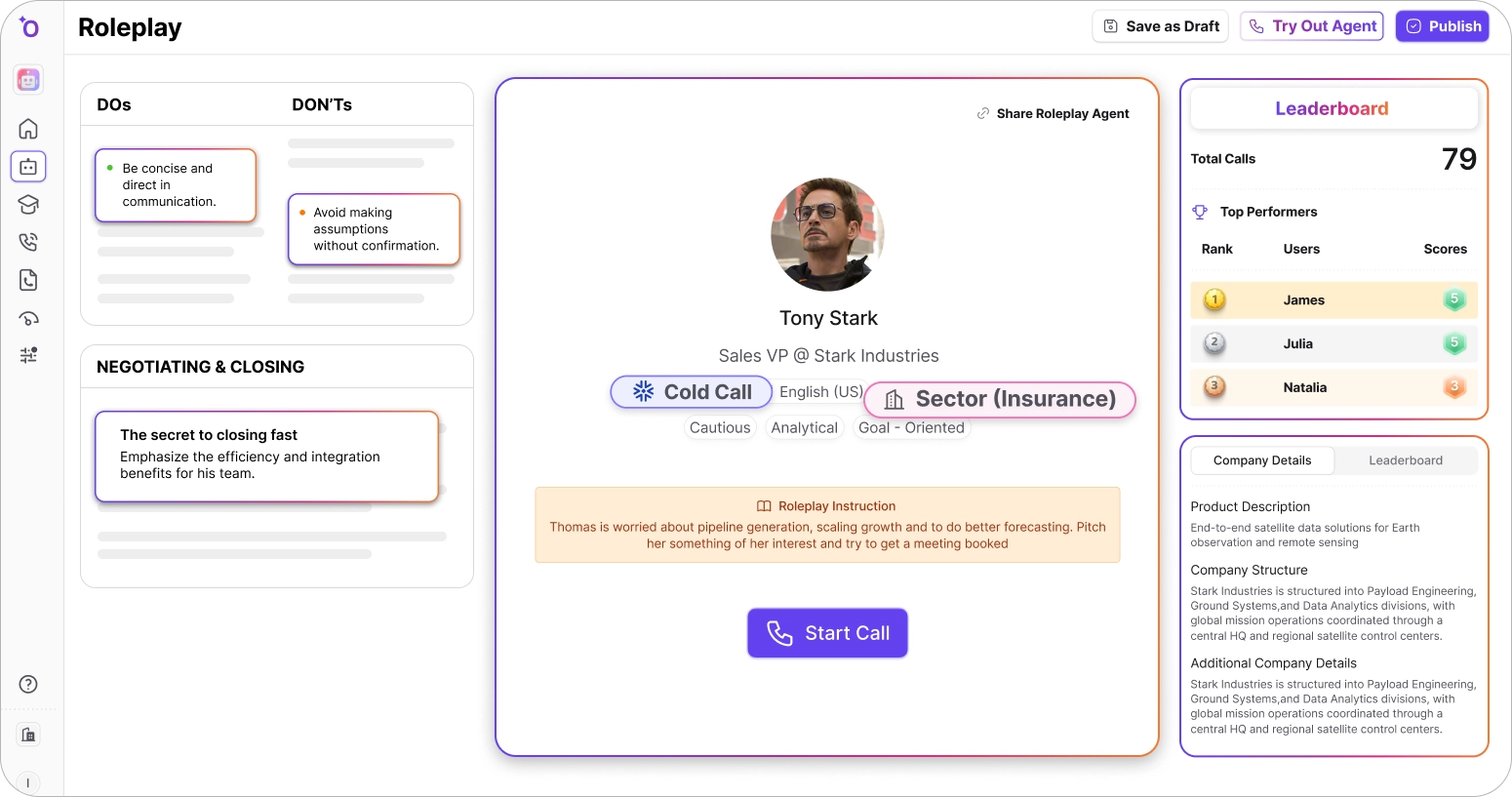
Outdoo AI is the enterprise AI roleplay and coaching platform built to run this end to end for L&D teams.
1. Build realistic practice from your real calls and content
Outdoo AI offers six ways to create a roleplay agent, including building an AI buyer twin from a real recorded call, generating one from a prompt, starting from a template, or grounding it in a playbook or product doc so the practice mirrors your actual buyers and messaging rather than generic personas.
2. Score every rep on the same rubric
Every session is graded with a scorecard aligned to SPIN, BANT, MEDDIC, MEDDPICC, Challenger, or a custom rubric built from your own playbook, which is what lets L&D report competency instead of completion, consistently across every region.
3. Reinforce and certify at scale
Outdoo AI packages scenarios into courses with pass-fail certifications and runs Call Blitz drills for back-to-back repetition, then exports completion to the LMS through SCORM and xAPI, with native integrations for Docebo, Cornerstone, and TalentLMS. This is the spaced reinforcement that beats the forgetting curve without adding facilitator hours.
4. Validate practice against live calls
Outdoo AI coaching scores real customer calls on the same rubric used in practice, through Gong, Clari, and native conversation intelligence, then ties results to CRM and pipeline data. L&D can finally show leadership that practice scores predict live performance, which is the proof that turns training from a cost line into a revenue lever.
Make AI roleplay everyday practice
The teams that win the next few years will not be the ones with the most training content. They will be the ones whose reps treat realistic practice as a daily habit and walk into live conversations already sharp.
Start with one sales motion, build scenarios from your real calls, set a reinforcement cadence that beats the forgetting curve, and connect the practice data to ramp and win rate. That is how L&D scales realistic sales training and proves it moved the number. Schedule a demo to see how Outdoo AI runs it for your team.
Frequently Asked Questions
.svg)
AI roleplays give every rep unlimited, on-demand practice scored on a fixed rubric, removing the manager bottleneck that limits live roleplay to a few sessions a day. L&D delivers consistent, realistic practice across regions and languages while measuring demonstrated skill instead of completion.
Traditional training delivers knowledge but almost no practice, and up to 75% of new information fades within days without reinforcement. The skills that decide deals are behaviors, not facts, so reps need repeated practice to build the reflex, which one-time training events do not provide.
L&D compares ramp time, win rate, and deal size for reps who practiced against those who did not, isolating training's effect. Research found companies using AI in sales coaching achieved 3.3x higher growth in quota attainment, the kind of outcome L&D can tie directly to scored practice data.
Yes. Platforms like Outdoo AI export practice and certification data to existing learning systems through SCORM and xAPI, with native integrations for Docebo, Cornerstone, and TalentLMS, so AI roleplay extends the LMS L&D already runs rather than replacing it.
No. AI roleplay handles unlimited repetition and consistent scoring at scale, while managers review the patterns and provide contextual coaching only humans can. The strongest L&D programs combine AI for practice and measurement with managers for judgment and development.
Table of Contents
Talk to Sales
Have questions about training and enablement for your sales, CS, support, or leadership team? Let's talk.
Talk to Sales