




Cold calling roleplay remains one of the most widely used training methods for SDR teams, yet most programs fail to produce consistent pipeline outcomes. The gap is not in adoption, but in how roleplay is structured, measured and connected to real call performance.
In most organizations, reps practice scripted conversations that assume a cooperative buyer and a linear flow. Actual cold calls rarely follow this pattern. Prospects interrupt within seconds, question relevance and redirect the conversation based on their priorities, not the rep's agenda.
This mismatch between training conditions and live environments leads to predictable execution gaps. Reps rely on memorized talk tracks, struggle to adapt under pressure and fail to transition from opening to meaningful discovery, which impacts meeting quality and downstream conversion.
Across internal assessments of outbound teams, a consistent pattern emerges. SDRs who train on generic roleplay formats often lose control within the first minute of a cold call. This is the point where relevance is tested, objections surface and the conversation either progresses or disengages.
The issue is not activity levels or effort. It is the absence of contextual practice that reflects how real conversations behave, including unpredictability, resistance and limited attention spans.
Effective cold calling requires more than message clarity. It requires situational awareness, where reps interpret signals in real time, adjust positioning based on buyer responses and maintain direction without relying on a fixed sequence.
Traditional sales training methods do not build this capability. They optimize for repetition and familiarity, but not for decision-making under dynamic conditions, which is where most cold calls succeed or fail.
High-performing SDR teams address this by shifting toward scenario-based roleplay and AI-driven simulations. These approaches introduce variability, multiple buyer behaviors and real objection patterns, allowing reps to practice across conditions that mirror actual conversations.
And that's the reason reps need to be prepared for different types of scenarios they might encounter during a cold call, and that's what we are going to cover in this blog post in great detail.
What Is Cold Call Roleplay?
Cold call roleplay is a training exercise where an SDR practices an outbound call against a manager, peer or AI buyer playing the prospect, so the rep can rehearse openers, objections and next steps before taking live calls.
Cold Calling Roleplay Scenarios and Detailed Prompts for SDR Teams
Most SDR teams do not need more generic roleplay, they need better scenario design. Good scenario design also covers more than the cold call, so here is how to practice every SDR sales conversation with AI roleplay, from gatekeepers to warm handoffs.
A useful cold calling scenario is not defined only by the objection. It is defined by the buyer's context, their mindset at the moment of interruption, the level of resistance, what they already know, what they care about protecting and what would make them stay on the line for another thirty seconds.
That is where most roleplay programs fall short. They simulate a surface pattern such as "not interested" or "send me an email," but they do not model the pressure behind it. As a result, reps practice responses without learning how to read the situation underneath the response.
The scenarios below are built to solve that. Each one includes what the rep is actually being tested on, what the buyer is protecting, what mistakes usually break the call and a detailed prompt that can be pasted into an AI tool for practice.
1. Gatekeeper Interception
This scenario matters because many outbound calls fail before the rep reaches the intended buyer. Most SDRs treat the gatekeeper as an obstacle to bypass, when the real task is to establish enough relevance and credibility to earn a transfer.
A strong rep understands that the gatekeeper is protecting executive time, filtering noise and making a fast judgment about whether the call sounds specific or generic. If the SDR sounds vague, over-rehearsed or too eager to "just get five minutes," the call usually ends there.
a. What this scenario should test
- Clarity in the first ten seconds
- Whether the rep can explain relevance without over-pitching
- Ability to stay calm when screened aggressively
- Whether the rep sounds like someone worth passing through
b. What the buyer environment should include
- Mid-sized or enterprise company
- Executive assistant or front desk operator handling multiple calls
- No prior relationship or warm context
- Low patience for generic vendor language
c. Common mistakes this scenario should expose
- Asking to be transferred too early
- Giving a vague reason for the call
- Sounding secretive or over-scripted
- Trying to "trick" the gatekeeper instead of earning credibility
When I call, ask direct screening questions such as who I am, why I am calling, whether this is relevant to the VP and whether they are expecting my call. Do not be rude, but do not make this easy.
Your job is to filter out weak outreach. If I use generic language like “I just wanted to connect” or “I thought this might be helpful,” push back and ask me to be more specific. If I ramble, interrupt and ask for the point. If I sound credible, concise and relevant to the VP’s priorities, you may transfer me or ask me to send a note.
Do not cooperate too quickly. Force me to earn the transfer by showing relevance, clarity and confidence. If I handle the interaction well, gradually become more receptive. If not, end the conversation professionally.
My goal is not to sell you. My goal is to get through to the VP of Sales by giving you a credible reason to believe the conversation is worth their time.
2. First 15 Seconds with a Busy Prospect
This is the highest-pressure part of a cold call. The rep has limited context, limited permission and almost no margin for weak wording. In most cases, the prospect decides whether to continue within the first few lines.
This scenario is not only about the opener. It tests whether the rep can establish relevance without sounding overly polished, overly casual or immediately transactional. It also tests whether the rep knows how to continue once the prospect does not hang up.
a. What this scenario should test
- First-line relevance
- Brevity under pressure
- Whether the opener earns curiosity instead of tolerance
- Transition from opening into light discovery
b. What the buyer environment should include
- Senior prospect answering unexpectedly
- Tight schedule and low attention span
- No prior engagement
- Mild skepticism from the first second
c. Common mistakes this scenario should expose
- Long introductions
- Asking permission in a weak way
- Talking about product before context
- Sounding like every other SDR the prospect hears
When I open, react naturally based on relevance. If my opening is generic, unclear or too long, cut me off and say you are busy. If my opening is specific and tied to a priority you care about, stay on the line briefly and give me a narrow window to continue.
You should sound like someone protecting time. Ask things like “What is this about?” or “Why are you calling me specifically?” if I do not make it obvious. If I start pitching too early, disengage. If I establish relevance quickly, allow a short conversation and respond like a real operator would, with practical concerns rather than curiosity for its own sake.
Do not give me an easy path. Make me earn the next twenty seconds through relevance, control and concise language.
My goal is to get past the first fifteen seconds, establish a reason for the conversation and earn enough attention to ask one or two meaningful questions.
3. Early 'Not Interested' Rejection
This scenario is important because "not interested" is rarely a full diagnosis. Sometimes it means bad timing. Sometimes it means weak relevance. Sometimes it is simply a reflex to end an interruption.
A good SDR does not challenge the objection aggressively or accept it blindly. They assess whether the rejection is final, reactive or recoverable. That requires tone control, judgment and the ability to re-anchor the conversation without sounding persistent.
What this scenario should test
- Recovery after early rejection
- Ability to reframe without resistance
- Emotional control
- Whether the rep can introduce a sharper angle quickly
What the buyer environment should include
- Prospect is mildly defensive
- They have no context for the rep
- They want to end the conversation efficiently
- They will only re-engage if the rep sounds specific and credible
Common mistakes this scenario should expose
- Fighting the objection directly
- Asking "why not?" too early
- Sounding needy or overeager
- Using canned objection-handling lines
If I respond with pressure, scripts or obvious objection-handling language, become less receptive and move to end the call. If I respond with calm relevance and a specific reason for the outreach, give me a brief chance to continue.
You should not become interested too quickly. Make me work to recover the conversation. If I introduce a practical business angle connected to operational inefficiency, process breakdown or missed visibility, you may shift from dismissal to cautious engagement.
Keep your tone realistic. You are busy, slightly guarded and not looking to help me succeed. You will only stay on the line if the call starts sounding materially relevant to your role.
My goal is to determine whether the objection is reflexive, reopen the conversation without friction and earn enough space to continue discovery.
4. Existing Vendor Objection
This is one of the most common outbound scenarios in B2B. A prospect says they already use another tool or already have a process in place. Weak reps either retreat too quickly or attack the competitor too directly.
The better move is to understand whether "we already use something" means satisfaction, switching cost, procurement fatigue or simply a convenient way to exit the call. That distinction matters.
What this scenario should test
- Whether the rep can differentiate without becoming defensive
- Ability to explore dissatisfaction without forcing it
- Judgment in competitor conversations
- Whether the rep can move from vendor status to business impact
What the buyer environment should include
- Existing vendor in place
- Some operational compromise, but not enough yet to trigger a switch
- Moderate resistance to vendor comparisons
- Low interest in a feature war
Common mistakes this scenario should expose
- Bashing the competitor
- Launching into product comparison too early
- Assuming the existing vendor is failing
- Confusing curiosity with buying intent
When I call, explain that you already have a provider. Do not elaborate unless I ask smart follow-up questions. If I start listing features or attacking your current vendor, disengage. If I ask thoughtful questions about how the current process is working, where inefficiencies remain or how renewal decisions are made, engage cautiously.
You care about consolidation, spend control, switching risk and implementation overhead. You are open to improvement, but only if the difference sounds material rather than incremental.
Make the conversation realistic. You are not looking for innovation for its own sake. You want better economics, lower operational friction or stronger control. My goal is to uncover whether the existing vendor is truly sufficient or whether there is an opening based on business impact.
5. Budget Pushback
Budget objections on cold calls are often misread. In some cases the buyer genuinely has no budget. In many others, "no budget" is shorthand for "I do not see enough value yet to keep talking."
This scenario should train reps not to defend price too early, but to understand the business cost of inaction. If the rep jumps into discounts or feature justification, they lose control. If they connect the conversation to inefficiency, lost time or missed revenue, the buyer may continue.
What this scenario should test
- Whether the rep can handle budget pushback without discounting
- Value articulation under pressure
- Ability to connect cost to business consequence
- Maturity in talking to financially oriented stakeholders
What the buyer environment should include
- Budget ownership or influence
- Low patience for generic ROI language
- Real concern about spending discipline
- Expectation that value should be concrete
Common mistakes this scenario should expose
- Talking about price before value
- Offering concessions too early
- Using vague ROI claims
- Ignoring the buyer's financial lens
If I answer with features, product enthusiasm or broad efficiency claims, remain unconvinced. If I try to discount before understanding your environment, become more skeptical. If I connect the conversation to cost leakage, duplicate tools, wasted effort or delayed outcomes, allow a deeper exchange.
You respond well to logic, clarity and concrete examples. You do not respond well to hype. Ask practical questions such as where value would come from, who would use the tool and what would justify attention if budget is constrained.
Make me earn the right to continue the conversation by showing that this is a business conversation, not a pricing defense. My goal is to shift the discussion from budget resistance to business impact and secure enough interest for a follow-up.
6. Multi-Stakeholder Mention
Even on an early outbound call, the buyer may reveal that finance, IT, procurement or leadership will be involved. That is not a throwaway comment. It is one of the most important buying signals in the conversation.
Many reps miss it and continue selling to a single point of contact. Strong reps use that moment to begin mapping the decision environment. This scenario trains that habit.
What this scenario should test
- Whether the rep notices stakeholder signals
- Ability to explore decision structure without sounding political
- Early stakeholder mapping
- Message adaptability across functions
What the buyer environment should include
- Buyer is interested but not sole decision-maker
- Other stakeholders have different priorities
- Approval process is not fully visible upfront
- Prospect will only share more if asked intelligently
Common mistakes this scenario should expose
- Ignoring the stakeholder mention
- Asking vague questions like "who else is involved?"
- Assuming internal alignment
- Pushing for a next step before understanding the buying group
If I ignore that signal and continue speaking only to your own priorities, remain partially engaged but uncommitted. If I ask how each group would evaluate the decision, what concerns they tend to raise or how approval works internally, provide realistic detail.
Finance is likely to care about cost control, budget timing and measurable impact. IT is likely to care about integration, security and adoption burden. You care about workflow improvement and execution. These priorities do not fully overlap.
Your role is to reveal this gradually and only in response to good questioning. My goal is to identify the buying group early, understand how decisions will be evaluated and avoid treating the call as a single-threaded conversation.
7. 'Send Me an Email' Deflection
This is one of the most common cold call exits and one of the most misunderstood. Sometimes it is genuine. More often, it is a polite way to end the interruption.
The rep's job is not to refuse the request. It is to test whether there is enough interest to shape what goes into that email and whether the conversation can continue for another thirty seconds.
What this scenario should test
- Judgment under polite resistance
- Ability to keep the conversation alive without sounding pushy
- Whether the rep can qualify interest before ending the call
- Message control
What the buyer environment should include
- Prospect wants a quick exit
- Mild politeness, low commitment
- Some chance of engagement if the rep asks a smart follow-up
- High risk of defaulting into a dead follow-up
Common mistakes this scenario should expose
- Agreeing immediately and ending the call
- Pushing for a meeting too quickly
- Asking weak follow-up questions
- Sending generic follow-up content
If I immediately agree and move to hang up, end the conversation. If I ask what would be most useful to include, what area is most relevant or whether there is a current priority behind the request, stay engaged briefly and answer selectively.
You should not become highly interested too fast. Make me prove that I know how to turn a dismissal into a useful exchange. If I sound pushy, withdraw. If I sound thoughtful and concise, offer enough information for me to shape a more relevant follow-up.
My goal is to avoid a dead-end email, gather just enough context to make the follow-up relevant and determine whether this is a polite dismissal or a potential opening.
8. Skeptical Prospect Who Challenges Intent
Some prospects challenge the reason for the call directly. They ask who gave you their name, why you called them specifically or whether this is just another generic sales pitch.
This scenario is useful because it tests credibility, composure and the rep's ability to establish a real reason for outreach without sounding evasive.
What this scenario should test
- Credibility under scrutiny
- Specificity in reason for outreach
- Comfort with direct buyer skepticism
- Whether the rep can maintain trust without overexplaining
What the buyer environment should include
- Intelligent, skeptical operator
- Low tolerance for generic outbound
- Strong instinct to challenge weak relevance
- Some openness if the rep sounds grounded
Common mistakes this scenario should expose
- Evasive answers
- Overexplaining data sources
- Generic personalization
- Losing composure when challenged
You are not hostile, but you are sharp and difficult to impress. You have heard too many outreach calls that pretend to be personalized but clearly are not. You value directness and clarity.
If I give a credible reason tied to your role, company context or likely business priorities, allow the conversation to continue. If not, end it quickly. My goal is to establish relevance under pressure and sound like someone who did the work rather than someone reading a sequence step.
How to Use These Prompts Properly
Running these prompts once is not enough. The value comes from repetition, variation and focused review.
A practical way to use them is to assign each rep one scenario at a time and evaluate:
- Opener clarity
- Talk-to-listen balance
- Objection response quality
- Transition into discovery
- Quality of next-step attempt
The point is not to "win" the roleplay. The point is to identify where control is lost, what language breaks relevance and which moments repeatedly cause the conversation to stall.
That is when roleplay becomes useful. Not as rehearsal for a perfect call, but as training for the exact points where real cold calls usually break.
Create Custom SaaS Discovery Roleplay Scenarios and AI Agents
Generic roleplay improves fluency, it does not improve judgment. The difference between average and high-performing SDRs is not how well they deliver a script. It is how well they interpret context, adjust mid-conversation and maintain control when the situation changes.
That capability cannot be built using static prompts or one-off simulations. It requires contextual, evolving roleplay environments that mirror real buyer conditions, retain memory and allow performance to be measured over time.
Why Generic AI Roleplay for Cold Call Falls Short
Most teams experiment with tools like ChatGPT or Claude for cold call simulations, which work for early-stage practice but do not scale into a structured training system. Each session resets with no memory of past attempts, no connection to real call data and no consistent scoring framework, which makes it difficult to track improvement over time.
They also operate within a single conversational thread, which removes the complexity of real calls where stakeholders introduce new priorities, challenge direction and shift the conversation dynamically. As a result, reps may improve within individual sessions, but that improvement remains isolated and rarely translates into consistent performance in live outbound conversations.
Step-by-Step: Building a Custom Roleplay Agent
Step 1: Create the Roleplay Agent
Start by creating a centralized agent instead of running isolated prompts. This ensures that scenarios can be reused, refined and standardized across the team.

What this unlocks
Without a central agent, every rep practices a different version of the scenario. This creates inconsistency in training and makes performance impossible to compare.
Step 2: Define Persona and Business Context
This is where most teams under-invest.
Instead of writing "VP of Sales at a SaaS company," define company size and growth stage, internal processes, current challenges, reporting structure and buying constraints.

What changes with depth
When context is shallow, the agent behaves cooperatively. When context is detailed, the agent behaves selectively, which is what forces better discovery.
Step 3: Add a Detailed Scenario Prompt
This is the foundation of the simulation.
Instead of a short instruction, build a full narrative that includes company context, persona traits, current situation, pain points, goals, buying mindset and conversation expectations.

What breaks without this
Short prompts create predictable conversations. Detailed prompts create resistance, which is where real learning happens.
Step 4: Run the Simulation
Once the agent is configured, run full conversations.
The agent should interrupt weak responses, question assumptions, shift direction based on answers and introduce new constraints mid-conversation.
.gif)
Why this matters
Reps are not learning what to say. They are learning how to respond when control is challenged.
Step 5: Review the Conversation Before Scoring
Before jumping into evaluation, review the raw interaction.
Look for where the rep lost control, where relevance dropped, where the buyer disengaged and missed signals or follow-up opportunities.
What this reveals
Scorecards show outcomes. Conversations show behavior. Without reviewing both, coaching remains incomplete.
Step 6: Evaluate Using a Unified Scorecard
Now evaluate the session using consistent criteria: opening clarity, discovery depth, objection handling, value articulation and next-step effectiveness.


What changes here
When scoring is standardized, improvement becomes measurable. You can compare reps, track progression and identify patterns across the team.
Step 7: Analyze Conversation Metrics
Go beyond qualitative feedback.
Track talk-to-listen ratio, number of questions asked, longest monologue and engagement points.
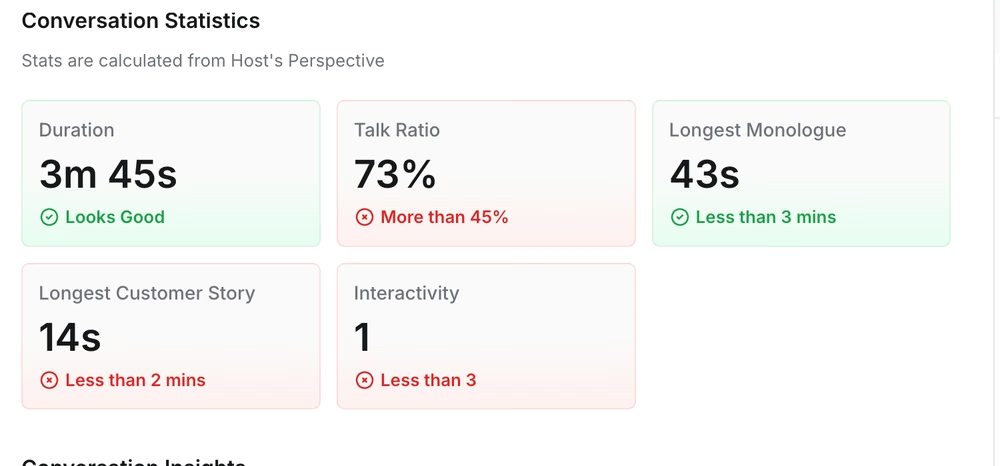
What this surfaces
Many reps think they are doing discovery. The data often shows they are over-talking or asking shallow questions.
Step 8: Fine-Tune the Agent Without Rebuilding
Instead of recreating scenarios, refine them.
Adjust persona tone, objection intensity, scenario complexity and stakeholder involvement.
Why this is critical
Markets change. Messaging evolves. If scenarios are static, training becomes outdated quickly. Iteration keeps roleplay aligned with reality.
What This Enables at a Team Level
Once this system is in place, roleplay stops being a one-time activity.
It becomes a repeatable training system, a performance measurement layer and a feedback loop tied to real calls.
Reps are not just practicing more. They are practicing against conditions that mirror actual buyer behavior.
Cold Calling Roleplay Performance Tracking for SDR Teams
Most roleplay programs focus on running scenarios, but very few measure whether those scenarios improve live cold call execution. This creates a gap between training activity and actual performance in outbound conversations.
Reps may perform well within a roleplay session, but that does not always translate into real calls where time pressure, interruptions and lack of context shape how the interaction unfolds. The conditions are different, and so is the outcome.
The issue is not lack of practice, but lack of structured measurement that connects roleplay performance to real call behavior. Without this, teams cannot determine what is actually improving.
Without a consistent evaluation framework, roleplay becomes subjective and difficult to scale across teams. Feedback varies by manager, sessions are judged in isolation and performance cannot be compared over time.
This leads to inconsistent coaching, where reps receive general advice instead of targeted input based on specific breakdown points. Over time, this reduces the effectiveness of roleplay as a training tool.
To make roleplay effective, performance needs to be measured across a defined set of signals that reflect real cold call execution. These include opening clarity, objection handling, transition into discovery and next-step conversion.
These signals indicate whether a rep can move a conversation forward rather than simply sustain it. They also provide a consistent way to evaluate performance across different scenarios.
When tracked across multiple sessions, patterns begin to emerge in how reps handle conversations. Some lose control after the opening, while others struggle to maintain relevance during objections.
These patterns are not visible in a single session but become clear over time when performance is measured consistently. This allows teams to identify where coaching should be focused.
A structured approach connects roleplay sessions to measurable outcomes through consistent scoring and repeated evaluation. Each session builds on the previous one, creating continuity in training.
Over time, roleplay shifts from a one-time exercise to a performance system that reflects real call behavior. Reps are evaluated on consistency, not just individual outcomes.
This creates a more reliable way to improve outbound execution, where training is directly linked to better connect-to-meeting conversion and overall pipeline quality.
Closed-Loop Coaching for Cold Calling Performance
Most SDR teams run roleplays, review calls and conduct coaching sessions, but these activities often operate independently. This fragmentation makes it difficult to determine whether training is actually improving real call execution.
Without a connected system, reps may practice one set of behaviors, execute another in live calls and receive feedback that is not tied to either. This breaks continuity and slows down improvement.
Closed-loop coaching solves this by linking practice, execution and feedback into a single system. Each stage informs the next, creating a continuous cycle of improvement rather than isolated interventions.
The model operates across four stages: practice, execute, validate and reinforce. Reps practice through roleplay, apply those behaviors in live calls, get evaluated on actual execution and then receive targeted coaching based on observed gaps.
This creates alignment between what is trained and what is measured. Reps are not just improving in simulations, they are improving in real conversations where outcomes matter.
The validation stage is where most teams fall short. Many review calls, but do not evaluate them using the same criteria applied during roleplay, which creates inconsistency in feedback.
When scoring is unified, it becomes possible to compare roleplay performance with live call execution. This highlights where skills break under pressure and where additional coaching is required.
Reinforcement then becomes specific rather than generic. Instead of broad feedback like "improve your opening," reps receive targeted input such as improving clarity within the first ten seconds or tightening objection responses.
This level of precision accelerates improvement because reps know exactly what to change and can practice that behavior in the next roleplay session.
Over time, this loop creates compounding gains. Reps refine specific skills, apply them in real calls and receive feedback that is directly tied to outcomes.
For sales leaders, this provides visibility into what is working and what is not. Coaching becomes data-driven, and enablement can connect training efforts to pipeline metrics.
Closed-loop coaching turns cold calling from a repetitive activity into a measurable system, where performance improves through structured practice, consistent evaluation and targeted reinforcement.
Measuring Cold Calling Performance and SDR Readiness
Most teams track activity metrics such as dials, connects and meetings, but these numbers do not explain why certain reps consistently convert better than others, since activity reflects effort while execution determines outcomes.
To improve cold calling results, teams need to measure how conversations are handled rather than how many are initiated, which requires shifting from volume tracking to behavior-based evaluation that captures real interaction quality.
A structured system focuses on a small set of observable signals that indicate whether a call is progressing effectively, and these signals should remain consistent across both roleplay and live calls to ensure alignment.
| Metric | What It Indicates | Signal of Strength | Risk Indicator |
|---|---|---|---|
| Opening clarity | Relevance in first seconds | Clear, specific reason for call | Generic or vague opener |
| Objection handling | Control under resistance | Calm, contextual response | Defensive or scripted replies |
| Discovery transition | Depth of conversation | Moves beyond pitch | Stays surface-level |
| Talk-to-listen ratio | Conversation balance | Buyer engaged | Rep dominates |
| Next step clarity | Conversion potential | Specific follow-up agreed | Vague or no next step |
These metrics are interdependent, since a weak opening often leads to early objections, which then limits discovery depth and reduces the likelihood of securing a meaningful next step.
High-performing calls follow a consistent pattern where the rep establishes relevance early, handles resistance without losing control and transitions into a focused exchange that leads to a defined outcome.
Low-performing calls tend to stall early in the interaction, where the rep either over-explains, reacts without direction or fails to move the conversation forward toward a clear objective.
Readiness should be assessed before reps engage in high-volume outbound activity, which means evaluating roleplay sessions using the same criteria as live calls so that performance expectations remain consistent.
Reps who demonstrate control across these signals in practice are more likely to replicate that performance in real conversations, which reduces variability and improves overall team efficiency.
Connecting these metrics to pipeline outcomes provides additional clarity, since calls that establish relevance early and secure clear next steps tend to convert into qualified opportunities at a higher rate.
Over time, this creates a feedback system where behavior is continuously refined based on measurable outcomes, allowing cold calling to shift from a volume-driven activity to a structured process with predictable performance signals.
For revenue leaders and enablement teams, this approach enables better coaching decisions, more accurate forecasting and a clearer understanding of which behaviors drive outbound success.
From Practice to Performance with Outdoo AI
Most teams run roleplays, but lack a system that connects practice to real call outcomes, which is where performance gaps persist.
Outdoo AI: The Enterprise AI Roleplay and Coaching Platform connects roleplay, live calls and scoring into a single system, ensuring that training translates into measurable behavior change.
Reps practice using real scenarios derived from calls and objections, get evaluated using the same scorecard across practice and live conversations, and receive targeted micro-roleplays to fix specific gaps.
This creates continuity, where improvement compounds over time instead of resetting after each session.
If you want to see how this applies to your SDR team and outbound motion, the next step is to experience it through a demo tailored to your workflows.
Frequently Asked Questions
.svg)
The most effective cold calling roleplay scenarios include gatekeeper interception, first 15-second openers with busy prospects, early rejection recovery, existing vendor objections, budget pushback, multi-stakeholder mapping, email deflection handling, and skeptical prospect challenges. Each scenario should define buyer context, test specific skills and expose common execution mistakes.
Effective cold calling roleplay requires structured scenarios with detailed buyer personas, clear evaluation criteria and repeated practice. Assign one scenario at a time, evaluate opener clarity, objection handling, discovery transitions and next-step quality. Use consistent scoring across sessions and connect roleplay results to live call performance.
AI roleplay tools do not replace traditional practice but extend it significantly. Platforms like Outdoo AI allow SDRs to practice against realistic AI buyer personas that adapt dynamically, provide instant feedback and track improvement over time. This solves the scaling problem where managers cannot coach every rep individually.
Track opening clarity, objection handling quality, talk-to-listen ratio, discovery transition depth and next-step conversion. These signals indicate whether a rep can move a conversation forward under pressure. When measured consistently across roleplay and live calls, they reveal where coaching should be focused.
SDR teams should practice cold calling roleplay weekly as a non-negotiable part of their training cadence. Research shows reps who receive at least three hours of coaching per month exceed quota by 7 percent and close 70 percent more deals. Short, focused sessions with targeted scenarios produce better results than occasional intensive workshops.
Table of Contents
Talk to Sales
Have questions about training and enablement for your sales, CS, support, or leadership team? Let's talk.
Talk to Sales