




I have spent years around customer-facing teams and the tools that promise to train them, and I will be honest: most of them look brilliant in a demo and disappointing the moment a real, furious customer is on the line. A slide deck and a knowledge-base walkthrough do not prepare an agent for a caller who is three billing errors deep and done being patient.
Quick disclosure before we dive in: yes, we build Outdoo AI, so we are not going to pretend we are a neutral third party. What we can do is give you an honest map of this space, where we genuinely shine, and where another tool might fit you better. We would rather you land on the right tool than oversell you ours.
This is where AI roleplay helps. It lets agents practise the hard conversations first: de-escalating an angry caller, handling a complaint, saving a churning account. The AI roleplay simulation reacts to how the agent responds, and the tool scores the conversation so the agent knows what to fix. We looked at the tools in this space through a customer service lens, not a sales one. Here is what we found.
How I evaluated these tools
We did not rank these on flashy features. We looked at the handful of things that decide whether a support agent is actually ready for a live call:
- Does the AI customer feel real? Does it get angrier when handled badly, calm down when handled well, and can you build it from your own tickets?
- Does the scoring understand the conversation? Empathy, tone, listening, de-escalation, and resolution, not just counting keywords.
- Does it cover the modes agents actually work in? Voice, chat, and the on-screen steps.
- Can team leads coach from it? Can a lead see who is struggling and act on it?
- How much upkeep is it? The quiet dealbreaker: how hard is it to keep scenarios current as products and policies change?
To be clear about method: this is our read on how each tool is positioned and built for customer service, based on what each one publishes and how it shows up in the market, not a lab test of every edge case. Use it to shortlist, then put your single hardest real scenario in front of the two or three that fit, and see which one holds up.
Short on time? My quick picks
- Best overall for customer service and contact centre roleplay: Outdoo AI, realistic practice from your own calls and tickets, scored all the way through to live interactions.
- Best for immersive soft-skills scenarios: Virti, experiential practice on empathy and communication across functions.
- Best for communication style and delivery: Retorio, a behavioural, video-first lens on how agents come across.
The full rundown is below, six tools, an honest take on each, and who I would actually recommend it to.
1. Outdoo AI: Best for realistic customer service and contact centre roleplay
Best for: Sales, support, and any customer-facing team that wants realistic roleplay practice and improvement they can measure on live calls. Customer service and contact centre roleplay is a use case we are built to win.
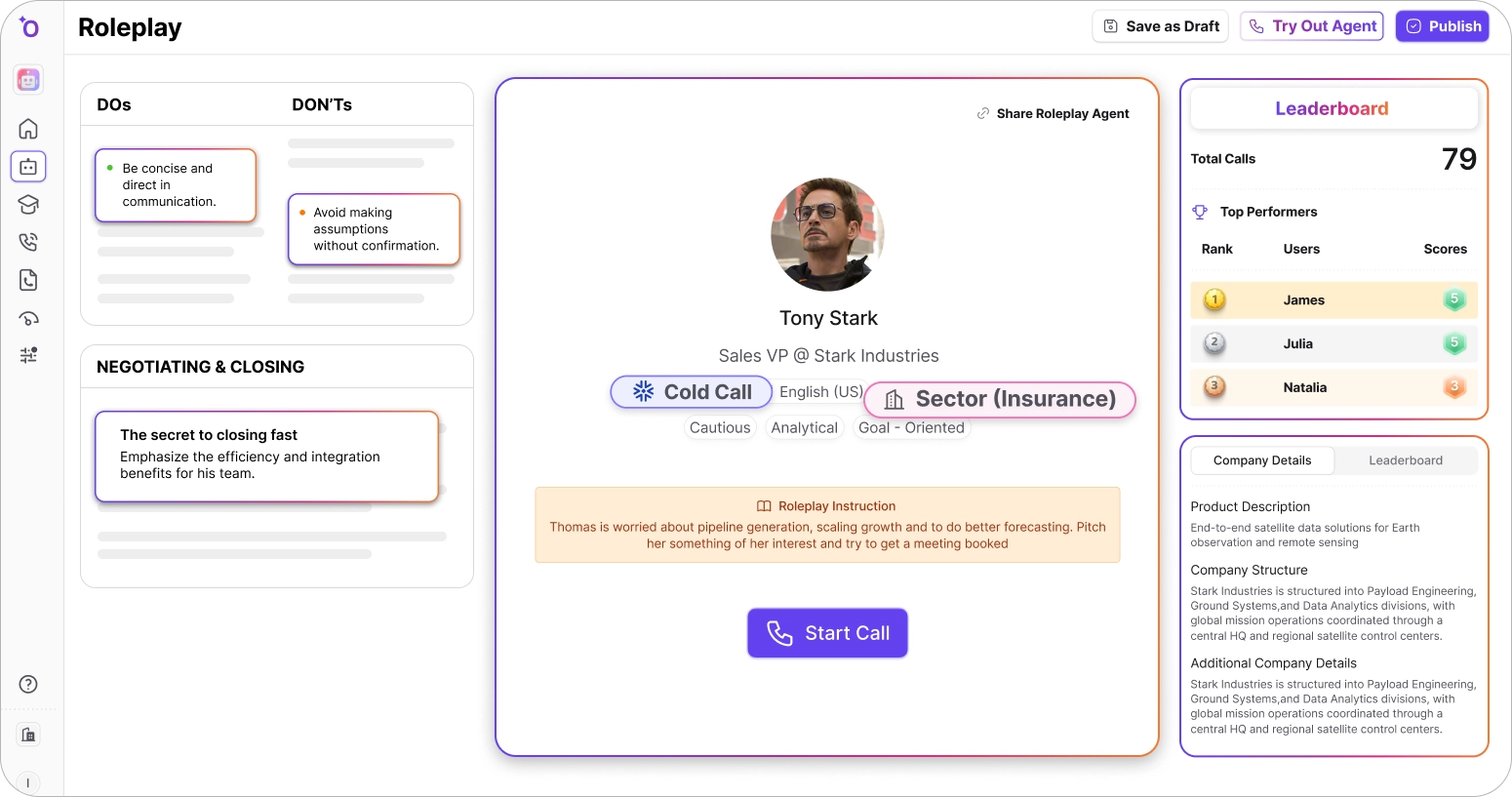
Outdoo AI is an enterprise AI roleplay and training platform built for customer-facing teams. It is designed for both sales and customer support scenarios, so support is a real, first-class use case here, not a sales tool with a customer service label added on later.
Here is what makes it strong for customer service. Agents practise against AI customers built from your own calls and tickets, so the frustration and phrasing match what your team actually hears. The AI customer reacts in real time: give it a vague apology and it gets more annoyed; give it real acknowledgment and it settles. That reactivity is what makes the practice carry over to live calls.
Worth knowing: Outdoo is not customer-service only. It is built for customer-facing teams across sales, support, and success, with dedicated scenarios and training agents for each use case. So if you are training a support floor and a sales team, you are not buying two tools, the same platform covers both.
On the enterprise side, Outdoo covers what larger and global teams need: 74+ languages for multi-region support floors, 120+ integrations across CRM, helpdesk, conversation intelligence, and LMS, and SCORM, xAPI, and AICC export so roleplays and scores flow into your existing systems. It also meets enterprise compliance standards including GDPR, HIPAA, CCPA, and SOC 2, with SSO and role-based access.
The strongest part of Outdoo AI is the closed-loop coaching. The same scorecard, tuned to empathy, tone, de-escalation, accuracy, and resolution, runs across both practice and real calls. So you can see whether the skill an agent drilled actually showed up with customers. Most tools stop at scoring the practice session.
It also covers more than the conversation. AI Tutors is an on-screen, voice-led trainer that teaches product and policy knowledge and gives real-time feedback to check the agent can apply it. Workflow simulation then trains the after-call ticket work. Together, that covers the whole job, not just the talking part.
Pros:
- Support-first: scenarios and scoring built for CS behaviours, not adapted from sales
- AI customers built from your real calls and tickets, so practice feels real
- One scorecard across practice and live calls, so you can measure real improvement
- Adds knowledge (AI Tutors) and after-call workflow simulation
- Enterprise-ready: 74+ languages, 120+ integrations, SCORM/xAPI/AICC, and GDPR, HIPAA, CCPA, SOC 2 compliance
Cons:
- More than you need if you only want a lightweight content or narration tool
- Pays off most when you use the full practice-to-live loop, not a single feature
Our take: If your goal is realistic customer service or contact centre roleplay that carries through to live-call performance, this is exactly what we built Outdoo for, and where we believe Outdoo is the strongest fit on this list. If you only need a slice of that, the tools below may suit you better, and we will say so honestly.
2. Retorio: Best for communication style and delivery
Best for: Teams that care most about how an agent comes across, tone, warmth, composure.
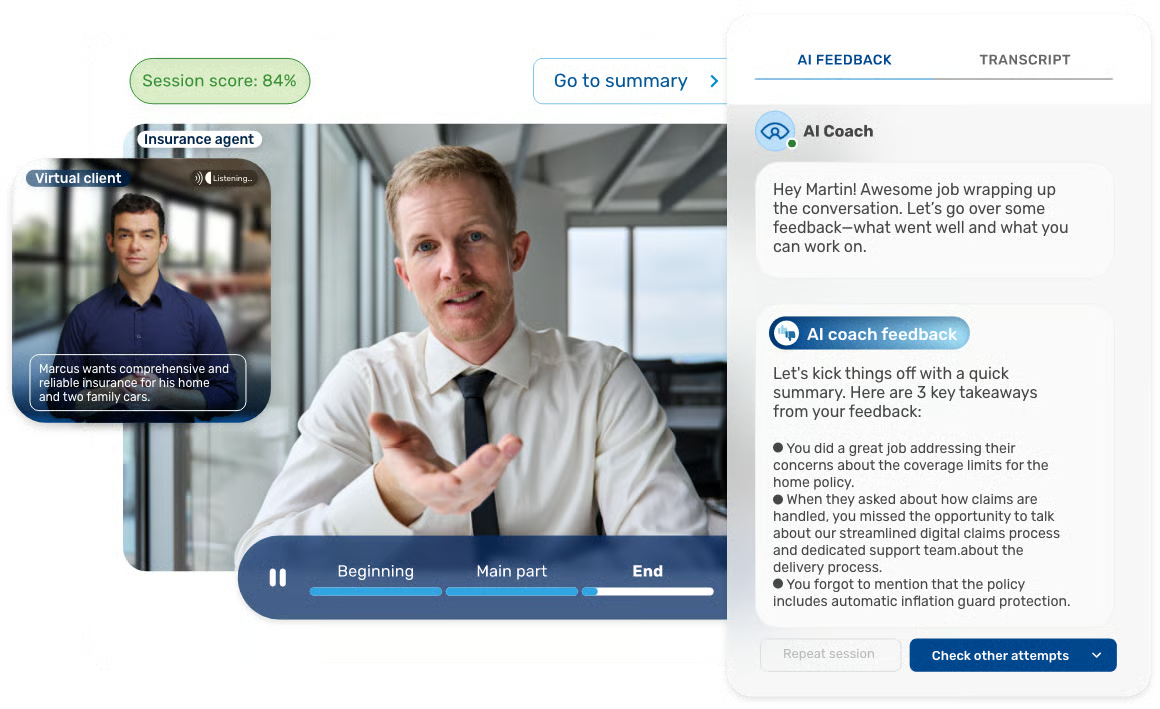
Retorio takes a behavioural-science angle, using video-based practice to coach the softer signals in a conversation. If your main gap is not what agents say but how they say it, whether they sound calm and human under pressure, that lens is a genuine strength, and not something most tools focus on.
Pros:
- Behavioural, video-first focus on communication style
- Good for coaching tone, warmth, and delivery
- A differentiator for teams focused on how agents present
Cons:
- Narrower than an end-to-end practice-and-workflow platform
- Less depth on ticket workflow and connected practice-to-live scoring
Our take: Great if communication style is your priority, less so if you need the full workflow and closed-loop scoring.
3. Smart Role: Best for support-specific QA and coaching
Best for: Support teams that want QA and coaching tied tightly to CS metrics.
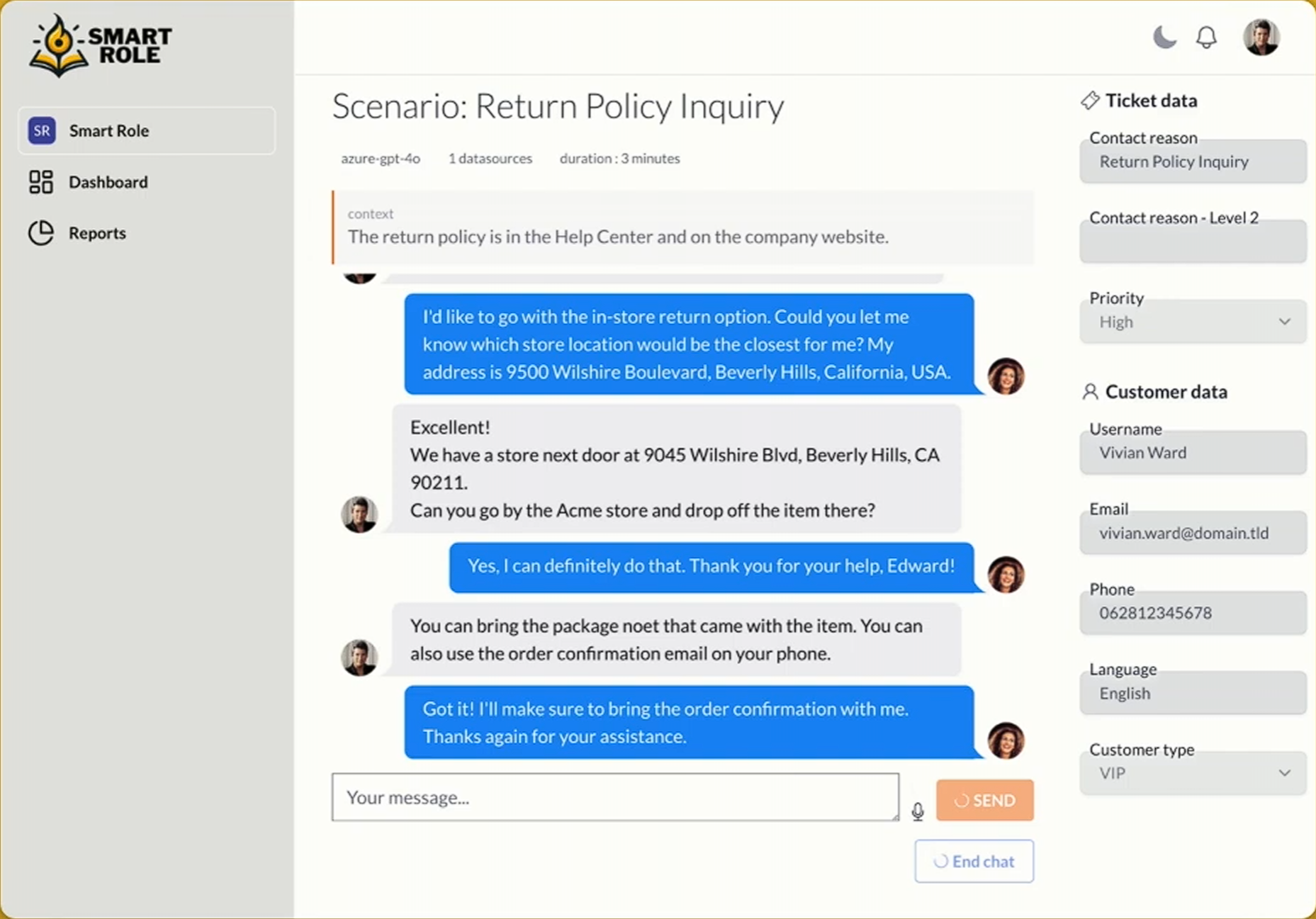
Smart Role focuses only on customer support: training, QA automation, and coaching. It frames everything around the numbers CS leaders track, onboarding speed, QA scores, CSAT, and first-contact resolution. That single-minded focus makes it feel purpose-built rather than borrowed from sales, and there is a free tier with ready-made scenarios to try it.
It is SOC 2 Type 2 and ISO certified, so security is covered. As a newer, more focused player, the main thing to check is whether its breadth and integrations match what a very large or complex operation needs.
Pros:
- Built specifically for customer support
- QA automation and coaching tied to CS metrics like CSAT and FCR
- Feels purpose-built rather than adapted from sales
Cons:
- Newer and more focused, so less breadth and fewer integrations than the largest platforms
- Security is certified (SOC 2 Type 2, ISO); very large orgs should still confirm breadth and integration fit
Our take: A promising support-first option worth shortlisting alongside Outdoo if support QA is your top priority.
4. Virti: Best for immersive soft-skills scenarios
Best for: Teams wanting immersive, experiential soft-skills practice across several functions.
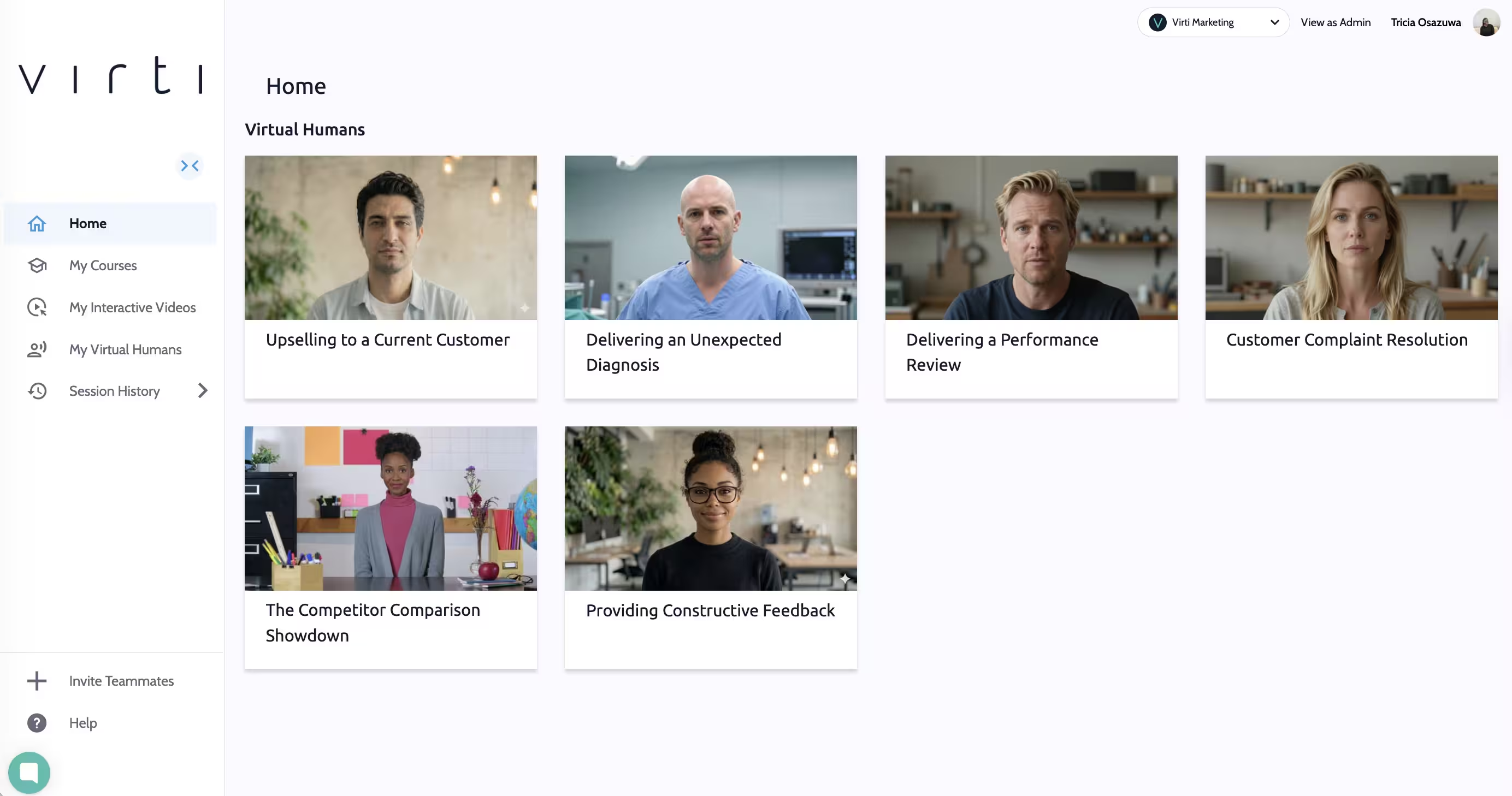
Virti builds immersive, scenario-based practice for soft skills across customer service, healthcare, leadership, and more. You can build scenarios from existing materials and dial difficulty up or down, and the experiential feel is nice for empathy and communication work. The trade-off is breadth: because it spans many industries, it is less laser-focused on the specific mechanics of a support floor.
Pros:
- Immersive, experiential soft-skills practice
- Flexible across multiple training use cases
- Adjustable difficulty and scenario building
Cons:
- Less specialised for support-specific QA, scoring, and workflow
- Breadth can mean less depth for a pure CS team
Our take: Worth a look for immersive soft-skills practice across functions; a CS-specialised tool will go deeper on support scoring and workflow.
5. Zenarate: Best for regulated process and procedure simulation
Best for: Teams that specifically want a simulation tool oriented around regulated, process-heavy workflows.
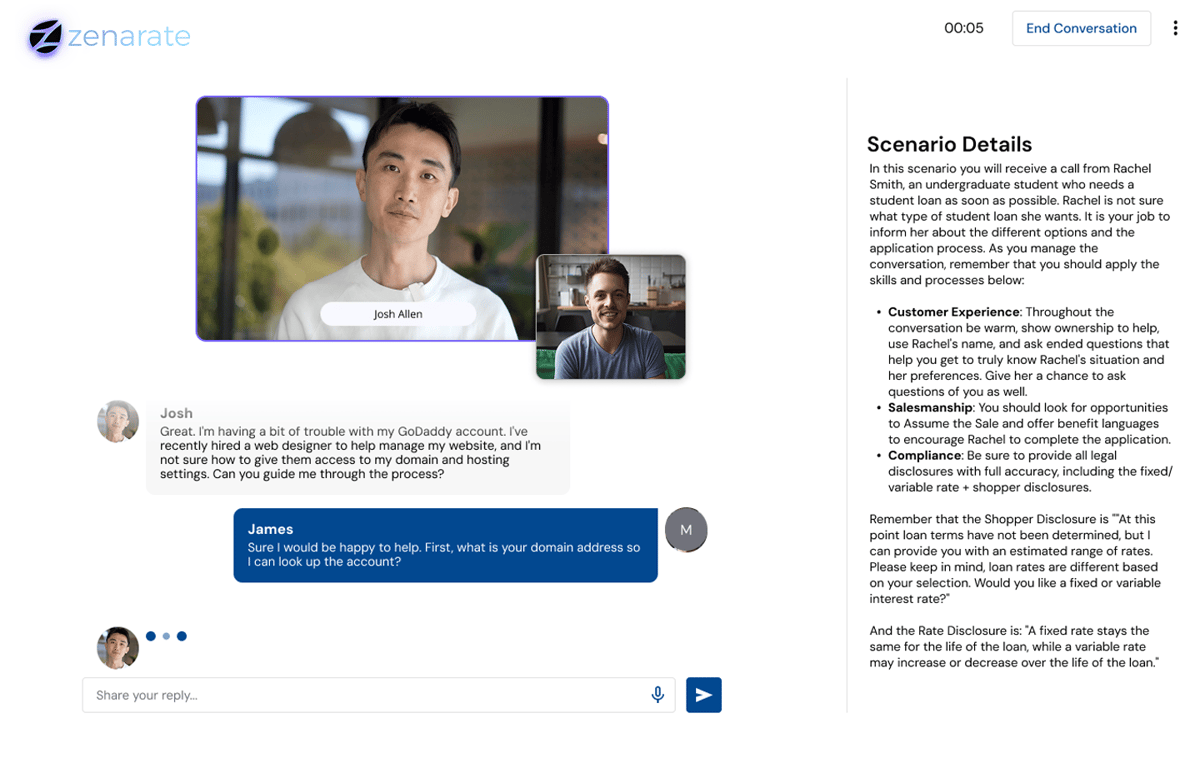
Zenarate offers voice, chat, and screen simulation aimed at larger, process-driven teams, with a focus on standardising how agents follow regulated procedures. If your priority is process and compliance consistency more than open-ended conversational roleplay, it is worth a look. For realistic, reactive customer roleplay tied to live-call scoring, though, we think that is territory Outdoo covers more completely.
Pros:
- Voice, chat, and screen simulation in one place
- Oriented to regulated, process-driven workflows
- Focus on procedure and compliance consistency
Cons:
- Can feel heavy and enterprise-oriented for a smaller support team
- Less suited to teams that want something quick and lightweight
Our take: Reasonable if your emphasis is regulated process simulation; for reactive customer roleplay scored through to live calls, we would point you to Outdoo.
6. Mindtickle: Best for roleplay inside a full enablement suite
Best for: Large organisations that want roleplay bundled into a broader enablement platform.
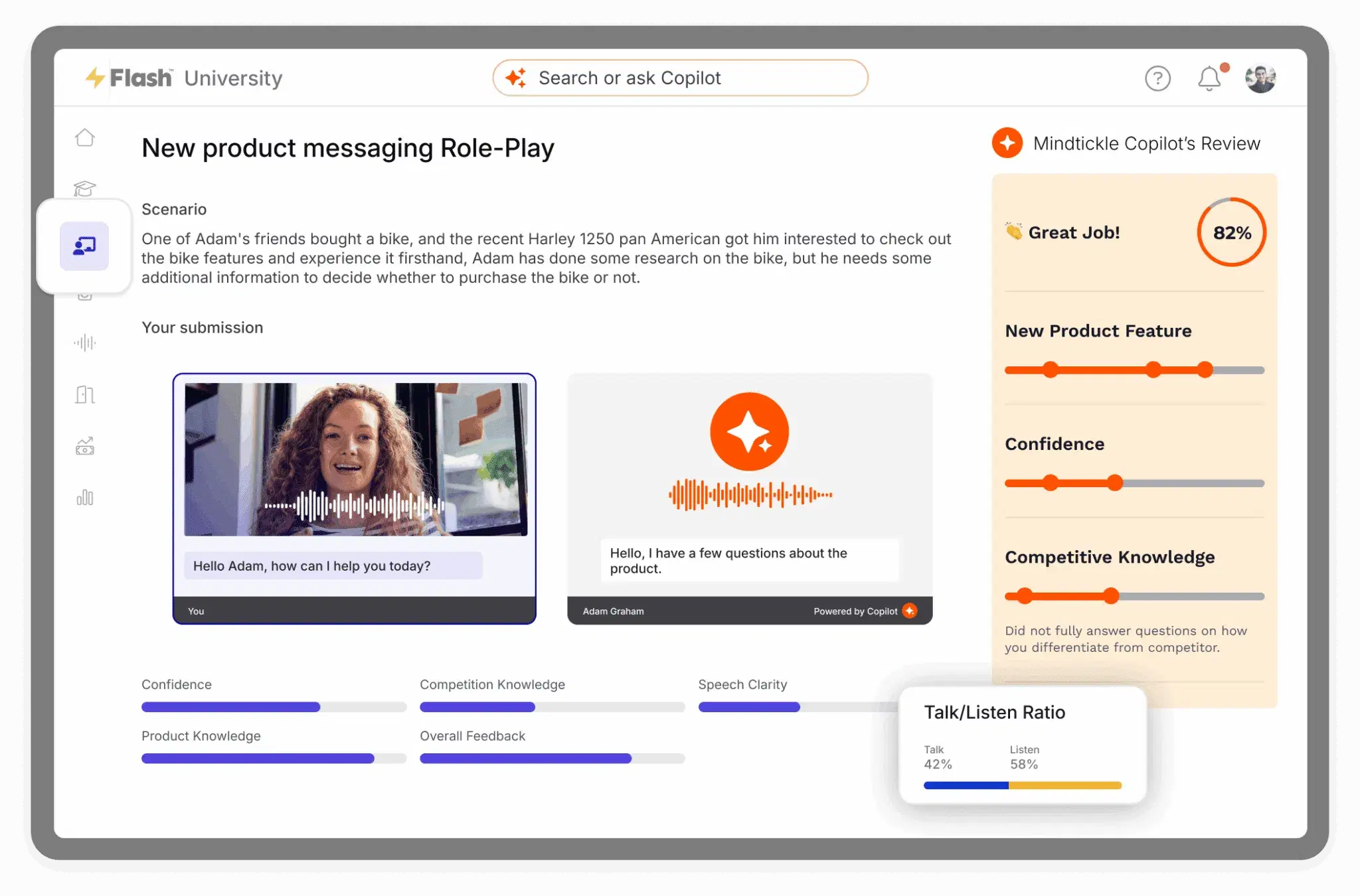
Mindtickle has a well-regarded AI roleplay simulator, but the honest framing is that it lives inside a much bigger enablement suite covering training, coaching, and performance management. If you want one vendor for the whole stack and roleplay is just one piece, it is a credible, enterprise-proven choice. Just go in knowing the platform is broad.
Pros:
- Roleplay sits inside a full training and enablement suite
- Strong enterprise adoption and breadth
- One vendor for much of the enablement stack
Cons:
- Built historically around sales enablement, so CS depth can feel secondary
- A CS-only team may pay for a lot of functionality it will not use
Our take: Makes sense if you want roleplay as part of a wider suite; a support-first tool is usually leaner for a focused CS use case.
Top customer support AI roleplay training tools compared at a glance
Here is the whole shortlist side by side, framed for a customer service audience.
| Tool | Best for | Simulation modes | Free tier? | Pricing |
|---|---|---|---|---|
| Outdoo AI | Realistic CS practice from your own calls, closed-loop scoring | Voice, video, chat, workflow | Yes | Free, then usage-based; enterprise custom |
| Retorio | Communication style and delivery | Video, voice | No | Custom |
| Smart Role | Support-specific QA and coaching | Voice, chat, email | Yes | Free tier, then custom |
| Virti | Immersive soft-skills scenarios across functions | Voice, immersive | No | Custom |
| Zenarate | Regulated process and procedure simulation | Voice, chat, screen | No | Custom |
| Mindtickle | Roleplay inside a full enablement suite | Voice, chat | No | Custom |
Which one should you actually choose?
If you take one thing from this: match the tool to your reality, and we will be straight about ours.
- Want immersive soft-skills scenarios across functions? Virti is worth a look.
- Care most about communication style? Retorio's behavioural lens fits.
- Want roleplay folded into a wider suite? Mindtickle makes sense.
But if your goal is realistic customer service or contact centre roleplay, scored on the behaviours that decide CSAT and resolution, and tied through to live calls, that is the use case we built Outdoo AI for. It is where we genuinely think we are the strongest fit on this list.
Whatever you shortlist, do the one test that matters before you commit: build your single hardest real scenario, an irate customer, a messy multi-issue ticket, and see which tool handles it in a way that would genuinely prepare your agents. To try that with your own calls and tickets, schedule a demo with Outdoo AI.
Frequently Asked Questions
.svg)
For most customer success and support teams, Outdoo AI is the strongest all-round choice. It builds AI customers from your own calls and tickets so practice feels real, scores agents on CS behaviours like empathy, tone, de-escalation, and resolution, and runs the same scorecard across practice and live calls so you can see improvement. Zenarate is a strong alternative for large regulated contact centres.
Focus on scenario realism (a customer that reacts dynamically, ideally built from your real tickets), soft-skill scoring that evaluates empathy, tone, listening, de-escalation, and resolution rather than keywords, simulation modes across voice, chat, and workflow, coaching visibility for team leads, and how easy scenarios are to create and keep current. Then test each with your single hardest real scenario.
They serve opposite purposes. A customer service chatbot talks to your customers to resolve their issues. An AI roleplay tool plays the customer so your agents can practise and be scored on how they handle the interaction. Roleplay tools are built for training and assessment, with scoring and coaching, whereas chatbots are built for live conversation generation.
Yes, and it is one of their strongest use cases. A good tool has the AI customer start frustrated and react to the agent's responses, getting more agitated with a vague apology and de-escalating with genuine acknowledgment. Agents practise staying composed and reading emotional cues repeatedly, then get scored on empathy, tone, and de-escalation, which builds those skills as reflexes rather than theory.
They can be, if you pick one sized to your needs. Some platforms are built for large regulated contact centres and can feel heavy for a small team. Support-first tools with a free or usage-based entry, like Outdoo AI, let a smaller team start without a big commitment and scale up later, so you get realistic practice and scoring without enterprise overhead.
Table of Contents
Talk to Sales
Have questions about training and enablement for your sales, CS, support, or leadership team? Let's talk.
Talk to Sales