



Most claims training programs are solving the wrong problem. They invest in conversation practice while ignoring the system navigation that eats 30% of a new adjuster's mental bandwidth on every live call, then wonder why classroom confidence doesn't translate to the floor.
Teams that run 15 or more varied simulation reps per week during onboarding move adjusters from "I know what to say" to "I've said it under pressure 20 times before." Teams that don't are shipping people into production with one or two rushed role plays and a hope that real calls will fill the gaps. They won't. The structural reasons this gap persists have less to do with trainer quality and more to do with a training design that was never built to mirror the actual job.
This piece makes a specific argument: integrated simulation, where conversation practice and system practice happen in the same rehearsal, is the design standard claims L&D should be building toward. Not because it's novel, but because it's how the work actually happens. Training that practices conversation and system navigation separately is practicing a version of the job that does not exist.
What Is AI Claims Adjuster Roleplay Training?
AI claims adjuster roleplay training is practice where an adjuster handles a simulated claimant call with an AI persona that reacts in real time, ideally while working the same claims system steps they use on live calls.
The old game: classroom scripts and one-off role play
The pattern in claims training rooms has barely changed in two decades. New adjusters learn policy language, coverage structures, and regulatory requirements through slides and job aids. Then they do a handful of role plays, usually with a senior adjuster or trainer standing in as the claimant. The scenarios are rushed, feedback is inconsistent, and the system side of the job gets treated as a separate track entirely.
The result is a predictable split: adjusters who can recite the right language in a controlled setting but freeze when a real caller gets emotional, or adjusters who handle callers well but fumble through the claims platform, extending handle time and creating documentation gaps.
This isn't a new observation. But the structural reasons it persists are worth examining.
Human role play doesn't scale
A claims operation onboarding 40 new adjusters per quarter cannot provide each person with enough live practice reps against varied scenarios. The math doesn't work. Managers and senior staff have their own caseloads. The format itself also creates resistance. Becky Kimminau, a Training Manager from NARS, an insurance firm handling commercial claims across general liability, property, workers' comp, and transportation, put it plainly: "We've done a lot of role play, and everybody hates role play. Myself included. It just puts you in such an awkward position where you feel vulnerable, like you're looking stupid." That vulnerability doesn't produce good practice. It produces people going through the motions to get the session over with.
Knowledge decay compounds the problem
Research on learning retention, including widely cited work on the "forgetting curve" first described by Hermann Ebbinghaus and reinforced by modern meta-analyses, has found that up to 87% of new knowledge learned in training is lost within 12 weeks. Only 1 to 2% of training content ever makes it into sustained practice. The majority of what you invest in onboarding dissolves before an adjuster has handled enough real claims to build durable habits. If your training program delivers content in a concentrated burst and doesn't follow it with spaced, realistic practice, the investment is leaking from day one.
Technology experience is fragmented
According to a 2024 Insurance Journal analysis drawing on Sedgwick research, roughly 50% of insurer IT budgets still go toward maintaining legacy systems, and most claims organizations operate across siloed platforms that don't talk to each other. The vision of AI-augmented claims processing running smoothly from intake to resolution is well ahead of reality. When the production environment is a multi-screen maze of disconnected tools, training that happens in a single clean interface is already misrepresenting the job.
AI adoption is broad but shallow. The same research shows adoption ranges from 58% to 82% depending on the function, but scalable, mature deployments remain rare. The human side of claims (the judgment calls, the difficult conversations, the documentation discipline) still carries most of the weight. That human side is where training keeps falling short.
What changes when AI roleplay enters claims training
An adjuster preparing for first notice of loss calls can practice the same scenario type twenty times, each with slightly different caller behavior. An adjuster struggling with denial conversations can rehearse against an AI persona calibrated to push back on coverage decisions with realistic emotional intensity. Settlement pushback, high-emotion callers, subrogation discussions, coverage disputes: each becomes a repeatable practice environment rather than a once-a-quarter exercise.
What makes this land differently than traditional role play isn't just the technology. It's the removal of social risk. As Becky Kimminau described it: "It gives people an opportunity to practice themselves, almost like you're practicing in the mirror, but somebody's actually saying something back. So you don't have that vulnerability. You're just looking stupid to a computer." When the fear of judgment disappears, reps actually practice. They try the hard response instead of the safe one. They experiment. That's when real skill development starts.
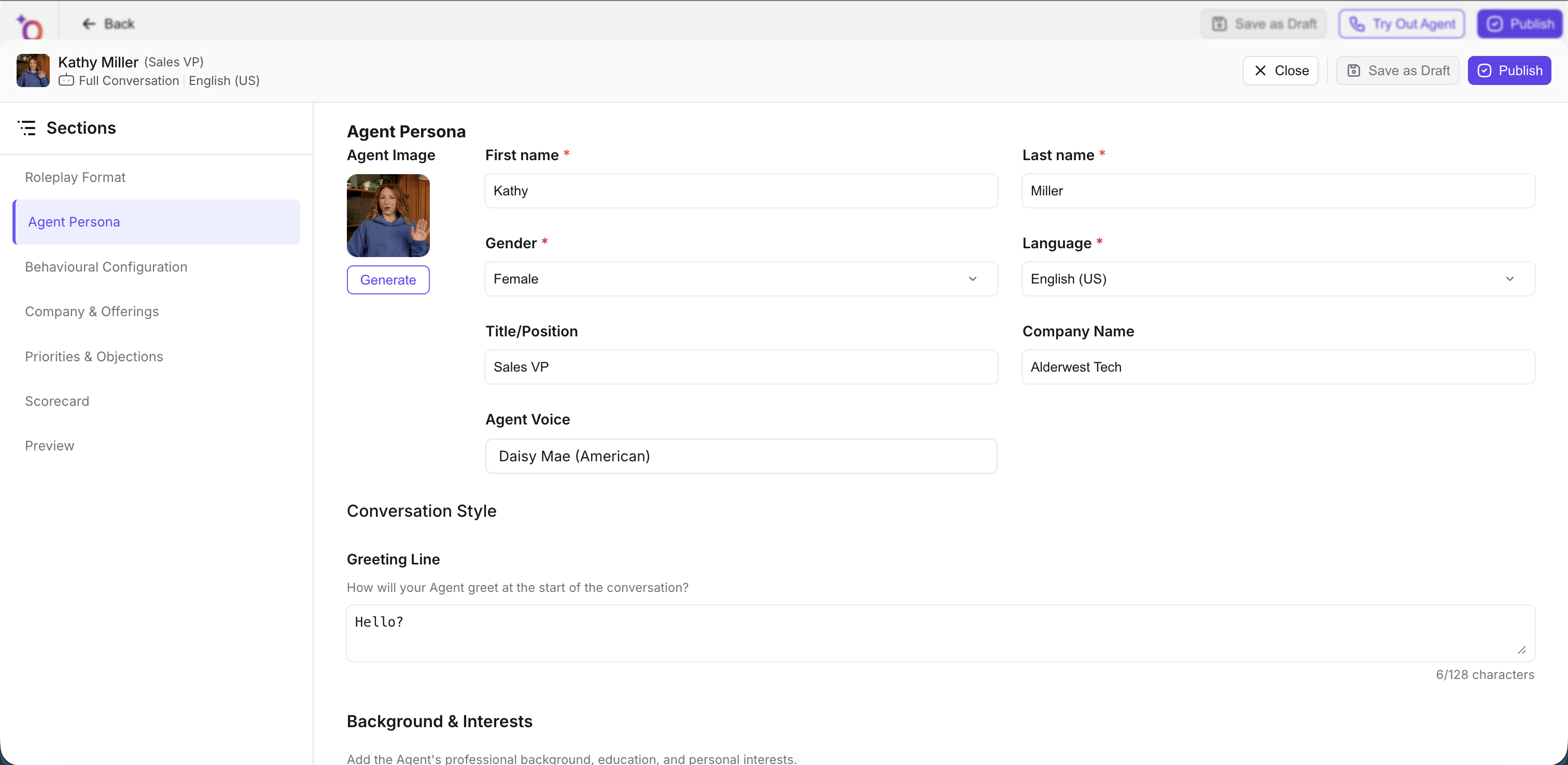
Good AI roleplay for claims includes branching dialogue that responds to what the adjuster says, not a scripted decision tree. It includes variation in caller personality: cooperative claimants, frustrated ones, combative contractors, confused policyholders who don't understand their deductible. It includes structured feedback after each session, scored against rubrics that reflect what the organization actually values in call handling. Becky's team needed practice on two distinct conversation types: the front end of the claims process, walking claimants through what to expect and answering their questions, and the back end, settlement negotiations on vehicle values, property damage, and injury claims. Those are meaningfully different skills, and they need meaningfully different scenarios.
AI roleplay works for skill gaps. It does not fix a broken feedback culture, a QA rubric that no one trusts, or a pipeline of scenarios written for a product version from three years ago. Teams that see strong results are the ones who came in with a clear definition of what good looks like on a real call and built their scenarios backward from that definition. Teams that skip that step get higher completion rates and flat performance metrics. Industry bodies have repeatedly identified intake clarity, difficult conversations, and negotiation as persistent development needs. These aren't knowledge gaps. They're performance gaps that only improve through repeated practice with feedback in a low-stakes environment. Nearly 90% of all sales and service training has no lasting impact on behavior, and only 10 to 20% of what is retained actually gets applied on the job. The format of practice matters at least as much as the content.
A mid-size P&C carrier onboarding 30 new adjusters illustrates the difference. In a traditional program, each adjuster might complete two or three live role plays during a four-week onboarding window. With AI roleplay, each adjuster can complete 15 to 20 varied scenario reps per week, covering FNOL (First Notice of Loss) intake, denial explanations, and settlement negotiations. Within the first month, adjusters who practiced denial conversations repeatedly reported less hesitation on live calls and fewer escalations to supervisors, because they had already encountered and navigated the emotional pushback in a safe environment.
Practice moves from an event to a rhythm. Instead of one role play during onboarding and maybe another during annual recertification, adjusters can practice specific conversation types weekly, with the scenarios adapting based on where they struggled last time. Reps who resisted traditional role play often become the most consistent users of AI practice, because they're not performing for an audience.
What most AI roleplay tools still miss
Most of the current market for AI sales roleplay tools focuses on the conversation layer in isolation. That approach improves talk tracks. It does not train the parallel cognitive work of navigating systems, managing documentation, and completing compliance steps while holding a live conversation. For a SaaS sales rep, that gap is manageable. For a claims adjuster juggling three screens and a regulatory clock, it is the gap that matters most.
The broader conversation intelligence category, including tools focused on recording and analyzing live calls, faces a different limitation. Post-call analysis tells you what went wrong after the fact. It does not give adjusters a low-stakes environment to practice what to do differently before they are on a real call. Insight and practice are not the same investment, and organizations that rely solely on call analytics are measuring skill gaps without closing them.
What changes when software simulation enters the same program
Claims adjusters don't work with a single, elegant application. They work across CRM platforms, claims management systems, policy databases, compliance checklists, and documentation tools, often at the same time, often while talking to a claimant. The cognitive load of navigating multiple systems while maintaining a professional, empathetic conversation is one of the hardest things about the job and one of the least trained.
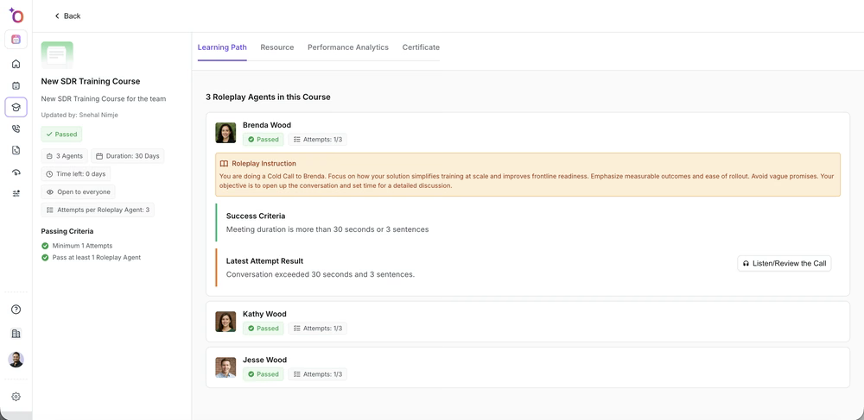
Software simulation addresses this by replicating the system environment adjusters will actually use. Instead of learning the claims platform in a sanitized sandbox disconnected from any conversational context, adjusters practice the clicks, the navigation paths, the documentation workflows, and the compliance steps in a realistic production-like environment.
This matters for specific, practical reasons:
Post-call documentation
A huge source of quality failures in claims isn't what the adjuster said on the call. It's what they did (or didn't do) after hanging up. Did they log the claim correctly? Did they flag the right coverage codes? Did they initiate the follow-up workflow? Software simulation builds muscle memory for these steps before an adjuster touches a real claim file.
Multi-screen navigation under pressure
The system environment isn't a single tool. It's a maze. New adjusters who practiced conversation skills in isolation often perform well on the phone but lose minutes searching for the right screen, the right field, the right dropdown. Those minutes compound into handle time problems and claimant frustration.
Compliance adherence in context
Regulatory requirements in claims show up as specific actions in specific systems: checking a box, entering a date, generating a letter within a mandated timeframe. Practicing compliance as a system workflow, not just a knowledge test, turns compliance from a concept into a habit. For regulated carriers operating across HIPAA, GDPR, or CCPA frameworks, simulation needs to verify that required actions happen in the right sequence, not just that the adjuster knew they were supposed to happen.
Search and record lookup during roleplay.
In a live claims call, the first task is often locating the right file. Outdoo AI's software simulation mirrors this directly: adjusters practice searching for claim records, policy information, and coverage history within a realistic interface that replicates their actual claims management system. The simulation tracks every search action, including search terms entered, filters applied, and navigation paths taken, to evaluate whether the adjuster found the correct information efficiently and in the right sequence. This matters because poor search habits inflate handle time and frequently lead adjusters to pull incorrect records under pressure, creating documentation errors before the conversation even ends.
Identifying denial and disposition reasons.
One of the most common failure points in claims handling is not the conversation. It is what comes after it. Adjusters must correctly identify why a claim was denied, which disposition code applies, and how to explain that reasoning clearly to a claimant. Outdoo AI's simulation places adjusters inside the actual decision screens they will use on the job: locating the coverage section, reviewing the denial reason, selecting the correct disposition code, and documenting the basis for the decision. Practicing this sequence within the same session as an active claimant roleplay ensures adjusters can explain their reasoning confidently because they have already worked through it in the system, rather than guessing at it under the pressure of a live call.
Making system changes and corrections accurately
Documentation errors in claims are costly. A missed field, an incorrect date entry, or a misnumbered policy code can delay processing, trigger compliance flags, or create legal exposure. Outdoo AI's simulation requires adjusters to enter, update, and correct data in realistic claim and CRM interfaces, scoring field accuracy, step sequence, and whether corrections were made without introducing downstream errors. When combined with an active roleplay, this trains adjusters to handle documentation accurately even when attention is split between the claimant and the system, which is the actual condition of the job. The platform captures every interaction, including field inputs, navigation steps, correction actions, and validation behavior, giving managers step-level visibility into exactly where adjusters hesitate or make errors, and making it straightforward to update or refine the simulation when the underlying system changes.
Why the combination is what closes the gap
AI roleplay alone improves talk tracks. Software simulation alone improves clicks. Claims work requires both at once.

An adjuster taking a first notice of loss call isn't just listening and responding. They're entering data, checking coverage, flagging potential issues, and queuing next steps simultaneously. The cognitive integration of conversation and system work is the actual skill being tested on the job. Training that practices them separately is practicing a version of the job that doesn't exist.
Integrated simulation, where an adjuster handles a realistic AI-driven conversation while navigating a realistic system environment in the same session, replicates how claims work actually happens. The adjuster practices listening to a claimant describe property damage while entering details into the correct fields. They practice explaining a coverage limitation while pulling up the relevant policy section on screen. They practice wrapping up a call with clear next steps while initiating the right system workflow.
Most claims organizations have drifted into a fragmented vendor stack: a conversation practice tool here, an LMS there, a system sandbox somewhere else, none of them connected. This fragmentation mirrors the siloed technology problem that plagues claims operations themselves. L&D ends up managing three or four platforms that each address a slice of the job but never the whole thing. Reps learn how to use playbooks in one environment and how to navigate systems in another, but they never practice using both in the same moment, which is the only moment that matters on a live call.
This framework helps teams assess where they stand and what to build toward. Use it as a self-assessment: identify your current level, then focus your next investment on the specific gap between where you are and the next level up.
Isolated
Structured
Sequenced
Integrated
Adaptive
Isolated Knowledge Transfer
Training is content-driven. Adjusters learn policy, process, and systems through slides, manuals, and knowledge checks. Role play is occasional and unstructured. System training is a separate track, often a recorded walkthrough. No integration between conversation skills and system skills. Feedback is manual and inconsistent.
Diagnostic question: Can you point to a single exercise where an adjuster practices conversation and system navigation in the same session? If not, you're here.
Structured Practice, Separate Tracks
The organization has adopted some form of roleplay (AI or human) for conversation skills and some form of sandbox for system training. Both exist, but they don't connect. An adjuster might do a great roleplay in the morning and a system exercise in the afternoon, but never both at once. Feedback is more structured but still siloed by skill type.
Diagnostic question: Do your conversation practice scores and system practice scores feed into the same performance profile? If they live in different platforms with different rubrics, you're here.
Sequenced Integration
Conversation practice and system practice are deliberately sequenced. An adjuster completes a roleplay scenario and then immediately moves to the corresponding system workflow: documenting what they just discussed, initiating the right follow-up, entering the data. The two aren't simultaneous yet, but they're linked in the learning design. Feedback begins to cross both dimensions.
- First step to reach Level 3: Take your highest-volume roleplay scenario and pair it with the corresponding system workflow. Have adjusters complete them back to back in the same session. That single design change moves you from 2.
Simultaneous Integrated Simulation
The adjuster handles a realistic conversation while navigating a realistic system environment in the same session. The practice fully mirrors the cognitive demands of the actual job. Scoring covers both conversation quality and system accuracy. Coaching addresses the interplay between the two, not just each in isolation.
- What to measure: Track whether adjusters who score well on integrated simulation also show lower handle times and fewer documentation errors in their first 90 days of production work. If the correlation holds, the simulation is calibrated correctly.
Closed-Loop Adaptive Practice
Integrated simulation is connected to live call performance data. The scenarios an adjuster practices are informed by their actual on-the-job gaps: if post-call documentation is consistently weak, the system generates practice that targets that workflow specifically. If denial conversations are triggering complaints, the AI persona calibrates accordingly. Practice adapts based on production reality, not a static curriculum.
If you want a quick starting point: identify your organization's single highest-failure-rate call type, build an integrated simulation for that one scenario, and measure whether practice performance predicts production performance. That one proof point will tell you whether to invest further.
How this stack supports coaching, not just content delivery
Knowing policy language, claims procedures, and regulatory requirements is necessary but insufficient. Doing once isn't the same as doing consistently under pressure. The difference is coaching: repeated practice, specific feedback, targeted reinforcement of weak areas.
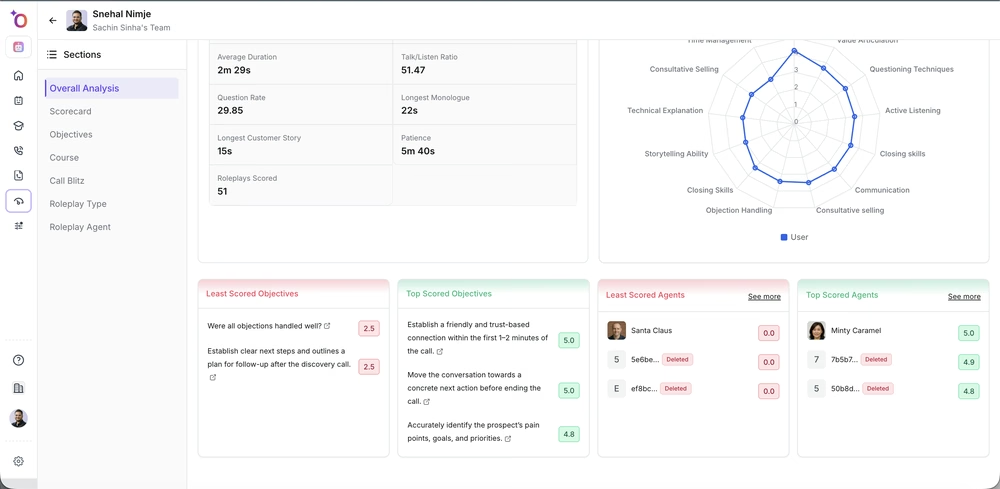
Integrated simulation enables coaching in ways that classroom training and standalone e-learning cannot. A Midwest credit union's talent development team articulated this clearly when working on member service training. Their organization runs member service training on a rolling cadence, sometimes every other week, across six branches with a seventh opening. The challenge isn't willingness to coach. As one of their L&D leaders put it, "Coaching and manager engagement is a big part of our environment here." The challenge is consistency at scale. When adjusters and representatives are geographically dispersed and managers are stretched, structured simulation data becomes the connective tissue that makes coaching possible without requiring someone to sit in on every practice session.
Outdoo AI's economic analysis of enterprise deployments found that managers in traditional enablement environments average 12 coaching hours per week, while teams using AI-supported simulation bring that figure down to 6 hours. This reduction doesn't mean coaching becomes less important. Automated skill gap visibility replaces the manual observation time that was consuming managers' calendars. That recovered time goes into higher-quality one-to-one conversations rather than diagnosing problems by intuition.
Session recordings and analytics
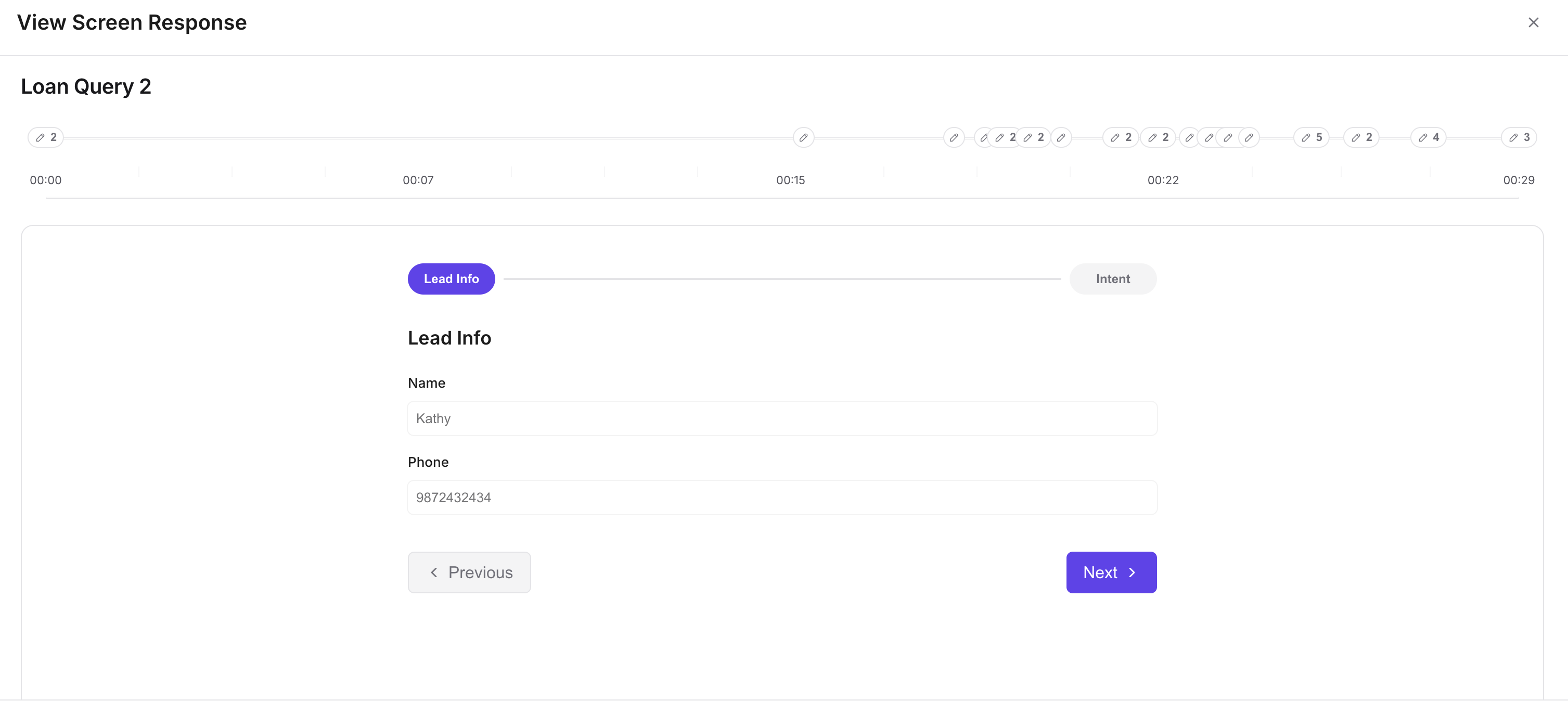
When an adjuster completes an integrated simulation, the session produces data: what they said, how they navigated the system, where they hesitated, what they missed. This data is structured, not anecdotal. A coach reviewing it can point to specific moments rather than offering general impressions.
Rubric-based feedback
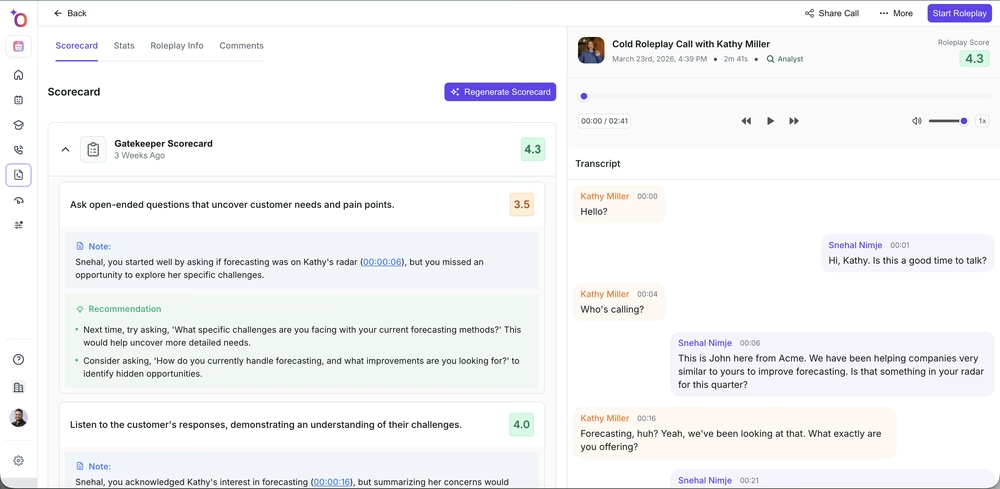
Instead of "that was pretty good" or "you need to work on empathy," feedback is tied to defined criteria: coverage explanation clarity, de-escalation effectiveness, documentation accuracy, compliance step completion. The rubric reflects what the organization actually values, not generic communication skills.
Spaced repetition on weak scenarios
If an adjuster consistently struggles with settlement pushback conversations, the system can surface those scenarios more frequently. If documentation accuracy drops under conversational pressure, the practice environment can increase that specific type of cognitive load. This is targeted development, not curriculum recycling.
Manager-ready summaries for 1:1 coaching
Frontline managers in claims operations are busy. They don't have time to sit in on every practice session. But they can review a structured summary that shows where an adjuster is strong, where they're struggling, and what specific scenarios would benefit from guided coaching. This turns the one-to-one from a general check-in into a focused development conversation.
The hybrid coaching question
Research consistently shows that a blend of AI-driven practice and human coaching outperforms either approach alone. A frequently cited Harvard Business Review analysis found that companies using a hybrid coaching model, where AI handles repetition and pattern detection while managers focus on judgment and motivation, outperform those relying on a single method. For claims organizations, the practical implication is specific: AI simulation is most valuable when it handles the high-volume, low-variability practice reps that would otherwise consume manager time, freeing those managers to focus their coaching attention on complex judgment calls that AI cannot yet replicate. Scenario completion data, skill gap flags, and session-level analytics give managers the situational awareness to make those conversations count.
What you can measure when practice looks like production
One of the persistent frustrations in claims L&D is that training metrics and operational metrics live in different worlds. Course completion rates tell you who finished the module. They don't tell you whether the module changed anything.
When practice mirrors the actual job, the metrics start to overlap in useful ways.

Average handle time (AHT)
If simulation sessions track how long adjusters take to complete both the conversation and the system workflow, you can benchmark practice AHT against production AHT. Gaps suggest where the transition from training to the job is breaking down. A practical threshold: if practice AHT is more than 30% lower than production AHT, the simulation likely isn't replicating enough of the real cognitive load.
First contact resolution (FCR)
Simulation scenarios can test whether adjusters resolve the claimant's core issue in a single interaction or leave loose ends that would generate callbacks. This predicts on-the-job FCR more reliably than knowledge assessments.
QA scores
If the simulation scoring rubric mirrors the organization's actual QA criteria, practice scores become a leading indicator of QA performance. You can identify adjusters likely to struggle on QA before they're handling real claims. The key design decision: build your simulation rubric from your existing QA scorecard, not the other way around. If those two instruments don't share criteria, the predictive value breaks down.
Compliance adherence
Simulation that includes system workflows can test whether adjusters complete mandated steps in the right sequence and within the right window: documentation entries, timeframe-triggered actions, required disclosures.
Simulation metrics should predict on-the-job behavior
They should not become vanity completion rates. The temptation to celebrate "95% of adjusters completed all simulation modules" is real, but it's the wrong metric. The question is whether adjusters who scored well in simulation actually perform better in production. If you can't connect those two data sets, the measurement framework is incomplete.
Platforms that apply consistent scoring across both practice and live performance make this connection possible. When the same rubric evaluates a roleplay session and an actual customer call, you can see whether skills practiced in simulation actually show up in execution. Outdoo AI's economic analysis, drawn from a composite of enterprise deployments, found that adjusters and representatives trained with AI-supported simulation reached full productivity in approximately 4.3 months compared to 6.5 months for those going through traditional enablement programs, and win rates after training reached 30% versus 22% in traditional programs. Those downstream numbers connect training investment to operational outcomes in a way completion dashboards never will.
Conclusion
Claims training has treated conversation skills and system skills as separate problems for too long. The job never separated them. Every live call requires an adjuster to listen, respond, navigate, document, and comply at the same time. Practice that doesn't replicate that reality leaves people unprepared for the moments that matter most.
The maturity model above gives L&D leaders a clear way to diagnose where their program stands. Most programs sit at Level 2, where conversation practice and system training exist but operate in separate tracks. The single highest-ROI move for a team at Level 2 is to take its highest-volume call type, build one integrated simulation scenario that requires adjusters to handle both the conversation and the system workflow simultaneously, and measure whether practice scores predict production QA scores. If they do, the design is right and the investment case builds itself. If they don't, the rubric needs work before the scenario library does.
For claims organizations running fragmented vendor stacks with no connection between conversation practice and system training, Outdoo AI is worth evaluating because it was built to close that integration gap. The platform's software simulation goes beyond simple interface walkthroughs: adjusters practice searching for records, identifying denial and disposition reasoning, and making accurate system changes, all within the same session as an active claimant roleplay. When the underlying system changes, simulations can be updated to reflect the new interface, ensuring training always mirrors real tools rather than an outdated version of them.
Book a demo to see how integrated claims simulation works in your environment.
Frequently Asked Questions
.svg)
Recorded call review is observational. AI roleplay is active practice, where the adjuster must respond in real time to a simulated claimant who can shift tone, push back on settlements, or introduce new information mid-conversation. The distinction matters because hearing a well-handled call and handling a difficult one yourself are two completely different cognitive experiences.
Modern AI roleplay personas can be scripted and tuned to reflect grief, frustration, confusion, and combativeness at varying levels of intensity. The simulation won't be identical to a real call, but research on stress inoculation training suggests that repeated exposure to high-pressure practice scenarios meaningfully improves performance under actual pressure, even when the simulation is imperfect.
Rubric design is the primary control. If your scoring criteria reward specific observable behaviors, such as completing a required disclosure at the right point in the conversation or using a named de-escalation technique, gaming becomes much harder. Pairing simulation scores with QA data from live calls also surfaces adjusters whose practice scores don't predict production performance.
Introduce integrated simulation two to three weeks into onboarding, after foundational policy knowledge is in place, not on day one. Introducing complex integrated scenarios before an adjuster has basic coverage vocabulary produces frustration rather than skill building. For teams running a four-week onboarding window, weeks one and two should cover policy foundations, and weeks three and four should move into integrated scenario practice with increasing cognitive load. That sequencing produces better transfer to production than front-loading simulation before adjusters have context for what they are practicing.
The core question is whether the platform can run conversation practice and system navigation in the same session, because that is what the actual job requires. Beyond that, look for simulation depth: can adjusters search for records, identify denial and disposition reasoning, and make system changes within the simulation, not just click through a static walkthrough. Look for rubric customization tied to your actual QA criteria, step-level scoring that shows which specific workflow actions are breaking down, and the ability to keep simulations current when your claims management system updates its interface. A platform that tracks search behavior, field accuracy, and navigation sequences gives managers actionable data, not just completion rates. Finally, confirm whether practice metrics connect to live call and QA performance data, so you can measure whether simulation scores are actually predicting on-the-job outcomes.
Table of Contents
Talk to Sales
Have questions about training and enablement for your sales, CS, support, or leadership team? Let's talk.
Talk to Sales