
- Gong is CI first, roleplay bolted on: Gong is a revenue intelligence platform that added roleplay as a module.
- Highspot is content first, roleplay bolted on: Highspot is a content and enablement platform that added roleplay as a module.
- Both modules beat expectations: both do it better than you'd expect from a bolt-on, and both are genuinely useful if you already need the bigger platform around them.
- Honest verdict: neither was built primarily to make reps practice better, and if practice is the actual priority, that gap matters more than either vendor's marketing suggests.
This page focuses on how their roleplay features compare. If you're weighing Gong more broadly, our full guide to Gong alternatives covers the wider field. The same goes for Highspot: see Highspot alternatives and competitors for more options.
Gong or Highspot: Which Is Best for AI Training?
- Gong: Best for revenue teams that already live in call recordings, deal-risk alerts and forecasting. AI Trainer builds practice scenarios from real customer calls.
- Highspot: Best for large enterprises that need content governance and guided selling. AI Role Play runs multi-persona practice but is gated to the 'Better' and 'Best' tiers.
- Gong and Highspot together: Best for enterprise teams that want call intelligence and content side by side. The two have a formal partnership and native integration.
- Outdoo AI: Best for teams whose top priority is dedicated, deep roleplay. One scorecard grades practice and live calls, with gatekeeper, workflow and video avatar practice.
At a Glance
| Gong | Highspot | |
|---|---|---|
| Core product | Revenue intelligence, call recording, forecasting | Content management, guided selling |
| Roleplay feature | AI Trainer (inside Gong Enable) | AI Role Play (native, powered by Nexus) |
| Roleplay in base plan | Bundled with Gong Enable | Gated to "Better" and "Best" tiers only |
| Best known for | Conversation intelligence and deal-risk signals | Content governance and Deal Agent's real-time signals |
Full feature-by-feature breakdown further down.
What Are Gong AI Trainer and Highspot AI Role Play?
Gong AI Trainer and Highspot AI Role Play are the AI roleplay modules inside two larger platforms: AI Trainer sits in Gong Enable and builds practice scenarios from a team's recorded calls, while AI Role Play is native to Highspot and runs multi-persona practice tied to a team's own coaching frameworks.
What Gong Does Well
Gong's core product is conversation intelligence, and it earns its reputation there.
Call recording, deal-risk signals, and pipeline forecasting are mature, and the review base backs it up: Gong holds 4.7 out of 5 stars across 6,679 reviews on G2, with 2026 Best Software badges for Top 50 Sales Products and Top 100 Highest Satisfaction Products.
Reps consistently praise the visibility it gives into customer conversations and the way it surfaces what top performers do differently.
Roleplay lives inside Gong Enable, under a feature called AI Trainer, which launched officially on February 25, 2026 as part of a platform release Gong calls "Mission Andromeda," alongside AI Call Reviewer and Initiative Tracking.
It generates practice scenarios from real customer calls rather than generic scripts, and Gong's own marketing makes a specific claim worth taking seriously: managers can reuse the same scorecards from AI Call Reviewer in both simulated and live calls, so feedback stays consistent across practice and the real thing.
That's a legitimate feature, not vaporware, and it overlaps directly with what a dedicated roleplay tool would pitch as its main selling point. Initiative Tracking, a companion feature, already ties enablement programs to win rate, deal size, and ramp time.
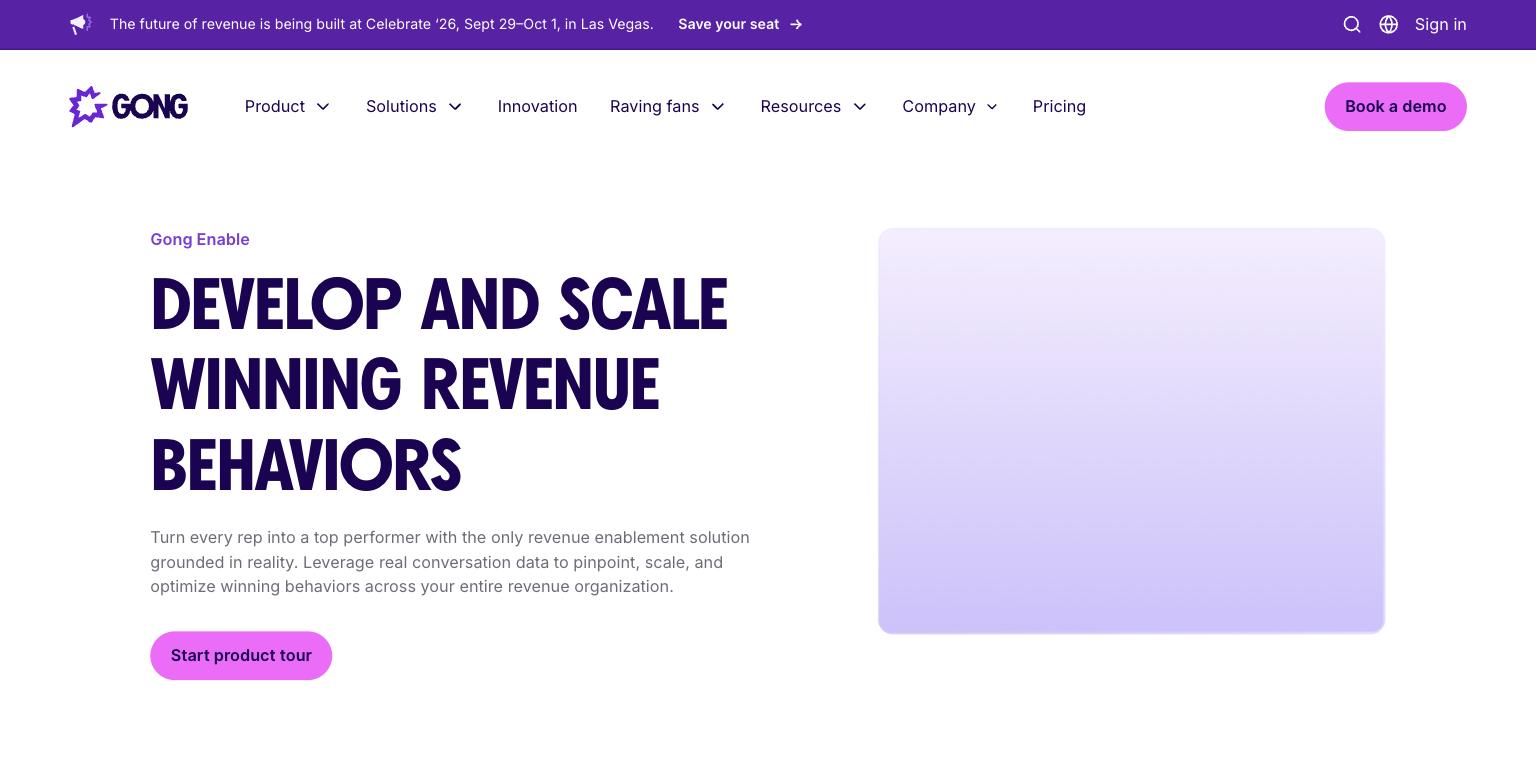
Screenshot: Gong's AI Trainer feature page, inside Gong Enable, captured directly from Gong's site, August 2026.
Gong is also shipping fast on this front. A second release train, "Mission Big Dipper," reached general availability around June 2026 and added AI Coach (automatic post-session feedback) and AI Builder for Scorecards, which auto-generates a rubric from a team's own closed-won calls.
Where Gong still falls short on roleplay specifically: it's one module inside a much larger CI-and-forecasting platform, not the reason most teams buy Gong in the first place, and it still has no dedicated marketing page of its own on gong.io, only help-center documentation.
Its scenarios are mined entirely from a team's existing recorded calls, so AI Trainer works best for teams with an established call library and offers little to brand-new reps or net-new scenarios without one.
It's built for cold-call practice, discovery, and objection handling as scenario types, run single-persona with a difficulty slider.
There's still no dedicated workflow rehearsal (practicing the CRM and process work that happens after the call), no gatekeeper-screening phase, no multi-persona buying-committee mode, and no video avatar mode.
G2 reviewers also flag two recurring frustrations that are worth knowing before a demo: the volume of data and notifications can feel overwhelming for larger teams, and transcription accuracy can struggle with accents, overlapping speakers, or industry jargon.
Pricing also comes up as a sore point for smaller teams trying to justify the cost. Third-party estimates put the base license around $1,200 to $1,600 per user per year, plus a platform fee of roughly $5,000 to $50,000 a year and $7,500 to $30,000-plus in onboarding.
Gong now layers a 2026 usage-credit meter on top of all of that. One mid-market estimate puts an all-in, 50-seat Gong Enable plus AI Trainer deployment at $100,000 to $200,000-plus a year.
One more honest wrinkle: Gong is frequently a hard renewal lock-in. If a team already has a multi-year Gong contract, "switch your roleplay tool" is a much easier conversation before renewal than after.
What Highspot Does Well
Highspot's core product is content management and guided selling, sold mostly to large enterprises. Its customer list (Uber, Siemens) tells you who it's built for, and a 2025 Gartner Magic Quadrant Leader placement for Revenue Enablement Platforms backs up that enterprise trust. See how it stacks up against another enablement suite in Highspot vs Allego.
G2 reviewers consistently point to how it brings scattered sales content and training into one governed place, which is exactly what it's designed to do. Highspot holds 4.7 out of 5 stars across 1,206 G2 reviews and 4.6 out of 5 across 75 Capterra reviews.
Its roleplay feature, AI Role Play, is native rather than a third-party bolt-on.
Older battlecards floating around the industry sometimes describe it as running on a partner tool; that's stale.
Highspot's current product page positions it as "Powered by Nexus, built into Highspot," and the feature itself is more capable than that framing might suggest.
It supports genuine multi-persona practice, letting a rep run deal champions, vendor skeptics, and economic and technical buyers in the same session, and scenarios are built from the company's own Highspot content and messaging rather than generic scripts.
Feedback is tied to a team's own coaching and competency frameworks instead of a fixed rubric.
Highspot expanded this further in a Summer 2026 launch: an MCP Server that can generate roleplay scenarios from outside AI tools including ChatGPT and Claude, plus Deal Agent surfacing real-time deal-risk signals directly inside Slack and Salesforce.
A separate Spring 2026 launch added GTM Agent. All are real, shipped features, not roadmap promises.
Where Highspot falls short: AI Role Play is gated behind the "Better" and "Best" pricing tiers, not included in the base plan, per Highspot's own pricing page.
A team that wants roleplay as its main use case still has to buy up into a bigger content-enablement contract to get it.
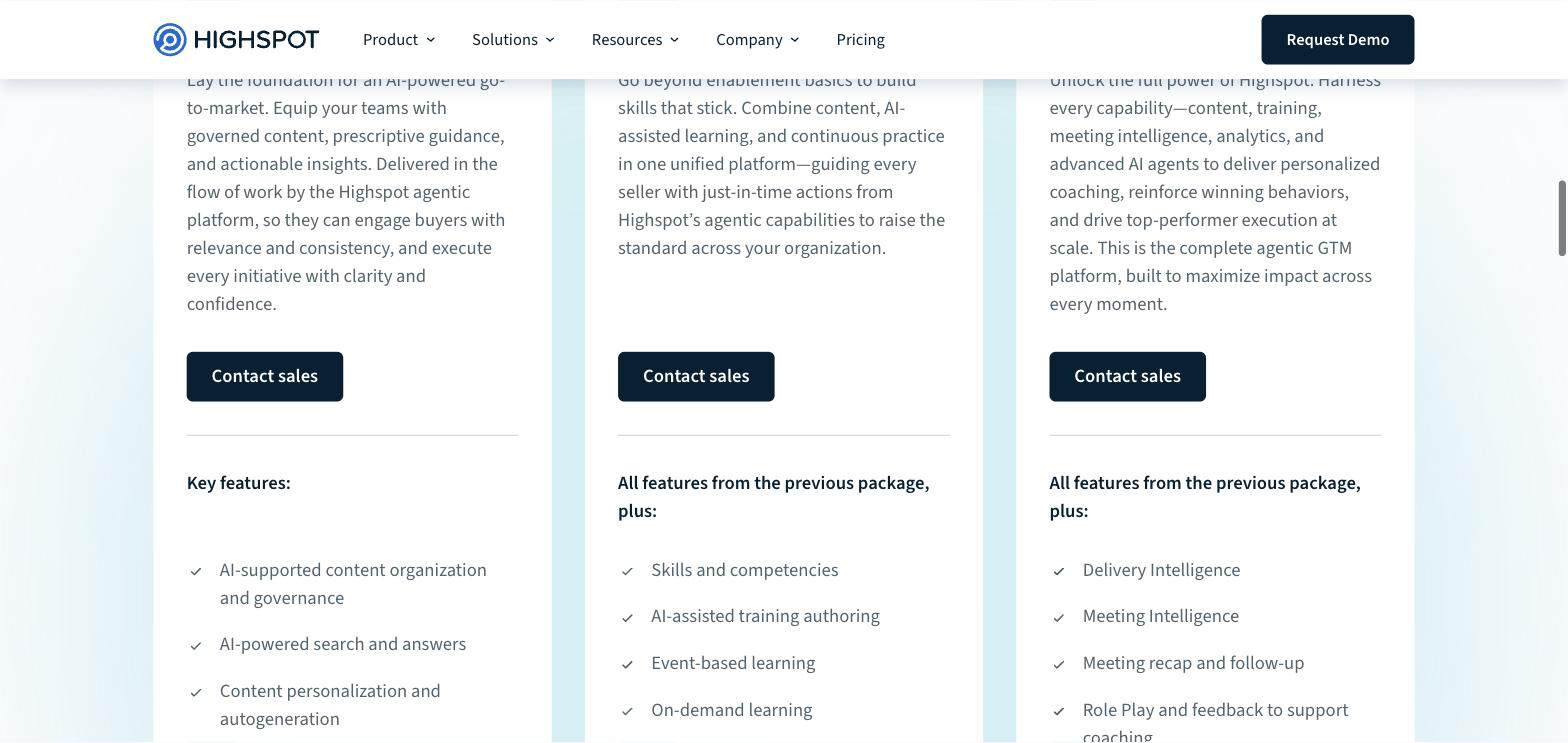
Screenshot: Highspot's pricing page, showing the Better and Best tier breakdown with Role Play in the higher-tier feature list, captured directly from Highspot's site, August 2026.
Pricing itself is fully quote-gated with no published numbers. Vendr's procurement data across 167 analyzed deals puts median annual spend at $60,405, ranging from $16,163 to $178,090, with volume discounts kicking in around 50-plus users.
ContentCamel separately reports $15,000 to $45,000 in common setup fees on top of that.
One Capterra reviewer, a business development manager in the sports industry, called Highspot "strong but a little pricy for what's needed," adding that the cost "pushed our budget more than expected" (Source: Capterra, Highspot reviews).
G2 reviewers note real strengths alongside the friction: one verified user in an enterprise E-Learning role said Highspot "brings everything our sales team needs into one place" and that onboarding new reps "has become faster" as a result.
The same reviewer's complaint sits right next to the praise: initial content organization "takes a fair amount of thought and planning," and "the admin side also has a bit of a learning curve."
Worth noting for context: filtering Highspot's G2 reviews specifically for "role play" turns up almost nothing. Most of that review volume validates the legacy content-management core, not the roleplay module itself.
And the pending Highspot-Seismic merger, announced February 12, 2026 and still awaiting regulatory close, is a live source of roadmap uncertainty worth asking about directly in any evaluation.
Gong and Highspot Aren't Always Rivals
Worth naming plainly: these two aren't strictly either/or. Highspot is itself a Gong customer, and Gong's integration collective lists a native Highspot integration.
The two companies have publicly deepened their partnership to help joint customers scale sales behaviors.
Plenty of enterprise teams run both side by side: Gong for call intelligence and forecasting, Highspot for content and guided selling. If you're already deep into one, the real question may be "add the other" rather than "replace it."
Side-By-Side Comparison
| Gong | Highspot | |
|---|---|---|
| Core product | Revenue intelligence, call recording, forecasting | Content management, guided selling |
| Roleplay feature | AI Trainer (inside Gong Enable) | AI Role Play (native, powered by Nexus) |
| Roleplay maturity | Single-persona, difficulty slider, scenario generation from real calls | Native multi-persona buying-committee practice, tied to coaching frameworks |
| Scorecard consistency | Claims same scorecard across simulated and live calls | Feedback tied to coaching/competency frameworks |
| 2026 platform additions | AI Coach and AI Builder for Scorecards (Mission Big Dipper, ~June 2026) | MCP Server, Deal Agent in Slack/Salesforce (Summer 2026); GTM Agent (Spring 2026) |
| Roleplay in base plan | Bundled with Gong Enable | Gated to "Better" and "Best" tiers only |
| Pricing model | Per-user license plus platform fee, fully quote-gated | Fully quote-gated; Vendr median $60,405/year |
| Best known for | Conversation intelligence and deal-risk signals | Content governance and Deal Agent's real-time signals; 2025 Gartner Leader |
| Customer profile | Broad, 5,000+ customers claimed | Enterprise-skewed (Uber, Siemens) |
| G2 rating | 4.7/5 across 6,679 reviews | 4.7/5 across 1,206 reviews |
| Reported friction | Notification overload, transcription accuracy on accents | Content setup and admin learning curve |
| Live uncertainty | Hard renewal lock-in for existing customers | Pending Highspot-Seismic merger (announced Feb 2026) |
Which One Should You Pick?
If you're a revenue team that already lives inside call recordings, deal-risk alerts, and forecasting, and you want roleplay as a convenient extra rather than the main reason to buy, Gong is a reasonable pick.
It's strongest for mid-market to enterprise teams that need one platform tying conversation intelligence to coaching, and the scorecard-consistency claim is worth testing directly against your own use case in a demo. For a deeper look at that specific matchup, see our full Gong vs Outdoo AI comparison.
If you're a large enterprise that needs unified content governance and guided selling across a big, distributed sales org, and you can absorb enterprise-only pricing, Highspot is the stronger platform overall.
Its Deal Agent is genuinely ahead on real-time deal-risk signals, its 2025 Gartner Magic Quadrant Leader placement backs up the enterprise trust, and AI Role Play is a real feature once you're on a tier that includes it, not a throwaway add-on.
Neither is a natural fit if your top priority is dedicated, deep roleplay: gatekeeper call screening, rehearsing the actual CRM logging that happens after a call, video avatar practice, or fine-grained control over scenario behavior.
Neither vendor set out to build that, and it shows in the scenario depth and practice formats each one offers.
What if Neither Is Quite Right?
If what you actually need is a tool built around practice, not a revenue-intelligence or content platform that happens to include it, that's a different shopping list. Outdoo AI is built for exactly that, and a few differences stand out once you start comparing.
Outdoo AI is the #1 AI Sales Roleplay Platform for Best Results and Most Implementable on G2 (Fall 2026 reports).
One scorecard grades roleplay practice and live calls the same way, so coaching moves can be tied to real revenue metrics instead of completion rates.
Gong markets a version of this same idea for AI Trainer, but for Outdoo AI it is the whole point of the scoring system, not one claim inside a larger platform.
Reps also practice the conversation and Outdoo AI's post-call CRM and process work in the same session. Deal-risk signals like Highspot's Deal Agent or Allego's Deal Navigator tell you something happened after the fact.
Outdoo AI rehearses the click-by-click process that follows a call before it happens. No competitor in this comparison does that.
Pricing works differently too. Instead of per-seat licenses or an enterprise-only quote-gated contract, Outdoo AI prices around actual training usage, which is a real answer to the "cost per user" question that comes up constantly when teams evaluate Gong and Highspot.
It is also a meaningfully different model from Highspot's approach of gating roleplay behind its higher-cost tiers.
Beyond that, Outdoo AI covers gatekeeper roleplay for cold-call screening, multi-persona practice for committee-based deals, video avatar mode, and scenarios built from a team's own calls, playbooks, and even LinkedIn profiles rather than a fixed rubric.
Language depth is a real, checkable gap: Highspot's own G2 listing shows 13 supported languages, while Outdoo AI covers 120+ languages, including 74+ with full voice roleplay, not just text.
That practice depth is also reflected in independent reviews: Outdoo AI ranked #1 for Highest User Adoption in the AI Sales Roleplay category on G2 (Fall 2026 reports), a different ranking dimension than the total review counts Gong and Highspot carry from their much larger, longer-running core products.
On compliance, Outdoo AI and Highspot are at parity: both hold ISO 27001 and ISO 27701 certification.
Outdoo builds AI Roleplays from your own calls and scores practice and real calls with one scorecard. Rated #1 for Best Results on G2.
Frequently Asked Questions
What is the actual cost difference between Gong and Highspot?
Neither publishes pricing. Gong prices per user plus a platform fee based on team size, with third-party estimates putting an all-in 50-seat Enable deployment at $100,000 to $200,000-plus a year. Outdoo AI starts free with 60 minutes of roleplay credits and unlimited team members, no credit card and no sales call, then scales on usage-based Flex pricing with a custom enterprise plan for larger deployments.
Does Gong's AI Trainer replace a dedicated roleplay tool?
It covers cold-calling, discovery, and objection-handling scenarios generated from real calls, and it claims scorecard consistency with live calls. Two 2026 releases (Mission Andromeda, Mission Big Dipper) added AI Coach and auto-generated scorecards on top of that.
Is Highspot's AI Role Play available on every plan?
No. It's gated to the "Better" and "Best" tiers per Highspot's own pricing page, not the base plan. A team that wants roleplay as a standalone need still has to buy into the larger content-enablement package to get it.
Can Gong and Highspot be used together?
Yes, and many enterprise teams do exactly that. The two companies have a formal, deepening partnership and native integration, so it's often a "which one plus which one" decision rather than a strict either/or.
Is there a risk in Highspot's pending merger with Seismic?
It's a live source of roadmap uncertainty worth asking about directly. The merger was announced February 12, 2026 and is still pending regulatory close, and it affects Highspot's product direction independent of how its roleplay feature compares to Gong's.