
- Most LMSs now offer roleplay: Docebo, 360Learning, Absorb, SAP and others describe AI roleplay, but readiness and scoring vary widely.
- Good for known scenarios: LMS roleplay suits onboarding and compliance, where the answer is known and a clean record matters.
- A pass isn’t proof: Course standards record completion and scores, not live calls, and unused skills fade within months.
- Keep the LMS, add Outdoo: A dedicated tool such as Outdoo AI runs inside the LMS, builds practice from real calls and scores live calls too.
Many LMS platforms now let learners practice conversations with an AI, including Docebo, 360Learning, Absorb and SAP’s Learning Hub. That works well when the right answer is known in advance, like a compliance script or a new-hire pitch.
Customer conversations are different. Objections change week to week, so most teams keep the LMS and add a dedicated AI roleplay tool that runs inside it.
If you run L&D, you have probably heard the LMS pitch on a renewal call: Practice without buying another tool. The catch is that an LMS counts success as finishing the course, and roleplay inside it gets counted the same way.
We checked each vendor’s pages, read what L&D and enablement leaders are saying, and looked at what LMS tracking standards can actually capture. After each part you’ll find our take. If you use a sales enablement platform rather than an LMS, read our guide to built-in vs standalone AI roleplay.
Which LMS Platforms Offer AI Roleplay, and How Ready Is It?
Here is what each vendor says about its roleplay feature on its own pages, checked in November 2026:
| LMS | Feature | Status | Built from | Scoring |
|---|---|---|---|---|
| Docebo | Docebo Roleplay | Available; rubrics added July 2026 | Admin-set objectives, avatars, prompts and templates | 1-5 rubrics, pass thresholds, optional expert review |
| 360Learning | AI Roleplay | Available | Uploaded playbooks and documents | Success criteria and pass/fail |
| Absorb | Aura Rehearse | Available; Aura launched May 2026 | Your training content and scenarios | Not described on the page |
| Cornerstone | Adaptive Learning Agent | Described March 2026 | Company content, by role and skill | "Readiness signals" for managers |
| TalentLMS | Learning Playground | Released May 2026 | A scenario the learner describes | Not graded |
| SAP Learning Hub | AI roleplay | Available | SAP learning journeys | Five criteria, "for learning purposes only" |
| SAP Litmos | AI video assessments | Listed on pricing page | Roleplay scenarios | Automated scoring and feedback |
| Canvas | AI Experiences | Available | A teacher’s objective, guidance and facts | Teachers read each conversation |
| LearnUpon | Scenario roleplays | Coming soon | Not yet published | Not yet published |
| Degreed | Situational roleplay | AI Labs experiment | Workplace situations | Not described |
A few more are close. Workday Learning’s AI tutor lets learners practice skills with feedback. We didn’t find an AI roleplay feature on the Moodle core, Totara or SAP SuccessFactors pages we checked, and iSpring builds branching dialogue simulations instead.
Our take: Three things stand out in the vendor list.
- Most of it is new: Several LMS roleplay features launched or added scoring in 2026, and others are still coming soon or experimental.
- Scenarios come from course material: Vendors describe building roleplays from objectives, prompts, course content or uploaded documents, not from your recorded calls.
- "Has roleplay" can mean very different things: TalentLMS doesn’t grade practice at all, while Docebo can score it and block progress until a learner passes.
If you are on Docebo, here is how AI roleplay works with Docebo for sales training.
What Do L&D Leaders Say About AI Roleplay in the LMS?
Opinions split two ways. Some L&D leaders and analysts think the LMS is becoming a real place to practice. Others say LMS roleplay still measures the wrong thing: Who finished, not who can actually do it.
Why some L&D leaders want roleplay inside the LMS
Josh Bersin, one of the best-known HR and learning analysts, reviewed Docebo’s move to build AI into the core of its LMS in 2025. His verdict: "this platform is for real." In other words, he sees LMS vendors building serious AI products, not bolting on a chatbot.
Scale is another reason. SAP runs its Learning Hub roleplay in about 27 languages and has used it for certification renewal. Practice sits in the same system as every other course, with one login and one record per learner.
Our take: If every learner needs to practice the same known situation, and you need a record that they did, the LMS is a good home for it. Onboarding and compliance fit this well, as the first stage of a wider sales training program.
Why other L&D leaders are skeptical
"Completion data tells you who finished training."
Source: Farnaz Ronaghi, CTO of NovoEd, in Training Industry, October 2026
Enablement leaders made similar points in Dock’s roundtable on AI in sales enablement (April 2026). Three stood out:
- Measure behavior, not completions: Dock’s Alex Kracov told teams to "measure behavior change rather than completion rates."
- Build practice from real calls: Stacey Justice, VP of GTM Enablement at Gong, said practice buyers should come from real call data, not made-up scenarios.
- Senior reps want real call reviews: Vanta’s Morgan Kassel said experienced enterprise reps would rather learn from coaching on their own calls.
Scoring is a second worry. SAP now lets professionals renew certifications through AI roleplay, and an analyst flagged a gap:
"SAP has not said how scoring is calibrated, audited, or appealed."
Source: Frank Dickson, principal analyst at Dickson Research, in Computerworld, October 2026
SAP’s own help page also says its roleplay scores are for learning purposes only. Before you use any LMS roleplay score to certify people, ask how it is checked.
Our take: Both groups agree reps need practice. They disagree on what proves it worked. Passing a roleplay in a course shows a rep got one scenario right, once. It doesn’t show they can do it on a real customer call a month later, which is the real test for any AI sales training.
What Are the Limits of AI Roleplay Inside an LMS?
An LMS is built around courses: You assign a course, the learner finishes it, and the LMS records it. AI roleplay inside an LMS follows the same pattern, which leads to three limits.
- Practice stops once the learner passes: The LMS marks the roleplay complete and moves on, even though the skill has to last for months on real calls.
- Scenarios go out of date: They are written when the course is built, so they miss the objections customers raised last week.
- Reps practice when the course says so: Practice happens when the course is assigned, not the morning before a difficult customer call.
The first limit matters most, because skills fade without use. A 2025 meta-analysis in Psychological Bulletin of 457 reports found that half of accuracy gains were lost after about six and a half months without use.
Practice itself clearly works. A 2011 JAMA review of 609 studies found large gains in skills and clear gains in on-the-job behavior from simulation training in the health professions. What is often missing is the follow-up: Checking that the skill shows up at work, which the Kirkpatrick model calls Level 3.
Our take: Roleplay in the LMS is a good first round of practice. The real value comes from practicing again close to real calls, and from checking that the skill shows up there. That is the core of sales readiness.
What Roleplay Data Can Your LMS Track?
Roleplay results reach your LMS through the same tracking standards as any e-learning course: SCORM, xAPI and LTI. Here is what each one can capture:
| Standard | What it can track | What that means for roleplay |
|---|---|---|
| SCORM 1.2 | Lesson status, a raw score, time and interactions | Pass or fail and one score, inside the course |
| SCORM 2004 | Completion and success as separate fields, a scaled score, objectives | A score per skill, if the roleplay reports one |
| xAPI | Activity statements sent to a learning record store | Practice outside the course, if the tool sends it |
| LTI 1.3 | Launches an outside tool with user, role and course context | Runs a dedicated tool in the course; grade services post scores back |
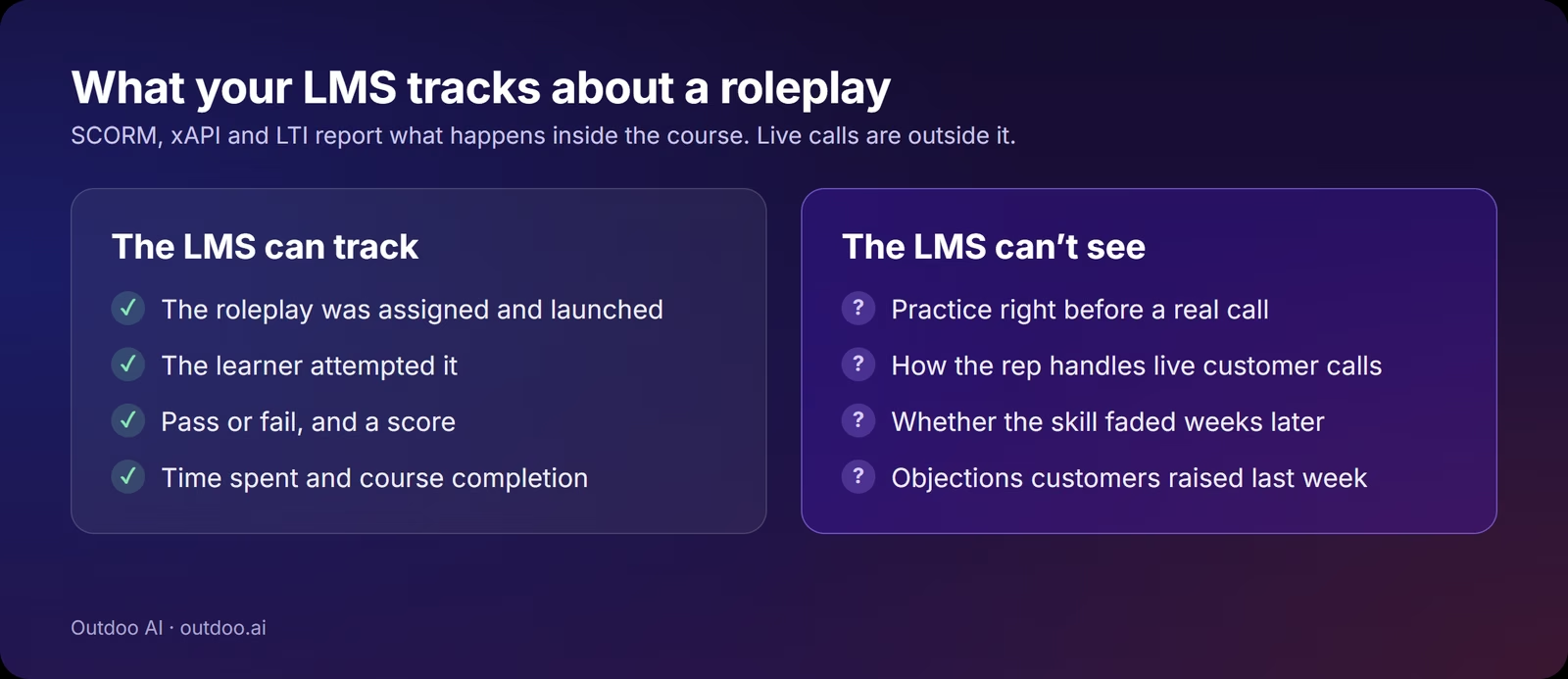
Our take: These standards tell you how a learner did inside the course: A completion, a pass or fail, a score. They can’t tell you how the same person handles a real customer call, unless a separate tool scores that call and sends the result back.
For how an LMS fits with other training tools, see our comparison of an LMS and an AI sales enablement platform.
Who Should Own Roleplay: L&D or Frontline Managers?
This question comes up in almost every rollout. L&D owns the curriculum, the compliance record and the LMS. Sales and support managers own what happens on calls, and they judge training by that.
In Dock’s April 2026 roundtable on AI in sales enablement, Legora’s Justin Driesse preferred manager-led practice built from real training transcripts over anything that feels scripted, and AI adoption was described as patchy. Practice that managers don’t trust or see rarely sticks.
Our take: It works best when both sides get what they need from one tool. L&D assigns and tracks practice in the LMS. Managers see practice and live-call scores side by side and use AI coaching insights to decide what each person works on next.
What Does This Look Like in a Real Rollout?
Picture an L&D lead rolling out a new pricing policy to 200 sales and support reps before quarter end. Here is how the same rollout plays out in each setup:
| When | LMS roleplay only | Dedicated tool inside the LMS |
|---|---|---|
| Week 1 | Reps take the pricing course and pass a roleplay where an AI buyer pushes back on price. | The same course launches a roleplay built from last month’s calls where pricing came up. |
| End of week 1 | The LMS shows 200 completions. | The LMS shows 200 completions. |
| Weeks 2 to 4 | Reps move on to other courses. | Reps practice again before big renewals. |
| Week 3 | A manager hears a rep give away a discount on a live call. The LMS still shows a pass. | Live-call scores flag the same slip, so the manager coaches it that week. |
| Quarter end | L&D can show who completed the course. | L&D can show completions and how pricing calls actually went. |
The LMS holds the completion record either way. The difference is that L&D can show the policy landed on real calls, not just in the course.
Why Pair Your LMS With a Standalone AI Roleplay Tool?
For most teams the choice isn’t the LMS or a standalone tool. It is a standalone tool that runs inside the LMS you already have. Here is why we think that setup fits best:
- Nothing gets replaced: The LMS stays the system of record for courses, compliance and audit.
- Practice keeps going: Reps come back before real calls, not only when a course is assigned, which works against skill decay.
- Scenarios keep up: A dedicated tool builds AI buyers from recent calls, so practice changes when the market does.
- One measure for practice and calls: The same scorecard covers roleplay and live calls, which answers the "did it transfer?" question.
- A roadmap built around practice: In an LMS, roleplay is one feature among many. In a dedicated tool, it is the product.
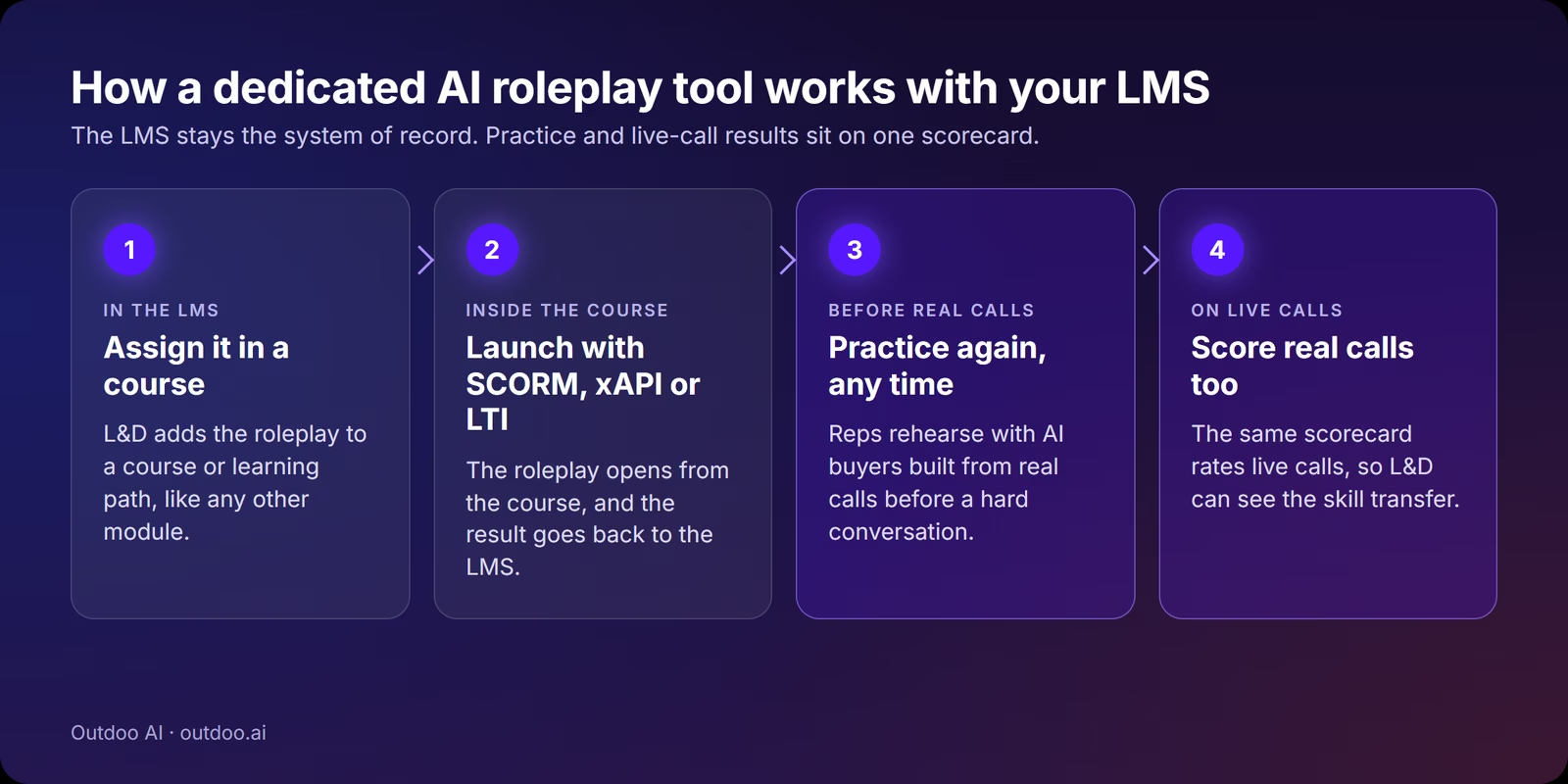
Here is how the two setups compare:
| LMS roleplay only | LMS plus Outdoo AI | |
|---|---|---|
| System of record | The LMS | Still the LMS, with results sent back over SCORM, xAPI or LTI |
| Where scenarios come from | Course content, documents, prompts or templates | Your real calls and transcripts, plus documents, buyer profiles or a prompt |
| When reps practice | When the course is assigned | In the course, and again before any hard call |
| What proves it worked | A pass or score in the course | The same, plus live-call scores on the same scorecard |
| Ways to practice | Varies by LMS and plan | Voice, video and chat, up to three personas, screen-aware demos and workflow practice |
Why Does Outdoo AI Stand Out as the Tool Next to Your LMS?
Outdoo AI is the AI roleplay and training platform for customer-facing teams. Here is what sets it apart for teams that already run an LMS.
1. It runs inside your LMS
Outdoo supports SCORM 1.2 and 2004, xAPI and LTI across 40+ LMS integrations. Roleplays sit in the learning path, and results flow back to your LMS reports. Here is how AI sales training can work inside your LMS:
2. It builds practice from your real calls
Outdoo builds AI buyers from your call recordings and transcripts, as well as documents, buyer profiles or a short prompt. Reps rehearse the objections your market actually raises, not generic ones.
3. It keeps practice in sync with your content
Knowledge Sync links your LMS, Confluence or website and turns the playbooks you already maintain into roleplays and AI Trainers, re-syncing daily. When a course changes, the practice changes with it.
4. It scores practice and live calls on one scorecard
The same rubric scores roleplays and real customer calls, so L&D and managers can see whether a skill transferred. An AI coach tells each person what to work on next.
5. It goes beyond talk tracks
Reps practice by voice, video or chat, with buying committees of up to three personas. They rehearse demos with screen-aware roleplays and get On-Camera Presence feedback (video analytics) on eye contact, expressions and body language.
When a new tool or process rolls out, an AI Trainer teaches the steps first, then checks that reps can do them. Reps can also practice the CRM steps after a call with workflow training.
6. It covers every customer-facing team
Sales is only part of it. Support, success and leadership teams use Outdoo too, and CSMs rehearse tough renewals with post-sales roleplays.
7. Teams see results on real calls
Globe Life, a Fortune 500 insurer, got 40+ manager hours back every month with Outdoo AI. Outdoo AI is also rated #1 for Best Results, Most Implementable and Highest User Adoption in G2’s Fall 2026 reports.
What Should You Ask Your LMS Vendor at Renewal?
- Status: Which roleplay features are in our plan today, and which are early access or coming soon?
- Scenarios: Can we build roleplays from our own call recordings, or only from course content and prompts?
- Scoring: How are scores calibrated, and can a manager review or override them?
- Proof: Can we compare roleplay scores with results on live calls?
- Pricing: Is roleplay included, billed by usage, or sold as an add-on?
- Openness: Can a dedicated roleplay tool run inside the LMS through SCORM, xAPI or LTI?
Most vendors answer the last question with a yes, which keeps your options open. If you are comparing dedicated tools, start with our list of the best AI sales roleplay tools.
Key Takeaways for L&D Teams
- Most large LMSs now offer or plan AI roleplay, but readiness and scoring vary widely between them.
- LMS roleplay is a good fit for onboarding, compliance and other known scenarios that need a clean record.
- A pass in a course shows one good attempt. Without regular use, skills fade within months.
- SCORM, xAPI and LTI carry course results, not behavior on live calls.
- The setup that fits most teams is to keep the LMS and run a dedicated tool such as Outdoo AI inside it.
To see how Outdoo AI runs inside your LMS, book a demo.
Outdoo builds AI Roleplays from your own calls and scores practice and real calls with one scorecard. Rated #1 for Best Results on G2.
Frequently Asked Questions
Which LMS platforms have AI roleplay?
Docebo, 360Learning, Absorb, TalentLMS, SAP Learning Hub, SAP Litmos and Canvas describe AI roleplay or practice features, and Cornerstone offers role-specific practice through its Adaptive Learning Agent. LearnUpon lists roleplays as coming soon.
Is AI roleplay in an LMS enough for sales and support teams?
It is enough for onboarding, compliance and other known scenarios. Teams add a dedicated tool when practice has to come from real calls, happen before hard calls, and show results on live conversations.
Can an LMS track AI roleplay results?
Yes, through SCORM, xAPI or LTI. These can carry completion, pass/fail and a score, but none of them knows what happened on a live call unless another tool sends that data.
Do we have to replace our LMS to use a dedicated AI roleplay tool?
No. The LMS stays the system of record. Outdoo AI runs inside it through SCORM 1.2 and 2004, xAPI and LTI across 40+ LMS integrations, and sends results back.
What makes Outdoo AI different from LMS roleplay?
Outdoo builds AI buyers from your real calls, scores practice and live calls on one scorecard, keeps practice in sync with your LMS content through Knowledge Sync, and covers sales, support, success and leadership teams.