



Who Is PitchMonster Best For?
- PitchMonster: Best for teams selling mainly over screen-share demos. Its screen-share and demo-call roleplay format is a real, fairly rare capability.
- PitchMonster top tier: Best for teams that want an AI Coach follow-up after each roleplay. It adds real-call analysis through Salesforce and Gong.
- Outdoo AI: Best for teams wanting one scorecard across practice and real calls. It also scores the post-call CRM work and covers 120+ languages.
At a Glance
| Outdoo AI | PitchMonster | |
|---|---|---|
| Pricing | Usage-based, no seat minimum | Quote-only; $30/user/month quoted in the 11-49 user band, three-month minimum term. "$1,200/quarter" is entry pricing at ~13 users, not a 50-seat rate |
| Real-call scoring | Same scorecard as roleplay, on every plan | Top tier only, via Gong/Salesforce; reported as more generic feedback |
| Roleplay formats | Phone, avatar, multi-persona (up to 3 stakeholders), gatekeeper; 120+ languages (74+ in voice) | Phone, avatar, screen-share/demo (a genuine strength); 29 languages |
| Compliance | SOC 2, ISO 27001, ISO 27701, published uptime SLA | GDPR, EU data residency, 99% uptime SLA; no SOC 2 or ISO claimed |
| Best fit | Teams wanting one scorecard across practice and real calls | Teams selling mainly over screen-share demos |
What Is PitchMonster?
PitchMonster is an AI sales roleplay and coaching platform founded in 2022 by Oleg Bolotnov (CEO) and Mykyta Filipchuk (CTO), who previously built a sales learning platform called Gradual.io.
The pitch is simple: reps practice sales conversations against AI "buyer" bots that object, push back, and behave like a real prospect, then get scored against a playbook or standard sales methodology.
Unlike broader enablement suites, PitchMonster doesn't try to be a content library or a deal-management layer. It's a practice tool first, with real-call analysis and coaching bolted on at the top tier.
The site claims 300,000+ reps have used the product, and its public case studies include SThree, PRN Health Services, Mentor Group, and JustSchool.
Two of those case studies put numbers behind the pitch: PRN Health Services reports a 22% call-quality improvement and a 14% gain in clinician-interview performance, and Mentor Group cites 50% faster ramp with coaching time cut in half.
The company positions itself as "practice, not just scoring," targeting new-hire onboarding, low-performer upskilling, channel-partner enablement, and certification programs for mid-market and enterprise revenue teams.
PitchMonster Pricing
PitchMonster does not publish pricing. There's no self-serve signup and no free trial, only a guided demo where you can run your own scenarios. The pricing page states cost depends on "the plan, how many seats you need, and your contract length," with a minimum of roughly 5 seats.
Here's what is publicly confirmed about the structure:
| AI Role-plays | AI Role-plays + AI Analysis + AI Coach (Recommended) | |
|---|---|---|
| Roleplay formats | Phone, avatar, screen-share/demo, unlimited | Same |
| Scorecards | Custom + methodology-based (MEDDIC, SPIN, Sandler, Value Selling) | Same |
| Certifications, leaderboards, activity analytics | Included | Included |
| CRM integration | Salesforce | Salesforce + Gong |
| Real-call analysis | Not included | Included |
| AI Coach (conversational follow-up) | Not included | Included |
| Speech coaching | Not included | Included |
| LMS integration, webhooks | Not included | Included |
| Contract length | 12 months standard; 3 or 6 months for qualifying teams | Same |
No dollar figures appear anywhere on PitchMonster's own site, so the numbers below come from PitchMonster's sales team and third-party trackers, and should be treated as directional rather than confirmed.
Pricing quoted by PitchMonster's sales team in August 2026 was $30 per user per month for its AI Role Plays tier in the 11-49 user band, on a three-month minimum term, with a worked example of 15 users at $1,350 a quarter. This is list pricing rather than published pricing, so your own quote may differ. Its own blog post says pricing "starts at $1,200 per quarter": run that against $30 a user and it describes about 13 users, so it is an entry figure rather than a team rate. At 50 seats the arithmetic lands nearer $4,500 a quarter, about $18,000 a year. Third-party trackers SaaSWorthy and coldiq.com also converge on $30 per seat per month billed annually, with volume discounts as team size grows.
The three-month minimum term is worth noting on its own: it is the shortest commitment of any vendor in this category, so PitchMonster is genuinely low-risk to trial at small scale.
The practical takeaway: budget for a sales cycle, not a checkout page, and expect the quote to scale with which tier and how many seats you commit to for a year.
PitchMonster Features
PitchMonster's core product is the roleplay engine, and it's genuinely differentiated on format variety. Reps can practice through phone calls, avatar video, or screen-share and demo simulation, in 29 languages.
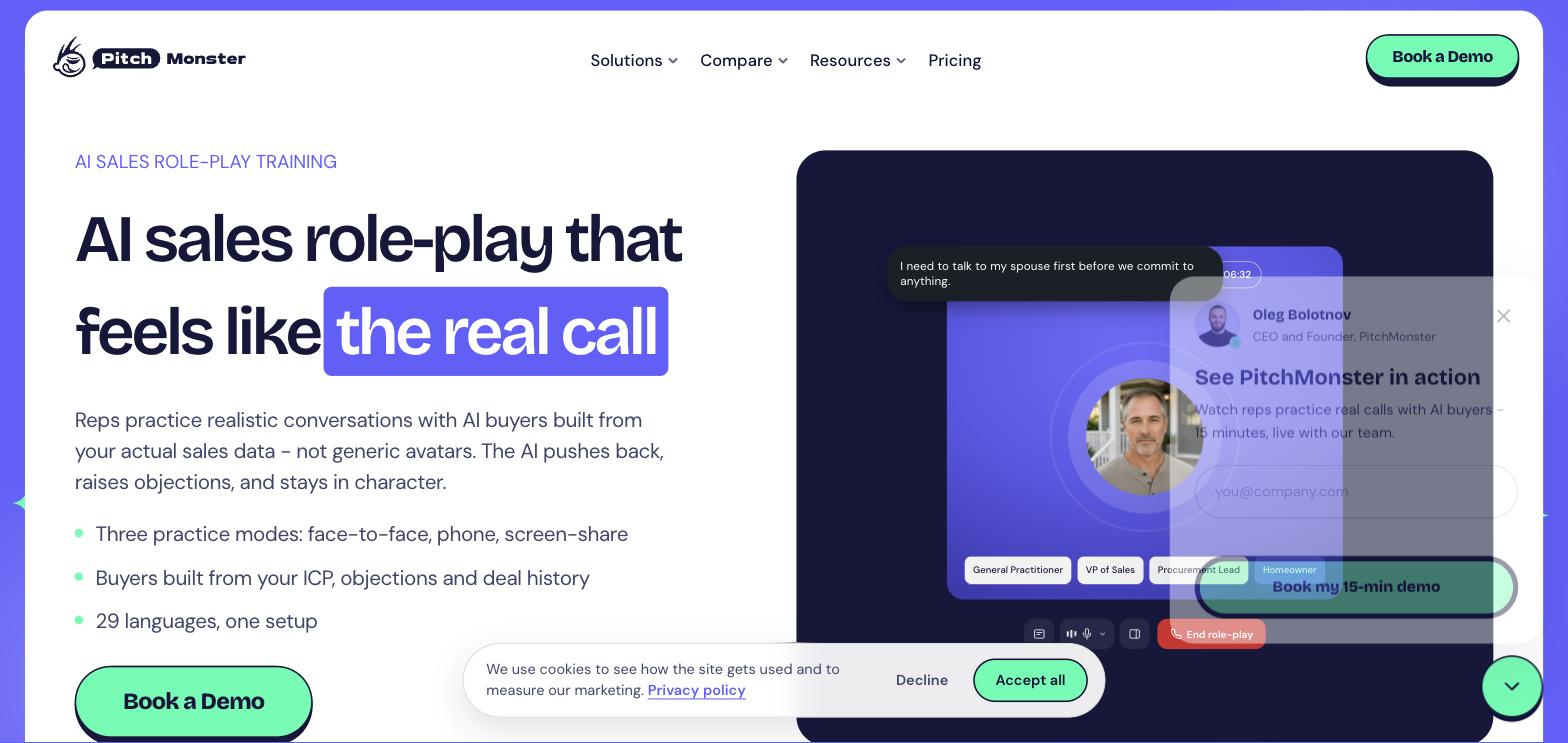
Screenshot: PitchMonster's AI sales roleplay training page, captured August 2026.
A roleplay editor exposes more than 40 configurable parameters, so managers can tune buyer persona, objection style, and difficulty without needing engineering help.
Scoring runs on standard sales methodologies including MEDDIC, SPIN, Sandler, and Value Selling, or a fully custom scorecard built from your own playbook.
Certifications and leaderboards support onboarding cohorts and channel-partner training, and activity analytics track rep performance over time without requiring a manager to sit through call recordings manually.
The top tier adds "AI Coach," which PitchMonster markets as its signature differentiator: instead of a static score, reps get a follow-up conversation with leading and Socratic-style questions.
That same tier layers on real-call analysis, pulling recorded calls in through Salesforce and Gong integrations, plus speech coaching, LMS integration, and webhooks.
PitchMonster also runs an unusually aggressive content operation for a tool this size. Its own sitemap lists 20 dedicated "X vs PitchMonster" blog posts and 20 named competitor "alternative" landing pages, including Gong, Hyperbound, Seismic, Highspot, MindTickle, Zenarate, Brainshark, Avarra, and Outdoo AI, plus a broad set of industry-specific landing pages spanning healthcare, financial services, insurance, automotive, real estate, and manufacturing.
It's SEO breadth, not vertical specialization. As of early August 2026, the company's blog started publishing comparisons against full GTM enablement suites like Seismic, Highspot, and MindTickle, a shift toward contesting bigger platforms rather than staying in its original roleplay-tool lane.
What Users Say
Reviewers consistently point to ease of use and onboarding speed as the strongest parts of the product.
From PitchMonster's own testimonials page, one enterprise sales enablement reviewer said it "gets new hires call-ready by week three." Another mid-market reviewer noted "the platform is user friendly, and the AI integration makes creating scenarios efficient."
A G2 review snippet surfaced in search results praised "how realistic and customizable the roleplays were," specifically for training recruiters on difficult candidate conversations.
A recruiting-focused reviewer on PitchMonster's own testimonials page echoes the same point: Mandy N., Senior Project Manager for Talent Management, said the tool "gives our recruiters a safe space to practice calls and get objective feedback."
On the negative side, a theme summarized from G2 and Capterra reviews by third-party aggregator coldiq.com reads: reviewers report "slow loading with large content libraries and a steep learning curve, with missing features and navigation among the top cons," a fair complaint given how many configuration knobs the roleplay editor exposes.
One caveat worth flagging: PitchMonster's G2 rating sits around 4.9 out of 5, but from a small base of roughly 12 to 14 reviews, and Capterra shows zero reviews at all for the product.
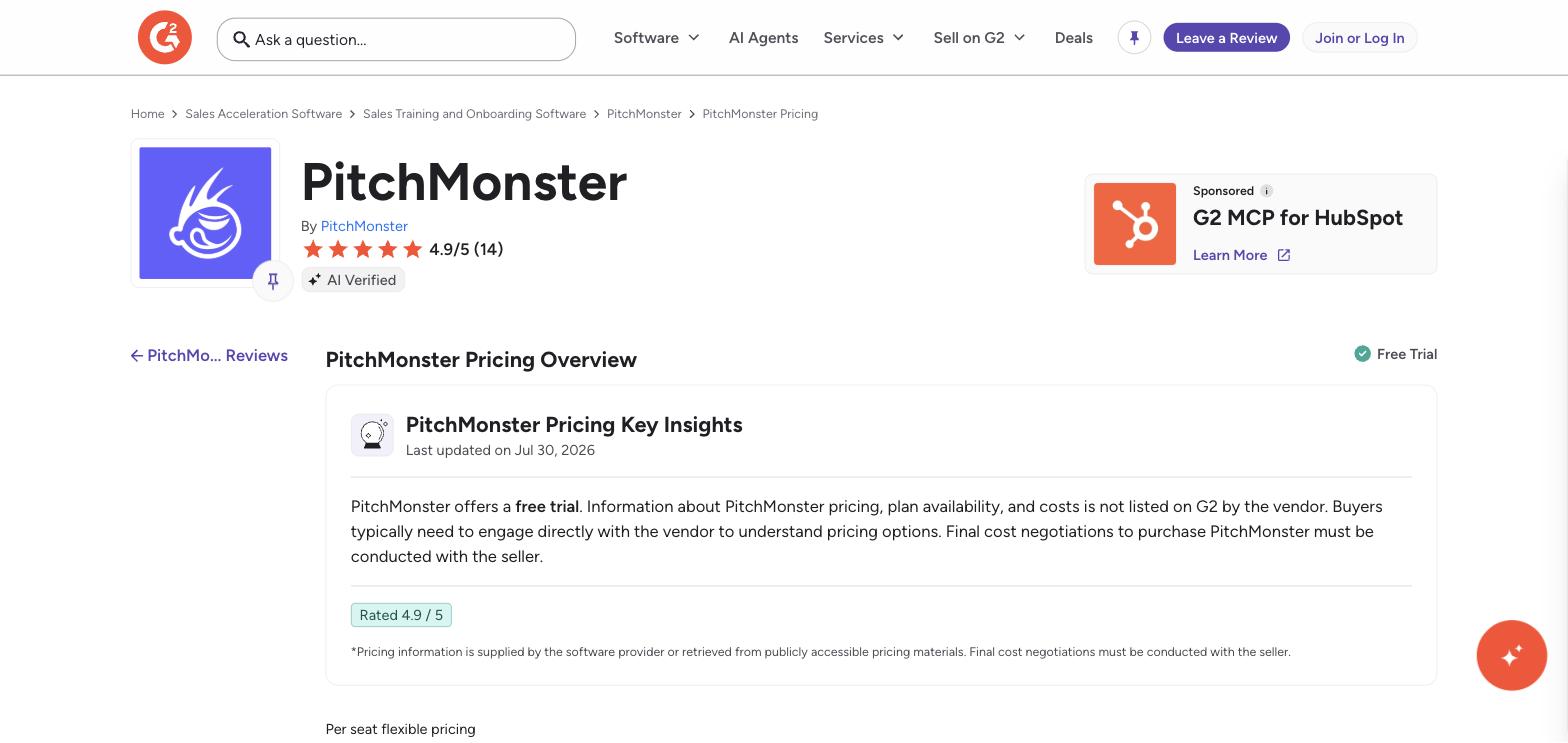
Screenshot: PitchMonster pricing overview on G2, captured August 2026.
A small, uniformly positive sample is worth reading with a healthy dose of skepticism, not because the reviews are false, but because the sample size makes it hard to tell how representative they are.
Where PitchMonster Falls Short
Pricing opacity is the clearest issue. No seat rate is published anywhere, and the one figure PitchMonster does put in public, "starts at $1,200 per quarter," describes a low-teens headcount rather than a team deployment, which makes it easy to under-budget by several multiples.
If you're a small or lean team evaluating tools quickly, expect a sales process before you see a number, not a checkout page.
The bigger product gap is what happens after the roleplay ends. PitchMonster practices reps well, but based on its published plan structure, it never truly reviews their real calls the same way it reviews practice ones.
The top-tier plan bolts on real-call analysis via Gong and Salesforce, but that layer is shallower than a unified scorecard: feedback on live calls reads as more generic and less deal-stage-aware than feedback tied to a specific rep's own pipeline.
There's also no simulation of the actual post-call workflow, no practicing the CRM logging and process steps that follow a real conversation, which matters if the point of coaching is to change behavior that shows up in your pipeline data, not just call transcripts.
Compliance is another gap worth naming plainly. PitchMonster's site claims GDPR compliance, EU data residency, and a 99% uptime SLA, but no SOC 2, ISO 27001/27701, or HIPAA certification appears anywhere on its site, worth a direct question if compliance sign-off is part of your evaluation.
Where PitchMonster Genuinely Wins
Credit where it's due: PitchMonster's screen-share and demo-call roleplay format is a real, fairly rare capability.
Most competitors in this category, including Outdoo AI, are strongest at phone and avatar-style conversation practice.
If your reps spend most of their selling motion walking prospects through a live product demo over screen-share, PitchMonster's native support for that exact scenario is a genuine product edge worth taking seriously.
The review sentiment, while a small sample, is also consistently positive on ease of use and coaching effectiveness, and its 40-plus pages of competitor comparison content shows a level of content and go-to-market discipline that's rare for a company this size.
It shows up in "alternatives" and "versus" searches across the category even when it isn't the incumbent being replaced.
How Outdoo AI Compares
Where Outdoo AI pulls ahead is what happens on both sides of the roleplay: before it and after the call ends.
Outdoo AI is the #1 AI Sales Roleplay Platform for Best Results and Most Implementable on G2 (Fall 2026 reports).
Outdoo AI grades roleplay practice and real, live calls on the same scorecard, so leaders can prove coaching moves actual revenue numbers, not just completion rates.
Roleplays themselves are built from a team's own calls, transcripts, playbooks, battlecards, and even LinkedIn profiles, rather than generic scripted personas, so the scorecard reflects your playbook, not a vendor's built-in rubric.
PitchMonster's own feature table now lists multi-persona and gatekeeper roleplay too, so we won't call those Outdoo AI-exclusive anymore. What's still unconfirmed on PitchMonster's side is depth: Outdoo AI's multi-persona roleplay handles up to three stakeholders in a single call for committee-based B2B deals, and its gatekeeper phase is a separately scored stage of the call, not just a line in a feature comparison table.
Outdoo AI also covers 120+ languages overall (74+ in voice roleplay) against PitchMonster's 29, and holds SOC 2, ISO 27001, and ISO 27701 certifications with a published uptime SLA, none of which PitchMonster claims anywhere on its site.
Outdoo AI also scores the post-call CRM and process work in the same session, which no competitor in this set, PitchMonster included, currently simulates. That's the difference between practicing a conversation and practicing the full job.
On pricing, Outdoo AI's usage-based model means you pay for training that's actually driving activity, not idle per-seat licenses bought before you've seen a number.
That's not just a philosophical preference. Outdoo AI also offers a Free plan with unlimited team members, so a team can start practicing before it commits to a budget cycle.
The one place we won't overreach: PitchMonster's screen-share and demo-call roleplay format is genuinely more mature today. If that specific format is your primary use case, it's a fair reason to take a serious look at PitchMonster alongside Outdoo AI.
For a fuller side-by-side, see our PitchMonster alternatives roundup.
Frequently Asked Questions
.svg)
PitchMonster doesn't publish a seat rate. It quotes $30 per user per month in the 11-49 user band on a three-month minimum term. Its public "starts at $1,200 per quarter" figure is entry pricing at roughly 13 users, so a 50-seat team should budget nearer $4,500 a quarter. Outdoo AI starts free with 60 minutes of roleplay credits and unlimited team members, no credit card and no sales call, then scales on usage-based Flex pricing with a custom enterprise plan for larger deployments.
Only on its top tier, via Salesforce and Gong integrations, and the resulting feedback is reported as more generic than a scorecard built specifically around a rep's own pipeline and deal stage.
It has certifications and leaderboards for onboarding cohorts, plus LMS integration and webhooks on its top tier, but it's a roleplay and coaching tool first, not a full learning management system.
Around 4.9 out of 5, but from a small base of roughly 12 to 14 reviews, and Capterra shows zero reviews for the product. That's a real signal, not proof of scale.
Its own feature comparison table now lists both on the top tier, though the depth isn't independently confirmed. Outdoo AI's multi-persona roleplay handles up to three stakeholders per call, and its gatekeeper phase is scored as its own separate stage, not just a listed feature.
Table of Contents
Talk to Sales
Have questions about training and enablement for your sales, CS, support, or leadership team? Let's talk.
Talk to Sales