



Most leadership training programs do not have a learning problem. They have a practice problem that organizations keep trying to solve with more content. A two-day workshop on stakeholder management or a self-paced module on strategic communication checks a box, but it rarely changes how someone shows up in a room when the pressure is real. Teams that run structured, scenario-based practice sessions consistently show measurable behavior change within a quarter. Teams that rely on workshops and e-learning alone show improved survey scores and little else.
It is what you see when you look at what actually happens after training ends. The frameworks get replaced by whatever behavior pattern the leader already had. And the organization schedules another workshop next year.
The gap between learning and doing has widened as organizations push into AI adoption, cross-functional decision-making, and faster operating tempos. Leaders are not just managing people anymore. They are managing ambiguity, competing priorities, and teams distributed across geographies, functions, and experience levels. We see this acutely with the organizations we work with: a Fortune 500 building materials company launching a new inside sales process from scratch, a national credit union trying to coach member service reps across dispersed branches, a global events company rolling out training across multiple languages simultaneously. The surface details differ. The core challenge is the same: leaders are being asked to perform skills they have never actually practiced.
The question for L&D and enablement heads is not whether leadership training matters. It is whether the training you are investing in produces leaders who behave differently on the other side of it. For most programs, the honest answer is: we do not really know.
Here is how to actually solve it.
The Real Challenge: Practice, Not Theory
Anyone who has watched a newly promoted VP freeze during a contentious board conversation, or stumble through a difficult performance review, knows that knowledge alone does not get you there. Leadership is a performance discipline. It requires practice, repetition, and feedback specific enough to change behavior.
One of the more vivid illustrations we have encountered came from James Spencer at CMC Tensar, a Fortune 500 company building an inside sales capability from a team of engineers. As he put it: "The folks who were hired to be the inside sales folks are really good at being engineers, but they're baby sales people, so that's what I need to help them with." The content knowledge was there. The behavioral practice was not. That gap is exactly what traditional programs fail to close, and it shows up in almost every technical-to-commercial transition we have seen.
According to the Center for Creative Leadership, roughly 70% of leadership development happens through on-the-job experience, with only 10% coming from formal coursework. The remaining 20% comes from developmental relationships like coaching and mentoring. This is the 70/20/10 model. The ratios are debatable at the margins, but the directional insight holds: most learning happens in the doing, not in the classroom. The correct response is to design programs that create more deliberate doing, not to add another classroom.
Most programs interpret "on-the-job experience" as a reason to trust organic development. It is not. Unstructured on-the-job experience is inconsistent and often unsupported. A leader might face a critical stakeholder negotiation once a quarter. They get one shot, limited feedback, and months before the next repetition. That is a poor way to build any skill.
Traditional executive coaching helps, but it does not scale. A Leaders Adapt Executive Coaching Survey (2025) puts the average cost of executive coaching at $300 to $500 per hour. Most organizations can afford that for their top 20 or 30 leaders. Everyone else gets a webinar.
This creates a two-tier system where senior leaders get personalized development and mid-level managers get generic content and good wishes. The people arguably with the most direct impact on team performance receive the least investment. The scale of this problem is concrete: 82% of middle managers report feeling invisible and unsupported, and 79% of companies identify an urgent gap in frontline manager support.
Wanda Lynch, a Principal L&D Adviser at a major insurance company, described her organization's setup: "We have instructor led training. We have digital training. And we have our own fleet of internal facilitators, within our company as well as department facilitators. So we have lots of training going on. We have a lot of different tools." Lots of infrastructure. The question is whether it produces behavior change or just activity. In most cases, the honest answer is activity.
Why the AI Era Makes This Worse
A Harvard Business School survey found that 60% of leaders feel they need new capabilities to manage effectively in an AI-influenced environment. These are not just technical skills. They include managing through ambiguity, facilitating cross-functional alignment when nobody has clear ownership, and coaching teams through transitions they did not ask for.
AI also changes the nature of leadership conversations in ways most training programs have not caught up to. When teams adopt AI tools, leaders face questions they were never trained for: how to set expectations around AI-assisted work, how to evaluate performance when workflows are shifting, how to maintain trust when roles feel uncertain. These are high-stakes, emotionally loaded conversations that require practice, not a policy memo. A leader who has never rehearsed that conversation will default to avoidance or vague reassurance. Research backs this up: 70% of leaders avoid difficult conversations. That avoidance compounds directly into more escalations, slower team development, and inconsistent communication across functions.
James Spencer captured the visibility problem precisely when describing his new sales process launch: "I don't know what anybody is saying on the phone at all and have no analytics or visibility into that, and since we're launching a new process, people are gonna be not good at it, and I don't mean it judgmentally. We're launching something new and I want to train people on the right things." That is a leadership problem as much as a sales problem. When you cannot see what is happening, you cannot coach what needs to change.
Leaders need reps. Not more slide decks.
What to Look for in an AI Leadership Training Program
Before evaluating any specific platform, be clear about what actually makes leadership training effective. Based on patterns from organizations that have successfully scaled leadership development, three capabilities matter most. Use these as direct evaluation criteria when shortlisting vendors.
Training That Adapts to the Individual
Generic programs treat every leader the same, and that is where they fail. A first-time manager handling a difficult conversation with a direct report has fundamentally different needs than a VP preparing to present a restructuring plan to the board. Effective programs adapt to the learner's role, experience level, and specific skill gaps.
AI changes the delivery mechanism, not just the context. Instead of a uniform curriculum, AI-driven coaching platforms analyze a leader's performance across multiple scenarios and surface the specific areas where they need the most work. That might be how they handle pushback, how they frame strategic priorities, or how they manage competing stakeholder interests in a group setting.
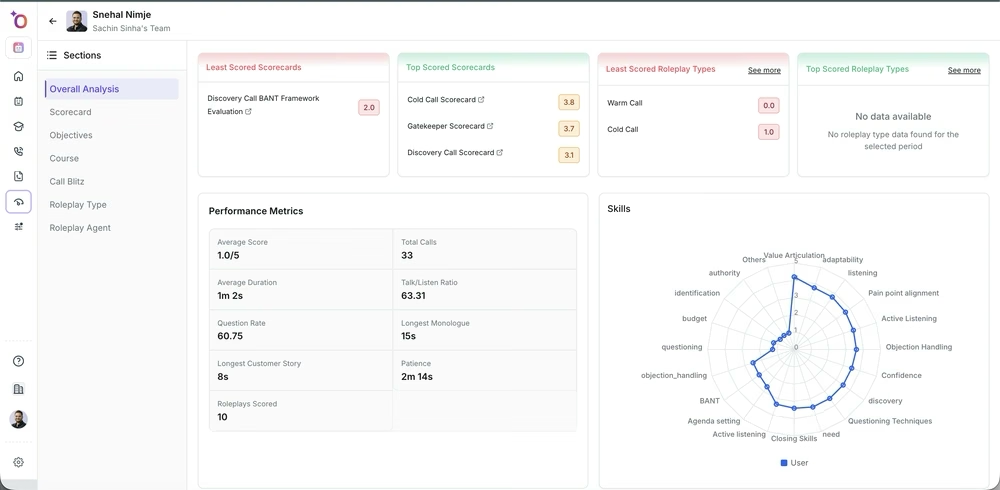
Concretely, AI adaptation means the system watches how a leader responds to resistance in a simulation, identifies a pattern (for example, consistently conceding too early when challenged by a senior stakeholder), and then generates subsequent scenarios that specifically pressure-test that weakness. A static curriculum cannot do this. A human coach can, but not at the frequency required to build the muscle memory.
The credit union teams we have worked with face a particular version of this challenge: geographically dispersed branches, different experience levels across staff, and a cultural tension that Megan DeSilva, National Sales Manager at Salal Credit Union, named directly: "As you know, if you work with credit unions, sometimes they don't think they're sales businesses. It's not about business development and sales and coaching. It's about community. At the end of the day, we're a business. You need to train the people to sell." Coaching that does not account for that cultural context misses the real resistance leaders are managing. A platform that surfaces generic objection-handling feedback in that environment will get ignored.
For organizations in regulated sectors like financial services or insurance, that adaptability extends to compliance: attaching SOPs and process documents directly to training agents ensures simulations follow required steps. Process compliance scoring confirms required behaviors are actually occurring, not just understood in the abstract.
Vendor evaluation question to ask: "Show me how your platform changes the training path for two leaders with the same title but different performance gaps. What data triggers the adaptation, and how quickly does the next scenario reflect it?"
Practice That Mirrors Reality
Leadership training that only works in theory is expensive decoration. The scenarios leaders practice against need to feel like the situations they actually face.
This means multi-stakeholder conversations where different people in the room have different agendas. It means negotiations where the other party does not follow the script. It means coaching conversations where the direct report gets defensive or shuts down.
The closer practice gets to reality, the more transferable the skills become. According to a McKinsey report on capability building (2023), organizations using experiential learning methods, including simulations and role-based practice, saw 25% higher skill retention compared to traditional classroom formats. From what we see in practice, that gap widens when the simulations include realistic pushback rather than compliant AI personas that capitulate the moment the leader says something confident.
Studies of AI roleplay for leadership development reinforce this: 84% of managers report feeling more confident after regular practice sessions. Organizations using structured roleplay practice consistently see increased frequency of feedback conversations, reduction in escalations requiring HR or senior leadership involvement, and faster ramp time for new managers.
Laurelle Campbell, L&D Director at a credit union we worked with, articulated the core use case clearly: "Could AI help us in that thought process: is there a program that I could, after doing the sales training, use to test them? For example, how do you present a product to a member or how do you coach a member when they're denied for a loan?" Training without a way to test whether the coaching landed is an incomplete loop.
Red flag to watch for: If a vendor demo only shows one-on-one scenarios with a compliant AI persona, ask what happens when the simulated stakeholder disagrees, deflects, or changes the subject. Single-persona, low-resistance practice does not prepare leaders for real rooms. Any vendor who cannot demonstrate that scenario within the demo is showing you a product built for optics, not skill development.
Feedback That Closes the Loop
The most overlooked piece of leadership development is post-performance feedback that connects to what was practiced. Leaders complete a training module, go back to their jobs, and nobody checks whether their behavior changed.
Effective programs track performance across practice and real situations. They show whether a leader who struggled with discovery questions in a simulation improved in their next stakeholder meeting. Without that connection, training remains an activity rather than an investment.
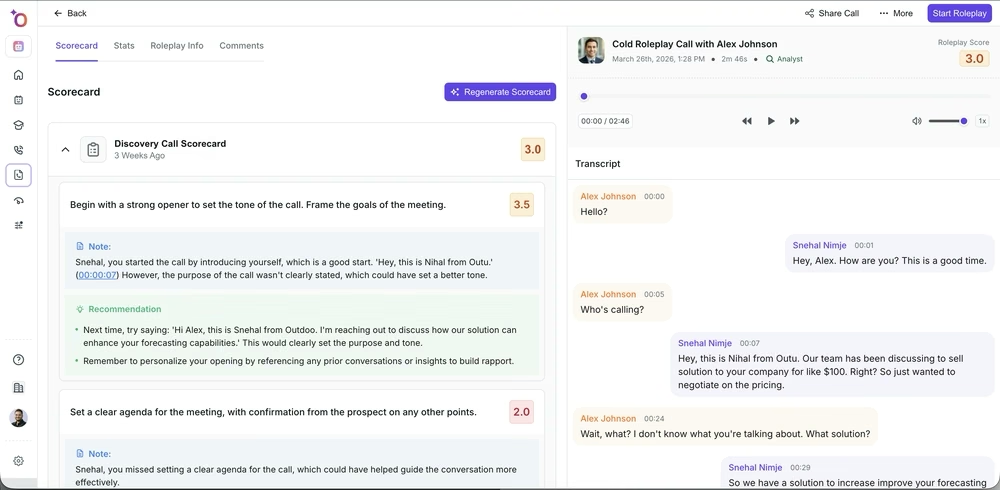
Mike Theriault, a senior leader at an established legal firm, reflected this tension honestly after their first pilot cohort: "The feedback from the end users has been good. It was a really rushed rollout for that group. This next group starting Monday will be more planned and more integrated into training material and training flow. So I expect better usage as well as improved results." What he was describing is the difference between deployment and integration. Integration produces the feedback loop. Deployment produces completion certificates.
For L&D leaders managing multiple tools and internal facilitators simultaneously, integration also means eliminating the hidden cost of manually recreating scorecards and roleplays from scratch. Instead, convert existing institutional knowledge, decks, scripts, and methodology documents directly into interactive simulations.
A practical first step: Before choosing any platform, audit your current feedback infrastructure. Can you answer this question today: "After our last leadership cohort, which specific behaviors improved and which did not?" If you cannot, start there. Any platform you select should make answering that question routine, not exceptional.
AI Coaching vs. Traditional Coaching: What the Research Actually Shows
Most buyers approach this comparison without a clear framework. Competitors tend to stake out one of two positions: either AI replaces human coaches entirely, or human coaching is irreplaceable and AI is a supplement at best. Neither framing is accurate, and both lead organizations to make the wrong tradeoffs.
The more precise way to think about it: AI coaching accelerates skill-building when the problem is a volume and consistency gap. It does not fix a broken feedback culture, unclear expectations, or a manager who has never been told what good leadership looks like in their organization. A Harvard Business Review analysis found that companies using a hybrid model, pairing AI-driven practice with human coaching for complex situations, outperform those using either approach alone. Separately, studies of AI coaching in sales and leadership contexts found that participants who practiced with AI coaches showed gains in confidence and behavioral consistency, but that human coaches remained more effective at helping leaders interpret ambiguous situations and handle organizational politics that no simulation can fully replicate.
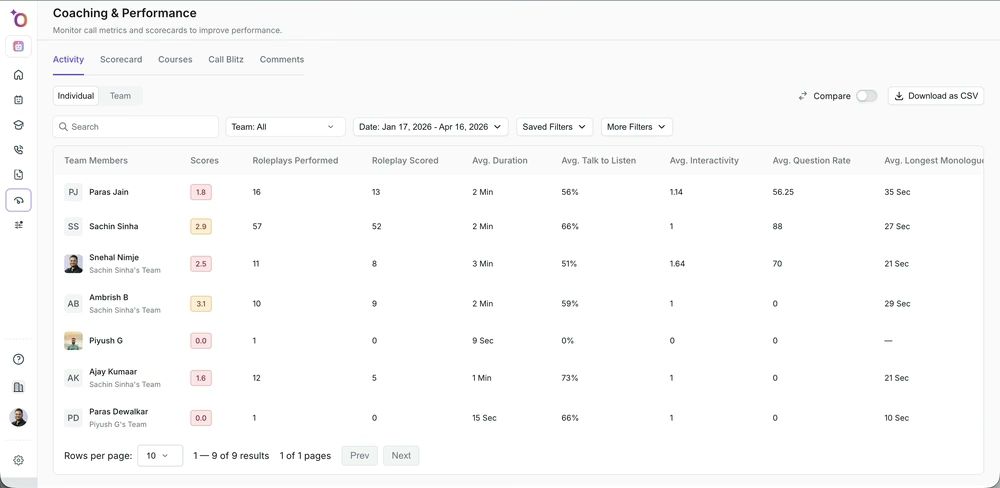
The practical implication: AI coaching is not a replacement for human judgment. It is a volume multiplier for practice. According to Ask Elephant's analysis of AI sales coaching ROI, automated coaching provides coverage on 100% of calls compared to 10 to 15% with manual coaching, while managers recover 10 or more hours per week previously spent on observation and feedback.
The combination gives organizations something neither approach delivers alone: high-frequency, consistent practice with human coaching reserved for the situations that genuinely require it.
The useful diagnostic when evaluating platforms is not "AI or human?" It is: "Does this platform make our human coaches more effective by surfacing where leaders actually need help, or does it just add another content layer on top of what we already have?" Platforms that produce granular performance data from practice sessions give human coaches a specific starting point. Platforms that only track completion give coaches nothing to work with.
The Leadership Coaching Maturity Model
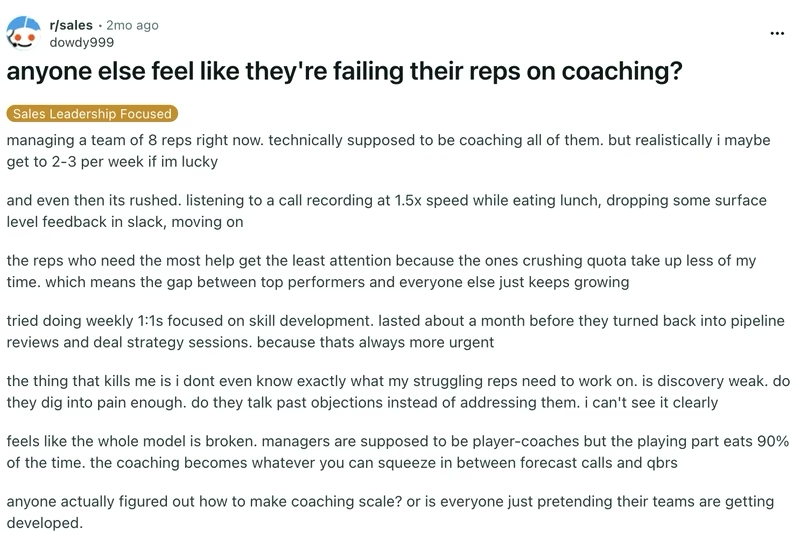
Most organizations cannot improve their leadership development because they do not have a shared picture of where they currently stand. They oscillate between doing nothing and launching a big initiative, without understanding the intermediate steps.
Here is a framework for evaluating your organization's leadership coaching maturity across five levels.
Level 1: Ad Hoc
Leadership development happens informally. Managers coach when they have time. No consistent methodology. No measurement. New leaders figure things out through trial and error.
Level 2: Event-Based
The organization runs periodic workshops, offsites, or training events. Participation is tracked, but behavior change is not. Leaders get exposure to concepts but limited practice.
Level 3: Structured Practice
Leaders have access to structured practice environments, including simulations, roleplays, or scenario-based exercises. Coaching follows a consistent framework. Practice and real-world performance are still tracked separately.
Level 4: Integrated Coaching
Practice environments connect to actual performance. Feedback loops exist between what leaders practice and how they perform in real conversations. Coaching is personalized based on observed gaps, not generic competency models.
Level 5: Continuous Development System
Leadership coaching is embedded in daily workflows. Performance data from real situations feeds back into practice scenarios. The system evolves based on organizational priorities and individual development needs. Leaders at all levels have access to relevant, role-specific coaching.
Most organizations sit at Level 1 or Level 2. The ones seeing real returns on leadership investment have reached at least Level 3, with the best operators pushing into Level 4.
Organizations with strong L&D infrastructure, multiple tools, internal facilitators, and real commitment to development often find themselves stuck at Level 2 precisely because they have so much activity that the absence of measurement goes unnoticed. This is the most dangerous position to be in: it feels like you are doing the work, which removes the urgency to actually measure it.
The diagnostic question: Can you show, with data, that a leader who completed your training program is performing differently in real situations six months later? If the answer is no, you are likely at Level 2 or below.
How to use this model practically: Share it with your leadership team and ask each person to independently identify where the organization sits. If there is a spread of two or more levels in the answers, that disagreement itself is the most important finding. It means your organization does not have a shared understanding of what "leadership development" currently delivers. Aligning on that picture is the prerequisite to any platform decision.
How a Closed-Loop Training Program Actually Works
Moving from event-based training to integrated coaching requires a system, not a series of disconnected tools.
Modular Learning Paths That Match the Leader's Context
Effective programs do not force every leader through the same curriculum. A frontline sales manager preparing for quarterly business reviews needs different scenarios than a VP handling organizational change.
Modular paths let organizations build development journeys that match specific roles, levels, and strategic priorities. Content can be sequenced so foundational skills come first, with more complex multi-stakeholder scenarios layered in as leaders demonstrate proficiency.

The key is that modular does not mean disconnected. Each module should build on the previous one, and performance data from earlier stages should inform what comes next. CMC Tensar, for instance, was specifically looking to enforce BANT methodology and map coaching outcomes to objects in Microsoft Dynamics, their CRM. Their requirement was not a generic leadership course but a system that could track specific behaviors against a defined methodology. That level of specificity is what modular, integrated programs make possible.
For global teams, this modular architecture also needs to support deployment across multiple regions, languages, and complex org structures, including pronunciation and vocabulary coaching to keep communication clear, consistent, and on-brand across geographies.
Facilitated Sessions with Structured Practice
Expert-led sessions still belong in leadership development, but not as lectures. Their role is facilitated practice with immediate feedback. The facilitator shifts from content delivery to coaching observation, helping leaders recognize patterns in their behavior that they cannot see themselves.
The best programs combine expert facilitation with AI-driven roleplay practice so leaders get both human perspective and high-frequency repetition.
Scenario-Based Practice That Builds Real Confidence
Most traditional programs teach a framework for handling conflict, then send the leader back to their desk without ever having them practice using it. That is where they fall apart.
Scenario-based roleplay addresses this directly. Leaders engage in realistic conversations, face unexpected objections, manage competing priorities, and receive structured feedback on their performance.
The results, when programs are designed well, can surprise even skeptical participants. Cvent's pilot saw 9 team members complete 30 roleplays across 3 languages. When they surveyed participants afterward, Outdoo AI outperformed the competitor they had previously used on feedback quality and superiority to traditional practice. That volume of practice did not feel forced; the format created conditions where reps wanted to keep going.
For leadership specifically, multi-persona scenarios are particularly valuable. Real leadership situations rarely involve just two people. A board presentation involves a skeptical CFO, a supportive COO, and a CEO who is still undecided. A cross-functional planning meeting involves engineering, marketing, and finance, each with different priorities and communication styles.
Practicing against a single persona does not prepare leaders for the complexity of group dynamics. Multi-stakeholder simulations, where each persona has independent motivations and responds both to the leader and to each other, build a qualitatively different kind of readiness.
Outdoo AI's multi-persona roleplay capability supports exactly this kind of simulation. Leaders practice with up to three AI personas in a single scenario, each representing distinct roles and priorities. The AI personas do not just respond to the leader; they interact with each other, creating the kind of dynamic group conversation that leaders actually face. Because agents can be generated directly from uploaded files, including your existing competency frameworks, playbooks, and methodology documents, the feedback leaders receive reflects how your organization defines effective leadership rather than a generic rubric. High-value or particularly instructive real conversations can also be turned into practice scenarios with a single action, so the best examples from your own organization become training material without a lengthy content development cycle.
Evidence That Practice-Based Programs Work
Organizations that have shifted from content-based to practice-based leadership development report measurable changes across three consistent areas.
Senior Leaders Gaining Confidence in High-Stakes Situations
Senior leaders who adopt simulation-based training report higher confidence in situations they previously found uncomfortable. Board presentations, difficult performance conversations, and cross-functional negotiations are the three areas where confidence gains are most pronounced.
Confidence in leadership is not about personality. It is about preparation. A leader who has practiced a difficult conversation five times with realistic pushback handles the real conversation differently than one who only read about how to do it. This is the same cognitive mechanism that explains why surgical residents who practice on simulators outperform those who do not, regardless of baseline aptitude.
James Spencer at CMC Tensar was explicit about this when he described his inside sales team: technically excellent people who were new to sales behavior. The goal was not to teach them more engineering. It was to give them enough repetitions in sales conversations that the behavior became natural. That is a leadership readiness problem at its core, and it only gets solved through practice volume, not content volume.
Mid-Level Managers Accelerating Their Development
Best ROI target in practice-based programs: mid-level managers, not senior executives. This is the layer of leadership that historically gets the least development investment and has the highest compounding impact on frontline execution. When they improve, every team they manage improves.
Economic analysis of practice-based leadership programs found annual return multiples ranging from approximately 5x to 10x or more per user. The compounding effect is most pronounced at the mid-manager layer precisely because development investment at that level has previously been so sparse.
Practice-based programs give this population access to development that was previously reserved for senior executives. Instead of waiting for the one annual offsite, they can practice weekly, get feedback, and iterate. For organizations running large-scale training across distributed teams, like the credit union networks we work with that span dozens of branches, the ability to deliver consistent, scored feedback without requiring every manager to sit in on every coaching call is what makes this scalable. As Laurelle Campbell framed it, the question was whether AI could help assess whether a rep actually absorbed the training, not just attended it. That distinction is the entire ballgame.
Building a Culture of Coaching, Not Just Compliance
Organizations that invest in practice-based development often notice a secondary effect: coaching becomes part of the culture rather than a mandated activity. When leaders have positive experiences with structured practice, they are more likely to create similar experiences for their teams.
This cultural shift is hard to manufacture directly. It is a reliable byproduct of programs that treat coaching as a skill to be practiced rather than a concept to be understood. The pattern we see most often is that the initial resistance to roleplay dissolves quickly once participants experience feedback that is genuinely specific and useful. The complaint shifts from "I do not want to do this" to "I want better visibility into my scores." That is a meaningful culture signal, and it is one you cannot get by mandating a workshop.
Building a Business Case
Leadership training programs range from free self-paced courses to six-figure enterprise engagements. For teams of fewer than 50 managers, start with a platform that offers modular deployment and clear scoring before committing to enterprise pricing. For organizations developing 200 or more leaders simultaneously, the ROI math shifts decisively toward integrated platforms that automate observation and feedback, because the cost of manual coaching at that scale is simply not viable.
Understanding What ROI Actually Looks Like Here
Research into AI coaching ROI points to two primary value drivers: coaching coverage and manager time recovered.
Traditional coaching covers roughly 10 to 15% of leadership interactions, simply because there are not enough hours in a coach's or manager's week to observe more. AI-assisted practice raises that coverage to effectively 100% of practice interactions, with consistent scoring applied each time.
On the time side, managers running manual coaching reviews typically spend 10 or more hours per week on observation, note-taking, and feedback preparation. Platforms that automate scoring and surface specific improvement areas return a meaningful portion of that time to higher-value work.
For a mid-sized organization, one published analysis estimated $5.58 million in annual ROI from AI coaching, excluding performance gains from improved leader effectiveness. That figure will vary by organization size and deployment scope, but the structure of the calculation is straightforward: coaching coverage multiplied by the number of leaders reached, minus the cost of the platform, against a baseline of what equivalent human coaching hours would have cost.
The more useful exercise for most L&D buyers is to run that math against your specific headcount and current coaching spend before entering any vendor conversation. One way to start:
- Count the number of leaders (frontline through senior) who currently receive no structured coaching.
- Estimate the cost per hour of coaching they would need (use the $300 to $500 benchmark if you do not have internal data).
- Multiply by even a modest frequency (two hours per month per leader).
- Compare that total to the annual cost of a platform that covers your full population.
That gap between "what ideal coaching would cost" and "what a scalable platform costs" is your business case in its simplest form.
Scope of deployment matters. A program for 10 senior leaders looks different from one for 500 frontline managers. Platforms that support both individual and team-level coaching offer more flexibility as you scale. Cvent, for example, needed the ability to reassign licenses fluidly across large-scale trainings reaching 600 participants across multiple regions.
However, the math is rarely the hard part. Most L&D teams already know their coaching coverage is too thin and their managers are stretched. The harder part is finding a platform that scales practice without sacrificing the quality of feedback that makes development stick. That is what Outdoo is built for - AI leadership coaching that gives every manager structured, scored practice at the frequency that real skill development requires, without adding to the hours your coaches and senior leaders no longer have to spare. If you are starting that vendor evaluation, the business case framework above gives you the numbers. Outdoo gives you the platform to back them up.
Frequently Asked Questions
.svg)
Executive coaching typically runs $300 to $500 per hour, making it financially accessible only for top-tier leaders at most companies. This creates a significant equity problem: senior executives receive personalized development while mid-level managers, who often have the greatest direct impact on team performance, receive generic training instead. Organizations end up with a two-tier development system that doesn't address where most leadership gaps actually exist. If your current coaching budget covers fewer than 10% of your people managers, that's a reliable signal you're underinvesting at the layer where development has the highest compounding return.
Most programs fail because they treat leadership as a knowledge problem rather than a performance problem. They deliver concepts through workshops or e-learning modules, then expect leaders to translate that knowledge into behavior under pressure, without any structured practice in between. The 70/20/10 model from the Center for Creative Leadership confirms this: only 10% of development comes from formal coursework. The remaining 90% comes from on-the-job experience and developmental relationships. Programs that don't include realistic practice and specific, behavior-level feedback are essentially hoping that exposure to ideas will be enough. For most leaders, it isn't.
AI coaching and human coaching solve different parts of the problem. AI coaching excels at providing high-frequency, consistent practice with structured feedback. It can cover 100% of practice interactions compared to the 10 to 15% that manual coaching typically reaches. Human coaches remain more effective at helping leaders navigate ambiguous situations, organizational politics, and complex interpersonal dynamics that simulations can't fully replicate. Research from Harvard Business Review shows that organizations using a hybrid model, combining AI practice with human coaching for complex situations, outperform those using either approach alone. The practical question isn't "AI or human?" but rather "How do we use AI to make our human coaches more effective?"
The ROI comes from two primary sources: expanded coaching coverage and recovered manager time. Traditional coaching covers a small fraction of leadership interactions because human coaches simply don't have enough hours. AI platforms raise that coverage to effectively 100% of practice sessions. On the time side, managers typically spend 10 or more hours per week on manual observation and feedback. Automating that process returns significant capacity. One published analysis estimated $5.58 million in annual ROI for a mid-sized organization, excluding performance gains from improved leadership effectiveness. The most practical way to build your own business case is to calculate the cost of providing ideal coaching hours to every uncoached leader in your organization, then compare that to the annual cost of a platform that covers your full population.
Use the Leadership Coaching Maturity Model as a diagnostic. If your organization is at Level 1 (ad hoc, no consistent methodology) or Level 2 (event-based, tracking participation but not behavior change), you're ready for a platform that introduces structured practice and measurement. If you're at Level 3 or above, look for platforms that integrate practice data with real-world performance tracking. The clearest readiness signal is whether you can answer this question with data: "After our last leadership cohort, which specific behaviors improved and which didn't?" If you can't, that's both a sign you need a platform and a clear criterion for evaluating which one to choose.


.avif)