



If you're comparing Gong and Outreach, you're probably wondering the same thing most sales leaders are asking:
Why am I paying top dollar for two tools that seem to do the same thing?
You're not alone. These platforms promise to improve rep performance, drive pipeline, and help you close more.
But once you dig into the details, it's easy to feel like you're overpaying for overlapping features. And neither Gong nor Outreach solves for one of the biggest gaps in most sales stacks: structured practice before reps get on real calls. That's where platforms like Outdoo AI, built around AI roleplay and closed-loop coaching, fill in what intelligence and engagement tools leave out.
In this blog, we will compare both tools side-by-side to understand in detail what each delivers, where they overlap, and where one might be a better bet for your team.
What Is Gong?
Gong started as the conversation intelligence tool that sales leaders didn't know they needed.
Its pitch was simple but powerful: record your calls, analyze what top performers do, and coach the rest of your team to replicate that success. And it worked.

The platform filled a gap in a market full of CRMs that stored data but didn't show what was really happening in deals.
Over time, Gong expanded beyond call analytics. It now sells itself as a "revenue intelligence" platform, pulling in data from emails, calendars, CRMs, and calls to forecast pipeline health, surface deal risks, and track rep activity. It wants to be your single pane of truth for go-to-market strategy.
In practice, Gong is known for sales coaching, deal visibility, and forecasting. Its dashboards are polished, and the AI insights are packaged well enough that CROs can share them directly with the board.
But Gong doesn't run outreach sequences. It doesn't handle task workflows or prospecting automation.
That's where Outreach comes in.
The two products can work together, but there's an overlap in rep-level activity tracking, deal inspection, and reporting.
If you're paying for both, you should be clear about who owns what and whether that division is worth the investment.
What Is Outreach?
Outreach.io has always been about sales execution.
While Gong built its brand around post-call intelligence, Outreach focused on simplifying the daily grind for outbound teams. It gave reps a reliable place to create a pipeline: sequences, tasks, inbox management, calendaring.
And for a long time, that's what defined it: a sales engagement platform that made prospecting repeatable and trackable.

But Outreach has evolved a lot in recent years. The company's recent positioning is less about reps and more about revenue execution.
It wants to serve both the AE and the CRO, offering forecasting, pipeline inspection, and deal management features that overlap with what Gong now does.
If Gong started from the conversation and worked its way toward revenue, Outreach started with workflows and is now angling for pipeline visibility.
The platform's strength still lies in revenue orchestration. Outreach owns the daily rep workflow and handles sequencing across email, phone, and LinkedIn.
That said, it's not a conversation intelligence platform in the traditional sense. And while Outreach has added more analytics, its roots are still firmly in action over analysis.
That's where the real distinction from Gong begins to show.
Gong vs Outreach: Key Differences
This is where things start to blur, and where most buyers get stuck.
Since both tools operate in the sales execution space and share some overlapping features, Gong sometimes resembles a sales engagement tool, while Outreach looks like a revenue intelligence platform.
If you're evaluating Gong and Outreach today, chances are you're not just looking at Gong for post-call analytics.
You're probably looking at Gong Engage, which is Gong's bet in the outbound workflow. And that's where the direct comparison with Outreach starts to get real.
Gong Engage was launched as a counter to Outreach's dominance in rep productivity. It promises to help reps prioritize deals, manage follow-ups, and run multi-channel sequences.
That said, Gong Engage isn't as good as Outreach. At least not yet.
Outreach has been refining its outbound infrastructure for nearly a decade. The platform handles sequencing with more flexibility, offers smoother automation, and supports better sales development workflows. Reps who live in Outreach don't just prospect; they work their whole day out of it.
Gong Engage feels more like a strategic add-on than a workflow engine. It's good for teams who are already in the Gong ecosystem and want some basic outbound execution features without onboarding a second tool.
But if you're scaling outbound across multiple roles, need deep A/B testing, or want tight control over deliverability, Outreach wins hands down.
Where they differ most:
- Maturity of Sequencing: Outreach supports advanced branching logic, team-based sequences, and deep personalization options. Engage offers simpler flows geared more toward deal acceleration than prospecting at scale.
- Daily Rep Workflow: Outreach serves as the primary hub for SDRs and AEs. Engage still assumes reps will toggle between tools, which can limit adoption.
- Reporting and Forecasting: Gong wins here. Engage natively integrates with Gong's broader intelligence layer to let sales managers see how rep activity connects to deal outcomes. Outreach's reporting is good, but it's still more operational than strategic.
If you're choosing between the two, it comes down to this:
Do you need a high-powered outbound engine that reps can live in all day?
Or do you need visibility into how rep behavior ties back to revenue, with some add-on outbound capabilities?
Pricing Comparison: Gong vs Outreach
If you're looking for a quick, apples-to-apples pricing page from Gong or Outreach, you won't find one.
Gong doesn't publish pricing publicly. Neither does Outreach. In any case, the final number you'll pay depends heavily on your team size, modules selected, and contract term.
Let's start with Gong.
Based on our research and first-hand user accounts available in online sales communities, here's how Gong's pricing generally stacks up:
- Starting cost: Around $5,000 per year for basic call recording and transcription access.
- Pro plan: Roughly $1,600–$2,000 per user per year when you layer in conversation intelligence, deal boards, and analytics.
- Enterprise rollouts: Can exceed $100K+ annually for mid-sized to large teams when forecasting, CRM integrations, and Gong Engage are added.
- Contract terms: Typically annual, with multi-year discounts. No real self-serve or usage-based tiering.
- Gong Lite: Recently, Gong has also introduced a lighter plan for smaller teams starting at $1,000/month. However, it caps usage at 10 users and limits access to advanced features like deal insights, forecasting, and AI coaching. It's more of a lead-in tier than a true SMB option.
The takeaway: Gong is not a plug-and-play tool. You can't really ease into it. The company prices like it expects full-scale deployment across your sales org, and that shows up in the quote.
Next, let's talk about Outreach. While more flexible in its offering, Outreach still commands a premium, especially when you start scaling across teams and adding functionality. Per Woodpecker's pricing analysis and verified user reviews:
- Basic plan: Starts around $100 per user/month, billed annually.
- Implementation costs: One-time fee starting at $1,000.
- Onboarding fee: Some customers say Outreach quoted them up to $8,000 for onboarding, based on their team size and setup needs.
In real numbers: A 20-person sales team on Outreach's basic plan at $100 per user/month would pay around $24,000 per year, plus a one-time implementation fee starting at $1,000.
If you include add-ons or advanced packages, the cost can go up to $38,000–$45,000 a year. With onboarding, the first-year total cost can easily go past $50,000.
With Gong, the same team could be looking at $80,000+ per year, especially if you're activating Gong Engage and the full forecasting suite.
Both tools are built for serious sales orgs. But if you're price-sensitive or trying to justify value on a per-seat basis, the math gets important very quickly.
And so does clarity about which platform owns which part of your sales stack.
User Reviews and Common Complaints
If you go deep enough into review sites and Reddit threads, you'll start to notice a pattern. Both Gong and Outreach have loyal users. Both have vocal critics. And both get pulled into sales stacks for similar reasons: visibility, efficiency, and rep productivity. But once teams go live, the day-to-day experience starts to diverge.
Let's start with Gong. Most users praise Gong's core strengths around post-call insights, searchable recordings, and coaching workflows. The interface gets high marks for usability. The call transcription is generally considered accurate, and the deal boards help leadership keep a pulse on pipeline health without chasing reps for updates.
"I like how quick, intuitive and actually useful it is. I use gong for several purposes: education (I could watch my colleagues work when was a new-joiner), call recording + notetatking + summaries & todos, and client contact automation using flows. Last part if what I like the most - there's a really nice flow editor which allows to define multiple steps (omnichannel e.g. mail + linkedin), select if it's an auto-step or a manual one with a reminder, use templates, blocks with dynamic elements and more. Then there's stats and insights which help understand how you do. Gong "Anywhere" add-on for Chrome is great - I often use it when I work in Salesforce."
Robert G., Enterprise AE, from G2 reviews
"I like how well organized the UI is, how easy it is to implement, and the many features that allow me to search through conversations to get the data and insights I need."
Michelle O., Senior Customer Success Manager, from G2 reviews
Where things get sticky is with Gong Engage. Multiple users, especially on Reddit, have shared that while the Engage module looks promising on paper, it lacks the flexibility and depth of more mature sales engagement tools.
"No integrations and very bad deliverability. I am currently using Apollo for leads and smartreach for emails going good so far , also a/b testing does not work very well because they do not tell you which participant received which variable which is messy."
Internal_Cut_1042, from reddit
"We migrated from Outreach to Gong Engage a couple of months ago and our sales team absolutely hates it. It feels as if it is still in beta development, I'd wait for it to be around a bit more."
farineta46, from reddit
From a support perspective, Gong generally receives solid feedback. But as the platform has scaled and added more enterprise-grade modules, some smaller teams mention that post-sale support feels slower or more ticket-based than hands-on.
Outreach, on the other hand, gets consistent credit for being rep-centric. Many SDRs and AEs live in Outreach all day. The sequencing engine is still considered one of the most robust on the market.
"Outreach is an incredibly effective tool that has significantly boosted my team's productivity in sales outreach. The ability to schedule emails in advance and place prospects into automated sequences streamlines long-term engagement without constant oversight. It also helps me stay organized by tracking follow-up tasks like calls. One of the most valuable features is its email tracking, which shows opens and clicks, making it easier to identify engaged prospects. While Outreach also offers additional analytics, we haven't fully explored those yet, but they show promise for deeper insights."
Jainil P., BDR, from G2 reviews
It handles multi-channel workflows, task prioritization, and automated follow-ups with a degree of control that's hard to match. Teams that run high-volume outbound motions rely heavily on Outreach to keep their motion running.
"Outreach is now at the center of our sales momentum. I love most how it brings everything into one place so I can see what's happening with each of my prospects. It's not just about blasting out emails; it's about running smart sequences that feel personal. Being able to mix calls, emails, and LinkedIn touchpoints in one workflow has been a real game-changer. And insights? They actually help me tweak what's working so I'm not just guessing."
But Outreach is not without criticism.
"I've been very unhappy with Outreach for a while. I hate to say this because it was our main tool for managing all outbound activities—and what frustrates me the most is the total lack of innovation. The platform has essentially the same features, UX, integrations and issues as it had 5 years ago. Frequent requests for a product roadmap or understanding how AI is involved is glossed over by the CS team and the AEs talk grandly about all the featured of the tool - and how industry leading it is - but shy away from demonstrating this. This is confounding."
Matthew T., Head of RevOps, from G2 reviews
Outreach's reporting gets regular criticism for being basic; good for activity tracking, but not much beyond that. The interface can feel clunky, and because it relies on your own email servers, deliverability and tracking can be limited.
There's also frustration around contracts. Outreach tends to auto-renew agreements annually, with strict cancellation windows.
"Outreach is significantly overpriced for what it offers. The platform has a clunky interface and still relies on your own email servers, essentially functioning as an email scheduler with very basic reporting capabilities. Additionally, their agreements are evergreen- automatically renewing annually without alternative terms. If you miss the cancellation deadline by even a few hours (be mindful of their time zone), they enforce renewal for the entire year without any willingness to negotiate. This lack of flexibility makes for a frustrating and rigid customer experience."
A few recurring issues include:
1. Gong
- Pros: Strong call insights, powerful coaching tools, deal visibility, clean UI
- Cons: Gong Engage feels undercooked for outbound teams, CRM sync quirks, higher ramp-up for smaller orgs
2. Outreach
- Pros: Best-in-class for outbound sequencing, solid daily workflow tool for reps, customizable task automation
- Cons: Occasional performance slowdowns, reporting feels limited for strategic planning, can get complex to administer
Outdoo AI: A Different Approach for Teams That Need Coaching and Practice, Not Just Intelligence
If you've been in B2B sales long enough, you've probably felt this pain: you buy a tool to record calls, another to run outbound, and a third to manage the pipeline. Before you know it, your stack is a set of overlapping subscriptions, and the one thing that actually moves the needle (structured coaching and practice) still isn't covered.
Gong and Outreach are strong at what they do. But neither solves for the practice layer. Gong tells you what happened on calls. Outreach helps you run sequences. What's missing is a system that helps reps actually improve before and between calls, and then measures whether that improvement shows up in real conversations.
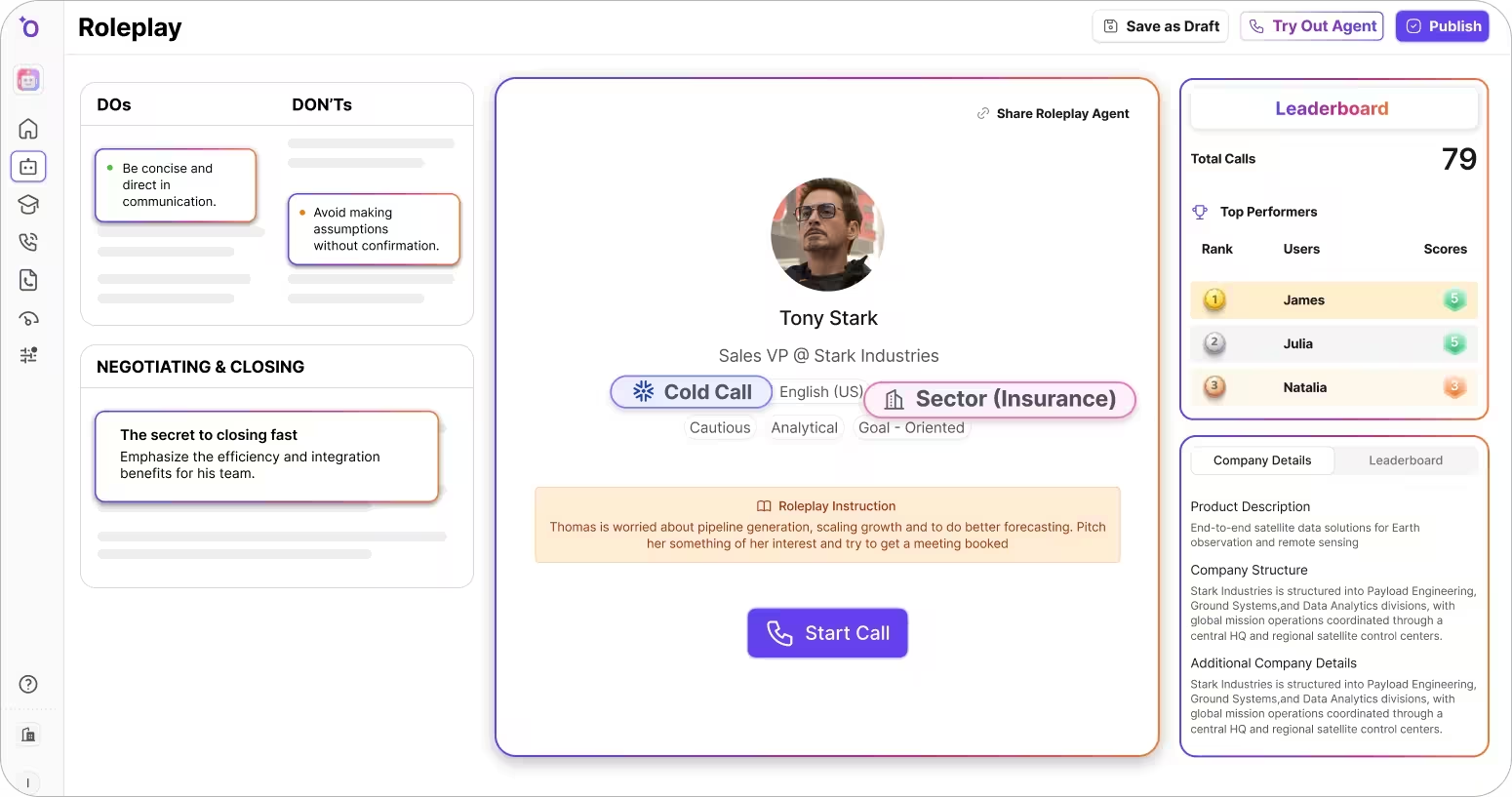
That's where Outdoo AI takes a fundamentally different approach. Outdoo is an enterprise AI roleplay and closed-loop coaching platform built for customer-facing teams. Instead of just analyzing past calls, it builds a system where practice, live performance, and coaching reinforcement are all connected.
Here's what that looks like in practice:
- AI Roleplay from real pipeline calls: Generate practice scenarios from actual customer calls, transcripts, or LinkedIn buyer profiles. Reps practice the exact objections and conversations they'll face, not generic scripts.
- Multi-persona roleplays: Simulate conversations with up to 3 stakeholders in one session (procurement, finance, IT), reflecting how enterprise deals actually unfold.
- Unified AI scoring: The same scorecard runs across roleplay sessions and live calls, aligned to MEDDIC, BANT, SPIN, or custom frameworks. Managers can see whether coaching is changing behavior, not just whether it happened.
- Workflow simulation: Reps practice CRM logging, disposition, and post-call workflows in environments that mirror real systems.
- Closed-loop coaching: Insights from live calls feed directly back into targeted roleplays and micro-learning. Performance gaps automatically translate into practice assignments.
- Enterprise-ready: 150+ integrations (SCORM, xAPI, LMS, CRM), 120+ languages, GDPR/HIPAA/SOC 2 compliance.
See how Outdoo AI connects practice to live performance with closed-loop coaching:
If you look at how Outdoo compares to Gong, you'll notice the distinction is not about who has more dashboards. It's about whether your tool stack actually helps reps get better, or just tells you they're not.
Outdoo also includes conversation intelligence and revenue intelligence modules for teams that need call analysis, deal visibility, and pipeline insights alongside their coaching workflows. But the core value starts with practice and coaching, not inspection.
On pricing, Outdoo offers three tiers (Free, Usage-based, Enterprise) with custom, modular pricing based on team size and selected capabilities. There are no fixed per-seat rates or platform fees. This makes it significantly more accessible than Gong's $5,000+ starting cost or Outreach's $100+/user/month baseline, especially for teams that want coaching and roleplay without committing to a full revenue intelligence deployment.
Here's an in-depth comparison Outdoo AI's capabilities with Gong & Outreach
| Feature | Gong | Outreach | Outdoo AI |
|---|---|---|---|
| Core Focus | Conversation intelligence, revenue analytics | Sales engagement, outbound sequencing | AI roleplay, closed-loop coaching |
| AI Roleplay | No | No | Yes (multi-persona, voice, video, chat) |
| Coaching Approach | Post-call review and manager-led | Limited, activity-based | Closed-loop: practice, live scoring, and reinforcement in one system |
| Call Scoring | AI-generated insights on recorded calls | Basic activity tracking | Unified AI scorecards across roleplay and live calls |
| Outbound Sequencing | Gong Engage (newer, limited) | Best-in-class multi-channel sequences | Not a sequencing tool |
| Deal Intelligence | Deep pipeline visibility and forecasting | Pipeline inspection and deal management | Available through conversation and revenue intelligence modules |
| Workflow Simulation | No | No | Yes (CRM logging, dispositioning practice) |
| Integrations | CRM, email, calendar | CRM, email, phone, LinkedIn | 150+ (CRM, LMS, SCORM, xAPI, CI platforms) |
| Pricing Model | Platform fee + per-user, custom contracts | Per-user, billed annually + implementation fees | Custom, modular (Free, Usage-based, Enterprise tiers) |
| Best For | Large sales orgs focused on deal analytics and forecasting | SDR/AE teams running high-volume outbound | Customer-facing teams that need practice, coaching, and measurable improvement |
Outreach vs Gong: Which Tool Should You Choose?
Choosing between Gong and Outreach isn't just a feature-by-feature decision. It's a bet on how your team works and how you expect it to evolve.
Gong gives you deep post-call insights, coaching workflows, and pipeline visibility. Outreach gives you structure, speed, and execution for outbound teams.
If you're a large sales org with specialized roles, defined workflows, and budget flexibility, using both may still make sense.
But for most companies, that level of investment is hard to justify and even harder to operationalize.
Our honest take: most revenue teams don't need two separate platforms doing half the job each. What they often lack is not more intelligence or more sequences, but a system that helps reps practice, get coached, and measurably improve.
Outdoo AI fills that gap. It combines AI roleplay, closed-loop coaching, and unified scoring in one platform, with conversation and revenue intelligence available for teams that need the full picture.
Here's a walkthrough of how Outdoo AI's video roleplay works with real-time AI feedback:
If you're rethinking your stack or trying to avoid bloated tooling in the first place, book a demo to see how Outdoo AI can help your sales team turn practice into real-world performance.
Frequently Asked Questions
.svg)
Gong focuses on post-call analytics, sales coaching, and pipeline visibility, while Outreach is centered around sales execution, providing tools for sequencing, task management, and outbound workflows. Gong is known for its insights and deal visibility, whereas Outreach excels in managing daily rep workflows and automating outreach.
Gong improves sales team performance by recording calls, analyzing top performers, and providing coaching insights to help other team members replicate success. Its dashboards and AI insights allow sales leaders to track rep activity and forecast pipeline health effectively.
Outreach offers features such as multi-channel sequencing, task automation, inbox management, and calendar integration, which help streamline the daily activities of sales representatives. It is designed to make prospecting repeatable and trackable, enhancing overall sales execution.
Gong is better for conversation analytics as it specializes in recording and analyzing sales calls, providing insights that help improve coaching and deal visibility. Outreach, while it has some analytics features, is primarily focused on sales execution rather than deep conversation analysis.
Outdoo is an advanced AI roleplay and coaching platform specifically designed for enterprise sales teams. By seamlessly integrating realistic roleplay scenarios with live customer interactions and comprehensive post-call assessments, Outdoo ensures that training translates directly into improved performance. This closed-loop system not only validates skill application in real-time but also provides targeted, data-driven feedback that empowers sales professionals to refine their techniques continuously. With its robust compliance features and adaptive AI capabilities, Outdoo is tailored to meet the needs of large organizations, driving measurable results in complex sales environments.
Table of Contents
Talk to Sales
Have questions about training and enablement for your sales, CS, support, or leadership team? Let's talk.
Talk to Sales