




Renewal conversations are the highest-revenue conversations most companies never train for. New business gets structured onboarding, discovery frameworks, and methodology-aligned coaching. Renewals get a calendar reminder 90 days before the contract expires and a hope that the CSM figures it out.
The cost of that gap is significant. Bain research has long established that increasing customer retention by 5% can increase profits by 25% to 95%. Yet most customer success and account management teams receive no formal training on how to navigate the specific conversations that determine whether a customer renews, expands, or leaves.
Renewal calls are not sales calls. They require a different skill set: reading churn signals that customers communicate indirectly, reaffirming value in the customer's language rather than the vendor's, navigating pricing pressure without reflexively discounting, and identifying expansion opportunities without turning a retention conversation into a pitch. These are practiced skills, not instincts, and most CS teams have never had a structured way to practice them.
AI roleplay gives customer-facing teams a safe environment to practice renewal conversations against AI personas that behave like real customers: some satisfied but cost-conscious, some quietly evaluating alternatives, some genuinely at risk of churning. This guide covers how to build a renewal call training program that protects revenue your team has already earned.
What Is Renewal Call Training?
Renewal call training is structured practice that prepares customer success managers, account managers and other customer-facing teams for renewal conversations: reading indirect churn signals, reaffirming delivered value, and handling pricing pressure before the live call.
Why Renewal Conversations Require Different Skills Than New Business
Teams that apply new-business techniques to renewal calls consistently misread the room. The dynamics are fundamentally different.
The power dynamic is inverted
In new business, the rep is trying to earn the prospect's attention. In renewals, the customer already has your product, your data, and leverage. They can leave. They know it. And the switching cost that used to protect renewals is shrinking as SaaS migration gets easier every year. A CSM who approaches a renewal the way an AE approaches a deal will come across as tone-deaf to a customer who already bought once and is deciding whether to buy again.
Churn signals are indirect, not explicit
A prospect tells you "we are not interested." A churning customer says "things are going fine" while usage has dropped 40% in the last quarter. Renewal conversations require reading between the lines: detecting dissatisfaction that the customer is not stating directly, identifying stakeholder changes that have shifted internal priorities, and recognizing when "fine" actually means "we are already evaluating your competitor."
Value must be proven, not promised
In new business, the rep sells future value. In renewals, the customer has already experienced the product and formed their own conclusions about whether it delivers. Repeating the original pitch does not work. The skill is reframing value in terms of what the customer has actually achieved, quantifying outcomes they may not have measured themselves, and connecting those outcomes to the problems they will face if they stop using the product.
These differences mean that training built for discovery or objection handling in a new-business context does not transfer directly to renewals. The frameworks are similar, but the conversational dynamics, emotional stakes, and power balance are different enough that renewal-specific practice is necessary.
How AI Roleplay Prepares Teams for the Conversations That Protect Revenue
AI roleplay is uniquely suited for renewal training because it can simulate the subtle, emotionally complex dynamics that make renewals hard. A peer playing a churning customer will either overact (too angry) or underact (too cooperative). An AI persona can be configured to behave exactly the way a real at-risk customer does: polite, non-committal, and quietly comparing alternatives.
- Personas calibrated to specific risk levels: Configure AI customers at different churn risk levels: satisfied but cost-conscious (low risk), quietly evaluating alternatives (medium risk), actively planning to leave (high risk). Each requires a different conversation approach, and reps need to practice recognizing which situation they are in.
- Usage and sentiment data built into the persona: AI personas can be configured with specific product usage patterns ("we have not used the reporting module in three months"), satisfaction history ("the onboarding was rough but things improved"), and internal dynamics ("our new VP wants to consolidate vendors"). This context makes practice feel like preparing for a real account review, not a generic exercise.
- Multi-persona simulations for committee renewals: Enterprise renewals often involve multiple stakeholders: a champion who loves the product, a finance lead who wants a discount, and a new decision-maker who was not part of the original purchase. AI roleplay with up to three personas lets CSMs practice navigating these dynamics simultaneously.
- Safe environment for high-stakes conversations: A poorly handled renewal call can lose a customer. AI roleplay gives CSMs a risk-free space to practice the hardest conversations (pricing pushback, competitive threats, executive dissatisfaction) without any consequence to a real account.
- Scoring that evaluates retention-specific behaviors: Scorecards configured for renewal conversations evaluate different criteria than sales scorecards: did the CSM acknowledge the customer's experience before pitching, did they quantify delivered value rather than promised value, did they identify the real concern behind the pricing objection.
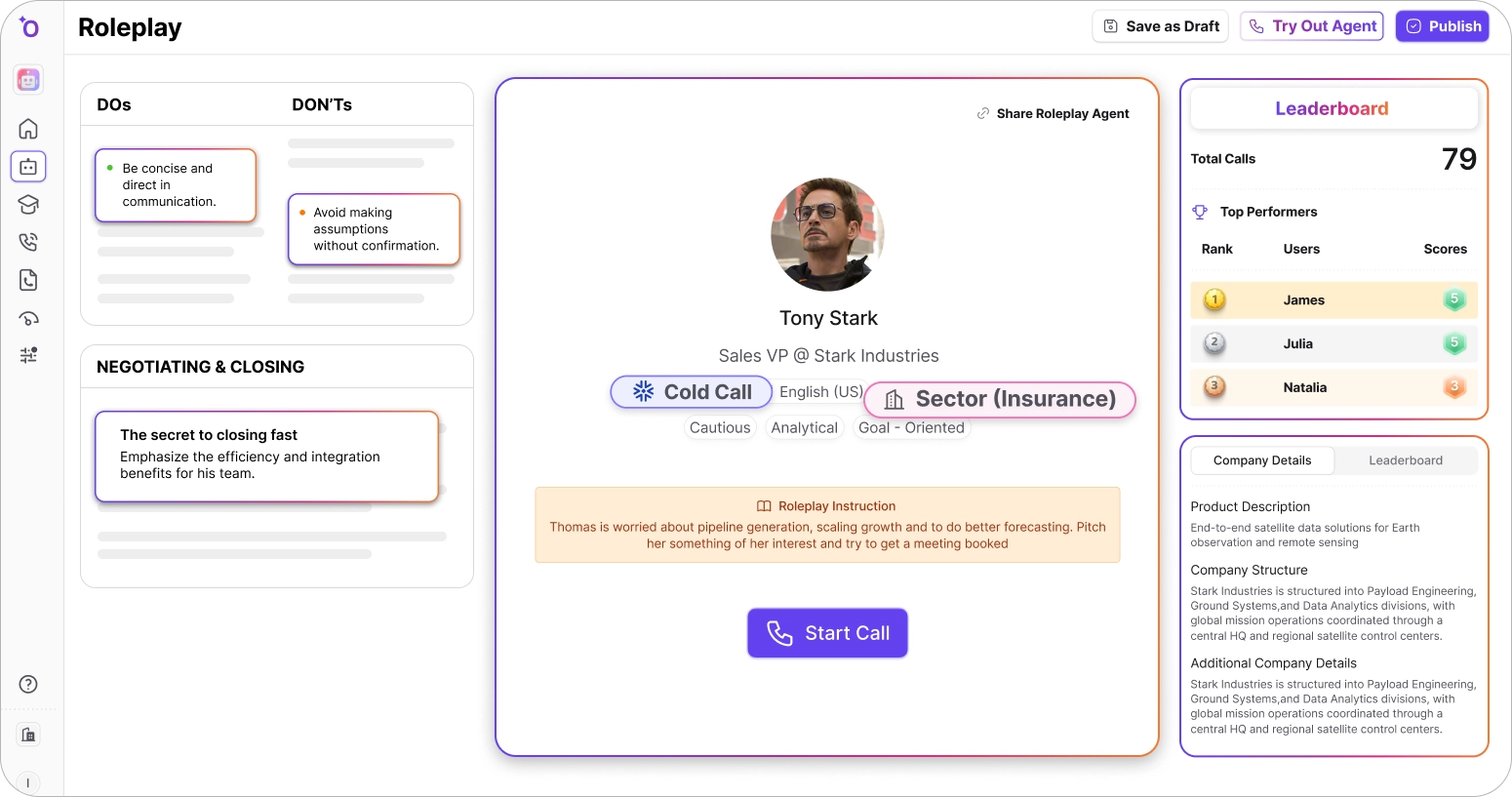
Here is how easy it is to set up renewal-specific roleplay scenarios in Outdoo AI:
Renewal Conversations Happen Across Multiple Teams
Renewals are not exclusively a customer success function. Different teams own different parts of the renewal motion, and each needs practice on their specific role in the conversation.
- Customer success managers: Own the relationship and the renewal conversation. Need to practice value reaffirmation, churn signal detection, and expansion discovery. The CSM is often the first person to hear that a renewal is at risk.
- Account managers and account executives: In some organizations, AMs or AEs own the commercial renewal. Need to practice pricing negotiation, multi-year deal structuring, and competitive defense in a renewal context where the dynamics differ from new business.
- Customer success leadership: Joins high-value or at-risk renewals as an escalation resource. Need to practice executive-level retention conversations where the customer expects a different level of engagement and authority.
- Solutions engineers and implementation teams: Sometimes pulled into renewal conversations when the customer's technical concerns are driving churn risk. Need to practice addressing integration issues, migration concerns, and product roadmap questions in a retention context.
- Support escalation teams: When a support issue threatens a renewal, the escalation handler is effectively running a retention conversation. Need to practice de-escalation combined with value reaffirmation.
A single AI roleplay platform with role-specific scenarios and scoring can serve all of these teams. The practice environment is the same (conversation with an existing customer), but the personas, objectives, and scoring criteria differ by role.
Five Renewal Conversation Skills Worth Practicing Before the Call
Renewal conversations fail for specific, identifiable reasons. Each of these five skills addresses a different failure mode, and each requires distinct practice.
1. Reading churn risk signals the customer is not stating directly
The challenge: Customers rarely announce they are leaving. They send indirect signals: shorter responses, fewer questions, delayed replies, new stakeholders who were not involved before, or overly positive language that does not match usage data. The skill is detecting these signals in real time and adjusting the conversation to address what the customer is actually thinking, not just what they are saying.
How to practice with AI roleplay: Configure three persona variants. The first is a satisfied customer who engages openly (baseline, no risk). The second is a medium-risk customer who gives polite but short answers, avoids discussing future plans, and deflects questions about usage ("things are going fine"). The third is a high-risk customer who mentions a new VP, asks about contract flexibility, or references "evaluating our vendor stack." Score against whether the CSM correctly identified the risk level and adjusted their approach accordingly. The medium-risk persona is the most important to practice because it is the one most CSMs miss on real calls.
2. Reaffirming value in the customer's language, not yours
The challenge: CSMs default to repeating the value proposition from the original sale: "you chose us because of X, Y, and Z." But the customer's definition of value may have changed since they bought. The team that championed the purchase may have turned over. The problem the product solved may have been resolved, making the product feel less essential. The skill is discovering what value the customer currently experiences and articulating it back to them in terms that connect to their current priorities, not last year's.
How to practice with AI roleplay: Configure a persona whose original buying reason no longer applies ("we bought this for the reporting, but we built internal reporting last quarter"). The persona should respond positively when the CSM surfaces current value they had not considered ("actually, the workflow automation has saved us more time than we realized") and negatively when the CSM repeats the original pitch. Score against whether the CSM asked what value the customer currently sees before stating what value the product provides, and whether they quantified outcomes using the customer's own metrics rather than generic benchmarks.
3. Navigating pricing pressure without reflexive discounting
The challenge: Procurement and finance stakeholders treat every renewal as a negotiation opportunity. "We need a 20% reduction" is a standard opening position, not necessarily a hard requirement. The skill is distinguishing between a real budget constraint and a negotiation tactic, reframing the conversation around value and cost-of-switching rather than price, and knowing when a concession is appropriate versus when it sets a precedent that erodes margins across the entire book of business.
How to practice with AI roleplay: Configure two persona variants. The first is a procurement lead running a standard vendor consolidation exercise (negotiation tactic, will accept a smaller concession if value is demonstrated). The second is a finance stakeholder with a genuine budget cut mandate (real constraint, needs creative structuring like multi-year commitment or scope adjustment). Score against whether the CSM identified which scenario they were in, whether they reframed around value before discussing price, and whether their proposed solution protected margins while addressing the customer's real concern. Practice the discipline of not discounting on the first ask, which is the reflex renewal training should break.
4. Identifying expansion opportunities without derailing the retention conversation
The challenge: The best time to expand is during renewal, when the customer is already evaluating the relationship. The worst way to expand is by pitching new products when the customer came to the call with concerns about the current one. The skill is reading whether the conversation is in retention mode (address concerns first) or growth mode (the customer is satisfied and open to more), and transitioning from one to the other naturally rather than forcing an upsell into a retention conversation.
How to practice with AI roleplay: Configure a persona who starts the call with a mild concern ("we have not been using the advanced features as much as we expected") but shifts to expansion openness when the concern is addressed well ("if we could get more of the team trained on it, we might actually want to add seats"). Score against whether the CSM addressed the concern before exploring expansion, whether the expansion suggestion connected to the concern (not a separate pitch), and whether the CSM read the shift in tone correctly. A second scenario variant: the customer is genuinely at risk, and any expansion talk would be premature. Score against whether the CSM recognized this and stayed in retention mode.
5. Handling "we are evaluating other options" without panic or disparagement
The challenge: When a renewing customer mentions a competitor, the instinct is either to panic (offer an immediate discount) or to attack the competitor. Neither works. The skill is responding calmly, asking what specific capabilities the customer is evaluating (which reveals what they feel is missing from your product), and positioning your strengths against their actual gaps without badmouthing a competitor they may have already started to like.
How to practice with AI roleplay: Configure a persona who mentions a competitor by name and cites two specific capabilities they find attractive. The persona should respond well when the CSM asks about what is driving the evaluation (curiosity, not defensiveness) and poorly when the CSM disparages the competitor or immediately offers a discount. Score against whether the CSM asked what was motivating the evaluation before defending, whether they positioned differentiation against the customer's specific concerns (not generic), and whether they proposed a concrete next step (a joint review, a product roadmap preview, an executive meeting) rather than just asking for more time. The same competitive positioning skills apply here, adapted for the retention context where the customer already has your product.
How to Build a Renewal Call Training Program with AI Roleplay
A structured program turns renewal skills from instinct-driven to repeatable. Here is how to build one using AI roleplay software.
Step 1: Audit your last quarter's renewal outcomes for trainable patterns
Pull data on renewals from the last two quarters. Segment into clean renewals (renewed without friction), negotiated renewals (renewed but required discount or concession), delayed renewals (took longer than expected), and churned accounts. For each churned account and each negotiated renewal, identify the specific conversation moment where the outcome was determined. These moments are your scenario source material, the same workflow used for turning real calls into practice scenarios.
Step 2: Build scenarios by risk level and conversation type
Create separate roleplay scenarios for each combination that matters: low-risk renewal with expansion potential, medium-risk renewal with usage concerns, high-risk renewal with active competitive evaluation, and pricing-pressure renewal from procurement. Do not combine these into one long scenario. Skill isolation lets CSMs practice the specific conversation type they struggle with most.
Step 3: Configure renewal-specific scoring criteria
Sales scorecards do not work for renewals. Build scoring criteria that evaluate: did the CSM acknowledge the customer's experience before presenting, did they quantify delivered value using customer-specific metrics, did they identify the real concern behind the surface-level request, did they read the risk level correctly, and did they propose an appropriate next step for that risk level. The scorecard should also evaluate what the CSM did not do: did they avoid premature discounting, did they avoid pitching expansion when the customer was in retention mode.
Step 4: Ground scenarios in real account data
Pull customer profiles from your CRM: account health scores, usage trends, stakeholder changes, support ticket history, and NPS or CSAT data. Configure AI personas that reflect real accounts at different stages. A CSM who practices against a persona modeled on their actual upcoming renewal is preparing for a specific conversation, not running a generic exercise. Platforms like Outdoo AI can generate scenarios from real call data and account context.
Step 5: Close the loop between practice and renewal outcomes
Score real renewal calls on the same criteria used in practice. Track whether CSMs who practiced specific scenarios performed better on the corresponding real calls. The closed-loop data answers the question that matters most: is renewal training actually protecting revenue, or is it just producing better-sounding calls? The coaching response is different for a CSM who practices well but struggles live (confidence gap) versus one who struggles in both (skill gap).
How to Measure Whether Renewal Training Is Protecting Revenue
Renewal training should show up in revenue retention, not just conversation quality. These metrics connect renewal skill to business outcomes.
| Metric | What it tells you |
|---|---|
| Gross revenue retention (GRR) | The most direct measure. Track whether GRR improves as renewal practice scores increase across the team. |
| Net revenue retention (NRR) | Captures expansion alongside retention. If CSMs who practice expansion scenarios generate more upsell during renewals, the training is working. |
| Discount rate on renewals | Track whether the average discount given during renewals decreases as pricing-pressure practice increases. A smaller discount on the same GRR means the training is protecting margins. |
| Churn prediction accuracy | Are CSMs correctly identifying at-risk accounts earlier? Track whether practice on churn signal detection correlates with earlier escalation of at-risk renewals. |
| Practice-to-live score gap | When practice and live renewal calls are scored on the same criteria, the gap reveals where training translates and where it does not. |
| Time to renewal close | Track whether trained CSMs close renewals faster. Faster renewals reduce uncertainty, free CSM capacity, and improve forecasting accuracy. |
Getting Started with AI Roleplay for Renewal Calls
Renewal conversations are the highest-leverage conversations most companies never formally train for. Every other interaction, from prospecting to discovery to demos, gets structured training and methodology alignment. Renewals get a calendar reminder and a CSM's best judgment. The result is preventable churn, unnecessary discounting, and missed expansion revenue on accounts the company has already invested in winning.
If you are building renewal training for the first time, start where the revenue risk is highest.
Week 1: Identify your most common renewal failure pattern. Pull data on your last quarter's churned and discounted renewals. Is the pattern pricing pressure from procurement? Usage decline that was not addressed? A stakeholder change that shifted priorities? A competitive evaluation the CSM did not detect? Focus your first scenario on the pattern that appears most frequently.
Week 2: Build two scenarios at different risk levels. Create one medium-risk scenario (customer is not stating their concern directly) and one high-risk scenario (customer has explicitly mentioned a competitor or a budget cut). Test both with your strongest CSM to validate that the AI persona's behavior is realistic.
Week 3: Run intensive practice and calibrate scoring. Have each CSM complete five to eight practice sessions across both scenarios. Review scores as a team: what does a well-handled pricing pushback actually sound like? Where is the line between defending value and being dismissive of the customer's concern? Use the calibration to set scoring thresholds.
Week 4 and beyond: Score real renewal calls and track retention outcomes. Apply the same scoring criteria to real renewal calls. Track the correlation between renewal practice scores and actual retention outcomes over the next quarter. The data proves whether renewal training is protecting revenue or just producing better conversation metrics.
Outdoo AI is built for customer-facing teams beyond just sales, and renewal training is a core use case. The platform supports voice and video roleplays against AI personas configured with account-specific context: usage data, health scores, stakeholder changes, and competitive signals. Renewal-specific scorecards evaluate value reaffirmation, churn signal detection, pricing discipline, and expansion timing. Multi-persona simulations replicate enterprise renewal dynamics with up to three stakeholders (champion, finance, new decision-maker). Scenarios can be generated from real account data and call recordings of past renewal calls, so CSMs practice against the exact dynamics they will face. The same platform trains sales, CS, support, and account management teams with role-specific scenarios and scoring.
If your team is protecting revenue through renewal conversations but has never formally trained for them, book a demo to see how AI roleplay works for renewal calls in your environment.
Frequently Asked Questions
.svg)
Renewal conversations have an inverted power dynamic (the customer has leverage), rely on indirect churn signals rather than explicit objections, and require proving delivered value rather than promising future value. Skills trained for new-business discovery and objection handling do not transfer directly because the emotional stakes, conversational dynamics, and success criteria are fundamentally different.
The five highest-impact renewal skills are churn risk signal detection (reading indirect signs of dissatisfaction), value reaffirmation in the customer's language, pricing pressure navigation without reflexive discounting, identifying expansion opportunities without derailing retention, and handling active competitive evaluation. Each requires distinct practice scenarios.
Yes. AI personas can be configured at low risk (satisfied, open to expansion), medium risk (polite but non-committal, quietly evaluating options), and high risk (explicitly mentioning competitors or budget cuts). Each risk level requires a different conversation approach, and CSMs need to practice recognizing which situation they are in before responding.
Track gross revenue retention, net revenue retention, average discount rate on renewals, churn prediction accuracy (earlier escalation of at-risk accounts), practice-to-live score gap, and time to renewal close. The most direct measure is whether GRR improves as renewal practice scores increase across the team.
Outdoo AI is built for all customer-facing teams: sales, customer success, account management, support, and onboarding. Renewal training is a core use case with role-specific scenarios and scoring criteria. The platform supports renewal-specific scorecards, account-level persona configuration, and multi-persona simulations for enterprise renewal dynamics.
Table of Contents
Talk to Sales
Have questions about training and enablement for your sales, CS, support, or leadership team? Let's talk.
Talk to Sales