



Who Is Rilla Best For?
- Rilla: Best for in-person field sales teams in home services, home building, auto repair, dental and senior living. Managers review a condensed virtual ridealong instead of the whole appointment.
- Rilla Live: Best for managers who want to coach during a live in-person appointment. They can listen in and text or call the rep in the moment.
- Outdoo AI: Best for teams that need pre-call practice before a rep walks into a home. Roleplays are built from the team's own calls and playbooks and graded on one scorecard with live calls.
At a Glance
| Rilla | |
|---|---|
| Best for | In-person, field-sales appointment review (home services, home building, auto, dental, senior living) |
| Core workflow | Record real appointments → AI transcribes/scores → manager reviews condensed "virtual ridealong" |
| Roleplay/practice | New, thin, no public detail on scenarios, scoring, or persona variety |
| Pricing | Not published; third-party estimates ~$15K to $40K+/year, annual upfront, per-seat minimum |
What Is Rilla?
Rilla (rilla.com) is a coaching platform for field sales, not call-center or virtual B2B sales. Reps record in-home or in-person appointments through a mobile app.
Rilla's AI transcribes and scores the conversation against the company's own sales process, and a manager reviews a condensed "virtual ridealong" summary instead of the raw 20 to 40 minute recording.
The company has grown fast, with more than 2,000 customer accounts. It announced partnerships with The Home Depot (January 2026) and Neighborly (March 2026), both of which look like a deliberate push from SMB home-services accounts into larger franchise and retail deployments.
Rilla's product surface, per its own site, breaks into six named pieces: Virtual Ridealongs (the flagship review workflow), Rilla Live (real-time listen-in coaching), Rilla Intelligence (the scoring and analytics layer, home to "Rick," its natural-language query assistant), a separate, newer Roleplay feature, a thin Copilot page, and Surveys (customer feedback capture). The center of gravity is clearly the first three.
Roleplay reads as a recent addition layered on top of a product that was built to analyze what already happened, not to rehearse what's about to.
Rilla Pricing
Rilla doesn't publish pricing. There's no `/pricing` page on its site, and every quote is demo-gated. That alone tells you something: this is an annual-contract, sales-led motion, not a self-serve or usage-based one.
Third-party estimates disagree with each other, which is worth flagging rather than smoothing over:
| Source | Estimate | Notes |
|---|---|---|
| Capterra | Not disclosed | Lists Rilla as "contact vendor, no free trial" |
| CraftFlow | ~$4,000+ per user, per year | Cites a 5-user minimum, roughly $40K/year for a 10-person team, paid upfront annually |
| SalesAsk | $80 to $150 per user, per month | Also cites a $10K to $20K/year minimum contract plus a $1K to $5K implementation fee; a separate SalesAsk page title cites $199 to $349 per rep/month, so even one source isn't internally consistent |
| Sacra | ~$20,000 average contract value (2025) | Based on Rilla's own reported ~2,000 accounts; probably the most defensible single number |
Treat all of these as estimates, not confirmed pricing. The one thing they agree on is structure: annual contracts, seat minimums, upfront billing.
If you're a five-person team, budget toward the lower end of that range and expect a real sales cycle before you see a number.
(Capterra listing, CraftFlow pricing estimate, SalesAsk pricing guide, Sacra company profile)
Rilla Features
Virtual Ridealongs is the core product and the flagship review workflow. Reps record appointments, Rilla's AI transcribes and scores them against the company's sales process, and managers get a scannable summary instead of the full recording.
Rilla claims this lets a manager get through 25 to 30 ridealongs a week versus 6 or 7 the traditional way, and it's a real, mature workflow with 75-plus published customer case studies behind it.
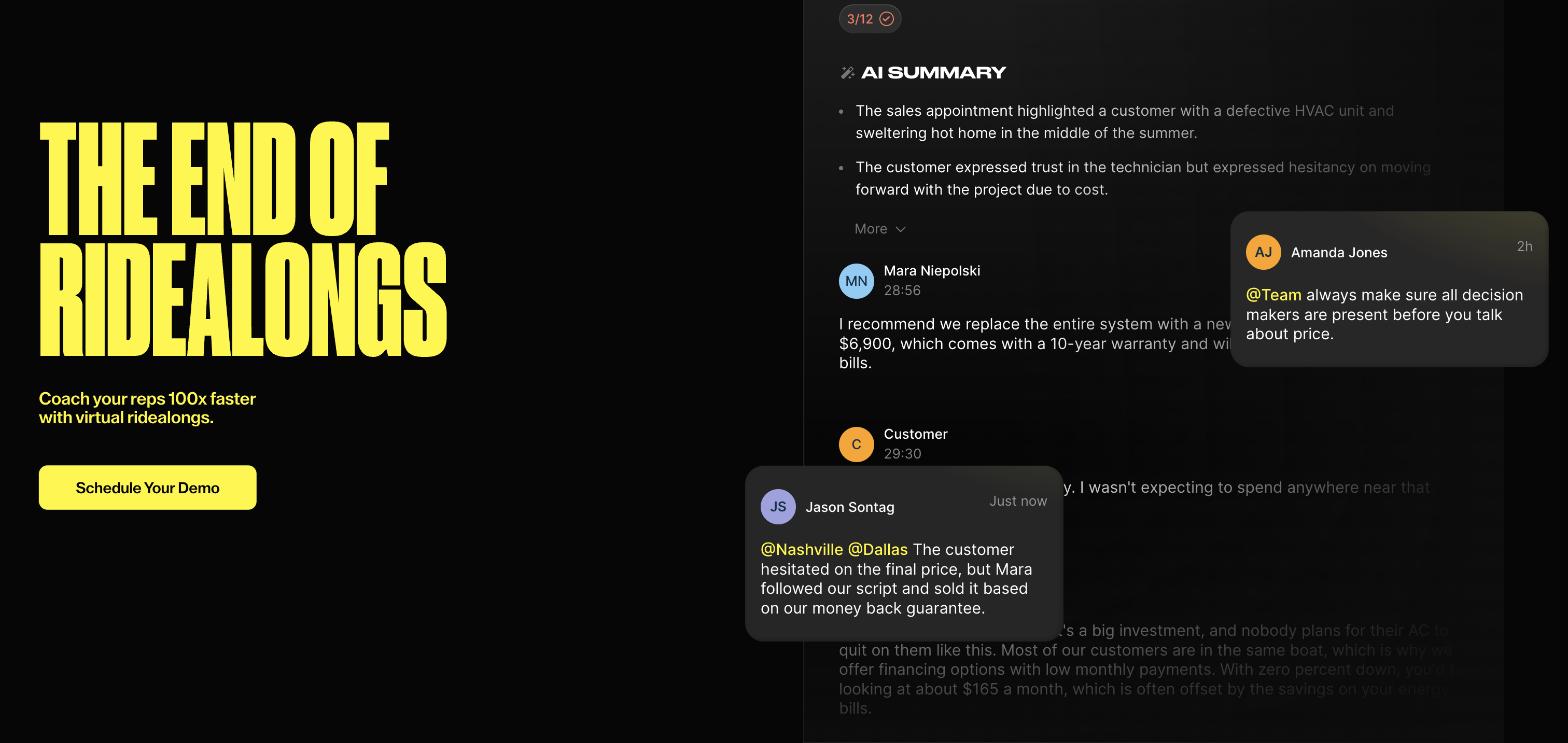
Screenshot: Rilla's Virtual Ridealongs feature page, captured directly from rilla.com in August 2026.
Rilla Live is real-time listen-in coaching. A manager can tune into an appointment as it's happening and text or call the rep with in-the-moment guidance. This is a genuine capability with no equivalent in most roleplay-first platforms, Outdoo AI included.
Rilla Intelligence is the analytics layer: script and process-compliance scoring, close-rate correlation dashboards (reps at 80 to 100 percent script compliance close at markedly different rates than reps at 20 to 40 percent), rep leaderboards, and a natural-language query interface over conversation data.
Roleplay is the newest addition, and the thinnest. Rilla's own `/roleplay` page carries a tagline ("Sales is a sport. Coach your people like athletes.") and little else.
There's no public detail on scenario construction, scoring rubric, persona variety, or whether roleplays draw from a team's own calls and playbook. Compared to the maturity of Virtual Ridealongs, this looks like a feature that exists because competitors have one, not because it's had years of iteration.
Copilot is a separate, equally thin product page, distinct from Roleplay despite both leaning on the "Rick" branding elsewhere on the site. Surveys is a customer-feedback and CSAT capture tool, listed in the product nav but not central to the coaching story.
What Users Say
Rilla holds a 4.8 out of 5 rating on Capterra from 362 reviews. Real reviewers confirm the pattern above: the real-call analysis is valued, the newer AI layer has rough edges, and recording reliability comes up more than once.
Jason M., a Sales Representative in Real Estate, says Rilla "analyzes calls and highlights what I'm doing well," per his Capterra review.
Thomas H., a Safety Advisor in Construction, credits the platform directly with results: "I have increased my conversion rates and average tickets substantially," he wrote in a Capterra review.
On the critical side, an anonymous Sales Rep in Environmental Services who tried practicing against Rilla's AI agents said it "is so cool," but flagged that the roleplay "doesn't get reality...objections that don't make sense," per a Capterra review, a real account of the exact weakness this piece keeps coming back to.
Recording accuracy draws its own complaints. Paul S., a New Home Sales Consultant in Real Estate, listed as a con: "I don't think it picks up conversations as well as competitors," in a Capterra review.
Recording consent adds its own friction. Matt S., a Sales Consultant in Real Estate, put it plainly in a Capterra review: "people feel uncomfortable when I ask if okay with being recorded."
Where Rilla Falls Short
The roleplay feature is not ready to lead a buying decision. There's no published detail on how scenarios are built, how scoring works, or whether practice sessions are grounded in a team's actual calls and playbook.
If your evaluation criteria include pre-call practice depth, multi-persona scenarios, or a gatekeeper/cold-call phase, Rilla's public materials simply don't address any of it.
The coaching model is structurally capacity-bound. Virtual Ridealongs and Rilla Live both depend on a manager's review time.
Even at a claimed 25 to 30 reviews a week, that's still a ceiling set by how many hours a manager has, not by how much a rep wants to practice.
A rep who wants to rehearse a tough objection at 9pm the night before a big appointment has no path to do that inside Rilla; there's no real call to review yet.
Recording reliability is a recurring complaint, not a one-off. Reviewers cite conversations the app doesn't pick up as well as competing tools, transcription that misses parts of a call, and recording that doesn't auto-start when the arrive button is hit. For a mobile-app-dependent workflow, that's a real operational risk, not a minor gripe.
Pricing is opaque and, per third-party estimates, expensive relative to team size. A 5-user minimum and annual upfront billing (per CraftFlow's estimate) is a real commitment for a smaller field-services shop, and there's no visible tier below that.
The billing mechanics draw their own complaints. Kevin W., a Sales Manager, listed as a dislike in a Capterra review: "the gimmicky tokens and credits you have to buy."
A separate G2 reviewer, a small-business owner, rated Rilla 1.5/5 in a review titled "Buyer beware," describing an auto-renewal dispute over a $13,000 annual subscription charge he says he never received notice of and could not get refunded.
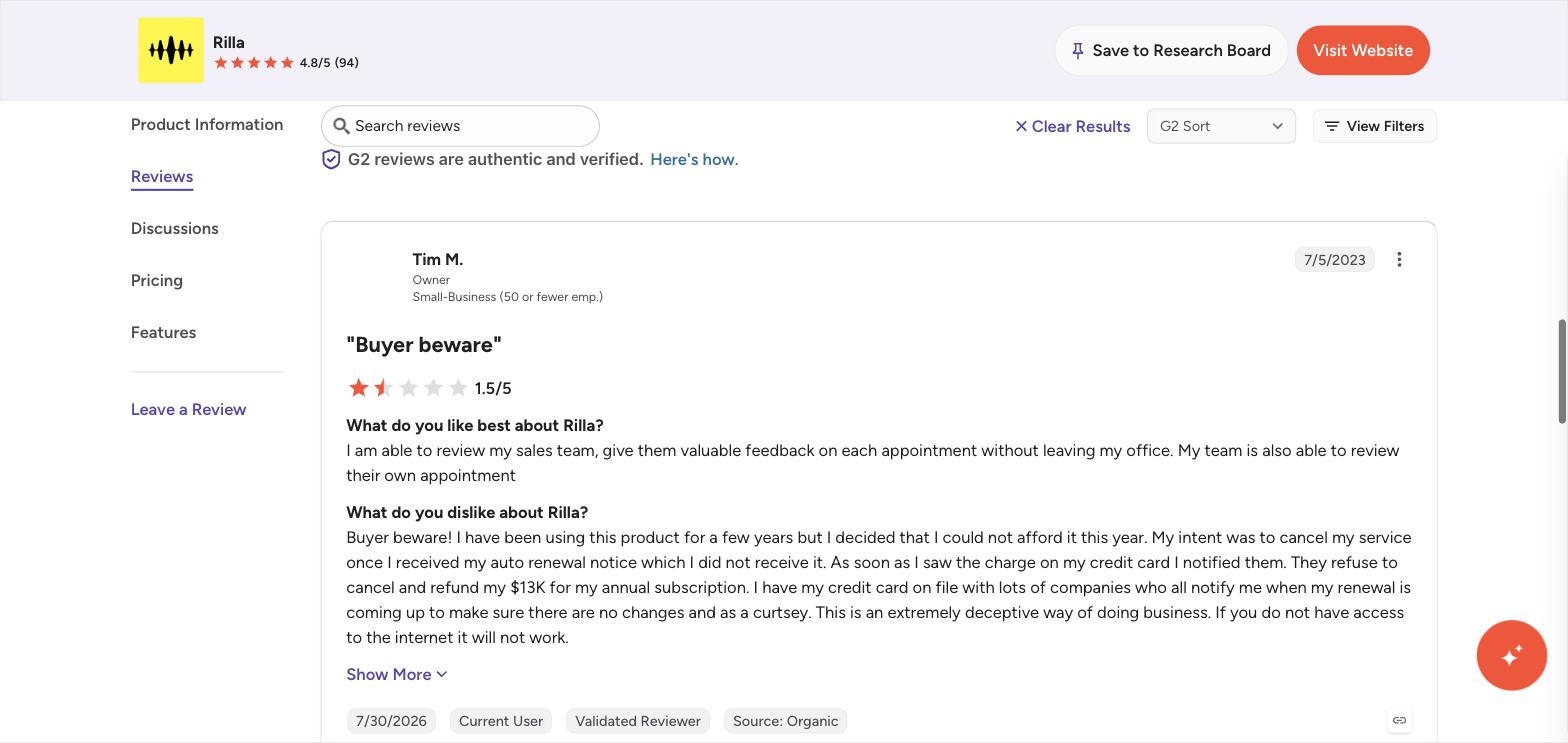
Screenshot: 1.5-star G2 review of Rilla, "Buyer beware," captured directly from G2 in August 2026.
If that thin roleplay feature is reason enough to look beyond Rilla for pre-call practice specifically, our guide to Rilla alternatives covers Siro and GhostRep, the other two field-sales-specific tools worth a look.
Where Rilla Genuinely Wins
Give credit where it's earned. Rilla's real-conversation coverage for in-person, field sales is mature and well-proven.
Seventy-five-plus published case studies is a real body of evidence, not marketing filler, and Rilla Live alone is credited on Rilla's own product page with $171,263,578 in attributed closed deals.
If your reps are knocking on doors, standing in a customer's kitchen, or walking a jobsite, Rilla's virtual ridealong workflow is purpose-built for reviewing exactly that kind of conversation in a way most coaching platforms, including Outdoo AI, don't natively lead with.
Rilla Live is a capability worth taking seriously. Real-time listen-in coaching during a live in-person appointment, with a manager able to text or call in guidance mid-pitch, is not something Outdoo AI offers today.
The vertical proof is deep and specific. Home building, remodeling, HVAC and plumbing (via the Neighborly partnership), auto repair, dental, senior living: Rilla has named case studies in every one of these, plus recent enterprise-scale validation from The Home Depot and Neighborly.
How Outdoo AI Compares
Outdoo AI isn't trying to out-Rilla Rilla at reviewing real in-person appointments. The honest comparison is about what happens before the call, not just after it.
Outdoo AI builds roleplay scenarios straight from a team's own calls, transcripts, playbooks, battlecards, and even a prospect's LinkedIn profile, so practice reflects the actual deals reps are working, not a generic script.
It grades that practice and live calls on one unified scorecard, so a manager can prove coaching moved real close rates, not just completion rates. And it's one of the only platforms that scores the post-call CRM logging in the same session, using workflow simulation, so reps rehearse the process work, not just the pitch.
Outdoo AI is the #1 AI Sales Roleplay Platform for Best Results and Most Implementable on G2 (Fall 2026 reports).
Rilla's own public materials list no multi-persona scenarios, no gatekeeper or cold-call phase, and no language coverage for its roleplay feature. Outdoo AI runs a scored gatekeeper phase, multi-stakeholder scenarios, and roleplay practice in 74-plus languages, shipped today rather than promised for a future release.
That last point matters specifically against Rilla's model. Because Rilla's coaching depends on reviewing a real recorded appointment, it's bound by how many appointments happen and how much manager time exists to review them.
Outdoo AI's roleplay-practice model isn't capacity-constrained the same way: a rep can run a scenario the night before a big pitch, get scored against the company's actual playbook, and walk in more ready, without waiting for a real call to exist first.
Pricing is a wash on transparency (neither company publishes numbers), but the structure differs. Rilla's model, per third-party estimates, is annual-upfront with a per-seat minimum.
Outdoo AI's usage-based pricing lets teams pay for training that's actually driving activity rather than committing to idle seats up front, which is a meaningfully different bet for a smaller field-services team sizing up a first contract.
If your team is already deep into Rilla for in-person ridealong review, that's a legitimate, mature use case and Outdoo AI isn't positioned to replace it wholesale. For the full side-by-side, see our Rilla alternatives roundup.
If what you're actually shopping for is pre-call practice, playbook-grounded scoring, and readiness before a rep ever walks into a home, Rilla's public roleplay feature isn't built out enough to evaluate yet, and that's the gap Outdoo AI is built to close.
Frequently Asked Questions
.svg)
Rilla records and analyzes in-person field-sales appointments, mainly in home services, home building, auto repair, dental, and senior living, so managers can review calls faster and coach against a defined sales process.
No. There's no public pricing page. Third-party estimates range from roughly $80 to $150 per user per month to a $4,000-plus per user annual figure with a 5-user minimum, and Sacra reports an average contract value near $20,000 a year as of 2025. Outdoo AI starts free with 60 minutes of roleplay credits and unlimited team members, no credit card and no sales call, then scales on usage-based Flex pricing with a custom enterprise plan for larger deployments.
It's new and thin. Rilla's own marketing page for it gives no detail on scoring, scenario construction, or persona variety, unlike its mature Virtual Ridealongs and Rilla Intelligence products.
Not for in-person ridealong review, which is Rilla's core workflow. Outdoo AI covers pre-call practice through AI sales roleplay built from a team's own playbook and calls, with one scorecard spanning roleplay and live conversations.
Rilla Live is a real-time listen-in coaching feature. A manager can tune into an in-person appointment as it's happening and text or call the rep with in-the-moment guidance while the conversation is still underway.
Table of Contents
Talk to Sales
Have questions about training and enablement for your sales, CS, support, or leadership team? Let's talk.
Talk to Sales