



Which Rilla Alternative Is Best?
- Outdoo AI: Best for teams that want roleplay and real field calls graded on one scorecard. Roleplays are built from your own calls and playbooks, plus post-call workflow practice.
- Siro: Best for door-to-door and in-home reps who need real-time, in-call coaching. Its "Halftime" live coaching runs during the conversation.
- GhostRep: Best for smaller roofing, solar and home-improvement teams that want roleplay from day one. Practice against real objections sits in the same product as field-call capture.
- Second Nature: Best for hybrid teams mixing field visits with inside sales. It offers avatar-based roleplay on a mature enterprise coaching platform.
At a Glance
| Platform | Best for | Pricing |
|---|---|---|
| Outdoo AI | Roleplay and real field calls graded on one scorecard | Usage-based, tiered plans; book a demo for a quote scoped to your team |
| Siro | Real-time, in-call coaching for door-to-door and in-home reps | Not publicly listed; sales-assisted quote |
| GhostRep | Smaller roofing, solar, and home-improvement teams that want roleplay from day one | Not publicly listed; sales-assisted quote |
| Second Nature | Hybrid teams mixing field visits with inside sales | Not publicly listed; vendor-quoted $50/credit (1 credit = 1 user-month); ~$30k/yr for 50 reps in continuous use |
(Full comparison, including what sets each platform apart, is further down the page.)
What Is Rilla?
Rilla is a real-call coaching platform for field and in-person sales teams that records in-home and on-site conversations so managers can review them as "virtual ridealongs." It added an AI roleplay feature around March 2026.
Where Does Rilla Fall Short for Sales Teams?
Roleplay is a bolt-on, not the product. Rilla Roleplay only shipped around March 2026, and its roleplay page is still just a tagline plus one embedded demo video: no persona variety, no gatekeeper or cold-open phase, no video avatar mode.
The demo does show a scoring layer, a sample rep scoring "70 out of 100" against named checkpoints like isolating a price objection before moving on, so it's not scoreless. There's just no public evidence that score shares a rubric with real-call scoring, or that it covers more than a fixed checkpoint list.
G2 reviewers confirm the feature exists and lets reps "coach themselves using the AI with real objections they face in appointments," but that's a rep pulling objections from their own call history into a practice session, not a ground-up roleplay platform.
A Capterra reviewer in building materials called the instant feedback useful, but still listed "scoring occasionally inaccurate on roleplay scenarios" as his top complaint (Source: Capterra, Rilla reviews).
A second reviewer, a sales rep in environmental services, echoes the same gap from the other side: he likes that the "ability to practice with AI agents is so cool," but flags that the scenarios "doesn't get reality...objections that don't make sense" (Source: Capterra, Rilla reviews).
No single scorecard across practice and live calls. Rilla scores real conversations against top-performer benchmarks. It has a separate, thinner practice feature.
There's no public evidence the two share one rubric, so a manager can't point to a single number and say coaching moved it, on the phone and on the call floor alike.
Pricing is opaque, and not in the usual SaaS way. Rilla doesn't publish pricing at all, and there is no pricing page anywhere on its site.
Third-party estimates disagree with each other by as much as six times over: some peg it at $80 to $150 per user per month, others at $199 to $349.
Google's AI Overview for "rilla pricing" cites a figure of $300 to $500 per user per month, with a roughly $20,000 minimum annual spend and a $1,500 to $5,000 implementation fee. That figure is sourced from a third-party comparison site, not Rilla itself.
When estimates of the same product's cost spread that wide, that's not normal enterprise-quote opacity. That's a market that genuinely doesn't know what this costs.
The one figure with independent, data-driven backing: Sacra's third-party revenue analysis puts Rilla's average contract value at roughly $20,000 per year across its 2,000-plus accounts (mid-2025 data). That lines up with the low end of the buyer-reported range above and is the closest thing to a defensible number in this mess.
Even a reviewer who rated Rilla five stars overall still flagged pricing friction: on Capterra, a sales manager in real estate listed his one complaint as "the gimmicky tokens and credits you have to buy" (Source: Capterra, Rilla reviews).
No multi-persona, multi-lingual, or LMS export that we could find. Nothing on Rilla's public site points to multi-persona scenarios for committee-based sales, multi-lingual roleplay coverage, or SCORM/xAPI export for teams running an existing LMS.
These aren't edge-case asks in 2026; they're standard checklist items for any team evaluating more than one vendor.
At least one documented billing dispute. A G2 reviewer, an owner in construction, wrote: "Due to the unresponsiveness of Rilla and the insistence on the last $6K payment... I can not recommend dealing with Rilla."
That's one review, not a pattern, and it shouldn't be read as more than it is. But paired with the pricing opacity above, it's a fair thing to ask about before signing an annual contract.
Here's what that kind of complaint looks like on Rilla's own G2 profile:
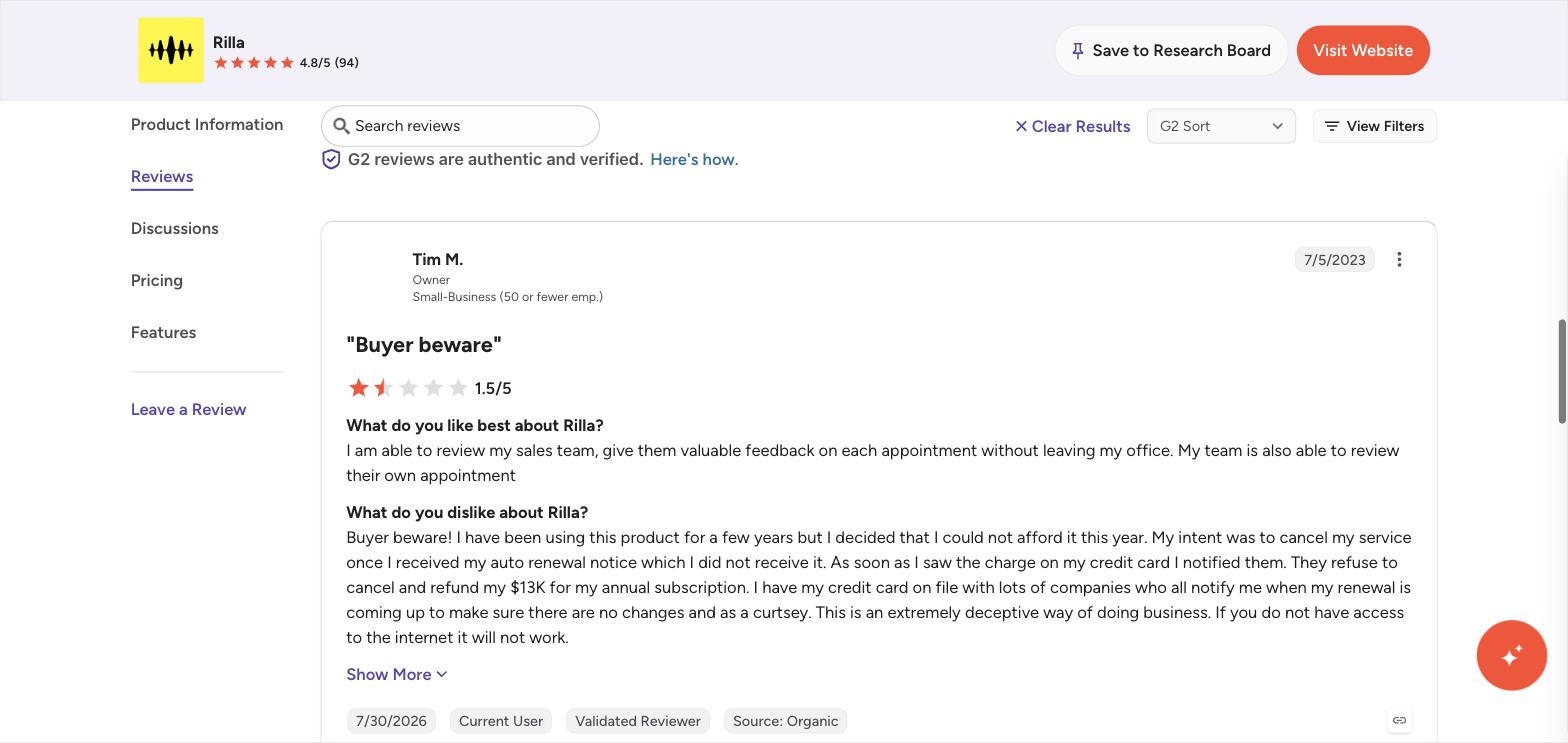
Screenshot: negative Rilla review on G2 describing a disputed billing charge, captured from G2 in August 2026.
To be fair to Rilla: its audio capture in genuinely hostile field conditions is a real, earned strength that reviewers and even competitor Siro's own comparison page single out, and its January 2026 deal to bring real-time coaching to Home Depot's service and sales staff is a concrete, large-scale logo in exactly this vertical.
It's also shipped fast: three new products, Live, Intelligence, and Roleplay, in under twelve months. That's a fast-moving competitor, not a stagnant incumbent, even though that effort is going mostly toward real-call infrastructure rather than roleplay depth.
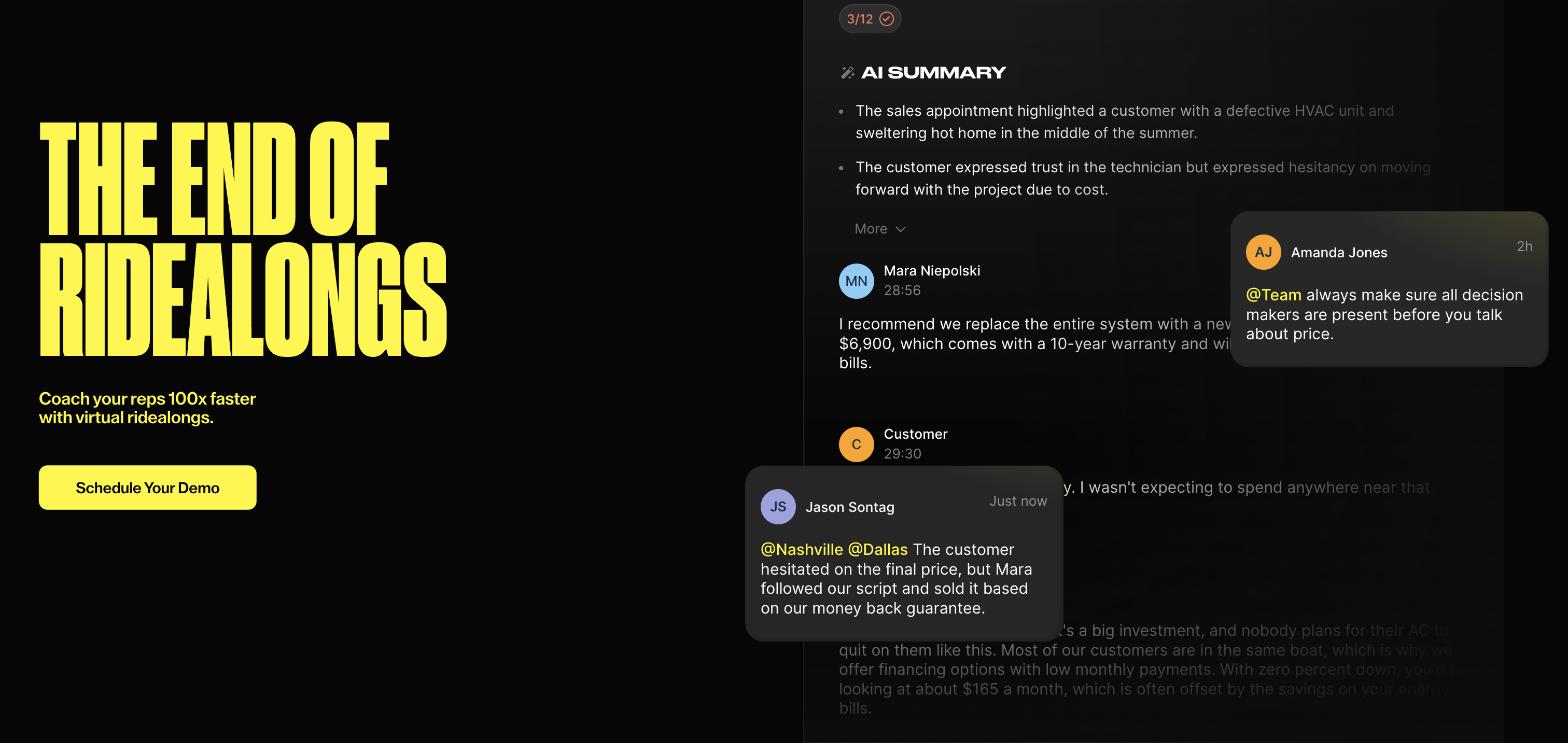
Screenshot: Rilla's virtual ridealongs product page, captured from rilla.com in August 2026.
This is a company whose roleplay module simply hasn't caught up to its real-call product yet.
Rilla Alternatives Compared
We're narrowing this list to tools that actually compete for field and in-person sales coaching, not generic B2B SaaS roleplay platforms.
Google's own results for "rilla alternatives" and "best ai sales roleplay software for roofing" back this up: Siro and GhostRep show up repeatedly as the direct, vertical-relevant comparisons, while horizontal tools like Mindtickle or Kendo AI barely register against Rilla-specific search intent.
We've added Second Nature as a fourth option for teams running a hybrid motion, part field, part inside sales, since it's one of the few coaching platforms combining avatar-based practice with a mature enterprise footprint.
| Platform | Best for | What sets it apart | Pricing |
|---|---|---|---|
| Outdoo AI | Teams that want roleplay and real field calls graded on one scorecard, plus post-call workflow practice | Roleplays built from your own calls, playbooks, and CRM data; unified scoring across practice and live calls; usage-based pricing | Usage-based, tiered plans; book a demo for a quote scoped to your team |
| Siro | Door-to-door and in-home reps who need real-time, in-call coaching | "Halftime" live coaching during the conversation, pattern-based team coaching instead of one appointment at a time, CRM auto-sync | Not publicly listed; sales-assisted quote |
| GhostRep | Smaller roofing, solar, HVAC, and windows/doors teams that want roleplay from day one | Practice against real objections built into the same product as field-call capture; positioned "rep-first" for faster ramp | Not publicly listed; sales-assisted quote |
| Second Nature | Hybrid teams mixing field visits with inside sales who want a mature enterprise coaching platform | Avatar-based roleplay, ISO 27001/27701 certification and published uptime SLA (parity with Outdoo AI) | Not published; vendor-quoted $50 per credit, and one credit is one user for one month, so ~$30,000/yr for 50 reps in continuous use |
Outdoo AI: The Strongest Overall Alternative
Outdoo AI is built for revenue teams that need practice and real performance to live on the same scorecard, which is precisely the piece Rilla's roleplay module doesn't do yet.
Where Rilla records a field visit and scores it against a benchmark, Outdoo AI builds the practice scenario itself from a team's own calls, transcripts, playbooks, and battlecards, then grades both that practice session and the live call that follows against one rubric.
A sales leader can point to a single number from Outdoo AI's AI coaching layer and show coaching moved it, not just that reps completed a training module.
Outdoo AI is the #1 AI Sales Roleplay Platform for Best Results and Most Implementable on G2 (Fall 2026 reports).
For field and in-person sales specifically, that means a roofing or solar rep can rehearse the exact objection a homeowner raised last week, pulled from a real transcript rather than a generic script, before walking into the next appointment.
Outdoo AI supports multi-persona roleplay for scenarios with more than one decision-maker in the room, a homeowner and a spouse, a facilities manager and a finance stakeholder.
It also runs a gatekeeper phase for cold-open and screening calls, something nobody else in this comparison set builds as a distinct scored phase. Video avatar roleplay covers reps who need to practice an in-person, face-to-face pitch rather than just a phone call.
Roleplay also runs in over 74 languages for voice practice, useful for multi-market field teams that Rilla's public materials don't address at all.
Rilla's own roleplay pulls from two sources: a rep's own recent real call, replayed back as practice, or sales material an admin uploads to build a generic new-hire course. Neither ties practice to the specific account, deal, or CRM data behind an upcoming call, the way Outdoo AI's does.
The differentiator that matters most against Rilla specifically is workflow training: reps practice the CRM and post-call process logging in the same session as the conversation, not as an afterthought. None of the field-sales tools in this comparison, Rilla included, simulate that click-by-click post-call process.
On honest fit: Outdoo AI doesn't yet have Rilla's years of field-hardened audio capture in genuinely hostile conditions, job sites, mechanical rooms, noisy showrooms, and it doesn't have a named enterprise-retail logo at Home Depot's scale in this specific vertical.
If your evaluation criteria start and end with "how well does this record a noisy in-home pitch," Rilla has a real head start there. If your criteria include roleplay depth, unified scoring, and what happens after the call ends, Outdoo AI is built for that from the ground up rather than added on top.
See our full Rilla review and pricing breakdown for a side-by-side on audio capture, roleplay depth, and pricing.
Pricing is usage-based and tiered rather than flat per-seat licensing, so a team pays for training that's actually driving activity instead of idle seats sitting on a roster.
That's a direct contrast to the seat-minimum, sales-assisted, opaque-quote model every source we checked confirms for Rilla. See pricing for a plan scoped to your team.
Siro: The Closest Head-To-Head Competitor
Siro is the most directly comparable tool to Rilla in this space, and third-party sources report meaningful customer movement from Rilla to Siro specifically.
It targets the same field and in-person verticals, home improvement, home services, dealerships, telecom, senior living, medical aesthetics, and its core pitch is real-time coaching delivered during the conversation itself rather than reviewed after the fact. Siro calls this "Halftime."
The company also pushes pattern-based coaching across a rep's calls rather than a manager reviewing one appointment at a time, plus CRM auto-sync and a claimed 97% license utilization rate.
Siro doesn't publish pricing either, so you're in the same sales-assisted-quote position as with Rilla.
If real-time in-call guidance for reps physically standing in front of a customer is your top priority, and roleplay practice is secondary, Siro is worth evaluating directly against Rilla. See Siro's own comparison page for their positioning.
Looking beyond Rilla and Siro? See how the leading AI sales roleplay platforms compare for teams evaluating options beyond field sales too.
GhostRep: Roleplay-First for Home-Improvement Trades
GhostRep is the one tool in this set that treats roleplay as core, not an add-on, which makes it the closest structural match to how Outdoo AI approaches the problem, just scoped narrowly to home-improvement trades: roofing, solar, HVAC, windows and doors.
Reps can practice against real objections alongside the field-call capture and AI coaching GhostRep also provides. The company positions itself as "rep-first," aimed at faster ramp and more confidence walking into a first appointment, rather than a manager-first review tool.
For a small or mid-size contractor that wants roleplay without paying for a large field-sales-intelligence platform built for multi-vertical enterprise accounts, GhostRep is a reasonable, more focused alternative. It's less proven at scale than Rilla or Siro, and pricing isn't public.
Want the full picture on AI roleplay before you choose? Our guide to AI sales roleplay covers how scoring, personas, and real-call grounding should factor into the decision.
How to Choose
Start with what you're actually trying to fix. If reps walk into appointments underprepared and objection-handling is the gap, prioritize roleplay depth and how realistic the practice scenarios are, not just how well a tool records the call after the fact.
If managers are drowning in ridealong hours and can't review enough calls, prioritize real-time or fast-turnaround call review, which is Rilla's and Siro's strength.
If you want one number that proves coaching worked, insist on a single scorecard spanning both practice and live calls, since most field-sales tools, Rilla included, keep these separate today.
And before you sign anything, get an actual number in writing. Every tool in this comparison routes to a sales-assisted quote with no public price. Outdoo AI publishes its pricing up front, so don't accept "trust us, we'll be fair" as a substitute for a written estimate.
Book a demo to see how Outdoo AI scores roleplay and real field calls on one scorecard.
Frequently Asked Questions
.svg)
Rilla doesn't publish pricing. Third-party estimates range from roughly $80 to $500 per user per month depending on the source, with a common estimate around $300 to $500 per user per month, a five-seat minimum, and $1,500 to $5,000 in implementation fees on top. Outdoo AI starts free with 60 minutes of roleplay credits and unlimited team members, no credit card and no sales call, then scales on usage-based Flex pricing with a custom enterprise plan for larger deployments.
Yes, launched around March 2026, but it's thin. Its demo shows a numeric score against named checkpoints, and G2 reviews suggest it also lets reps practice against objections pulled from their own past calls.
It depends on what you're optimizing for. Siro leads on real-time, in-call coaching delivered while the conversation is happening.
For roleplay depth, unified scoring across practice and real calls, and post-call workflow training, yes, that's Outdoo AI's core strength; see our Rilla review and pricing breakdown for specifics.
If you're a smaller contractor and want roleplay built in alongside field-call review, GhostRep is a focused, trade-specific option. It's less proven at enterprise scale than Rilla or Siro.
Table of Contents
Talk to Sales
Have questions about training and enablement for your sales, CS, support, or leadership team? Let's talk.
Talk to Sales