



Who Is Avarra Best For?
- Avarra: Best for large enterprise sales orgs sold on the avatar demo experience. Simulations run live over Zoom against 3D AI avatars.
- Avarra: Best for leaders who prefer coaching conversations to numeric scores. Its Socratic debrief skips a scorecard by design.
- Outdoo AI: Best for teams that need to prove coaching ROI. Closed-Loop Coaching grades practice and live calls on the same scorecard.
- Outdoo AI: Best for teams selling into buying committees or cold calling. It adds multi-persona roleplay and a gatekeeper phase.
Avarra at a Glance
| Avarra | |
|---|---|
| Pricing | Not published anywhere; every path routes to "Request a demo" |
| Independent reviews | None found on G2, Capterra, or Product Hunt |
| Coaching model | Socratic debrief (no numeric scorecard spanning practice and real calls) |
| Best for | Large, enterprise sales orgs sold on the avatar demo experience |
Full pricing detail and feature table below.
What Is Avarra?
Avarra (avarra.ai) is an avatar-based AI sales training tool that exited stealth in October 2024.
The company is led by CEO David Knight and sells roleplay simulations delivered live over Zoom against 3D AI avatars the site describes as having "beliefs, memories, and motives."
Reps build a scenario one of two ways: upload transcripts, playbooks, and scripts, or run a 10-minute guided "Avatar Interview Builder" that generates a sim from a conversational Q&A with no files required. After each sim, an AI coach delivers a debrief evaluated against a framework like MEDDIC or MEDPICC, or a custom model.
Customers include Broadridge and Forescout, an enterprise-skewing logo list that lines up with a demo-request-only sales motion.
One thing worth flagging directly: avarra.net is a completely different company, an offshore sales-staffing outfit, that shows up in some searches under the same name. If a result mentions Filipino sales talent, it's not this Avarra.
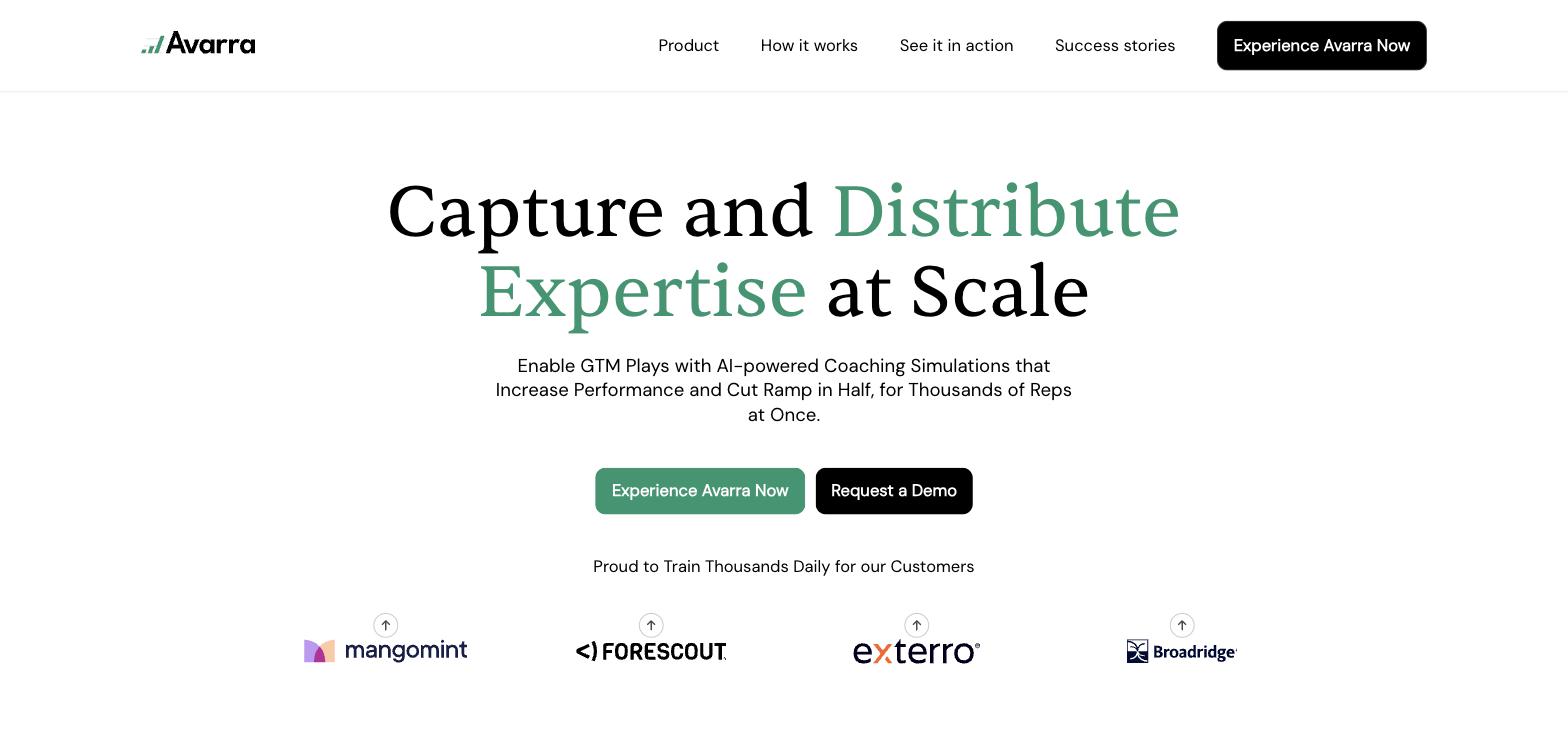
Screenshot: Avarra homepage, captured directly from avarra.ai, August 2026.
Avarra Pricing
Avarra does not publish pricing anywhere. There's no working /pricing page on avarra.ai, no pricing information in the site's sitemap, and no G2, Capterra, or Product Hunt listing where a reviewer might have shared a real number. Every path on the site routes to "Request a demo."
| Plan | Listed price | What we actually confirmed |
|---|---|---|
| Basic | Not published | No independent source states a tier price; the 2026 quote was $1,400/user/yr quoted across all seats |
| Pro | Not published | Same: unconfirmed anywhere |
| Enterprise | Custom, via demo | Consistent with the enterprise logo list and pure demo-request funnel |
A word on the "$99 to $119 a month" figure that has circulated in older competitor roundups, including an earlier version of this post: it traces back to unnamed "industry research," not to Avarra, G2, Capterra, or any other checkable source. On re-review, we can't verify it, so we're not repeating it here.
The one pricing-adjacent asset on Avarra's own site is a "Sales Ramp Acceleration Calculator," which models the projected ARR impact of adopting Avarra. It doesn't disclose what Avarra itself costs.
A company selling into Broadridge and Forescout through a demo-only funnel is unlikely to run production deals at a self-serve-sounding price point.
Avarra's sales team quoted $1,400 per user per year as of 2026, with usage unlimited and no platform or onboarding fees. That is list pricing rather than published pricing, so your own quote may differ. At 50 seats that is about $70,000 a year, and roughly $210,000 at 150 before any discount.
The detail that moves the total is the licence model. There is one licence type, and admins, managers and builders all pay the full $1,400. On a 50-rep team with five managers and two enablement builders that is about $9,800 a year of licences that most vendors in this category include free. Outdoo AI prices on usage instead, so a manager who only reads dashboards is not a billable seat.
Avarra Features
| Feature | What it does |
|---|---|
| Avatar roleplay delivery | Simulations run live over Zoom against 3D AI avatars, not through a browser widget or phone call |
| Scenario creation | Upload transcripts, playbooks, and scripts, or generate a sim through the 10-minute Avatar Interview Builder with no uploads needed |
| Coaching model | Debriefs are Socratic-style conversations built to reinforce specific behaviors, not a numeric score, scored against MEDDIC, MEDPICC, or a custom framework |
| Manager visibility | Dashboards track individual and team trends, plus gamified leaderboards |
| Language support | A multilingual engine for global sales teams |
| Certification | Built-in certification programs tied to completed sims |
| Security | SOC 2 Type II and GDPR-aligned; no mention on the site of ISO 27001/27701, HIPAA, or SSO/SCIM |
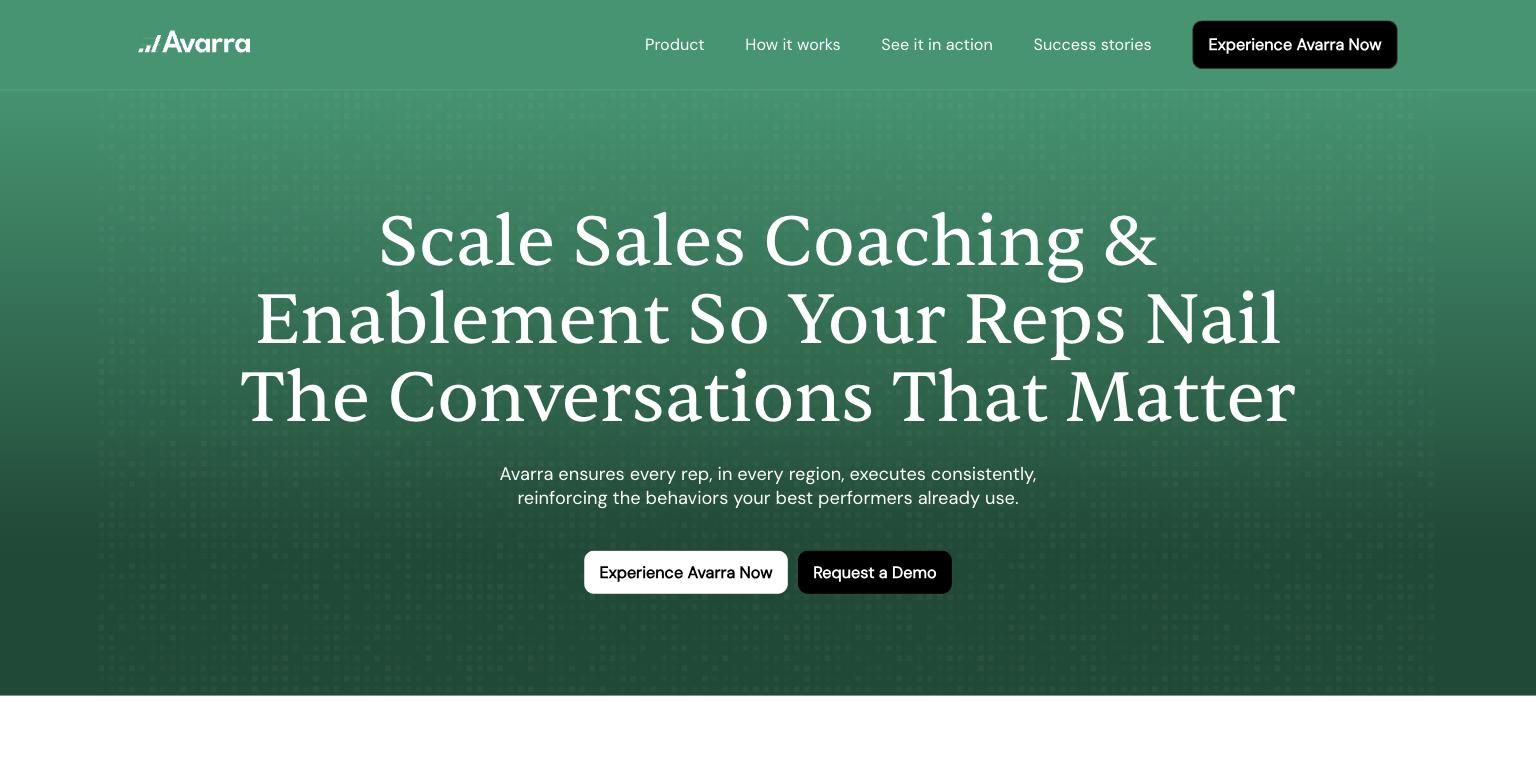
Screenshot: Avarra product/feature page, captured directly from avarra.ai, August 2026.
The coaching model is the most distinctive line in that table, not the avatars. CEO David Knight has described a deliberate pivot away from Avarra's founding thesis, which assumed more practice reps alone would improve performance.
According to Knight, internal data showed reps plateau around 70% mastery on unassisted practice and reach 90% or higher once structured coaching is layered in, which is why the debrief is built as a reflective conversation instead of a fixed scorecard.
Third-party comparison pages from direct competitors (PitchMonster, SalesArmor) claim Avarra has no live-call scoring, no dialer or CRM integration, no screen-share demo mode, occasional avatar voice latency, and dashboards that lean toward completion tracking rather than deep skill analytics. If a dialer and CRM-connected outbound are what you actually need, that is a different category, covered in our Apollo.io review.
We haven't verified those claims firsthand, and competitors selling against Avarra have an obvious reason to make their own product look better by comparison. Worth confirming on a live demo rather than taking at face value.
What Users Say
There's no independent review data to point to here. We checked G2, Capterra, and Product Hunt directly: Avarra has no listing on any of the three. LearnRush, a corporate LMS, is in the same position, as our LearnRush review and pricing breakdown shows.
The one "Avarra" that does turn up on G2 is an unrelated augmented-reality remote-assistance product, not this company. For a startup two years past stealth with enterprise logos, that absence is itself worth noting.
Most tools at this stage have at least a handful of independent reviews, and this one has none.
What we do have is first-party and third-party commentary. Knight put the company's own pivot in writing on LinkedIn:
"Our founding thesis for Avarra was wrong... Practice without feedback yields little improvement, while there is a very direct correlation between time spent in coaching and performance." (LinkedIn, David Knight)
A partner-marketing post from Agentic Partner Group frames the pitch in customer-facing terms:
"Reps get realistic 'at-bat' practice before real calls ready in weeks, not quarters." (LinkedIn, Agentic Partner Group)
That's marketing copy, not an independent review, so weigh it accordingly. Two of Avarra's own named customer case studies get more specific about outcomes. From Exterro's case study:
The published results: ramp time cut from 18 to 6 months (a 12-month reduction), a ~30% improvement in core selling skills, and gains specifically in discovery and objection handling. Nicole Mott, Exterro's Director of Sales Enablement, summed up the payoff in her own words: "The biggest ROI is that we don't need as many trainers." (avarra.ai case study)
And from Mangomint's:
"We're using it across all AEs — and all of our AEs have made quota." (Marchelle Mooney, Sales leader, Mangomint; avarra.ai case study)
These are still company-published testimonials, not independently verified reviews, so treat them the same way you'd treat any vendor case study. And a direct competitor, PitchMonster, sums up what it says Avarra offers on its own comparison page:
"Avatar-led simulations, dashboards, and a Socratic-style debrief" versus what it calls "the full training loop: AI role-play, real-call scoring on one scorecard, and an AI coach on every session." (PitchMonster, avarra-alternative page)
Take that one with the obvious grain of salt. PitchMonster is selling directly against Avarra.
Where Avarra Falls Short
No independent proof exists yet that Avarra works at the scale its logos suggest. There's no G2, Capterra, or Product Hunt page, and no published case study numbers beyond company names in the sitemap (Broadridge, Forescout).
Pricing is opaque by design. There's no pricing page, no plan comparison, and nothing across a year of related search results that pins down a confirmed number. If your evaluation needs a ballpark to bring to a budget conversation before a sales call, Avarra won't give you one. Fully Ramped takes a similar approach, with quote-based pricing and a confirmed 10-seat minimum, as our Fully Ramped review and pricing guide explains.
By design, Avarra doesn't produce a single score spanning practice and real calls. The Socratic debrief is a deliberate, defensible choice, but it means there's no unified scorecard to show a VP of Sales that coaching moved a real number.
If you need to prove coaching ROI in a board deck, that's a structural gap, not something a config setting fixes.
The content footprint is thin. Two blog posts, no comparison pages, and two literal placeholder job listings ("teasdfd," "test") still sitting in the site's sitemap as of this review. That points to a young, resource-constrained team, and it's a fair thing to factor into your evaluation.
Where Avarra Genuinely Wins
Avarra has a coaching philosophy that deserves a fair hearing, and we'll say so plainly.
The customer list is real. A roster that includes Broadridge and Forescout buys credibility in an enterprise sales cycle that a feature checklist alone can't replicate.
The Zoom-delivered 3D avatar format has real presence in a live demo. Watching an avatar respond in real time on a video call is a more memorable moment in a competitive bake-off than a chat window or a phone call, even if it doesn't change what a rep actually retains over time.
The coaching philosophy is the most genuinely interesting part of the product, and it's a considered position, not a shortcut.
Knight's account is that Avarra's own data showed a 70% mastery ceiling on unassisted practice versus 90% or higher with structured coaching, which is why the company rebuilt its debrief around Socratic conversation instead of a rigid scorecard.
Some sales leaders prefer that. A numeric score can be gamed or feel reductive, and a coaching conversation forces a rep to articulate why a move worked instead of just watching a number move. That's a real philosophical difference, worth engaging with rather than dismissing.
And the Avatar Interview Builder is a legitimately fast path to a first sim. Ten minutes of guided Q&A with no documents to gather beats an upload-heavy competitor for a same-day pilot.
How Outdoo AI Compares
This is one matchup where Outdoo AI's core pitch lines up almost exactly against what Avarra chose not to build. Outdoo AI's Closed-Loop Coaching grades practice and live calls on the same scorecard, so a sales leader can point to one number and say coaching moved it.
Outdoo AI is the #1 AI Sales Roleplay Platform for Best Results and Most Implementable on G2 (Fall 2026 reports).
Avarra's Socratic debrief model, by design, doesn't produce that number. If your VP needs to show the board that training changed a real revenue metric rather than a completion rate, that's a structural difference, not a matter of taste.
Outdoo AI also builds every roleplay and scorecard from a team's own calls, transcripts, playbooks, and even a prospect's LinkedIn profile, and grades against that team's own playbook rather than a fixed rubric.
Avarra offers a comparable path, either uploaded materials or the Avatar Interview Builder, so call this one closer to parity than a clean win.
A few other differences are more mechanical than philosophical. Outdoo AI scores the post-call CRM and workflow-logging step inside the same session as the roleplay itself, something nothing in Avarra's public materials claims to do.
Outdoo AI also runs multi-persona roleplay, up to three stakeholders on one call, plus a separate gatekeeper phase for cold-call screening. Avarra's format is one avatar per session, with no published committee or gatekeeper option, so a team selling into buying committees or running high call volumes has more formats to draw on with Outdoo AI.
Avatar realism is a real, visible difference too. Outdoo AI's video avatars are photorealistic and render natural gestures, while Avarra's avatars are 3D animated characters, a more stylized, cartoon-like look even though the live Zoom delivery itself is genuinely immersive.
On the integration side, Outdoo AI connects to 120+ tools, including Salesforce, HubSpot, Gong, and Salesloft, plus SCORM and xAPI for LMS handoff. Avarra's public materials don't list a native CRM or dialer integration at all.
And Outdoo AI's usage-based pricing is public and scales with actual training activity, a direct contrast to Avarra's fully opaque, demo-request-only process. If pricing transparency and a low-commitment pilot matter to your evaluation, that gap is worth raising on the first call.
None of this makes Avarra a bad product. It means the two companies made different bets on what coaching should look like, and Outdoo AI's bet is the one built to produce a defensible ROI number.
Frequently Asked Questions
.svg)
No. There's no pricing page on avarra.ai, no pricing mention in its sitemap, and no G2 or Capterra listing with a number. Figures like "$99 to $119 a month" circulate in some older content but trace back to unverifiable secondhand claims, not to Avarra itself. Every deal goes through a demo request. Outdoo AI starts free with 60 minutes of roleplay credits and unlimited team members, no credit card and no sales call, then scales on usage-based Flex pricing with a custom enterprise plan for larger deployments.
No listing exists on either site, or on Product Hunt, as of this review. The "Avarra" that does appear on G2 is an unrelated augmented-reality product.
Avarra deliberately skips a numeric scorecard in favor of Socratic, reflective debriefs after each avatar roleplay, a design choice the company says grew out of its own data on coaching lift. It's a genuine philosophical alternative to scorecard-based coaching, not a missing feature.
No. Avarra.net is an unrelated offshore sales-staffing company. Avarra.ai is the AI avatar roleplay and coaching platform reviewed here.
Outdoo AI grades roleplay practice and live calls on one scorecard, builds sims from a team's real calls and playbooks, adds multi-persona and gatekeeper roleplay formats, connects to 120+ CRM and LMS tools, and publishes usage-based pricing. Avarra's Socratic debrief model, one-avatar-per-session format, and enterprise-only sales process are the biggest structural differences.
Table of Contents
Talk to Sales
Have questions about training and enablement for your sales, CS, support, or leadership team? Let's talk.
Talk to Sales