



That gap is where a third option, Outdoo AI, comes in. Here's the detail before you book a demo with either.
This page focuses on how Hyperbound and PitchMonster compare head-to-head. If you're weighing Hyperbound more broadly, our guide to Hyperbound alternatives covers the wider field. The same goes for PitchMonster: see PitchMonster alternatives for more options.
Hyperbound or PitchMonster: Which Is Best?
- Hyperbound: Best for enterprise SDR floors running high-volume outbound. Kota ties practice to CRM deal-risk signals, and its security list clears procurement.
- PitchMonster: Best for leaner teams of 10 to 300 reps with demo and screen-share heavy motions. Its Socratic AI Coach runs a reflective debrief after each roleplay.
- Outdoo AI: Best for teams that want reps certified before their first live call. One scorecard follows the rep from roleplay into real calls, and reps also practice the post-call CRM workflow.
At a Glance
| Hyperbound | PitchMonster | |
|---|---|---|
| Best for | Enterprise SDR floors, high-volume outbound | Leaner teams (10 to 300 reps), demo and screen-share heavy |
| Pricing | Free tier only; Practice, Perform, and Enterprise are quote-only | Per-seat, quote-only, 12-month standard contract |
| G2 rating | 4.9 (~40 reviews) | 4.9 (~14 reviews) |
| Standout feature | Kota deal-risk signals tied to the CRM | Socratic AI Coach reflective debrief |
Full feature, integration, and compliance comparison further down.
What Are Hyperbound and PitchMonster?
Hyperbound and PitchMonster are AI sales roleplay platforms where reps practice calls against AI buyer personas and get scored feedback. Hyperbound targets enterprise SDR floors with Practice, Perform and Kota, while PitchMonster is a smaller UK-based tool for teams of 10 to 300 reps.
What Hyperbound Does Well
Hyperbound is really three tools stitched together: Hyperbound Practice builds AI buyer personas from a company's ideal customer profile and covers cold calls, gatekeeper calls, voicemails, discovery, demos, and manager coaching calls.
Hyperbound Perform scores live and recorded calls, summarizes deals, and drafts follow-up emails.
Kota, the newest piece, reads deal and pipeline data and flags risk, then triggers a specific roleplay to fix it. A rep with a stalled deal and no economic buyer engaged gets pushed into a CFO discovery scenario instead of generic practice.
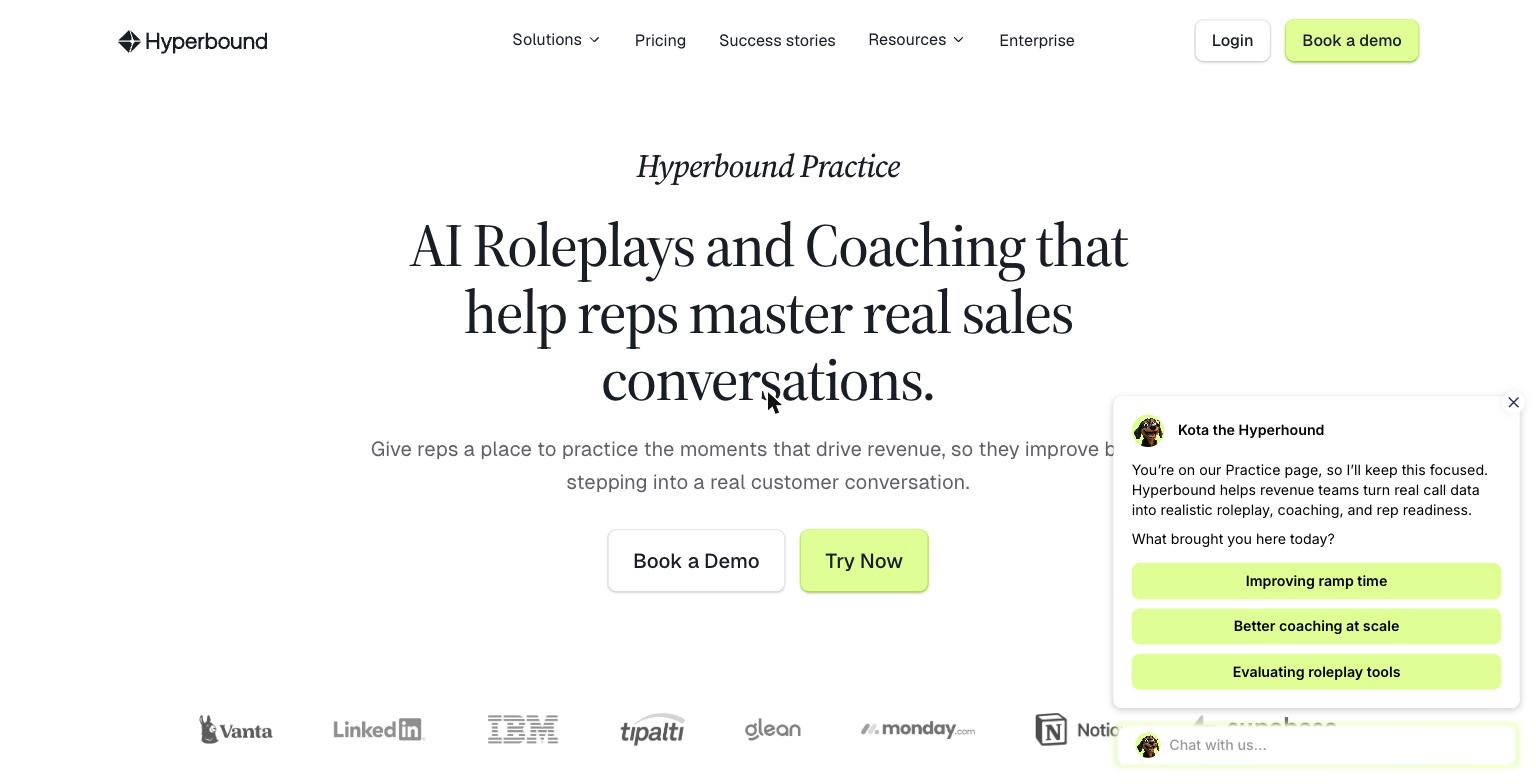
Source: Hyperbound Practice product page.
That link between practice and pipeline is Hyperbound's real edge.
Most roleplay tools stop at "you scored 82 on this call." Hyperbound tries to connect the score to the deal that's actually stuck.
It also has named enterprise customers, including Vanta and IBM, and Vanta's CRO is quoted saying Hyperbound "fundamentally changed the math" in how the company scales training (see Hyperbound's customer stories).
Security is a genuine strength too: Hyperbound claims SOC 2 Type II, ISO 27001, HIPAA, and GDPR coverage, which matters if your buyer is a security-conscious enterprise.
Where Hyperbound falls short is pricing transparency. Only the free tier, 45 prebuilt roleplays with prebuilt scorecards, has a public price: zero dollars.
Practice, Perform, and Enterprise plans are all quote-only, and Hyperbound's own pricing FAQ says as much directly (see hyperbound.ai/pricing).

Source: Hyperbound pricing page. Practice and Perform are both marked "Enterprise" instead of a price.
Reviewers notice.
One G2 reviewer, a VP of Technology in the mid-market segment, wrote that "Hyperbound does come at a cost, and is not the cheapest solution out there, but I do believe you get what you pay for" (archived on G2).
Another reviewer flagged the analytics dashboard as clunky and said deleting bots isn't as easy as creating them.
A separate G2 reviewer, a Senior Market Intelligence Lead in the mid-market segment, put the same complaint more specifically: "The reporting and analytics page; it'd be great if it were just a little prettier and more customizable... We wish deleting bots was just as seamless as creating them" (see G2).
Language coverage sits at 25 plus, narrower than some competitors in this category.
And Hyperbound's own blog post, "8 Reasons Not to Buy Hyperbound," concedes the product is a poor fit for teams without a defined sales playbook, without manager bandwidth to reinforce coaching, or for teams that mainly need searchable content rather than live practice.
It's an unusually honest piece worth reading before you buy (see the post itself).
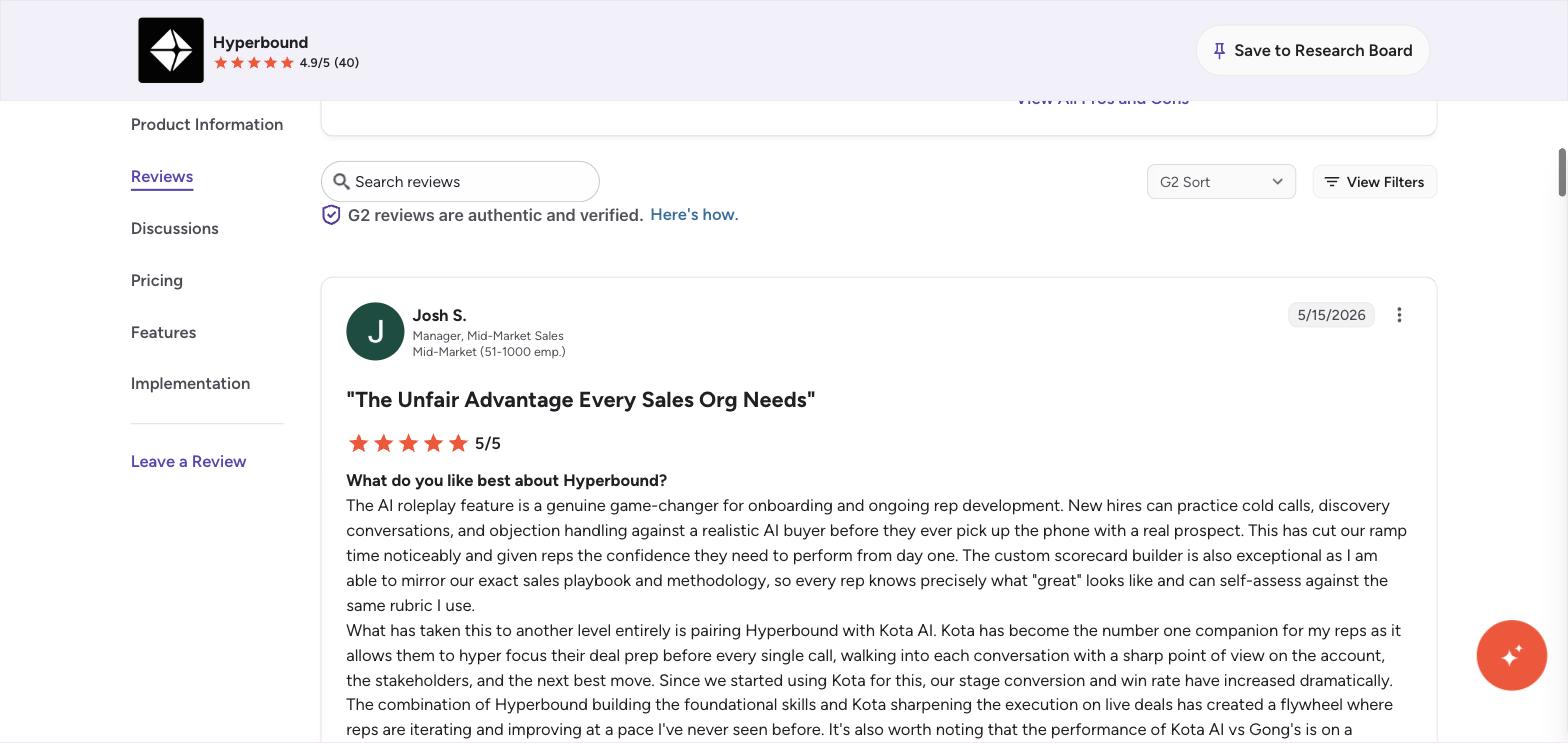
Source: G2, Hyperbound product page. This is the same 4.9/5 (~40 reviews) rating cited in the comparison table below.
What PitchMonster Does Well
PitchMonster is smaller and founder-led, built in the UK under CEO Oleg Bolotnov.
It covers the same practice territory, phone, video avatar, and screen-share roleplays, but its real differentiator is the Socratic AI Coach: a post-roleplay debrief that asks reflective questions instead of just handing back a number.
The idea is that a rep who talks through what went wrong retains more than one who just reads a score.
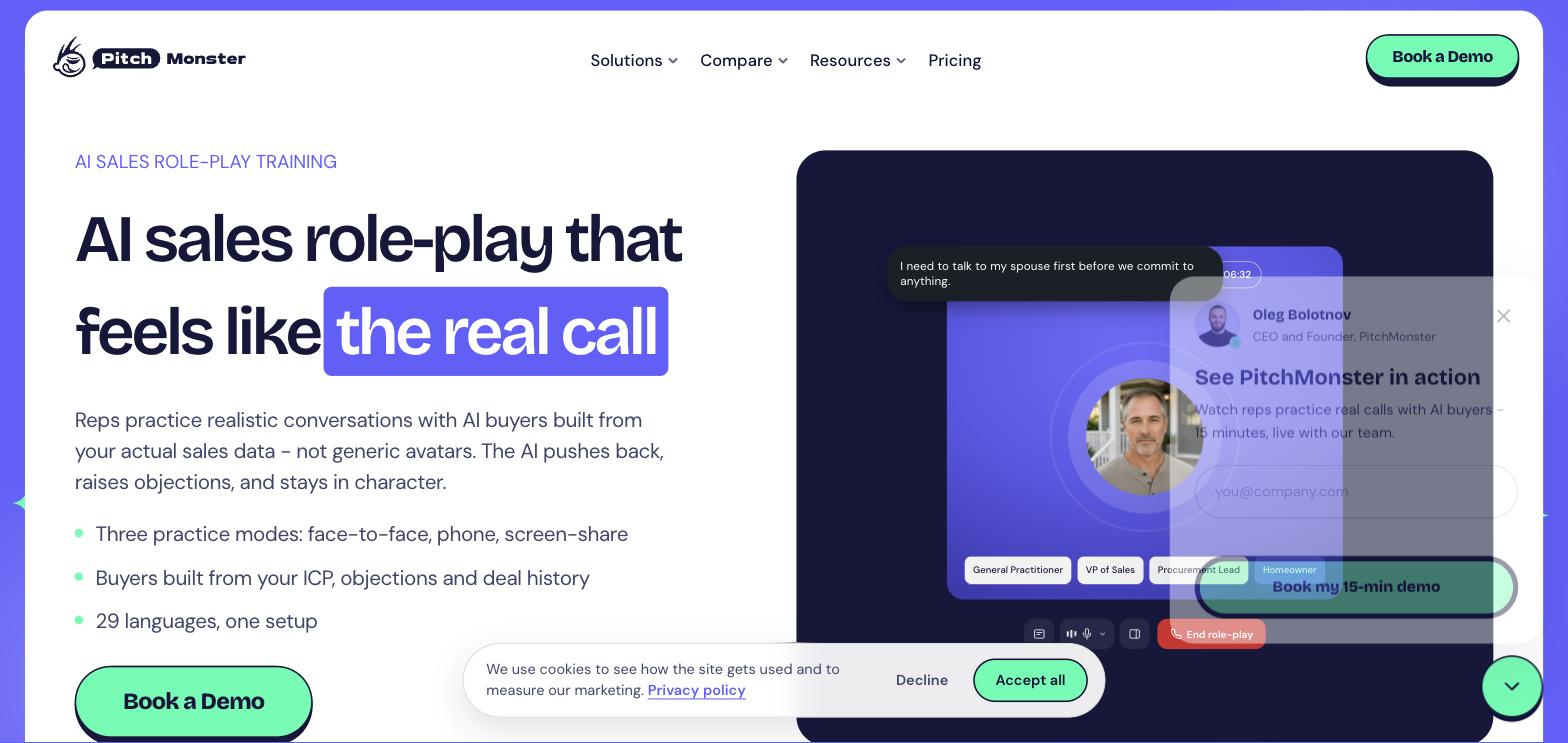
Screenshot: PitchMonster AI sales roleplay training page, captured August 2026.
Customer feedback backs this up.
One PitchMonster user, a senior instructional designer, called it "the most impressive" part of the product and said it would "save us a lot of time" (quoted on PitchMonster's own comparison page).
Screen-share and demo-roleplay support is a strength too, arguably ahead of Hyperbound here, and PitchMonster leans into a guided rollout with a dedicated customer success manager, which suits leaner enablement teams without much internal bandwidth.
It also ships EU data residency and GDPR compliance by default, which matters if your buyers are European.
PitchMonster states its ideal customer sits between 10 and 300 reps, with 20 to 80 as a sweet spot, so it isn't chasing the same enterprise SDR floors Hyperbound targets.
The gaps are real too. PitchMonster's G2 review base is thin, 14 reviews against Hyperbound's roughly 40, even though the average rating, 4.9, looks similar (see G2's PitchMonster listing).
Integrations are narrow: Salesforce and Gong are named, but there's no evidence of HubSpot, Chorus, SCORM, or xAPI support anywhere on PitchMonster's site.
And PitchMonster concedes the enterprise cold-call floor to Hyperbound outright in its own comparison post, a rare and useful bit of honesty worth noticing (see pitchmonster.io/blog/pitchmonster-vs-hyperbound).
One more thing worth flagging directly. PitchMonster runs its own comparison page against Outdoo AI, and it describes "Outdoo AI" as "built by MeetRecord."
That's not accurate, and it's the kind of detail that should make you double-check any vendor's compare content, including this one. Verify claims against the primary source before you decide.
Hyperbound vs PitchMonster: Side by Side
| Hyperbound | PitchMonster | |
|---|---|---|
| HQ / founded | San Francisco | UK, founder-led |
| Target team size | Enterprise SDR floors, high volume | 10 to 300 reps, sweet spot 20 to 80 |
| Roleplay modes | Cold, gatekeeper, voicemail, discovery, demo, post-sale, manager, multi-party | Phone, video avatar, screen-share, gatekeeper, multi-persona |
| Coaching model | Scorecards plus deal-risk signals via Kota | Scorecards plus Socratic AI Coach reflective debrief |
| Languages | 25+ | 27 to 29 |
| Integrations named | Salesforce, HubSpot, Gong, Zoom, Slack, Teams, Workday, Okta, and more | Salesforce, Gong |
| Compliance | SOC 2 Type II, ISO 27001, HIPAA, GDPR (claimed) | GDPR, EU data residency |
| Pricing model | Per-user license, quote-only above free tier | Per-seat, quote-only, 12-month standard contract |
| G2 rating | 4.9 (~40 reviews) | 4.9 (~14 reviews) |
Both vendors' sales teams quoted figures in 2026, which is firmer than the trackers: Hyperbound quoted $70 per user per month at 50 seats and $63 at 150, about $42,000 a year for a 50-rep team; PitchMonster quoted $30 per user per month in the 11 to 49 user band on a three-month minimum term, so nearer $18,000 a year at 50 seats. These are list pricing rather than published pricing, so your own quote may differ.
Treat the tracker estimates you'll find elsewhere (SourceForge, SaaSWorthy and Kendo AI's independent estimates) as directional, not quoted.
Which One Should You Pick?
If you run a high-volume outbound floor, dozens of SDRs making cold calls daily, and you want practice tied directly to which deals are actually at risk in the CRM, Hyperbound is the stronger fit.
Its security certifications also make it easier to clear a security review at a large enterprise buyer.
If your team is smaller, 10 to 300 reps, and your motion leans on demos and screen-share more than cold outbound, PitchMonster's format matches your day-to-day better.
Its coaching style also suits teams that want reps to reason through mistakes rather than just see a number, and the dedicated CSM model helps if you don't have a large internal enablement function.
If budget predictability matters more than either of those things, be honest with yourself: neither company will give you a number until you're in a sales call with them.
Both are per-seat or per-user licenses priced for annual contracts, and both push you toward a demo before you see a quote. That's standard for this category, but it's worth knowing going in.
What if Neither Is Quite Right?
Here's what both tools have in common, and it's the gap Outdoo AI was built to close.
Neither Hyperbound nor PitchMonster certifies a rep as ready before their first live call. PitchMonster's Call Analysis reuses the roleplay scorecard on recordings after the fact, and Hyperbound's Kota scores a real call first, then generates targeted practice from the gaps it finds. Neither ties that score forward into pipeline or revenue reporting, so neither can show a leader that a coaching session actually changed a rep's real deal outcomes weeks later.
Outdoo AI does both. A dedicated AI Tutor certifies reps against one scorecard before that first live call, and the same score follows the rep into pipeline reporting (unified scoring across roleplay and real calls), so a leader can point to the same rubric moving from a practice session to an actual deal.
Outdoo AI is the #1 AI Sales Roleplay Platform for Best Results and Most Implementable on G2 (Fall 2026 reports).
Neither tool trains the part of the job that happens after the call ends, either. Outdoo AI scores the post-call CRM and process logging in the same session as the conversation itself (workflow training), so reps rehearse the whole job, not just the talk track.
There's a scoring-philosophy gap too, and it's easy to miss. PitchMonster's default rubric leans on out-of-the-box MEDDIC, SPIN, or Sandler templates, and Hyperbound builds its buyer personas from a company's ICP rather than grading against that company's own playbook.
Outdoo AI grades roleplay and real calls against a team's own playbook, calls, and CRM data instead of a vendor's generic template (grading against your playbook, not generic AI advice), so reps are scored on your definition of a good call, not someone else's.
Compliance is a real gap too, but only against one of the two. Hyperbound's certification list, SOC 2 Type II, ISO 27001, HIPAA, and GDPR, is genuinely broad and lines up with Outdoo AI's own SOC 2, ISO 27001, and ISO 27701 coverage. PitchMonster's site claims only GDPR and EU data residency, with no SOC 2, ISO 27001, or HIPAA claim anywhere, which is worth naming plainly if your buyer runs a real security review.
And where both Hyperbound and PitchMonster price per seat regardless of whether that seat gets used, Outdoo AI's usage-based model means you pay for training that's actually happening, which matters if you're tired of paying for idle licenses.
To be fair to both competitors: Hyperbound's tie between practice and deal-risk data through Kota is a sharper signal than most tools in this category offer, and PitchMonster's screen-share and demo roleplay support is natively better than what Outdoo AI ships today.
If Hyperbound is your frontrunner, our full Hyperbound vs Outdoo AI comparison goes deeper on pricing, Kota, and workflow training specifically, or see how it stacks up against a communication-first tool in Yoodli vs Hyperbound.
Neither is a strawman here. But if your priority is proving coaching ROI with one number, training the whole workflow instead of just the conversation, and not locking into a per-seat contract before you know how much your team will actually use the product, Outdoo AI is worth a look before you sign with either.
Frequently Asked Questions
.svg)
Neither publishes real pricing. Hyperbound's only public number is its free tier, $0 for 45 prebuilt roleplays. Everything above that, on both platforms, is a custom quote. Outdoo AI starts free with 60 minutes of roleplay credits and unlimited team members, no credit card and no sales call, then scales on usage-based Flex pricing with a custom enterprise plan for larger deployments.
Both do. Hyperbound's integration list is longer and includes HubSpot, Zoom, Slack, Teams, Workday, and Okta, among others. PitchMonster's public integration list is limited to Salesforce and Gong specifically.
It depends on what you need. The Socratic Coach is a genuinely different coaching philosophy, reflection over raw scores, and reviewers like it. Hyperbound's scoring is more traditional but ties directly to deal and pipeline data through Kota, something PitchMonster doesn't have an equivalent for.
For most mid-market and enterprise sales teams, yes. Outdoo AI covers the same roleplay ground, cold calls, gatekeeper calls, multi-persona and demo scenarios, video avatar mode, and adds the two things neither competitor does: certification against one scorecard before a rep's first live call, tied forward into pipeline reporting, and scoring on the post-call workflow itself.
Hyperbound claims SOC 2 Type II, ISO 27001, HIPAA, and GDPR coverage. PitchMonster ships GDPR compliance and EU data residency by default. Hyperbound's certification list is broader, which matters more if your buyer is a large, security-conscious enterprise.
Table of Contents
Talk to Sales
Have questions about training and enablement for your sales, CS, support, or leadership team? Let's talk.
Talk to Sales